

Buying property under Sedona’s breathtaking red rock skies is an exciting adventure, but the paperwork side of things can feel like a cosmic puzzle. What is Sedona home deed type explained in plain language? That question trips up a surprising number of buyers every year. The deed you receive at closing is not just a formality. It determines how much legal protection you have, whether hidden claims can surface later, and how your property passes to heirs. Getting this wrong costs real money. Getting it right? That is where smart Sedona real estate decisions are born.
Table of Contents
- Key Takeaways
- What is Sedona home deed type explained
- Main types of Sedona property deeds
- Arizona-specific nuances in Sedona deeds
- Choosing the right deed type for your investment
- Common mistakes Sedona buyers make with deeds
- My take on Sedona deed types after years in this market
- Ready to invest in Sedona with confidence?
- FAQ
Key Takeaways
| Point | Details |
|---|---|
| Deed type affects legal protection | General Warranty Deeds offer the strongest buyer protections across the full ownership history. |
| Arizona uses deeds of trust | Sedona buyers often confuse deeds of trust with property deeds. They are very different documents. |
| Beneficiary Deeds skip probate | A Beneficiary Deed can save heirs 6 to 12 months of probate time and costly legal fees. |
| Mineral rights can surprise you | Even a solid deed does not protect surface ownership if mineral rights were previously severed. |
| Recording matters more than signing | A deed signed but not recorded offers far weaker legal standing in future disputes or sales. |
What is Sedona home deed type explained
A deed is a legal document that formally transfers ownership of real property from one party to another. Without it, a sale never legally happened. Simple as that.
Here is where Sedona buyers often get tripped up: a deed and a title are not the same thing. The title is a legal concept describing who has the right to own and use a property. The deed is the physical (or digital) document that makes a transfer happen. Think of the title as the idea and the deed as the proof.
Every deed in Sedona typically includes:
- The names of the grantor (seller) and grantee (buyer)
- A legal description of the property
- The type of warranty or guarantee being offered
- The grantor’s signature, notarized and witnessed
Understanding types of home deeds before you sit down at closing keeps you from nodding along when you should be asking sharp questions. Buyers who know their deed types walk into negotiations differently. Confident. Prepared. Ready to protect their investment.
Pro Tip: Always request a copy of the deed before closing day. Read the warranty language carefully, and if anything looks unfamiliar, ask your agent or attorney to translate it into plain terms.
Main types of Sedona property deeds
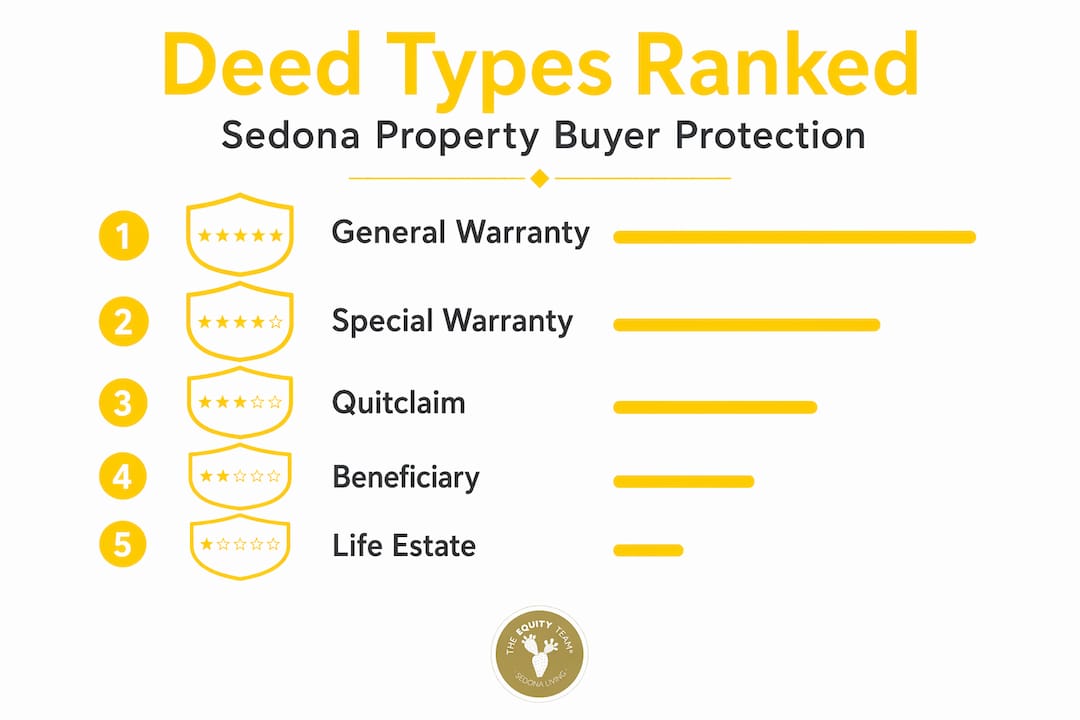
Not all deeds are created equal. Sedona real estate deeds come in several flavors, and each one carries a different level of protection. Here is a breakdown of the most common types you will encounter when buying in Northern Arizona.
| Deed Type | Warranties Offered | Common Use |
|---|---|---|
| General Warranty Deed | Full history, all claims | Traditional home sales |
| Special Warranty Deed | Only during seller’s ownership | Bank-owned, commercial sales |
| Quitclaim Deed | None | Family transfers, trusts |
| Beneficiary Deed | Varies | Estate planning, probate avoidance |
| Life Estate Deed | Varies | Retained lifetime occupancy |
General Warranty Deed
This is the gold standard of home ownership deed types. A properly executed General Warranty Deed guarantees that no undisclosed liens or defects exist across the property’s entire ownership history. Not just what happened while the seller owned it. The full chain, going back decades. Buyers in traditional Sedona sales should push for this deed whenever possible.

Special Warranty Deed
A Special Warranty Deed offers protection too, but with one important caveat. The seller only warrants against claims that arose during their period of ownership. Anything before that? Not their problem. You see these frequently in foreclosure sales, bank-owned properties, and commercial transactions. They are not inherently bad, but they demand thorough title research.
Quitclaim Deed
The quirky wildcard of the deed world. Quitclaim deeds offer no warranties and simply transfer whatever interest the grantor currently holds. If the grantor has zero ownership stake, you receive zero. If there are existing liens, they travel with the property. Quitclaim deeds show up constantly in family transfers, divorces, and moves into living trusts. They are not meant for arm’s-length purchases between strangers.
Beneficiary Deed
This one is Arizona’s clever gift to estate planners everywhere. Also called a Transfer on Death deed, it lets the owner keep full control of the property during their lifetime while naming someone to receive it automatically upon death. Beneficiary Deeds bypass probate entirely, potentially saving heirs 6 to 12 months of legal waiting and thousands in fees. For Sedona investors building a portfolio, this tool is worth serious attention.
Life Estate Deed
A Life Estate Deed splits ownership into two phases. The current owner retains the right to live in and use the property until death (the “life tenant”), at which point full ownership transfers to the named remainderman. It provides a clean transfer without probate but limits the life tenant’s ability to sell or refinance without the remainderman’s agreement.
Pro Tip: If you are purchasing a Sedona investment property for short-term rentals, estate planning around deed type matters from day one. A Beneficiary Deed costs very little to set up and can save your heirs a mountain of headaches later.
Arizona-specific nuances in Sedona deeds
Sedona sits in Coconino County, and Arizona has its own legal quirks that affect how home deed types play out in practice. Buyers coming from other states are often caught off guard.
One of the biggest surprises? Arizona primarily uses deeds of trust instead of traditional mortgages. A deed of trust pledges the property as collateral to a third-party trustee until the loan is paid. This is completely separate from the ownership deed. Many buyers at closing see both documents and get genuinely confused about which one makes them the owner. The short answer: the deed of trust secures the lender’s interest. The grant deed or warranty deed is what transfers ownership to you.
Here are four Arizona-specific realities every Sedona buyer should understand:
- Deed fraud protections are evolving. Arizona Senate Bill 1479 introduced stronger safeguards against fraudulent deed recordings, a real and growing threat in desirable markets like Sedona. Keeping copies of your recorded deed and monitoring your property records is good practice.
- Mineral rights can be severed. Even with a spotless warranty deed, a third party could hold the right to extract resources from beneath your beautiful red rock parcel. Severed mineral rights in Sedona can allow access to your land that your surface ownership simply cannot block.
- Deed of reconveyance after payoff. Once you pay off your mortgage, the lender should record a deed of reconveyance. Failing to record this document creates a cloud on your title that can derail a future sale.
- Titling matters as much as deed type. Robust deeds become ineffective for estate planning if assets are not properly titled in trusts or paired with named beneficiaries.
Sedona’s real estate market moves fast. Understanding the deed your property carries before you make an offer is not a formality. It is part of your due diligence.
Choosing the right deed type for your investment
Knowing the deed types is half the battle. The other half is figuring out which one belongs in your specific transaction. Here is a practical way to think through it.
- Assess the relationship between parties. Are you buying from a stranger, or is this a transfer within a family? Traditional arm’s-length sales warrant a General Warranty Deed. Family transfers or trust arrangements often use Quitclaim Deeds because both parties already understand the property’s history.
- Evaluate the property’s history. Has the property changed hands frequently? Are there gaps in the ownership chain? A longer, messier history calls for stronger deed protections and a thorough title search regardless of deed type.
- Consider your estate planning goals. If you are building a Sedona short-term rental portfolio and want a clean transfer to heirs without probate drama, a Beneficiary Deed deserves a spot in your planning conversation. Pair your Sedona real estate strategy with estate planning from the start.
- Consult a local real estate attorney. Arizona law has enough quirks that a 30-minute consultation can save years of headaches. This is not optional advice. It is the kind of thing professionals who have been in Sedona real estate for years wish more buyers did upfront.
- Record the deed immediately. Signing a deed transfers ownership morally. Recording it with Coconino County Recorder’s Office protects that ownership legally. Do not let a recorded deed sit unsigned in a drawer.
Pro Tip: Arizona title companies typically handle deed recording as part of closing. Ask your escrow officer to confirm the recording date and provide the document number once filed. Keep that number somewhere safe.
Common mistakes Sedona buyers make with deeds
Even sharp buyers trip on a few recurring issues. Watch out for these:
- Skipping a title search. A Quitclaim Deed from a relative feels simple and harmless until a lien surfaces. Title searches are not expensive. Surprises are.
- Confusing deed of trust with ownership deed. These documents live side by side at closing, and they serve completely different purposes.
- Ignoring mineral rights. Sedona is gorgeous from the surface. What lies beneath is a separate legal matter and worth investigating before you close.
- Missing the deed of reconveyance. If you paid off a Sedona property, confirm that deed of reconveyance was recorded. If it was not, chase it down before you try to sell.
- Poor titling for probate avoidance. Even the best deed type loses its estate planning power if the property is not properly titled. Work with an attorney to align your deed choice with your overall plan.
My take on Sedona deed types after years in this market
I have watched buyers walk into Sedona closings armed with excitement and zero deed literacy. They sign whatever is placed in front of them, trusting the process will protect them. Sometimes it does. Sometimes it really does not.
In my experience, the deed type conversation almost never happens unless someone specifically asks for it. Most buyers focus entirely on price and inspection results. The deed is treated as paperwork rather than the legal spine of the entire transaction.
What I have learned is that the Beneficiary Deed is one of the most underused tools in Arizona, especially for investors. People spend enormous energy building a Sedona short-term rental portfolio and then leave the estate transfer side completely unplanned. It takes surprisingly little effort to fix that.
I have also seen the mineral rights issue catch buyers completely off guard. Sedona feels like a spiritual, natural paradise where nobody is drilling for anything. But severed mineral rights are a real feature of some parcels in Northern Arizona, and a General Warranty Deed does not automatically save you if those rights were severed before the seller ever owned the property.
The most honest thing I can tell you: get a real estate attorney involved for at least a review. The cost is trivial compared to what is at stake.
— Chad
Ready to invest in Sedona with confidence?
Understanding Sedona real estate deeds is a great first step. Turning that knowledge into a profitable short-term rental investment is where the real fun begins.

The Equity Team specializes exclusively in Sedona short-term rental investments, representing clients in the top 10% of the rental market. Whether you are finding the right STR property or ready to explore profitable rental opportunities in Sedona, the team brings local expertise that generic agents simply cannot match. Deed knowledge, market insight, and STR strategy all in one place. That is what working with the Equity Team looks like.
FAQ
What is a Sedona home deed type?
A Sedona home deed type refers to the specific legal document used to transfer property ownership, each offering different levels of protection and warranty to the buyer. The most common types in Sedona are General Warranty, Special Warranty, Quitclaim, and Beneficiary Deeds.
What is the difference between a deed and a title in Arizona?
A deed is the physical legal document that transfers ownership, while a title is the legal concept of who holds the right to own the property. You need a properly recorded deed to establish and protect your title.
What deed type offers the best protection for Sedona buyers?
A General Warranty Deed offers the strongest protection, guaranteeing clear ownership across the property’s full history with no undisclosed liens or claims.
How does a Beneficiary Deed work in Arizona?
A Beneficiary Deed lets the current owner retain full control during their lifetime while naming a beneficiary to receive the property automatically upon death, bypassing probate and potentially saving heirs months of legal delays.
What is a deed of trust and how does it differ from a property deed?
A deed of trust is a financing document that pledges the property as collateral to secure a loan, while a property deed transfers actual ownership. In Arizona, deeds of trust are used instead of traditional mortgages in most real estate transactions.