

Sedona has red rocks, vortex gift shops and, hiding in the escrow paperwork, a handful of HOA fees with confusingly similar names. The short version: most of what gets called a “transfer fee” in Sedona is really one of two things. One is a capped paperwork charge Arizona law lets an association bill for resale documents. The other is a one-time contribution that a community’s own CC&Rs (the recorded rules of the neighborhood) require when a home changes hands. They are priced differently, billed differently and negotiated differently, and for a short-term rental buyer or seller, a surprise line on the settlement statement is a tiny villain in an otherwise good story.
Here is how the fees work, what Sedona-area communities have charged, and how to find the real number before closing.
TL;DR
- Arizona caps the association’s resale paperwork charge at $400 in total, with up to $100 more for rush service and up to $50 for an update, under A.R.S. § 33-1806 for planned communities.
- A separate transfer or capital contribution fee is only valid if the CC&Rs authorize it, so the governing documents are the place to check.
- Who pays the transfer fee is a matter of the purchase contract, so it can be negotiated. Past-due assessments the seller owes are not.
- Sedona communities vary widely: one 2021 directory listed everything from no fees at all to a $350 disclosure fee plus a $50 transfer fee.
- Ask the association for its fee schedule early, ideally before an offer is written.
Table of Contents
- Two fees that sound alike
- What the $400 cap actually covers
- Sedona-area examples, with a grain of red dust
- Who pays: the contract decides
- How the fee reaches the settlement statement
- How to verify the number for a specific Sedona HOA
- A worked example
- Promo: when the HOA is only half the numbers
- Perspective
- FAQ
- Sources
Two fees that sound alike
Much of the confusion comes from sloppy labels. Title companies, listing sheets and HOA management offices use “transfer fee,” “resale fee,” “disclosure fee” and “capital contribution” almost interchangeably. Arizona law, however, treats the first two groups differently.
The disclosure fee (the paperwork charge). When a home in an HOA sells, the association prepares a resale package: the governing documents, financial information, any lien estimate and related items. Arizona lets it charge a fee for preparing and delivering that package. A law firm’s summary of the Arizona rules describes this as a disclosure fee capped at $400 under the planned community and condominium statutes.
The transfer fee (the community’s own fee). Some communities charge a fee for a specified purpose, such as reserves or working capital, due when title changes. That summary notes it must be authorized by the CC&Rs. Arizona’s A.R.S. § 33-442 framework, as the same firm explains it, allows such a fee at close of escrow when the CC&Rs authorize it for a specific purpose, it relates to the land, and it is not paid to an unauthorized third party.
Neither is the same as monthly or annual dues, which pay for the community’s ongoing costs, and neither is the same as ordinary closing costs like title, escrow and lender charges. Think of dues as the subscription and the transfer fee as the sign-up charge.
What the $400 cap actually covers
The cap is the part buyers and sellers most often want in plain English. Under A.R.S. § 33-1806, the association may charge the seller an aggregate fee of no more than $400 for preparing and delivering the resale disclosure, the lien estimate and other transfer-related services. On top of that:
- Rush fee: up to $100 if the services are needed within 72 hours.
- Update fee: up to $50 if 30 or more days have passed since the original report.
- Timing: the fees are collected no earlier than close of escrow and only once per transaction.
- Penalty: an association that charges a fee the section does not authorize faces a civil penalty of up to $1,200.
Condominiums follow a parallel statute, A.R.S. § 33-1260, with the same cap. Many Sedona-area condo and townhome communities fall under it.
What changed in 2026
Arizona amended both statutes in 2026 through HB 2397, Laws 2026, Chapter 249. For communities with 50 or more units or properties, the association must deliver the disclosure within 10 days after receiving written notice of a pending purchase offer following acceptance. The law also says the disclosure fee may not be charged to the purchaser. The state Senate’s fact sheet on the bill confirms that the $400 aggregate cap stays in place for both condominium and planned community associations.
The practical takeaway: the statutory paperwork charge is a seller-side item, and it has a ceiling. A larger number labeled “transfer” on an estimate deserves a look at where it comes from.
Sedona-area examples, with a grain of red dust
Sedona’s communities do not agree with each other on anything, including fees. A 2021 directory of area HOA information from the local Realtor association shows how wide the spread is:
| Community | Dues | Disclosure fee | Transfer fee |
|---|---|---|---|
| Estates at North Slopes | $1,800 per year | $180 | $200 |
| Foothills South | $970 per year | $350 | $50 |
| Casa Del Sol | $205 per month | Not listed | $100 |
| Arroyo Seco | Not listed | $400 | Not listed |
| Bell Rock Plaza | Not listed | $400 | Not listed |
| Beaver Creek Preserve | Not listed | None | None |
These are 2021 figures. Treat them as a picture of the range, not a price list, because associations revise their schedules and the 2026 law changed how the disclosure is delivered and billed. The point of the table is the pattern: two neighborhoods a short drive apart can land on very different totals, and a few have no fees at all.
By the way, fees at closing are not the only HOA question for a rental investor. Whether the community even allows nightly rentals matters more to the numbers than a $200 line item. We cover that in Can You Run an Airbnb in a Sedona HOA?, and the alternative of owning outside an association is in Sedona Non-HOA Rentals.

Who pays: the contract decides
Arizona law does not hand the transfer fee to the buyer or the seller by default. The purchase contract does. The state Realtor association’s HOA addendum sets out several of the dues-related rules in the standard form:
- Prepaid HOA dues are assigned to the buyer.
- The seller pays any current assessment that is a lien at close of escrow.
- The buyer is responsible for an assessment that becomes a lien after closing.
A title company’s long-standing customary closing cost chart for Arizona lists the HOA disclosure fee as a seller cost and the HOA transfer fee as payable by buyer or seller, with current HOA payments prorated. “Customary” is the key word: it describes habit, and the contract on the table is what governs.
What is negotiable and what is not
A community’s capital contribution is generally not something the buyer or seller can negotiate with the HOA. What they can negotiate is who bears it. An explainer on HOA capital contributions notes that this is settled in the purchase agreement, and that sellers sometimes offer a closing-cost credit in competitive markets.
Overdue assessments are a different story. The seller clears them before closing, and that is not a negotiating chip. If a credit is part of the plan, our guide to Sedona seller concessions walks through how credits and loan caps interact.
How the fee reaches the settlement statement
No one writes a check to the HOA at the kitchen table. The escrow company handles it. After the contract is signed, escrow requests a demand statement from the association listing the fees and assessment balances. Each charge then lands on the settlement statement of whichever party the contract assigns it to.
Two timing points help:
- The association’s resale package has a deadline once it receives notice of an accepted offer, so notice should go out promptly.
- A rush request raises the allowed fee, so a slow start can cost up to $100 more.
The larger escrow picture, including how long each step takes, is in our Arizona escrow timeline and Sedona home purchase timeline.
One more distinction worth keeping straight: fees tied to the change of title are not the same as the paperwork involved when assets move into an association, which is its own legal topic. On a Sedona home sale, the charges to look for are the ones the CC&Rs and the statute actually authorize.
How to verify the number for a specific Sedona HOA
The rules give any interested party a way to check. Under A.R.S. § 33-1806(D), the association must make the amount of any established fee available to an interested party. Here is a simple routine.
- Ask for the fee schedule before writing an offer. The management company or association can state the disclosure fee, any transfer or capital contribution fee, and the rush and update charges.
- Find the authority in the CC&Rs. Capital contribution and working capital fees are typically found under headings like Assessments, Capital Contributions, Working Capital or Transfer Fees, according to the HOA capital contribution explainer. The same source says that if neither the documents nor the resale certificate mention a fee, the association may lack authority to charge it.
- Match the schedule to the estimate. The escrow demand statement should line up with what the association told you and with the documents. A mismatch is something to raise with escrow before closing day, not after.
- Put the allocation in writing. Whatever is agreed about who pays belongs in the contract or an addendum.
Our Sedona property disclosure guide covers the broader disclosure picture, and the contingencies guide explains how the review period for HOA documents fits into an investment purchase.
A worked example
Say a buyer is under contract on a townhome in a community with a $400 disclosure fee and a $200 transfer fee authorized in the CC&Rs. The seller’s side carries the disclosure fee by customary practice, and the contract assigns the $200 transfer fee to the buyer. That puts $400 on the seller’s settlement statement and $200 on the buyer’s. If the seller then needs the documents in a hurry, the rush fee could add up to $100 on the seller’s side, bringing the paperwork total to $500, which is within the statute’s structure of a $400 aggregate plus up to $100 for rush service.
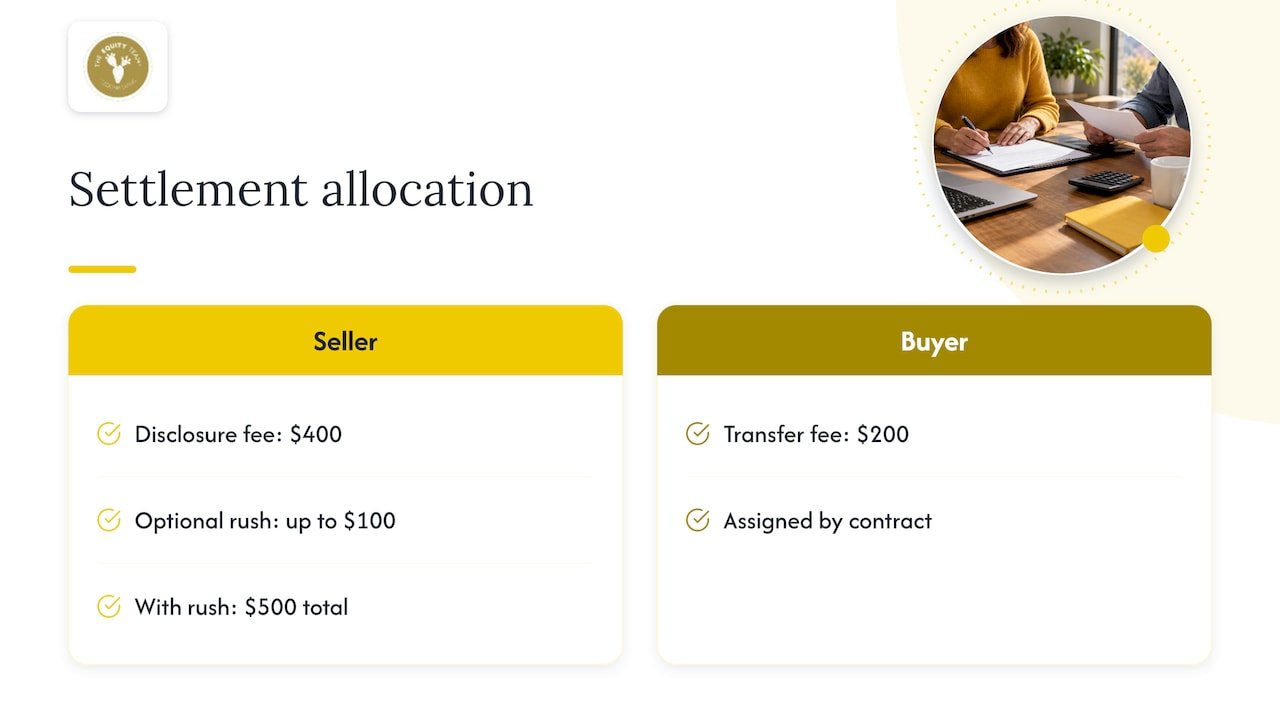
Change one sentence in the contract and the $200 moves. That is the whole game: the amounts come from the association and the statute, and the split comes from the paper.
Promo: when the HOA is only half the numbers
For a short-term rental seller, the HOA fee is a small piece of a bigger pricing question. The Sedona vacation rental CMA, or comparative market analysis, is where we look at what a rental-ready home is worth to the next owner, and the same page covers a seller prep consultation. Owners of an ordinary home can start with the Sedona Home CMA. Buyers weighing HOA communities for nightly rentals can work with us through our buyer representation.

Perspective
HOA fees are small numbers that cause big feelings. A $200 transfer fee will not make or break a deal, but a surprise one, discovered in the last week of escrow, can sour the whole mood.
We are Sedona’s dedicated short-term rental real estate team, and our view is that an HOA question is really an investment question. Before anyone fixates on the closing fee, we want to know whether the community permits the rental use the numbers depend on, what the dues are, and what the documents say about fees at transfer. Those answers belong in the analysis at the start, not at the end.
For sellers, the same thinking applies in reverse. Knowing the association’s fee schedule early means no scramble, no rush charge and a cleaner conversation with the buyer about who pays what. Our job is to put that information on the table while there is still plenty of time to use it.
Chad
FAQ
Is there a limit on HOA transfer fees in Arizona?
The statutes cap the association’s resale disclosure charge at $400 in total, plus up to $100 for rush service and up to $50 for an update. A separate transfer or capital contribution fee is allowed only if the CC&Rs authorize it for a specific purpose, so its size comes from the community’s own documents.
Does the buyer or the seller pay the HOA transfer fee in Sedona?
Arizona law leaves the transfer fee to the purchase contract, so either side can be assigned the cost. The disclosure fee is customarily a seller cost, and the 2026 amendment says it may not be charged to the purchaser.
When is the fee collected?
The statutory fees are collected no earlier than close of escrow and only once per transaction. Escrow requests a demand statement from the association and places each charge on the settlement statement of the party the contract assigns it to.
How do I find the exact fee for one HOA?
Ask the association or its management company for the fee schedule, which the statute requires it to make available to interested parties. Then compare it with the fee provisions in the CC&Rs and with the escrow demand statement.
Sources
- A.R.S. § 33-1806, Arizona Legislature
- Laws 2026, Chapter 249 (HB 2397), Arizona Legislature
- HB 2397 Senate Fact Sheet, Arizona Legislature
- Community Association Disclosure & Transfer Fees
- Homeowners Association Information directory
- HOA / Condominium / Planned Community Notice and Addendum
- Closing Costs: Who Pays What in Arizona
- HOA Capital Contributions and Working Capital Fees