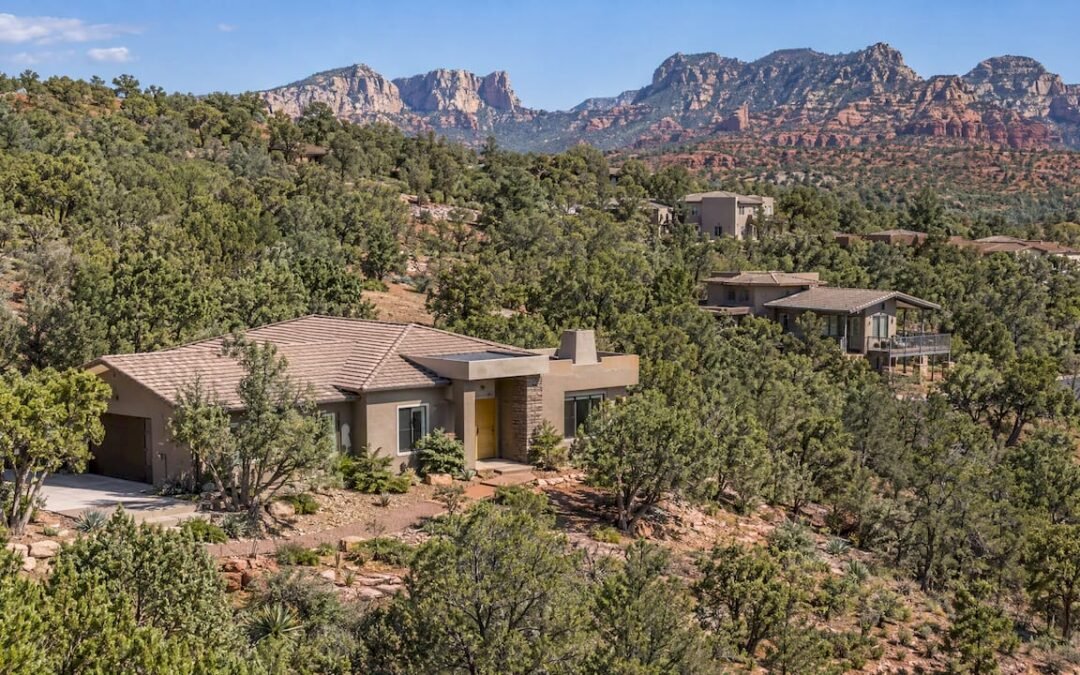
Sedona has red rocks, juniper-studded hillsides and a surprising number of people searching for the word “Firewise.” Here is the short version. Firewise USA recognition belongs to a neighborhood, not to a single house. A Sedona community earns it by organizing residents, assessing wildfire risk and doing a little fuel-reduction work every year. For anyone buying or selling a short-term rental, the practical question is simple: is this property inside a recognized community, and what has the surrounding land been doing about fuel? We build that question into every Sedona STR conversation, because wildfire exposure shows up in insurance, in inspections and in buyer behavior.
TL;DR
- Firewise USA is a free, voluntary program run by the National Fire Protection Association (NFPA). It recognizes whole communities, not individual homes.
- NFPA’s state listing names seven Sedona sites. The NFPA map cannot confirm whether a specific address sits inside one, so the HOA or the state forestry liaison has to confirm it.
- A site needs 8 to 2,500 dwelling units, a risk assessment, a three-year action plan and a yearly report of work done.
- Sedona’s city council backed a Fire Safe Sedona program in June 2026 to help subdivisions pursue recognition.
- For STR owners, Firewise status is one piece of a bigger picture that also includes defensible space, home hardening, insurance and Sedona’s fire code.
Table of Contents
- What Firewise USA actually is (and who runs it)
- Which Sedona neighborhoods are recognized?
- How a Sedona community earns recognition
- Fire Safe Sedona: the city joins in
- Firewise vs. home-level programs
- The five-foot rule everyone keeps mentioning
- What Firewise status means for rental owners, buyers and sellers
- How Sedona rules and Firewise fit together
- Our perspective
- Working with an STR-focused Sedona agent
- FAQ
- Sources
What Firewise USA actually is (and who runs it)
Firewise USA is administered by NFPA and co-sponsored by the USDA Forest Service, the Department of the Interior and the National Association of State Foresters. Communities that meet the voluntary annual criteria and stay in good standing may call themselves Firewise USA sites.
The program started in 2002 with 12 pilot neighborhoods. NFPA’s FAQ says it now has nearly 1,000 active member communities in 40 states, with an 80 percent retention rate over the past decade. The techniques are not mysterious: thinning trees and brush, choosing fire-resistant plants, using ignition-resistant building materials and placing structures away from slopes.
So “Sedona Firewise certification” is a bit of a nickname. The official wording is recognition as a Firewise USA site. The word “certification” gets thrown around because the city, insurers and agents all use it casually. It is worth knowing the difference when a listing says “Firewise community” and the HOA says nothing about it.
Which Sedona neighborhoods are recognized?
NFPA’s state listing of participants names seven Sedona Firewise USA sites:
- Canyon Mesa Country Club
- Cottages at Coffeepot HOA
- Del Sol Townhomes
- Firecliff Community Association
- LaBarranca II
- Les Springs HOA
- Oak Creek Estates
That is a short list for a town surrounded by national forest, and it is the reason the topic keeps coming up. Statewide the picture is brighter: Arizona’s Department of Forestry and Fire Management (DFFM), the state liaison for the program, added 35 new recognized communities in 2025, bringing the state total past 215.
How to check a specific address
NFPA’s interactive map is handy for browsing, but NFPA itself warns that it cannot determine whether a specific address is inside a site. Boundaries are drawn by the community. A house two streets over from a recognized HOA may not be covered at all.
A clean routine for a buyer or seller:
- Find the subdivision or HOA name on the listing or the plat.
- Look for it in NFPA’s state listing for Arizona.
- Ask the HOA or its board for the current boundary and the most recent annual report.
- Use DFFM’s map and list to confirm recognition. DFFM also names a Firewise contact for the Northern Arizona Zone, which covers Mohave, Coconino and Yavapai Counties and therefore Sedona.
For a property we are representing, we pull the subdivision name early and get the answer in writing before it becomes a surprise during escrow.
How a Sedona community earns recognition
The steps come straight from NFPA’s how-to-become-a-site page. They are manageable for an organized HOA, which is the charm of the program.
- Form a board or committee with a resident leader. The site must have between 8 and 2,500 dwelling units.
- Complete a community wildfire risk assessment with a local wildfire expert. NFPA wants it refreshed at least every five years. Its assessment template says the best results come from residents working with the state forestry agency or local fire department, and that communities should contact their state liaison before starting.
- Write a three-year action plan, updated at least every three years.
- Invest the equivalent of one volunteer hour per dwelling unit each year. A 100-home neighborhood logs 100 hours of work, or the monetary equivalent. Hauling brush, running a chipping day and pruning a shared entrance all count.
- Apply through the Firewise portal. The resident leader submits, the state liaison reviews it, and NFPA finishes processing.
- Renew every year. Annual applications are submitted each November to keep good standing, reporting outreach and risk-reduction investment. NFPA’s renewal guide says the deadline is the third Friday of November, so the work is best logged throughout the year rather than in a late-night scramble.
What it costs
The program itself is free. An industry guide for insurance agents describes it as a free, NFPA-administered program, with the main commitment being volunteer time and an annual education activity. Money enters only if a neighborhood chooses to hire crews or equipment, which counts toward the yearly investment.
Fire Safe Sedona: the city joins in
In June 2026 city staff presented a Fire Safe Sedona program to the council, which gave direction to begin outreach, property assessments and a landing page while staff pursues funding. Local reporting on the program describes a goal of helping at least two subdivisions a year pursue Firewise USA recognition, along with educational presentations and an annual Firewise event, and incentives under discussion such as chipping and disposal days and expedited permitting for home hardening projects.
The Sedona Fire District’s Fire Marshal described the aim in plain terms: reduce fuel between homes and the forest, with nobody profiting from it. He also offers free fire-risk assessments to residents.
Program details and incentives can change as the city finalizes them, so the city’s Fire Safe Sedona page and the fire district are the places to confirm what is on offer when you read this.
Firewise vs. home-level programs
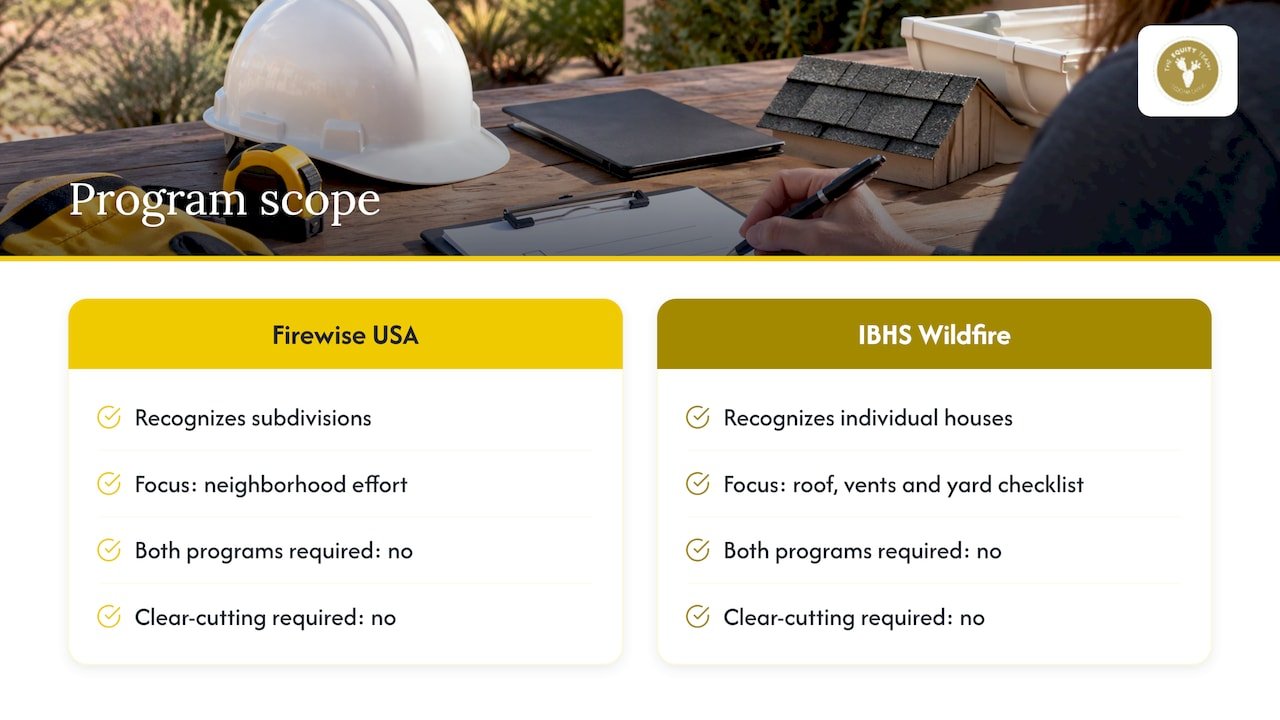
The same city reporting draws a useful line. Firewise USA recognizes entire subdivisions, while the insurance-industry-funded IBHS Wildfire Prepared Home program recognizes individual houses. Owners do not have to meet both, and neither demands clear-cutting. They are complementary: one is a neighborhood effort, the other a checklist for one roof, one set of vents and one yard.
NFPA also notes in its FAQ that property within 100 feet of a home can matter if neighbors are not Firewise, and that Firewise sits inside the larger Fire Adapted Communities effort. In a place like Sedona, where houses tuck into juniper and pinyon, the neighborhood is part of the property’s risk profile whether anyone planned it that way.
The five-foot rule everyone keeps mentioning
The zone closest to the house gets the most attention. NFPA’s Firewise toolkit calls the 0 to 5 foot area at the foundation, including fences, decks and porches, the critical zone to clear of flammables. It also recommends ember-resistant materials for roofs, siding and windows on new homes and retrofits.
That is where a rental owner has the most control. Dead pine needles in a gutter, a wooden planter against the stucco and a stack of firewood beside the hot tub are all small, fixable things. Our wildfire mitigation guide for Sedona rentals walks through the owner-side work in more detail.
What Firewise status means for rental owners, buyers and sellers
Insurance
Headwaters Economics’ Fall 2025 report says that as of early 2025 the program had worked with more than 2,790 communities, and that at least one insurer, USAA, recognizes certified Firewise communities with an estimated 5% discount in ten states. Recognition practices vary by company and by state, so the right move is to ask your own insurance agent how a recognized community or an IBHS-certified home affects a quote. For rentals, our guide to wildfire insurance for Arizona rentals covers what Sedona owners should line up.
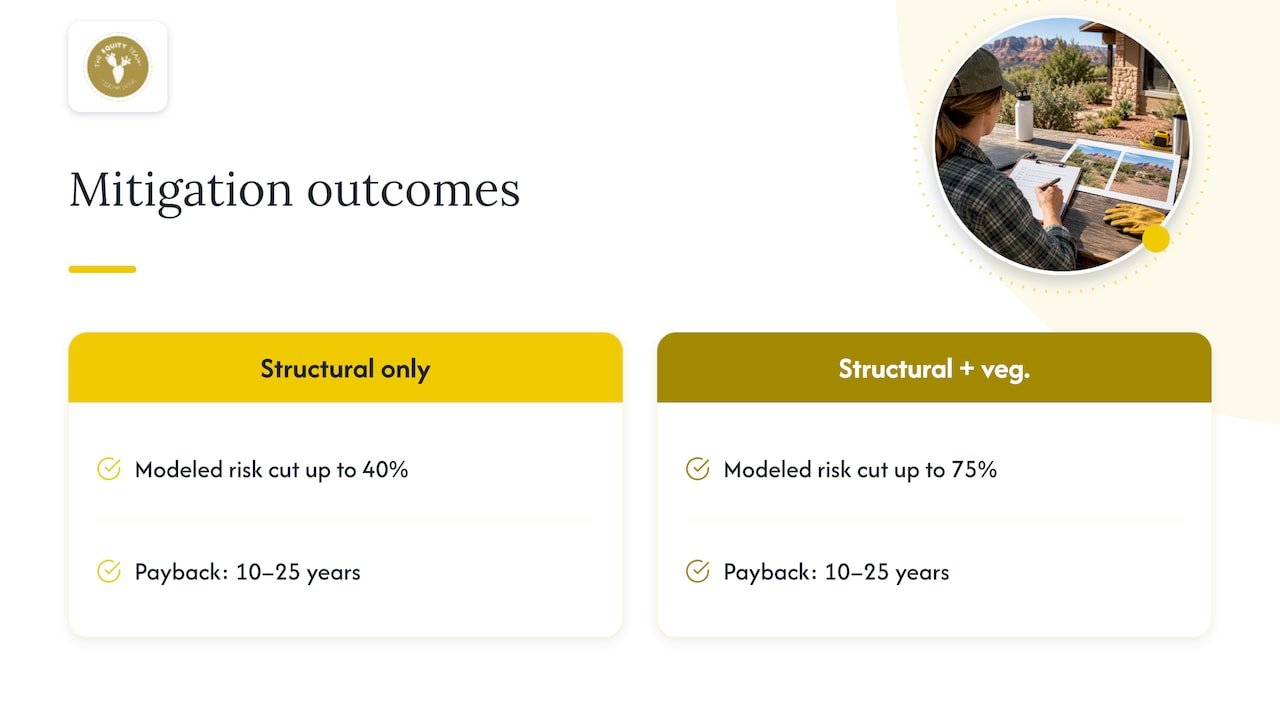
Mitigation also has measurable value. A study for the National Association of Insurance Commissioners found that structural changes can cut modeled wildfire risk by up to 40%, and structural plus vegetation changes by up to 75%, with payback periods of 10 to 25 years where risk-based pricing is allowed. That is the logic behind doing the work whether or not a neighborhood is formally recognized.
Buying a Sedona STR
For a buyer, Firewise recognition is a good tie-breaker and a good conversation starter. A recognized neighborhood has an organized board, a recent risk assessment and an action plan, which signals a community that pays attention. Pair that with a look at the lot itself: slope, vegetation, roof material and the distance from the house to the nearest heavy fuel. Before an offer, ask for the HOA’s latest Firewise report if one exists, and get an insurance quote on the specific address.
Our piece on why Sedona wildfire risk affects home value explains how these factors work their way into pricing, and six wildfire steps for STR buyers and sellers shows how to keep escrow from wobbling.
Selling a Sedona STR
A seller with a recognized community or a well-maintained lot has a story to tell, and the documentation backs it up: the HOA’s annual report, receipts for brush removal, photos of a cleared perimeter. Buyers’ agents ask about these things. Gathering them before the listing goes live keeps the conversation calm. Owners weighing what happens after a loss can also read about selling a fire-damaged house.
If the neighborhood is not recognized, the seller still has plenty to show. Cleared defensible space, a hardened roof and vents, and working smoke and fire alarms all count. On that last point, Sedona has its own rule for rentals: see our rundown of the Sedona Airbnb fire code and supervised alarms.
How Sedona rules and Firewise fit together
Firewise is voluntary. Local fire rules are not. The Sedona Fire District issues restrictions that can suspend burn permits and set conditions on fires during dry spells, so an STR host’s fire-pit policy and guest instructions should follow whatever restrictions are posted at the time. Firewise recognition does not exempt a property from those rules, and the rules do not depend on recognition.
Arizona’s new Zone 0 conversation, which centers on that five-foot ring around structures, is where the two meet. Firewise guidance already points owners at the same ring. If a recognition effort is underway in a neighborhood, it is a natural time to bring everyone’s foundation plantings and mulch into line. Specific legal requirements for a given parcel should be confirmed with the Sedona Fire District or the city before work or a sale.
Our perspective
We spend our days with Sedona STR buyers and sellers, and wildfire questions have moved from the end of the conversation to the beginning. Owners used to ask about occupancy, nightly rates and views. Now they also ask about the neighborhood’s fuel situation, the insurance quote and what a buyer’s agent will want to see.
Our view is that Firewise recognition is a real asset when a property has it, and a goal worth pursuing when it does not. A neighborhood that organizes, assesses and logs its hours has done something concrete for every home in it. Combine that with a cleared five-foot zone, a hardened roof and an insurance quote in hand, and a rental goes to market with answers instead of open questions.
That is how we approach Sedona transactions as a team that focuses on short-term rental investment. We look at the property as an income asset and as a piece of land in a fire-aware town, and we line up the paperwork before the buyer asks for it.
Chad
Working with an STR-focused Sedona agent
The Equity Team is a group of Sedona agents specializing in short-term rental investment. If a purchase is on the table, we represent buyers who want a top-performing rental. If a sale is coming, we offer a Sedona vacation rental CMA, a comparative market analysis built around rental properties, plus a seller prep consultation. Owners still deciding whether to sell can start with a rental exit strategy and valuation conversation.
To start the conversation, reach us at OwnInAZ.
FAQ
What does it mean to be in a Firewise community?
It means the neighborhood has been recognized by NFPA’s Firewise USA program after organizing residents, completing a wildfire risk assessment and writing an action plan. The community then reports its work every year to stay in good standing. Recognition applies to the neighborhood as a whole, not to one house.
Who runs the Firewise program?
NFPA administers Firewise USA, co-sponsored by the USDA Forest Service, the U.S. Department of the Interior and the National Association of State Foresters. In Arizona, the Department of Forestry and Fire Management serves as the state liaison and reviews applications before NFPA completes them.
Does Firewise recognition lower my insurance premium?
It depends on the insurer and the state. Headwaters Economics notes that at least one insurer offers an estimated 5% discount for certified communities in ten states. Ask your own insurance agent how recognition, or an individual IBHS home certification, affects a quote for your specific address.
Can a single Sedona home be Firewise certified?
Not through Firewise USA, which recognizes whole communities of 8 to 2,500 dwelling units. Individual homes can pursue the separate IBHS Wildfire Prepared Home designation. Many owners also work on defensible space and home hardening on their own, with or without a neighborhood program.
Sources
- Learn About the NFPA Firewise USA Program
- Firewise USA frequently asked questions
- Firewise USA state listing of participants
- Firewise USA, Arizona Department of Forestry and Fire Management
- How to become a Firewise USA site
- Firewise USA community wildfire risk assessment template
- Firewise USA annual renewal information
- Firewise USA program toolkit
- Firewise USA: A Tool Agents Can Put to Work
- Wildfire and Insurance, Headwaters Economics, Fall 2025
- Application of Wildfire Mitigation to Insured Property, NAIC
- Sedona council backs Fire Safe Sedona program
- City of Sedona unveils program to get subdivisions Firewise status