

The single highest-return move in Sedona Airbnb staging is prepping the property completely before you touch a single throw pillow, then staging one hero room around your red-rock view. Do these five things first: finish every repair and deep clean, style your best-view room for the listing photo, arrange furniture to frame the view instead of blocking it, choose furniture that survives dust and heat, and build a turnover routine before your first guest arrives.
- Deep clean and repair everything, cosmetic flaws included, before adding any decor
- Pick one hero room (usually the living area) and stage it around the best view in the house
- Position seating and beds so the view is the first thing guests notice, not an afterthought
- Buy durable, dust-resistant furniture over trendy pieces that won’t survive a Sedona summer
- Build your turnover checklist now, not after your first bad review about a messy handoff
Pro Tip: Book your staging work 6 to 10 weeks ahead of March through May or September through November if you’re doing a full-service project, since Sedona’s peak booking windows fill fast and installers get backed up right along with them.
Key Takeaways
Property preparation before staging, hero-room focus, and Sedona-specific durability choices together determine whether a listing books consistently at strong nightly rates.
| Point | Details |
|---|---|
| Prep before decor | Finish deep cleaning, repairs, and maintenance before spending money on furniture or decor. |
| Stage the hero room | Concentrate budget on your best-view room and its photos for the strongest rent-per-dollar return. |
| Choose climate-tough materials | Pick sealed wood, performance fabric, and powder-coated metal to survive dust and UV exposure. |
| Time staging around seasons | Book full-service staging 6 to 10 weeks before spring or fall peaks to avoid installer backlogs. |
| Work with Equity Team | Get staging, photography, and market-launch timing coordinated by Sedona’s STR-specialized real estate team. |
Table of Contents
- What Comes Before Any Sedona Airbnb Staging Decision?
- What Should Sedona Airbnb Staging Actually Achieve?
- Room-by-Room Staging: What Actually Needs Attention?
- What Makes Staging in Sedona Different From Anywhere Else?
- How Much Should You Actually Spend on Staging?
- What Does a Fast Turnover Checklist Look Like?
- What Furniture and Decor Actually Survive Sedona’s Climate?
- How Can Local Art Make a Sedona Listing Stand Out?
- How Do You Use Sedona’s Light to Your Advantage?
- How Do You Stage Sedona’s Outdoor Spaces?
- How Should Staging Change With Sedona’s Seasons?
- A Local Perspective on Sedona Airbnb Staging
- How Equity Team Helps Sedona Hosts Stage for Bookings
- Where to Learn More About Sedona Airbnb Staging
- Frequently Asked Questions
- Sources
What Comes Before Any Sedona Airbnb Staging Decision?
Nobody books a rental because of a clever throw blanket if the bathroom grout looks like it survived a dust storm. Property preparation is the unglamorous part of Sedona rental property staging, and it’s also the part with the biggest return. A clean, neutral foundation is what lets any styling choice actually work, and skipping it is like painting a mural on a cracked wall.
Start with the boring stuff. Steam-clean every carpet and rug. Repaint scuffed walls in a warm neutral, not stark white, since Sedona’s ochre and terracotta tones photograph better against warm backdrops. Replace any dated cabinet hardware, foggy light fixtures, or squeaky drawer pulls. Check every appliance actually works, not just looks like it works, because a broken ice maker generates a one-star review faster than a mismatched couch ever will.
Maintenance matters more here than in most markets. Dust infiltrates HVAC filters and window tracks fast in high desert conditions, so add filter changes and window-track cleaning to your standard pre-staging punch list. Grout lines in bathrooms and entryways trap red dust and show it within weeks. Sealing grout and stone surfaces before staging saves you from redoing the job every season.
Decor alone will not convert guests if the bones of the property still need work. Fix the leaky faucet, patch the drywall, and replace the cracked tile before you buy a single accent pillow. Owners who skip this step end up re-staging twice: once for the photos, once after a guest complaint forces the real repairs anyway.
What Should Sedona Airbnb Staging Actually Achieve?
Staging a short-term rental is not the same job as staging a house to sell. A home seller stages for one buyer’s imagination. You’re staging for hundreds of strangers a year who need to instantly understand how to use every space, because nobody reads a house manual before they book.
Functionality beats decoration every time in this category. A guest scrolling listings wants to see: where do I sleep, where do I eat, where do I sit and watch the sunset, and where do I put my hiking boots when I get back covered in red dirt. Staging vacation rentals in Sedona means solving that guest journey room by room, not just making things look nice for a photographer.
Think through the actual arrival sequence. A guest walks in tired from a flight or a long drive. What do they see first? Is the thermostat obvious? Is there a spot to drop keys and shoes? Then think about their evening: is there an obvious place to watch the sky change color over the rocks with a glass of wine, or does the best view get wasted behind a bulky armoire?
This functional lens is what separates a listing that gets five-star “just as pictured” reviews from one that gets docked for “confusing layout” or “hard to find things.” Staging with the guest’s actual movements in mind, not just camera angles, is the difference between decor and design that works. Design services that account for how guests actually move through a space consistently outperform staging done purely for aesthetics.
Room-by-Room Staging: What Actually Needs Attention?
Not every room deserves equal effort. Here’s where to focus, and why each one earns its spot on the list.
Living room: This is almost always your hero shot. Arrange seating to face outward toward the view rather than toward a TV, and keep the coffee table low enough that sightlines stay open from the couch.
Kitchen: Guests judge a kitchen by whether they can actually cook in it. Stock real cookware, a few good knives, and clear counter space instead of decorative bowls hogging the workspace.
Primary bedroom: A hotel-quality bed with layered neutral linens photographs well and sleeps well. Skip the decorative pillow pile that guests just toss on the floor at 11pm.
Bathroom: Fresh grout, good lighting, and matching towels do more work here than any art on the wall.
Entry: A console table, a hook for keys, and a bench for boots solve the “where do I put my stuff” problem before it becomes a complaint.
Outdoor space: In Sedona, this might be your most photographed room. Comfortable, weather-resistant seating aimed at the view matters more than any indoor upgrade.
The Sedona vacation rental staging playbook breaks these priorities down further if you want a room-by-room reference to hand your cleaner or stager directly.
What Makes Staging in Sedona Different From Anywhere Else?
Sedona’s red rocks aren’t just scenery, they’re your best unpaid marketing asset, and staging that ignores them is leaving money on the table. Furniture arrangement should treat the view like a fourth wall. Pull couches away from windows instead of pushing them flush against the glass, so guests can actually sit and look out rather than sit with their backs to a $2 million backdrop.
Desert palette choices matter for reasons beyond aesthetics. Warm neutrals, terracotta, sage, and sandstone tones don’t just match the landscape, they also hide dust better than stark white or charcoal upholstery. Neutral palettes and low-maintenance decor reduce the visible wear that high desert conditions cause between cleanings.
Outdoor living deserves real investment here, not an afterthought patio chair from a big-box store. Sedona guests come for the outdoors, and a rental that treats its patio, deck, or courtyard as a genuine living space earns higher engagement than one that treats it as leftover space behind the house.
Material choice is where a lot of owners lose money without realizing it. Direct desert sun fades fabric fast, and fine red dust works its way into every crevice a piece of furniture has. Choose UV-resistant outdoor fabrics, sealed wood or metal frames, and washable indoor upholstery over anything delicate. A Sedona amenities checklist pairs well with these material decisions, since amenities and durable staging choices tend to overlap in high-turnover properties.
How Much Should You Actually Spend on Staging?
Budget doesn’t need to be intimidating, and it definitely doesn’t need to be uniform across every room. A tiered approach protects your cash flow while still getting the visual results that drive bookings.
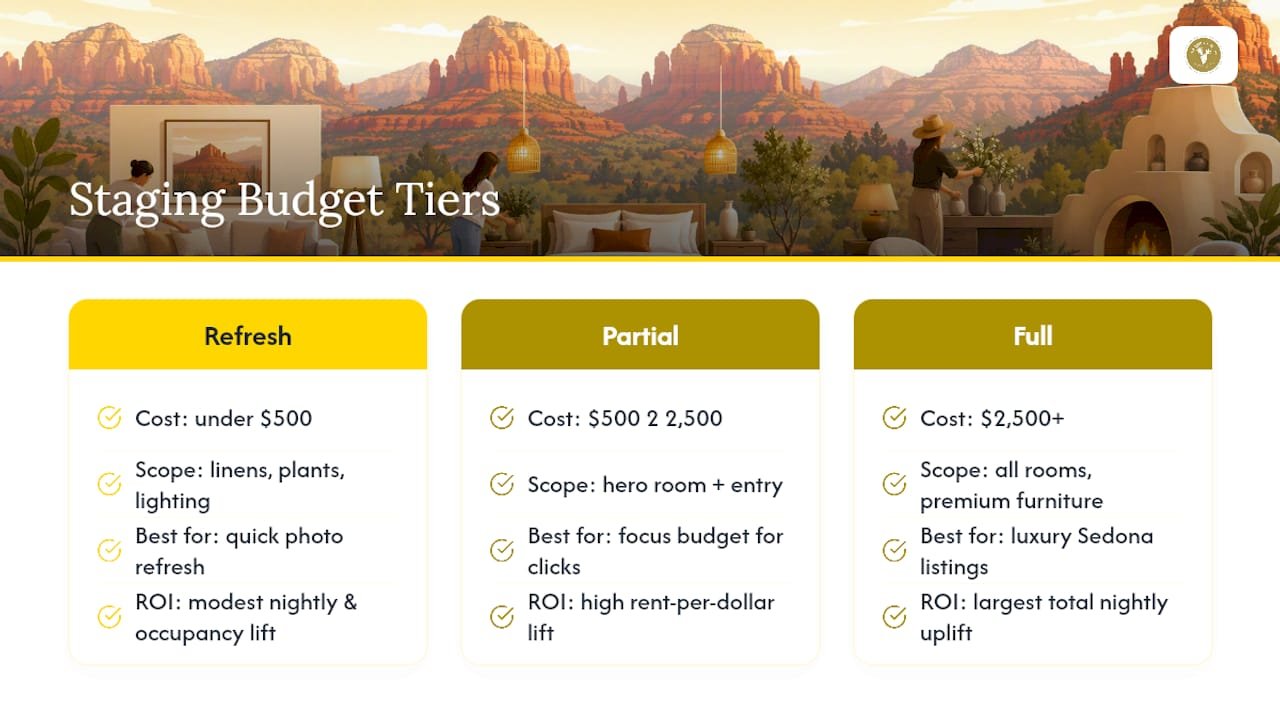
A quick refresh, new linens, a few plants, better lighting, decluttering, can run under $500 and still move the needle on photos. Partial staging, focused on your hero room and entry, typically lands between $500 and $2,500. Full staging across every room runs $2,500 and up, and that tier makes the most sense for luxury properties competing at the top of the Sedona market. Staging budget tiers map roughly to these ranges depending on scope and market position.
Here’s the part most owners get backward: they spread a modest budget evenly across every room instead of concentrating it. A hero-room-plus-photography approach tends to return more rent per dollar spent than an even split, because that’s the room and the image that actually gets the click on the listing page.
If your unit sits empty and you’re testing a new layout, Virtual staging is a reasonable stopgap, with costs varying per image, as it lets you preview arrangements before committing cash to furniture. Physical staging tends to perform better in Sedona’s higher-end segment, where guests expect the tactile, lived-in feel that a rendered image can’t fully deliver. Full staging costs increase based on number of rooms and quality of pieces chosen.
Track ROI the same way you’d track any capital improvement: cost of the staging against the increase in nightly rate and occupancy over the following 90 days. A broader ROI framework helps put staging spend in context against other property upgrades competing for the same budget.
What Does a Fast Turnover Checklist Look Like?
Guest changeovers in Sedona often happen on tight windows, sometimes same-day, and staging that looks great on day one but falls apart by week three is a design failure, not a cleaning failure. Build the staging with turnover speed in mind from the start.
Reset-friendly staging means every decorative item has an obvious home. Throw pillows go back on the couch the same way every time, extra towels live in a marked closet, and remote controls sit in a designated tray instead of wherever the last guest left them. A cleaning crew moving fast needs visual cues, not guesswork.
Keep a laminated checklist on-site or in a shared app that covers: strip and remake beds, restock toiletries and coffee supplies, wipe down high-touch surfaces, check for red dust accumulation on sills and outdoor furniture, reset staged decor to its photographed position, and do a final walk-through against your listing photos. That last step matters more than owners expect. Guests notice when the space doesn’t match the pictures, and mismatches show up in reviews within days.
Durable materials pull double duty here. Washable slipcovers, sealed countertops, and stain-resistant rugs cut cleaning time dramatically compared to delicate fabrics that need special care after every stay. The faster your turnover, the more nights you can book, and the fewer staging touch-ups you’ll need between guests.
What Furniture and Decor Actually Survive Sedona’s Climate?
Sedona’s combination of intense UV exposure, dramatic temperature swings, and fine red dust wears out the wrong furniture fast. Choosing pieces built for this environment saves money over a two or three year hold, even if the upfront cost runs slightly higher than a big-box alternative.
Indoor upholstery should lean toward performance fabrics, the same stain-resistant, easy-clean materials showing up in higher-end hospitality design. Leather and faux leather also hold up well against sunscreen, dust, and heavy turnover, and they wipe clean in seconds. Avoid delicate linen or light-colored fabric anywhere near windows that get direct afternoon sun.
Wood furniture needs a sealed finish, not just a nice stain. Unsealed wood cracks and fades under Sedona’s dry heat within a season or two. Metal frames with powder-coated finishes resist both sun damage and the fine grit that works into hinges and joints over time.
For decor, right-sized furniture and limited accent color tends to age better than trend-driven pieces that look dated within a year. Skip anything overly delicate, glass tabletops that show dust instantly, high-maintenance houseplants that need daily attention nobody’s paying for, or ornate textiles that trap red dirt in their weave. Guests want a space that feels curated but low-fuss, since most of them came here to hike, not to worry about ruining your throw pillows.
How Can Local Art Make a Sedona Listing Stand Out?
A generic rental with generic hotel art blends into every other listing on the platform. A few well-chosen local touches turn a house into an experience guests remember and mention in reviews, which matters more for repeat bookings than most owners realize.
Consider framed photography from local artists capturing the red rocks, Oak Creek Canyon, or the high desert at sunset, rather than mass-produced landscape prints available in any furniture store. Southwestern textile patterns, woven throws, or a single statement rug can nod to the region’s design heritage without turning the space into a theme park.
Small details work surprisingly well here. A coffee table book on Sedona’s geology or hiking trails, a local ceramic piece on an entry table, or a welcome basket featuring items from nearby makers all signal that a guest has arrived somewhere specific, not a generic vacation box. These touches cost little relative to furniture spend but generate outsized mentions in guest reviews, and review language directly influences future booking decisions.
Balance matters, though. Overdoing regional theming can tip into kitsch fast, all cactus motifs and turquoise everything reads more gift shop than getaway. One or two intentional pieces per room, chosen for quality over quantity, keep the space feeling authentic rather than costumed. The goal is a home that feels like it belongs in Sedona, not a home dressed up to look like a postcard of Sedona.
How Do You Use Sedona’s Light to Your Advantage?
Desert light is dramatic, and staging that works with it instead of against it does a lot of heavy lifting for free. Sedona gets intense, direct sun for much of the day, followed by extraordinary golden hour color as the sun drops behind the rocks, and your furniture arrangement should take advantage of both.
Sheer curtains or light-filtering shades let natural light flood a room during the day without turning the space into a greenhouse by 2pm. Reserve heavier blackout curtains for bedrooms only, where guests actually want darkness for sleeping in past sunrise. Mirrors placed opposite windows amplify natural light deeper into a room, which matters in homes with smaller interior spaces or fewer windows on the shaded side.
Evening ambiance needs its own plan separate from daytime staging. Warm-toned bulbs, 2700K to 3000K, create a cozier feel than the cool white light common in builder-grade fixtures. Dimmer switches, where wiring allows, let guests shift a living room from bright and functional during the day to warm and relaxed after a hike.
Outdoor lighting deserves particular attention given how much time guests spend outside here. String lights, path lighting, and a well-lit fire pit area extend usable hours into the evening and photograph beautifully for listing photos taken at dusk, exactly the kind of image that stops a scroll.
How Do You Stage Sedona’s Outdoor Spaces?
Outdoor space isn’t a bonus room in Sedona, it’s often the actual reason someone booked the property, and staging it like an afterthought wastes the biggest asset most Sedona rentals have.
Patios need furniture that invites lingering, not just a token bistro set nobody wants to sit in for more than ten minutes. Deep-seated outdoor sofas or a few well-placed lounge chairs, arranged to face the view, encourage guests to actually use the space and photograph it for their own social media, which is free marketing you can’t buy.
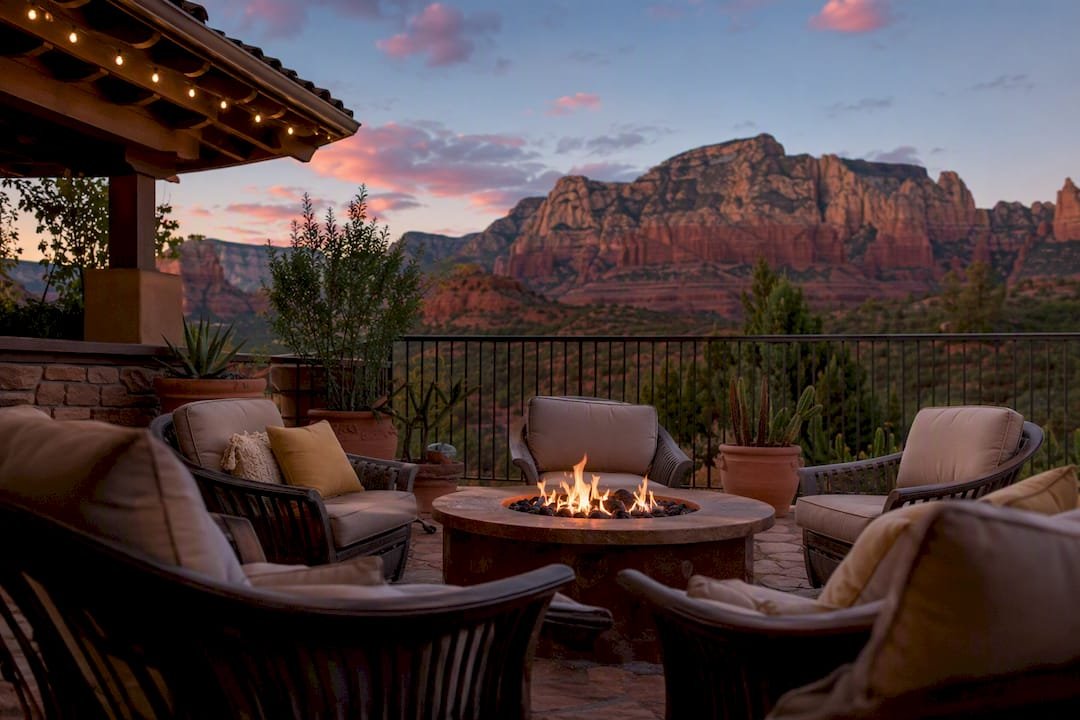
Fire pits have become close to a baseline expectation for higher-end Sedona listings, and for good reason given how dramatically the temperature drops after sunset even in summer. A simple gas or wood-burning fire pit with surrounding seating turns an ordinary evening into the kind of experience that shows up in five-star reviews.
Hiking gear storage solves a real, practical problem that most listings ignore completely. A mudroom bench, an outdoor closet, or even a simple boot tray by the entry keeps trail-dirty gear from tracking through the house, and guests notice when a host has clearly thought about their actual trip. Outdoor space investment consistently ranks among the highest-return staging decisions for Sedona properties specifically, since it’s the one feature guests can’t easily replicate at home.
How Should Staging Change With Sedona’s Seasons?
Sedona’s tourist patterns and temperature swings don’t move in sync with each other, and staging that ignores that mismatch leaves bookings on the table during shoulder seasons. Spring and fall bring the heaviest tourist traffic and the most comfortable weather, which means outdoor staging should be fully dialed in well before March and September arrive.
Summer heat pushes daytime activity indoors or toward early morning and evening hours, so staging should account for guests spending more midday time inside. Reliable air conditioning, light and breathable bedding, and shaded outdoor seating for evening use all matter more in June through August than they do in cooler months.
Winter brings colder nights and lighter but steady tourist traffic drawn by mild daytime temperatures compared to much of the rest of the country. Layered throws, a functional fireplace if the property has one, and warm lighting throughout carry more weight in staging decisions during this window.
The smartest scheduling move is doing major staging refreshes during slower windows, mid-summer or early winter, rather than scrambling right before a peak season starts. Planning staging work during slower local periods minimizes lost booking nights and lets you relaunch with fresh photos exactly when demand starts climbing again.
A Local Perspective on Sedona Airbnb Staging
Every high-performing Sedona short-term rental I’ve reviewed has one thing in common: the staging decisions were made with the guest’s actual trip in mind, not with a decorator’s mood board. Our video walkthroughs of Sedona rental properties show this pattern over and over.
How Equity Team Helps Sedona Hosts Stage for Bookings
Staging gets you better photos and more clicks, but the bigger question for most owners is whether the property itself is positioned to perform at the level Sedona’s top-tier STRs achieve. That’s where Equity Team comes in, not as a staging company, but as the real estate team that understands how staging, timing, and market positioning combine to drive nightly rate and occupancy for Sedona short-term rentals.

We help owners in three practical ways. First, we coordinate staging and photography timing around Sedona’s booking calendar, so your listing photos go live right before demand spikes, not weeks after. Second, we help time market launches, whether that’s a fresh listing or a relaunch after a renovation, to hit the moments when Sedona search traffic peaks.
The process is straightforward: a free consult to review your property and goals, a property assessment that flags prep priorities before staging, a coordinated photo shoot once repairs and staging are complete, and a market-timed launch designed around Sedona’s seasonal demand curve. Owners who follow this sequence typically see faster bookings, stronger average daily rates, and photography assets they can reuse across every future listing refresh.
If you’re evaluating whether your current property or a prospective purchase can hit that performance tier, start with a look at what’s actually working in Sedona’s STR market right now and reach out for a consult before your next staging decision.
Where to Learn More About Sedona Airbnb Staging
A few resources worth reading before your next staging project:
- Sedona vacation rental staging playbook for a room-by-room owner reference
- Sedona listing photography guide for capturing views correctly
- Sedona property value boost improvements for prioritizing repairs with the best payoff
- Local video walkthroughs and property analyses for real examples of staged Sedona rentals
- Sedona STR market climate overview for current demand and pricing context
Pro Tip: Bookmark the timing guide before you start any staging project, since booking installers or contractors too close to March or September usually means missing the exact window when demand justifies the spend.
Frequently Asked Questions
How much does Sedona Airbnb staging typically cost?
A quick refresh runs under $500, partial staging focused on a hero room lands between $500 and $2,500, and full staging across every room typically runs $2,500 or more depending on scope and furniture quality.
Do I need to stage every room in my Sedona rental?
No. Concentrating budget on your best-view room, kitchen, and entry usually returns more rent per dollar than spreading a modest budget evenly across every room.
When should I book staging for peak Sedona seasons?
Book full-service staging projects 6 to 10 weeks ahead of March through May or September through November, and streamlined projects 3 to 6 weeks ahead, to avoid installer backlogs.
What furniture holds up best in Sedona’s climate?
Sealed wood, performance fabric upholstery, and powder-coated metal frames resist UV fading and fine red dust better than delicate fabrics or unsealed finishes.
Should I stage before or after repairs are finished?
Always finish repairs, deep cleaning, and maintenance first. Decor and staging choices only work well once the underlying property is clean and functional.
Sources
- When to Book Airbnb Staging in Sedona, AZ
- Staging strategies for rental properties
- Staging your rental property for maximum impact
- How to stage your rental property for maximum appeal and profit