

An investor-friendly real estate agent is a licensed agent who works with rental buyers regularly, talks in rents, expenses and cap rates rather than paint colors, and will happily tell you a deal is a bad one. In Sedona, where red rocks tend to charm spreadsheets right out of people’s hands, you also want an agent who knows short-term rental (STR) rules, seasonality and the quirks of each neighborhood. This guide shows what to look for, how to vet agents, and what to ask before you sign anything.
TL;DR
- An investor-friendly agent has recent investor closings, quotes local rents and cap rates without flinching, and can describe a deal they talked a client out of.
- Sedona adds a layer: city permits, Arizona transaction privilege tax (TPT) and neighborhood-by-neighborhood rental performance all shape the numbers.
- Interview at least three agents, ask for past investor clients, and ask for written market data, not vibes.
- Sellers need the same rigor: an agent who can price a rental as a business, not just as a pretty house with a view.
- Our team at the Equity Team focuses on Sedona STR buying and selling, so this is the lens we use below.
Table of Contents
- What “investor-friendly” actually means
- Why Sedona is a special case
- The rules a Sedona investor-friendly agent should know cold
- Where to find investor-friendly agents
- How to interview an agent, step by step
- Questions to ask a Sedona realtor about short-term rentals
- Red flags that should end the call
- How to judge a Sedona property’s rental potential
- Our perspective: why we specialize
- Working with the Equity Team
- FAQ
- Sources
What “investor-friendly” actually means
The phrase shows up on a lot of agent websites, and it can mean anything from “I once helped a cousin buy a duplex” to “I run numbers before breakfast.” The useful definition is practical. One industry guide describes an investor-friendly agent as a licensed buyer’s agent who has recently closed purchases for rental investors, can quote local rents and cap rates, and will say so when a deal does not work.
That last part matters most. A regular home search is emotional: the kitchen, the light, the view of Cathedral Rock. An investment search is arithmetic with a view. The agent who gets starry-eyed along with you is lovely company and a terrible underwriting partner.
Here is what separates the two types in practice:
| Trait | Typical home-buyer agent | Investor-friendly agent |
|---|---|---|
| Leads with | Style, schools, lifestyle | Rents, occupancy, expenses, exit |
| Comparable data | Recent sales | Recent sales plus rental performance |
| Reaction to a bad deal | Finds a way to make it work | Says “pass” and explains why |
| Off-market access | Occasional | Part of the regular toolkit |
| Knows the rules | General real estate rules | Local permit, tax and operating rules |
Why Sedona is a special case
Sedona is a market where a general investor-friendly agent can still get tripped up. Demand is driven by tourism, the housing stock is a quirky mix, and rules for operating a rental sit on top of the purchase. A buyer who ignores those layers can end up owning a gorgeous house that is not allowed to earn what the listing photos promise.
Three things to understand before you even start interviewing:
- Performance varies by location and property. A home a short drive from uptown behaves differently from one in the Village of Oak Creek or Cottonwood. We lay out some of those differences in our guides to West Sedona Airbnb investment and Cottonwood Airbnb investment.
- High occupancy is not the same as high profit. Even luxury rentals with strong occupancy need a local comparative market analysis to back up the numbers, which is the point of our piece on Sedona luxury rental investing.
- The rules are part of the price. Permits, taxes and fines are line items, not footnotes.
The rules a Sedona investor-friendly agent should know cold
Your agent is not your attorney or CPA, but a specialist should know where the rules live and raise them early. A few anchors worth verifying yourself.
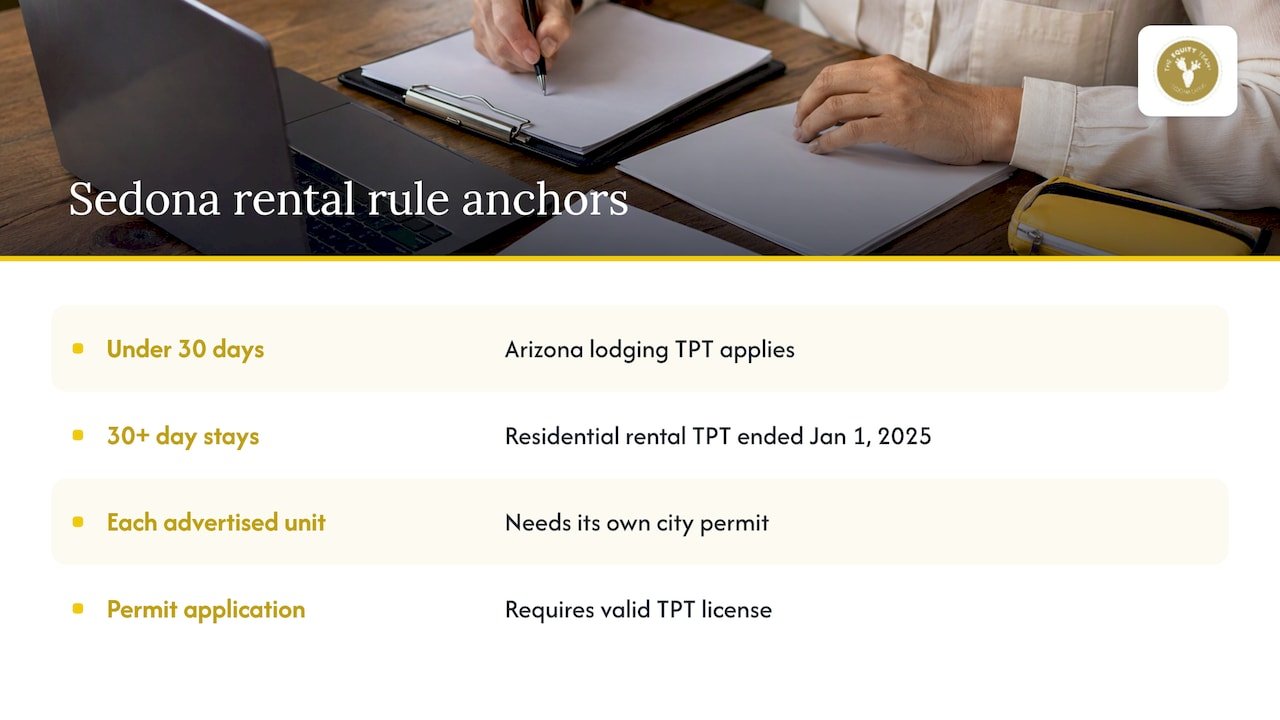
State tax. Arizona treats stays of less than 30 days as short-term lodging subject to transaction privilege tax. The Arizona Department of Revenue says operators report under specific business codes and must include the license number in advertising. It also says returns are due for every period, even one with no rental income, in which case you report $0.
Long-term stays are different. Residential rental TPT on stays of 30 days or more was eliminated effective January 1, 2025. If you ever plan to flip a property between nightly and monthly stays as a backup strategy, an agent should know where that line sits.
City permit. Sedona requires a city short-term rental permit. According to one host-focused summary of Sedona’s rules, the annual fee was $210 as of January 2025, each advertised unit needs its own permit, and a valid TPT license is part of the application. Fees and rules change, so confirm everything on the City of Sedona’s official page before you make an offer.
For the full picture we keep two plain-English guides: Arizona Airbnb taxes and our Arizona Airbnb laws checklist. If your investment involves cost segregation, our explainer on cost segregation and TPT is a good starting point before you talk to your CPA.
A good test: bring up permits and TPT in your first call. If the agent says “oh, that’s your problem,” keep walking. If they ask which permit status the property holds and whether the city rules apply to the unit, you are talking to a pro.
Where to find investor-friendly agents
There is no single registry, so you triangulate. The sources that tend to work:
- Referrals from professionals who see investor deals. Lenders, CPAs and real estate attorneys know who closes clean investor transactions and who creates drama. RealtyTimes suggests starting with existing professional referrals, agent websites and investor meetups, then talking with the agent’s previous clients.
- Local real estate investor groups and agent-finder tools. Local investor association chapters and national investing communities often have agent directories or recommendations from members.
- Owners who already operate in Sedona. An owner with a similar property can tell you who understood the permit process, who had realistic revenue estimates and who disappeared after closing.
- Agent websites. Look for market data, written analysis and neighborhood-level content, not just a headshot and a slogan. If a website shows real rental-market analysis, you can tell what the agent knows before you ever call.
One more thing: the agent finder and the agent’s own testimonials are both marketing. The real verification is a conversation with a past investor client.
How to interview an agent, step by step
Treat the interview like you would a property inspection. You are looking for what is behind the paint.
- Interview at least three agents. The same industry guide recommends at least three agents using a structured test call. It is the only way to notice that one of them is much better, or much worse, than the others.
- Ask for recent investor closings. Not total career sales, but investor deals in the last year or two, in a market like yours.
- Ask for written data. Rent ranges, occupancy trends, average daily rates and comparable sales. If it only exists as a story, it might not exist.
- Ask for a walk-away story. A real specialist can describe a deal they advised a client to skip and why.
- Call two past clients. Ask what happened after closing, not only what happened before.
- Run a mock deal. Hand over a listing and ask for a quick take on revenue, costs and risks. Watch how they think.
If you want a sense of how another market’s agents frame investor interviews and offer strategy, these investment tips for buyers show the type of questions that apply anywhere, then you can adapt them to Sedona.
Questions to ask a Sedona realtor about short-term rentals
Generic questions get generic answers. These are built for Sedona STR buyers, and the answers tell you quickly whether the agent has real depth.
Questions for buyers
- “How many STR purchases have you closed in Sedona and the Verde Valley in the past year or two?”
- “What are the typical nightly rates and occupancy for this neighborhood and this size of home, and where does that data come from?”
- “What would you subtract from gross revenue for cleaning, management, supplies, utilities, taxes, insurance and maintenance?”
- “Is this property currently permitted, and what does the transfer look like?”
- “Which comparable properties perform better and why?”
- “What would make you tell me to walk away from this one?”
- “How do you handle multiple-offer situations and what are your off-market sources?”
Our guide on questions to ask before you buy a luxury Sedona home expands on this list for higher-end properties.
Questions for sellers
Sellers sometimes assume investor knowledge is only for buyers. In Sedona the reverse is true: a rental sells as a business, and the buyer pool is full of people with spreadsheets.
- “How would you price this as a rental, not only as a house?”
- “What buyer groups are you reaching: investors, second-home buyers, relocators?”
- “What should I fix, furnish or leave alone before listing?”
- “How do you present the booking history and the revenue, and how do you handle the permit and tax questions buyers will ask?”
- “What are the tax traps if I sell a rental?”
That last one deserves real attention. We wrote about it in preparing a Sedona rental for sale, and your CPA should hear about it before listing day, not after closing.
Red flags that should end the call
The same sources that describe good agents also describe the warning signs. According to the industry guide on investor-friendly agents, watch for an agent who:
- focuses only on aesthetics
- has no written local market data
- gets defensive when you ask about cap rates
- cannot provide comparable sales
- cannot describe a deal they advised a buyer to walk away from
In Sedona, add a few local ones:
- Revenue promises with no source. “This house will make six figures” is a sentence, not an analysis.
- Zero mention of permits or taxes. Rules are part of the purchase price.
- One-size-fits-all numbers. If the same occupancy figure gets applied to a Cottonwood cottage and a West Sedona view home, the agent is guessing.
- No sense of an exit. A good investor agent thinks about resale at purchase. Our page on Sedona rental exit strategies covers why.
How to judge a Sedona property’s rental potential
Whether the agent is great or merely good, you should be able to sketch the logic yourself. A simple framework:
- Revenue. Estimate nightly rate and occupancy from comparable properties that actually operate, not from asking prices alone. Our Arizona Airbnb occupancy data shows why averages need interpretation.
- Expenses. Cleaning, management, utilities, supplies, insurance, taxes, repairs and reserves. Underestimating these is how profitable spreadsheets become mediocre bank balances.
- Rules. Permit status, TPT registration, HOA or neighborhood restrictions and city requirements.
- Seasonality. Sedona has busy stretches and calmer ones, and revenue management matters. Our vacation rental revenue management playbook digs into pricing across the year.
- Exit. Who buys this home later, and what will they pay for the booking history?
When you are ready for a number, our Sedona Airbnb valuation guide walks through the math, and the guide to finding the right short-term rental investment covers screening properties. To see what is on the market while you learn, you can browse listings through our Sedona property search.
Our perspective: why we specialize
We built the Equity Team around one idea: short-term rentals in Sedona are a different animal from ordinary homes, and the people who represent them should be too. We are a team of agents in Sedona, Arizona, focused on short-term rental investment, and we represent clients who operate STRs in the top 10% of the rental market. We were the first agents specialized in STR in Northern Arizona.
What does that change? Mostly the conversation. When a buyer calls, the first questions are not about granite. They are about revenue, rules, comps and exit. When a seller calls, we talk about how the home performs as a business and how to present that to buyers who will check our math.
We also think the best agents say “no” often. A buyer who walks away from a mediocre deal with their money intact has been served just as well as one who closes. Sedona is a place that rewards patience, and the red rocks, to be fair, have never been in a hurry.
— Chad
Working with the Equity Team
If you are buying, we represent buyers who want a Sedona short-term rental built to perform, and we will tell you plainly when a property does not fit the plan. If you are selling, start with a vacation rental CMA and seller prep consultation, or for a primary home, the Sedona Home CMA. If you are unsure whether to keep or sell, a conversation about rental exit strategy and valuation is a good way to find out. We do not publish pricing for these services; reach out through the site and we will explain how it works.
FAQ
Is it better to hire a specialist or a general agent for a Sedona rental?
For a rental you plan to operate as a business, a specialist is usually the safer choice. The numbers, permits and neighborhood differences are specific to short-term rentals, and mistakes are expensive. A general agent can still be great if they can show recent investor closings and written rental data.
How many agents should I interview?
At least three. Use the same questions each time so you can compare answers side by side, and ask each for references from recent investor clients.
Should I ask an agent for projected revenue?
Yes, but ask where the numbers come from. A solid projection names comparable properties, assumptions on rate and occupancy, and the expenses that come out of revenue. A single big number with no method is a red flag.
Do the same rules apply to sellers?
Sellers should ask about pricing the property as a rental, how the booking history is presented, and the tax and permit questions buyers will raise. A CPA or attorney should confirm tax and legal details before you list.
Sources
- How to Find an Investor-Friendly Real Estate Agent
- How Can I Find Real Estate Agents That Work With Investors, RealtyTimes
- Short-Term Lodging, Arizona Department of Revenue
- Residential Rental Tax Changes, Arizona Department of Revenue
- Sedona Short-Term Rental Regulations: What Hosts Need to Know