

Figuring out how to set asking price for a Sedona property is one of those challenges that feels deceptively simple until you actually try it. Sedona is not your average market. Red rock views, short-term rental income potential, quirky seasonal swings, and a buyer pool that has done its homework all collide in a way that makes traditional pricing strategies feel a little wobbly. Whether you are selling a cozy two-bedroom with a patio facing Cathedral Rock or a luxury five-bedroom STR generating serious revenue, the right asking price requires a very specific blend of market data and rental performance math.
Table of Contents
- Key Takeaways
- Gathering the right data before setting your price
- Integrating STR revenue into your asking price calculation
- Step-by-step: setting your final asking price
- Common pricing pitfalls Sedona STR sellers make
- What I have actually learned pricing Sedona STRs
- How Equity Team helps you price and sell smarter
- FAQ
Key Takeaways
| Point | Details |
|---|---|
| Sold prices beat listing prices | Sedona’s median sold price sits well below the median listing price, so price from sold comps. |
| STR revenue anchors valuation | Use real ADR and occupancy data to calculate defensible asking prices buyers will respect. |
| Dynamic pricing changes the math | Properties with dynamic pricing tools command stronger revenue and justify higher asking prices. |
| Seasonal swings matter a lot | ADR peaks in March and dips in August, so factor monthly fluctuations into your price model. |
| Negotiation room is real | Sedona buyers typically discount from list price, so build a realistic buffer without overreaching. |
Gathering the right data before setting your price
Before you type a single dollar amount into a listing form, you need data. And not just any data. Sedona-specific, property-type-specific, and STR-performance-specific data. Getting this wrong at the start sends everything else sideways.
The Sedona real estate market has a notable gap between what sellers hope for and what buyers actually pay. The median sold price in the Sedona 86336 area sits around $925,000, while the median listing price hovers closer to $1,062,500. That is a meaningful spread. Buyers in Sedona anchor their offers on what similar properties actually sold for, not what sellers listed them at.
Beyond the headline numbers, price per square foot tells a cleaner story. Condos in the area are running roughly $414 per square foot, though that number shifts based on location, view quality, and amenity package. A property overlooking Airport Mesa is simply not the same as one three blocks from a strip mall, even if the square footage matches.
For STR owners specifically, you also need to pull your actual rental performance stats. The average nightly rate for Sedona STR properties runs around $342 with roughly 49.4% occupancy, generating average annual revenue near $57,000. Broader citywide data shows some listings achieving closer to $69,600 annually at a $425 nightly rate with 48% occupancy. These numbers matter enormously for how a buyer will evaluate your property’s worth.
| Metric | Sedona Benchmark |
|---|---|
| Median sold price (86336) | $925,000 |
| Median listing price (86336) | $1,062,500 |
| Price per sq ft (condos) | ~$414 |
| Average nightly rate (STR) | $342 |
| Average annual STR revenue | $57,000–$69,600 |
| Average occupancy rate | 48–49% |
You also want to assess your property’s condition honestly. Views and amenities matter. A lot. But view and amenity premiums only translate into pricing power if the listing quality and operations are genuinely strong. A stunning view with bad photos and a broken hot tub is not commanding top dollar from any serious buyer.
Pro Tip: Run a comparative market analysis using sold prices from the past six months in your ZIP code. Pull the Sedona market trends data alongside your actual STR revenue records for the most defensible number.
Integrating STR revenue into your asking price calculation
This is where Sedona property pricing gets genuinely interesting. Most traditional real estate pricing ignores rental income entirely, treating the home purely as a physical asset. That approach leaves serious money on the table when you are selling a high-performing STR.
Start with your average daily rate and occupancy figures. Then run this sequence:
- Calculate gross annual revenue. Multiply your average nightly rate by your annual booked nights. If you average $380 per night at 50% occupancy over 365 nights, that is approximately $69,350 in gross revenue.
- Subtract operating costs. Platform fees, cleaning, utilities, insurance, maintenance, and management fees typically eat 35 to 50 percent of gross revenue. Know your actual number.
- Determine net operating income (NOI). This is the figure buyers actually care about when evaluating STR investments.
- Apply a cap rate or gross revenue multiple. Sedona STR buyers often think in terms of revenue multiples. A property generating $65,000 annually might trade at 12 to 16 times annual revenue depending on condition and permit security.
- Cross-check against comparable sold prices. Your revenue-based number should align reasonably with recent sales. If it does not, investigate why before committing to a price.
One of the biggest pricing variables right now is whether a property uses dynamic pricing tools or sets rates manually. Dynamic pricing significantly improves revenue capture, particularly during peak and shoulder seasons when static pricing leaves occupancy and rate potential untapped. A property running dynamic pricing tools can show meaningfully better revenue history, which directly justifies a higher asking price.
You should also factor in Sedona STR permit compliance. Many self-managing owners eventually hit burnout or operational gaps that drag down their revenue records. If your books show revenue shortfalls, a smart buyer will discount accordingly. Clean operations, documented income, and a transferable permit situation all support a stronger price.
Pro Tip: Present two to three years of actual booking revenue alongside your asking price. Buyers who can see consistent, growing income from a profitable STR operation are far more confident making strong offers.
Step-by-step: setting your final asking price
Once you have the data, the process of landing on an actual number becomes much more manageable. Here is how to work through it cleanly.

Step 1: Anchor to sold comps, not listing prices. Pull recent sales in your property type and ZIP. Use price per square foot as your baseline and adjust from there. Listing prices often exceed sold prices by 13 to 15 percent in Sedona, so do not let inflated listing data distort your anchor point.
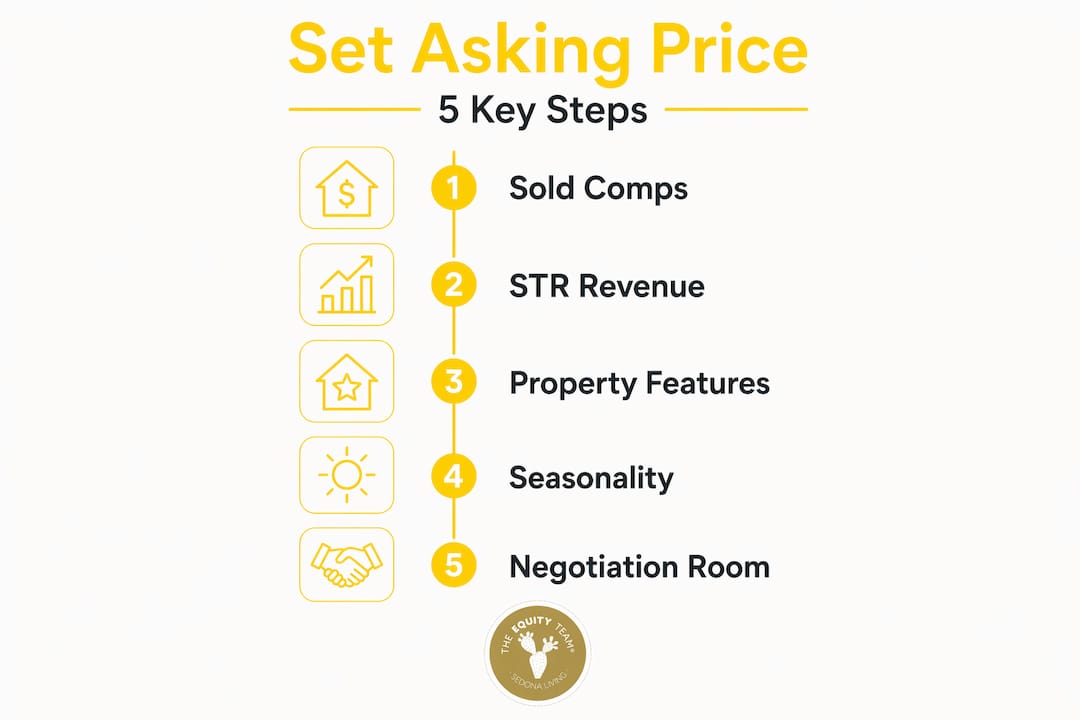
Step 2: Model your STR revenue realistically. Use actual booking history or local market benchmarks from sources like AirROI. Buyers will scrutinize this, so conservative and defensible beats optimistic and vague every time.
Step 3: Adjust for your property’s specific characteristics. Red rock views, a heated pool, a hot tub, proximity to trailheads, number of bedrooms, and recent renovations all move the needle. Quantify these where you can by looking at how comparable properties with and without them performed on the market.
Step 4: Factor in seasonality. ADR peaks in March and dips in August, with significant swings in between. If your asking price is based on peak-season revenue alone, a buyer running annual numbers will immediately see the gap. Price on annualized performance.
Step 5: Build in a realistic negotiation buffer. Sedona buyers negotiate. Build roughly five to eight percent of breathing room above your true target without crossing into territory that looks disconnected from the data. Overpricing scares off serious buyers and drags the listing stale.
| Pricing approach | Outcome |
|---|---|
| Based on listing price comps only | Likely overpriced, slower sale, more negotiation friction |
| Based on sold price comps + STR revenue | Realistic, defensible, attracts serious buyers |
| Based on peak-season revenue projections | Looks inflated annually, buyers discount immediately |
| Based on annualized dynamic pricing revenue | Strongest justification, cleanest buyer conversation |
Common pricing pitfalls Sedona STR sellers make
Sedona is a wonderful place to own a short-term rental. It is also a market where pricing mistakes are surprisingly easy to make. Here are the ones that show up most often.
- Using listing prices as a benchmark. The 13 to 15 percent gap between listing and sold prices is real and consistent. Anchoring your price to what others are asking rather than what similar properties actually sold for is the single fastest way to overprice yourself out of buyer interest.
- Ignoring seasonal revenue variability. Seasonality should be incorporated into any STR pricing model. A buyer who does the math on a full year will catch inflated projections immediately.
- Overlooking permit and regulatory constraints. STR regulation changes in Sedona directly affect how buyers view risk and value. A property with a grandfathered permit in a restrictive zone carries a premium. One with compliance questions does not.
- Neglecting operational readiness. A property that looks great on paper but shows inconsistent reviews, scattered booking records, or deferred maintenance will face discount pressure regardless of the asking price.
- Skipping a proactive monitoring plan. If your listing sits for 45 or more days with minimal interest, waiting it out rarely fixes the problem. Revisit your comps, check your revenue documentation, and adjust.
Pricing a Sedona STR property is a conversation between your data and the buyer’s due diligence. The cleaner and more honest your data, the shorter and smoother that conversation gets.
Knowing when to bring in professional help matters too. The current STR climate in Sedona is nuanced enough that local expertise is genuinely worth the investment. Agents who specialize in STR transactions understand how buyers are reading revenue records and what is moving the market right now.
Pro Tip: Review the STR restriction changes in Sedona before finalizing your asking price. Regulatory clarity is a selling point. Uncertainty is a discount.
What I have actually learned pricing Sedona STRs
I have worked with enough Sedona STR sellers to know that the most common pricing mistake is not greed. It is over-reliance on traditional comps without understanding how a buyer in this market thinks. Buyers who are targeting STR investments are running cash flow math before they ever call their agent. If your asking price does not survive their spreadsheet, they move on. Quietly.
What I have found genuinely works is presenting the revenue story alongside the price. Not just the top-line gross revenue number but the full operational picture, the permit situation, the historical occupancy trend, and a clear explanation of the dynamic pricing strategy in place. That combination gives a serious buyer confidence. Confidence closes deals.
I have also learned that operational readiness is one of the most underrated pricing factors in Sedona. A property that is running smoothly, generating consistent five-star reviews, and showing clean income history will hold its price through negotiation far better than a gorgeous property with sloppy books. Buyers are buying a business as much as a building. Present it like one.
My honest take: sellers who blend realistic comps with documented STR revenue, and who price with a clear negotiation margin built in, sell faster and closer to their target than those who lead with aspirational numbers. Sedona buyers are smart. Give them a price they can defend internally.
— Chad
How Equity Team helps you price and sell smarter
Equity Team is Sedona’s first STR-specialized real estate team, and pricing Sedona short-term rental properties is genuinely what we do every day. Whether you need a comparative market analysis grounded in real sold data or help translating your booking revenue into a price buyers will respect, the team has the tools and local knowledge to get you there.

From in-depth market trend reports to video walkthroughs of active Sedona STR listings, Equity Team gives sellers and investors a real edge. You can explore the team’s STR investment analyses to understand exactly how buyers in this market evaluate properties, or dive into the luxury market activity in Sedona if your property sits at the top of the range. Ready to get your number right? Start with Equity Team.
FAQ
What is the median sold price for Sedona STR properties?
The median sold price in the Sedona 86336 area is approximately $925,000, which sits notably below the median listing price of $1,062,500. That gap reflects real negotiation dynamics buyers and sellers should plan for.
How do I use STR revenue to determine my asking price?
Calculate your annualized net operating income using actual ADR and occupancy data, then apply a revenue multiple typical for Sedona STR transactions. Sedona properties generating $57,000 to $69,600 annually are often valued using revenue multiples alongside traditional comps.
Does dynamic pricing affect my property’s asking price?
Yes, significantly. Properties running dynamic pricing tools show stronger, more consistent revenue histories, which buyers use to justify higher offers. Static pricing often underperforms in peak and shoulder seasons, creating visible gaps in the booking record.
How much negotiation room should I build into my asking price?
In Sedona, listing prices frequently exceed sold prices by 13 to 15 percent. A realistic buffer of five to eight percent above your true target keeps you competitive without triggering buyer skepticism about whether the price is grounded in reality.
When should I consult a Sedona STR specialist to set my price?
If your property has complex permit status, inconsistent revenue records, or sits in a price range with limited direct comps, working with an STR-specialized agent early in the process protects you from both underpricing and the stale-listing spiral that comes from overpricing.