

Guest screening on Airbnb is mostly the art of reading a booking carefully and setting up a listing that attracts the right crowd. It is not a private investigation. Airbnb verifies identity and runs its own reservation screening, and hosts add their own layer with house rules, Instant Book requirements, a few polite questions and a sharp eye for mismatches. Hosts who go further, with their own criminal background checks, wander into policy and legal trouble fast.
That is the short version. The long version has a few plot twists, a few sensible scripts and one very important fair housing footnote. Sedona, with its red rocks, vortex seekers and the occasional “we just want a quiet weekend” group of fourteen, makes a fine backdrop for the story.
TL;DR
- Airbnb requires identity verification for every booking guest and runs its own reservation screening, but says this is no guarantee that someone is who they claim to be.
- Host-led screening works best when it screens the booking: group size, trip purpose, stay length, timing and how clearly the guest answers questions.
- Clear house rules, Instant Book requirements and a short pre-booking question do most of the heavy lifting.
- Hosts generally may not solicit personal data or run outside background checks on guests, and may never reject guests on protected characteristics.
- Keep every conversation inside the Airbnb app so there is a record if something goes sideways.
Table of Contents
- What Airbnb Already Screens for Hosts
- Screen the Booking, Not the Person
- Screening Methods That Actually Work
- Warning Signs and What to Do About Them
- The Legal Lines Hosts Should Know
- A Simple Consistency Checklist
- Screening in Sedona: Local Rules Do Half the Work
- Perspective: What We See From the Sedona Side of the Table
- Thinking About Buying or Selling a Sedona Rental?
- FAQ
- Sources
What Airbnb Already Screens for Hosts
Before a host lifts a finger, the platform has done some homework. Airbnb says every host, new co-host and booking guest must be identity verified, though it is honest that the process aims to reduce fraud and promote safety rather than guarantee anyone’s identity.
There is more under the hood. Airbnb’s resource center says AirCover for Hosts includes guest identity verification, that it uses proprietary reservation screening to help reduce disruptive parties and property damage, and that it conducts background checks on booking guests when permitted by law.
The takeaway is friendly and slightly deflating: the platform is a good first filter, not a bouncer with a clipboard. A host’s own judgment fills the gap, and the best tools for that judgment are surprisingly low-tech.
Screen the Booking, Not the Person
The smartest hosts stop asking “Who is this human?” and start asking “Does this booking make sense?” A booking can be examined without poking into anyone’s private life. Airbnb’s own guidance on preventing disruptive parties points hosts toward details like travel history, guest count, holidays and reviews that mention disruptive gatherings.
Here is what a reasonable read of a booking looks like:
- Group size versus property size. Eight adults booking a two-bedroom cottage is a math problem worth solving before check-in.
- Timing. A local guest booking on a known event night, such as prom weekend or a holiday, deserves a closer look.
- Trip purpose. A guest who can explain why Sedona (hiking, anniversary, a wedding nearby) is usually a guest who has a plan.
- Reviews and track record. Past hosts’ reviews, where they exist, say more than any form could. Reviews mentioning noise or gatherings are the ones to read twice.
- Communication. Clear, friendly, specific replies are a good sign. Dodging a simple question is the red flag with the neon sign.
None of these require collecting a single extra scrap of personal data, which is exactly the point.
Screening Methods That Actually Work
Write house rules that do the screening
Professional short-term rental managers often note that clear, enforceable house rules act as a quiet filter: guests who are comfortable with the rules book, and guests who are not tend to wander off. Airbnb’s guidance lists house rules first among the tools for hosts, and a company-blog guide from a U.S. property manager likewise recommends clear listing requirements and specific rules as practical screening.
Specific beats vague every time. “Be respectful” is a wish. “Quiet hours 10 p.m. to 8 a.m., no events or parties, registered guests only” is a rule. Hosts who want ready-made wording can borrow from these copy-ready house rules examples or, for a specific market, the Cottonwood rules checklist.
Rules also set expectations about the unglamorous parts of a stay. A guest who knows what condition to leave the place in makes turnover smoother, and cleaning pros will tell you how often a rental home needs cleaning depends heavily on how it was used. Rules that spell out trash, towels and extra guests save everyone a headache.
Use Instant Book requirements
Hosts who turn on Instant Book are not stuck accepting anyone. Airbnb’s booking settings guide says hosts can require a good track record, meaning no reported incidents or bad reviews, and can require guests to answer pre-booking questions. That gives the convenience of fast bookings with a gate that screens in the background.
Ask a few pointed, polite questions
Airbnb’s guidance says hosts may ask local guests why they are booking nearby, whether they will be present, and how many people will stay. The same page tells hosts to keep conversations on the Airbnb app, which is good practice twice over: it keeps a record and keeps the platform able to help.
A short, friendly template might read:
- “Thanks for booking! What brings you to Sedona?”
- “How many guests will be staying, and will everyone be sleeping here each night?”
- “Have you had a chance to read the house rules, including quiet hours and the guest limit?”
Three questions, no interrogation lamp. Hosts who ask the same questions of every guest also protect themselves from accusations of picking and choosing.
Set minimum stays and let the calendar help
Minimum stays are listed in Airbnb’s guidance as another lever. A longer minimum on holiday weekends or event dates quietly discourages one-night party bookings without singling anyone out.
Warning Signs and What to Do About Them
Airbnb’s guidance names a short list of red flags: locals booking during known events, groups that mismatch the property size, and guests who evade clarifying questions about their stay. None of these proves anything. They are reasons to ask a question, not reasons to slam a door.
When something feels off, the recommended path is calm and documented:
- Gather the facts. Note what in the booking triggered the concern.
- Ask directly. A friendly question about group size or purpose usually clears things up.
- Contact Airbnb Support for guidance if the answers are murky.
- Skip the assumptions. Airbnb specifically asks hosts to be mindful of making assumptions and to avoid discriminatory criteria.
That last one is not just good manners. It is the legal boundary, and it deserves its own section.
The Legal Lines Hosts Should Know
This is general information, not legal advice. A host with a specific situation should talk to a licensed attorney in their state.
Background checks and personal data
Hosts often ask whether they can run a criminal check on a guest before accepting. Airbnb’s own policy points the other way. Its policy on soliciting personal data says hosts generally may not ask for personal information, except where needed to comply with applicable law or a documented community association rule, or to facilitate an allowed contract, and they must disclose what is required and why.
ID at the door is treated separately. Under the same policy, a host may physically check a guest’s ID at check-in if the requirement is disclosed in the listing, but may not keep a copy except where the policy’s exceptions allow it.
In plain English: Airbnb handles the verification, and hosts handle the door. Running a private background check on a guest before booking is not the host’s job under the platform’s rules.
Fair housing
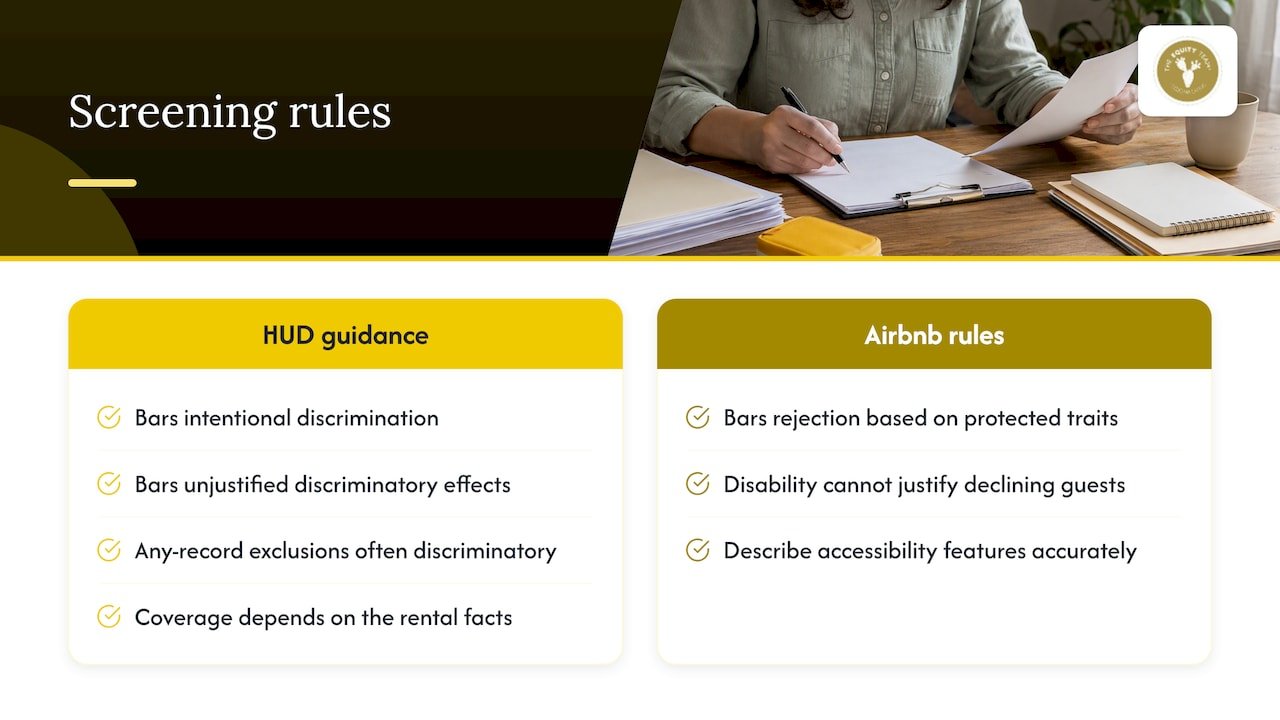
Guests staying a weekend in a vacation rental are not tenants in the usual sense, but the thinking behind rental screening law is still a useful guide. HUD says the Fair Housing Act prohibits intentional discrimination and screening policies with an unjustified discriminatory effect, and that imprecise or overbroad criteria may unjustifiably exclude people. HUD’s discriminatory effects rule fact sheet adds that a policy excluding anyone with any criminal record, including arrests, often has a discriminatory effect.
Whether the Fair Housing Act applies to a particular short-term rental depends on the facts, so that is a question for an attorney. Airbnb’s own rules leave less room for doubt. Its Nondiscrimination Policy bars hosts from rejecting guests because of protected characteristics such as race, religion, disability, sexual orientation or nationality. Hosts cannot decline guests over disability, but they must describe a home’s accessibility features accurately so guests can judge suitability.
Consumer reports
Some hosts who also run mid-term rentals use tenant screening services. The FTC explains that when a landlord takes adverse action, such as denying an application, based on a consumer report, the landlord must give an adverse action notice and tell the applicant about the right to dispute inaccuracies. The FTC has also warned that companies supplying tenant background information may count as consumer reporting agencies under the Fair Credit Reporting Act, with strict accuracy and dispute rules.
The practical upshot: the more a host leans on outside reports, the more rules come along for the ride. Consistent, booking-based screening keeps things simpler.
A Simple Consistency Checklist
Fairness is easier when the process is the same for everybody. Here is a short routine that hosts can adopt:
- Ask the same three or four questions of every guest.
- Judge answers against the listing’s written rules and capacity, not against a guest’s name, accent or photo.
- Keep all messages in the app.
- Write down the reason for any decline in terms of the booking, such as group size over the limit, rather than anything about the person.
- Never collect IDs, photos of IDs or extra personal details in messages.
- Do not promise a security deposit the platform will not support. Most hosts can’t collect one, as this explainer on Airbnb security deposits lays out.
Screening in Sedona: Local Rules Do Half the Work
In Sedona and the surrounding Verde Valley, the setting adds a few quirks. Red rock views invite big family reunions, bachelorette weekends and the occasional optimistic “just a few friends” booking. Local rules are the host’s friend here, because they give a tidy, non-personal reason to say no to a bad fit.
Occupancy limits, parking rules and permit requirements vary by jurisdiction. Hosts can read up on Sedona occupancy limits, the Sedona parking rules, the Coconino County rules, the Yavapai County rules and the Arizona statewide checklist. Quoting a legal limit in the listing is about as neutral and fair as screening gets: the number is the number, for everyone.
Perspective: What We See From the Sedona Side of the Table
We work with Sedona short-term rental owners who sit in the top slice of the market, and we notice a pattern. The hosts with the calmest calendars are rarely the ones with the longest screening questionnaires. They are the ones whose listings say, plainly and cheerfully, what the property is and is not: how many people it sleeps, what the quiet hours are, what the local rules require.
We also see screening show up at a moment hosts do not expect: the sale. A rental with a clean review history, clear rules and a documented, consistent booking process is easier to explain to a buyer, and easier to value. Buyers of Sedona rentals look at reviews, occupancy and income, and a property that has been run with care tells a better story than one with a trail of incident reports.
So our advice is simple. Let Airbnb do the identity verification. Let clear rules do the filtering. Let your own judgment handle the weird booking that does not add up. And let the law keep everybody honest.
— Chad
Thinking About Buying or Selling a Sedona Rental?
Well-run rentals hold their value, and guest screening is part of running one well. The Equity Team is a Sedona real estate team focused on short-term rental investment, helping buyers find properties built to perform and helping owners position a rental for a strong sale. Owners curious about what their vacation rental could fetch can start with a Sedona vacation rental CMA, or browse the Equity Team home page to see how we work with buyers and sellers.

Owners weighing an exit can also read about rental exit strategies before deciding on a next step.
FAQ
Can an Airbnb host run a background check on a guest?
Airbnb says it conducts background checks on booking guests when permitted by law, and its policy generally bars hosts from soliciting personal data. A host’s own pre-booking background check runs against that policy, and it can create fair housing and consumer report issues. Hosts with a specific concern should contact Airbnb Support, and an attorney if legal questions arise.
How do hosts screen Airbnb guests without being intrusive?
They screen the booking. Hosts read the guest’s reviews, compare group size with the listing, notice timing around local events and ask a few friendly questions inside the app. Clear house rules and Instant Book requirements add a quiet filter without asking for any extra personal information.
Can a host ask to see a guest’s ID?
According to Airbnb’s policy, a host may physically check a guest’s ID at check-in if the requirement is disclosed in the listing. The host may not keep a copy except as the policy’s exceptions allow. Airbnb already verifies guest identity during booking.
What are the biggest red flags in a booking?
Airbnb’s guidance lists local guests booking during known events, groups that do not fit the property size and guests who dodge simple questions about their stay. These are prompts to ask a question and document the answer, not proof of bad intent. Hosts should avoid assumptions and discriminatory criteria.
Can a host turn down a guest because of who they are?
No. Airbnb’s Nondiscrimination Policy prohibits rejecting guests based on protected characteristics such as race, religion, disability, sexual orientation or nationality. Decisions should rest on the booking and the written house rules, applied the same way to everyone.
Sources
- Airbnb Help Center: identity verification
- Airbnb Resource Center: how Airbnb protects hosts
- Airbnb Resource Center: tips to help prevent disruptive parties
- Airbnb Resource Center: how to pick your booking settings
- Airbnb Help Center: soliciting personal data
- Airbnb Help Center: Nondiscrimination Policy
- ATLStay: guest screening for short-term rentals
- HUD: guidance on screening of applicants for rental housing
- HUD: discriminatory effects final rule fact sheet
- FTC: using consumer reports, what landlords need to know
- FTC: warning letter on tenant background information