

Sedona has a funny cosmic contrast going on: the most dramatic decorator in town is already outside, and it works for free. The best Sedona Airbnb interior design lets that 300-million-year-old red rock do the shouting while the living room clears its throat politely and hands guests a coffee. Owners who treat the interior as a frame for the view, and who spend where guests actually notice, tend to protect their nightly rate. Owners who paint every wall terracotta and hang a cow skull in every room tend to get a very themed, very forgettable listing.
The design is also a purchase decision. Which house has the bones, the windows and the patio worth designing around is a question you answer before closing, and what a finished interior is worth is a question you answer at listing. That is where an agent who only works with Sedona short-term rentals earns a seat at the design table.
TL;DR
- Design the room around the red-rock view first, then add furniture, texture and a few natural objects. The interior is the frame, not the picture.
- Pull colors from the landscape in measured doses: a warm neutral base, one red-rock tone, one cooler balancing color, and let art carry the strongest reds.
- Choose fabrics, flooring and outdoor furniture for turnover and sun. Guests book for atmosphere and review for comfort.
- Photos are part of the design. A Harvard Business School study found verified, professional-quality images tied to higher occupancy.
- Buying or selling a rental? The view, layout and outdoor space are what a Sedona vacation rental valuation has to weigh.
Table of Contents
- Start with the window, not the mood board
- A palette that nods at the red rocks without shouting
- Bringing the landscape inside without a theme park
- Materials that survive a guest every three nights
- The outdoor room is part of the interior
- Photos: where design gets paid
- Where the budget goes first
- Buying or selling: the interior is a number
- Buying or selling a Sedona rental with the design in mind
- FAQ
- Sources
Start with the window, not the mood board
The first design decision in Sedona is not a paint chip. It is a window. One local design studio puts the job neatly: the interior should be the frame, not the picture. If a window frames Cathedral Rock or Bell Rock, anything planted in front of it loses the argument. Guests should want to be in the room and looking out of it at the same time.
Another Sedona design practice compares good landscape-inspired design to desert varnish, the thin mineral coating on desert rock: a layer that reveals what was already there rather than covering it. Its practical advice is to anchor the room around the view first, then layer furniture and varied textures.
What that means in a rental:
- Point the main seating toward the best sightline, not toward a television.
- Keep window treatments light and UV-resistant, so the view stays the star and the sofa does not fade.
- Use mirrors to bounce natural light around, as one Sedona 4-bedroom Airbnb project did to amplify daylight.
- Skip bulky window dressing, heavy valances and clutter on sills.
A rental with a genuine sightline has an advantage no throw pillow can match. One Sedona marketing page reports that Uptown or West Sedona homes with a real red-rock view clear $350 to $650 a night in spring and fall, against $220 to $320 for similar floor plans without one. It is a marketing company’s figure, so read it as a sense of scale rather than a promise, but the direction is consistent across Sedona hosting advice: the view is the product.
A palette that nods at the red rocks without shouting
Everyone’s first instinct in Sedona is terracotta. It is a fine instinct, in small doses.
Designers who write about the Sedona market describe a few recurring looks:
- Desert modern. Reported as the most requested style in Sedona’s rental market, with terracotta, burnt sienna, sandy beige and deep sage, raw wood and stone accents, linen, low-profile furniture and layered warm lighting.
- Organic luxury. Bouclé, travertine and brushed brass.
- Bohemian desert chic. Woven textures, pottery and layered patterns.
- Contemporary high desert. One Sedona redesign skipped literal Southwestern motifs in favor of white oak, sculptural forms and layered neutrals, with rich black accents.
The common thread is restraint. A palette guide for Sedona-inspired homes suggests building from a warm architectural neutral, one primary red-rock tone and a cooler balancing color, and letting artwork supply the strongest reds instead of painting whole rooms rust. A Sedona-based designer makes the same point from another angle: treat Southwest style as a concept rather than a theme, with a base of soft whites, cream and pale taupe, and then add vignettes of woven textiles, pottery and geometric patterns.
Two practical Sedona quirks deserve a mention.
The light turns everything orange. Late-afternoon sun bouncing off the rock can push every surface toward orange for an hour. Local designers recommend large painted sample boards tried in the actual room at several times of day before committing.
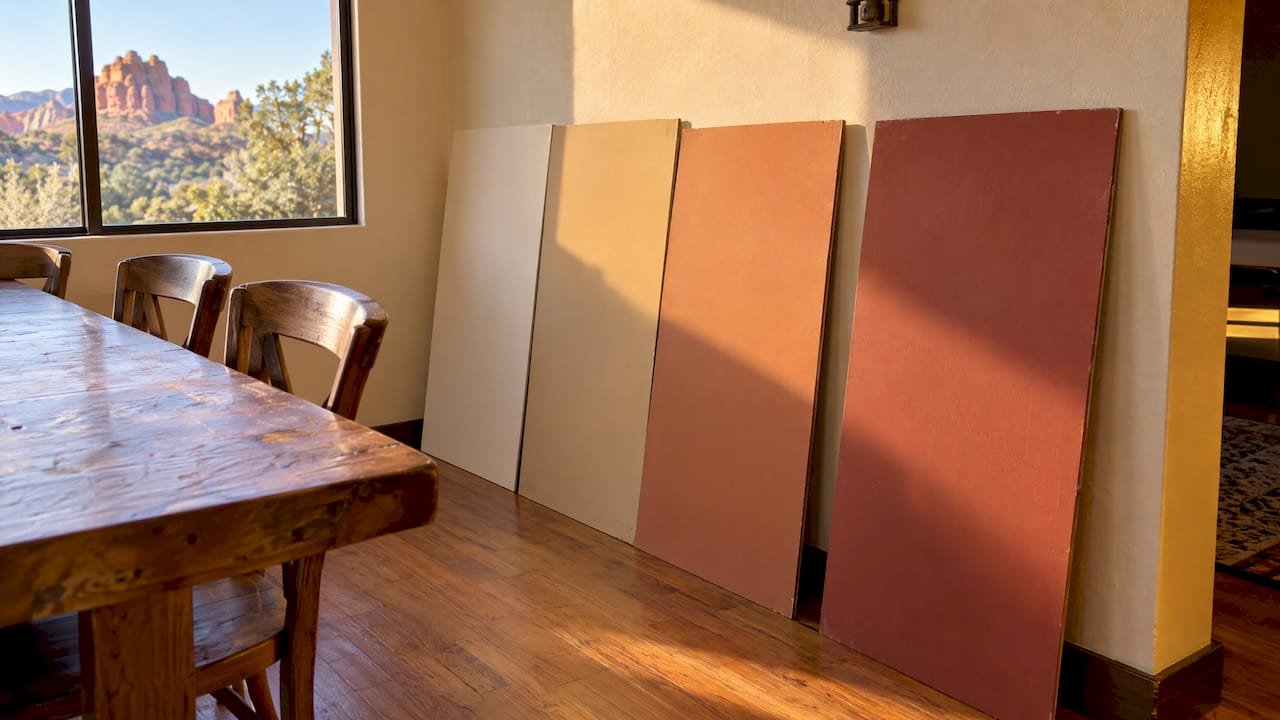
The town has opinions about exteriors. Sedona’s Land Development Code limits exterior colors by reflectivity. Under Section 5.7.F, buildings under 5,000 square feet are capped at a light reflectance value of 38%, with a maximum chroma of 2, and mirrored surfaces, faux rock and white or reflective roofs are prohibited. That governs the outside of the building, so a bold interior is a design choice rather than a code issue, but anyone planning a repaint of the exterior should read the code first.
Bringing the landscape inside without a theme park
The trick is small, natural and a little unexpected. Sedona designers suggest tying a room to the outdoors with a stick, rocks from outside the property, a single crystal or dark wood rather than a wall of Southwestern kitsch. One Sedona project echoed the red rocks with rough-hewn stacked stone, balanced it with warm wide-plank flooring and soft textures, and placed copper accents where moving sunlight would catch them, so the room goes from bright by day to glowing by night.
A few moves that work in almost any Sedona rental:
- Pick one hero material (stone, reclaimed wood or plaster) and repeat it twice, not ten times.
- Choose a single statement piece per room, not a collection.
- Layer lighting with table lamps, floor lamps, under-cabinet kitchen lighting and dimmers. A Sedona design studio notes good lighting also makes listing photography more effective.
- Add living texture. Plants soften stone and wood, and a guide on refreshing interior aesthetics shows how a few well-placed greens change a space. In a dry high-desert setting, pick hardy varieties.
One warning from a Sedona hosting writer sums up the whole section: guests book for the aesthetic and atmosphere, but they leave five-star reviews for comfort.
Materials that survive a guest every three nights
Sedona sits at roughly 4,300 feet, with real seasons, intense sun and freeze cycles. A rental here gets hard use from guests who hike all day and land on the sofa in trail dust. Designers who work the market recommend:
- Upholstery and cushions: solution-dyed acrylic or performance fabrics, and no light velvet or delicate weaves in high-traffic spots.
- Flooring: tile, stone or high-performance luxury vinyl plank.
- Windows: UV-resistant treatments.
- Outdoor furniture: powder-coated metal or teak.
All of that comes from one Sedona design firm’s guide to rental durability. The same guide advises avoiding fragile decor and excess accessories, and building a cohesive look around a few anchor pieces per room. Fewer things means fewer things to break, replace or dust.
For patios and decks, a primer on sun-resistant outdoor furniture (in Spanish) covers how fabrics and finishes stand up to strong sun, a useful lens at Sedona’s elevation and UV levels.
The outdoor room is part of the interior
In Sedona, the patio is not an afterthought. Host-market guidance describes outdoor spaces as among the most valuable square footage on a property, and recommends durable metal or UV-resistant wicker furniture, string lighting and a fire pit area.
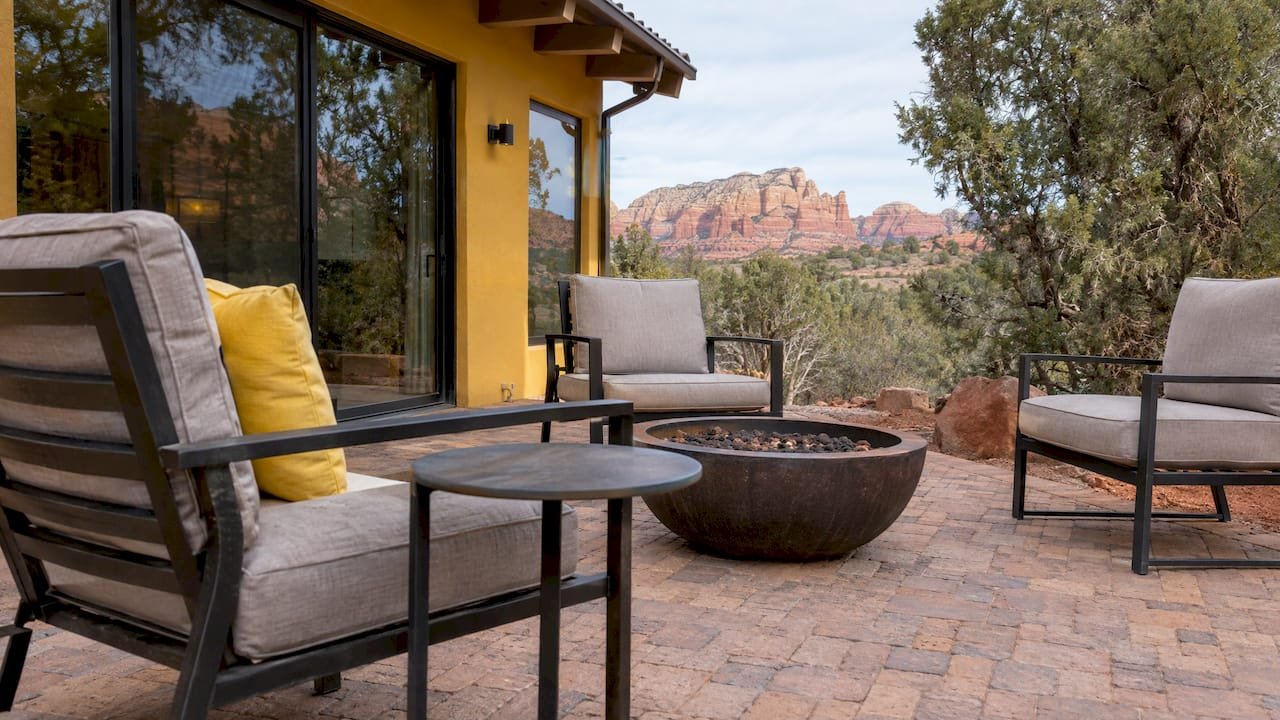
A Sedona market guide reports that guests skew older and higher income, usually couples and small families of two to four, and that they respond to easy trail access, parking guidance and comfortable outdoor spaces. The same guide points to unobstructed red-rock views, hot tubs, fire features, shaded lounge seating and wellness touches such as stargazing kits, yoga spaces and meditation nooks as differentiators. For a deeper checklist, our Sedona vacation rental amenity guide goes through them.
One Sedona redesign even added a private spa with a sauna, cold plunge and massage area to stay competitive. That is a bigger swing than most owners need, but it shows where the premium end of the market is heading.
Photos: where design gets paid
A beautifully styled room that photographs badly is a secret. The research on listing images is encouraging. A Harvard Business School study of 7,423 Airbnb properties over 16 months found that properties with verified images had 8.98% higher occupancy than those without, and that most of the 12 image attributes it tested correlated significantly with demand.
So shoot the design at its best:
- Time the shoot so the red-rock light helps, not hurts.
- Lead with the interior-to-landscape shot, the window with the view and the coffee table in the foreground.
- Stage for the camera with a few anchor pieces, not every trinket.
Our own guides to Sedona listing photography and vacation rental staging walk through the details.
Where the budget goes first
Blog-reported Sedona figures vary widely. One design guide puts a complete desert design at $12,000 to $35,000 depending on size and finish, with the living area, primary bedroom and outdoor spaces as the priority investments. Treat that as a planning range, not a quote. The useful lesson is the order: spend first where guests spend their time and where photos are taken.
A sensible priority list:
- Living area and primary bedroom. Mattresses, bedding and seating guests will actually use.
- Outdoor space. Seating, lighting and a fire feature.
- Kitchen refresh. Small upgrades photograph and perform well.
- Photography. The step that shows the others.
- Accessories last. Fewer, better, sturdier.
For line-by-line categories, see our Sedona Airbnb furnishing cost guide and the high-ROI staging checklist.
Buying or selling: the interior is a number
For an investor, interior design is not decoration, it is an underwriting line. A house with a real sightline, a patio that can hold a fire pit and a floor plan that sleeps the right number of guests needs a lighter design budget than one that does not. For a seller, a finished and photographed interior is part of the case for a higher price. Either way, the number should come from local comparables rather than a hunch. Our pieces on how to evaluate Sedona rental income potential and Sedona luxury rental investing show how that math works.
Our take on Sedona rental interiors
We specialize in Sedona short-term rentals, so we look at a design the way a buyer, a guest and an appraiser all will. We like interiors that treat the view as the headliner, use a restrained palette and are built for turnover, because that is the kind of rental we want our clients to own or sell.
Before a buyer falls for a staged living room, we want them asking which windows frame the rock, where the patio sits and what it would cost to furnish. Before a seller spends on new furniture, we want them to see how a Sedona vacation rental is likely to be valued as it stands. Design should be a decision made with the numbers beside it.
Chad
Buying or selling a Sedona rental with the design in mind
The Equity Team is a team of real estate agents in Sedona, Arizona, specialized in short-term rental investment, representing buyers and sellers. Selling a rental? Our Sedona vacation rental CMA and seller prep consultation are built for the question of what your furnished, finished property is worth. Buying? Our buyer representation is about finding the house with the bones worth designing around.
FAQ
What style works best for a Sedona Airbnb?
Desert modern is reported as the most requested style in Sedona’s rental market, with warm neutrals, terracotta and sage accents, natural wood and stone, and layered lighting. Keep the red tones measured and let art and views carry the drama.
Should I paint the walls terracotta?
Usually not the whole room. Palette guidance for Sedona homes suggests a warm neutral base, one red-rock tone and a cooler balancing color, with artwork supplying the strongest reds. Test large sample boards in the room at different times of day, since the late light turns surfaces orange.
Do interior design and photos really change bookings?
Images matter. A Harvard Business School study of 7,423 Airbnb properties found verified images were tied to 8.98% higher occupancy. Interior design and photography work together: a cohesive room built around a few anchor pieces photographs better.
What should I furnish first?
Start with the living area, the primary bedroom and the outdoor space, then the kitchen and photography. Durable, performance fabrics and sun-resistant outdoor pieces save replacement costs in a high-turnover rental.
Sources
- Sedona Interior Designers, Park Avenue Design
- Landscape Inspired Design in Sedona, Desert Varnish Design
- Luxury Casa Sedona, Jess Lyon Interior
- Sedona, Arizona Airbnb Marketing, Cavmir
- Modern Airbnb Staging Design Styles Trending in Sedona, Sabi Haus Design Labs
- Bristolecone House, LuxeSource Studio
- 12 Red Rock Color Palettes Inspired by Sedona, ART OF ROYALS
- Modern and Elevated Southwest Interior Design, SenHoma
- 5.7.F Building Design, Sedona Land Development Code
- Neo-Sonoran, Park Avenue Design
- Best Short Term Rental Design Trends in Sedona, Sabi Haus Design Labs
- Desert Airbnb Interior Design, MyBnBDesign
- Ways to refresh workspace aesthetics, Greenspace Plants
- Mobiliario de exterior resistente al sol, AMUBAR
- Sedona Airbnb Market Guide, Host Camp
- What Makes a Good Image? Airbnb Demand Analytics, Harvard Business School