
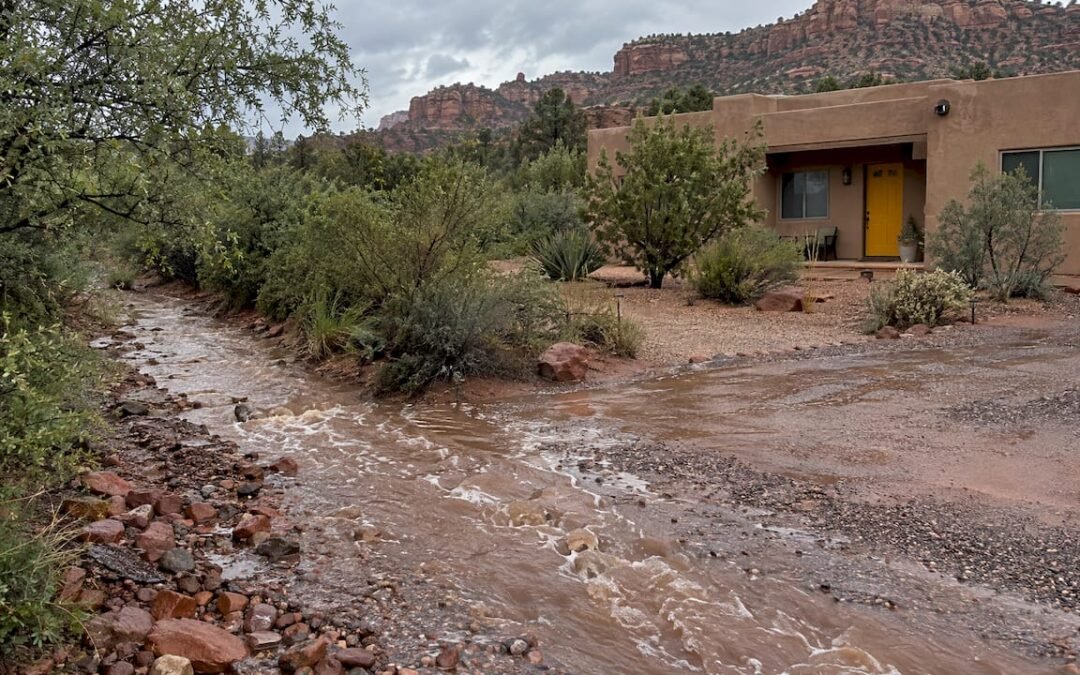
Sedona is famous for red rock and vortex talk, but the desert has a plot twist: when a monsoon storm dumps rain on hard, dry canyon ground, the water has nowhere polite to go. For a Sedona short-term rental owner or buyer, flood insurance is a separate policy, it usually has a 30-day waiting period, and it is worth sorting out before an offer goes in, not after the first thunderhead. We are the Equity Team, Sedona agents who focus on short-term rental purchases and sales, and this is the flood insurance routine we want every STR buyer and seller to know.
TL;DR
- Standard homeowners policies generally leave out flood damage, so flood coverage is its own policy, and FEMA’s National Flood Insurance Program (NFIP) is the main source.
- Lenders backed by the federal government require it in high-risk zones (those starting with A or V), and some lenders ask for it elsewhere.
- NFIP building coverage tops out at $250,000 and contents at $100,000, and business interruption is not covered, so a rental owner should plan lost income separately.
- Coverage typically starts after a 30-day waiting period, so buyers should start the quote during the offer period, not at closing.
- Check the flood zone of the exact address before you make an offer. Nearby homes can sit in different zones.
Table of Contents
- Why flood insurance matters in a place that looks so dry
- Step one: find the flood zone of the exact address
- When flood insurance is required
- What NFIP flood insurance covers, and what it leaves out
- What flood insurance costs around Sedona
- The 30-day clock: timing it with a purchase
- How this fits into a Sedona STR purchase or sale
- Our view: the insurance question belongs in the offer, not after it
- Working with us
- FAQ
- Sources
Why flood insurance matters in a place that looks so dry
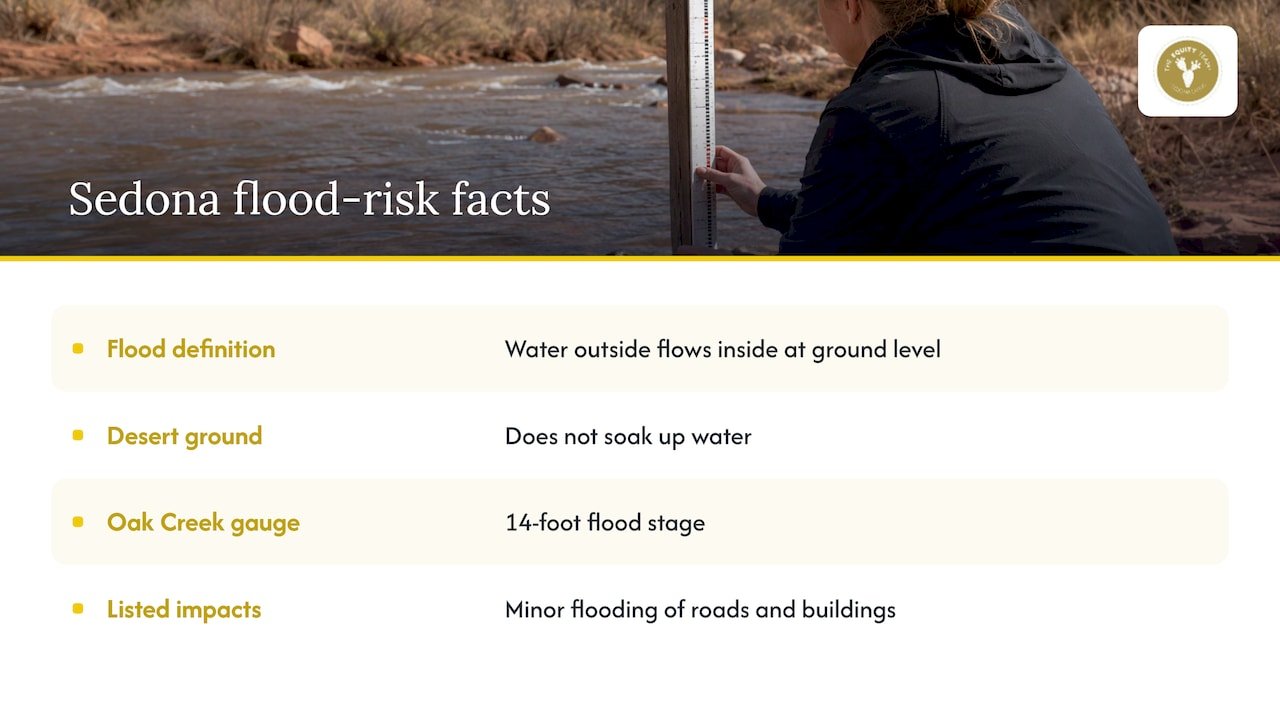
The Arizona Department of Insurance explains that, for insurance purposes, flood means water outside a home that flows inside at ground level. It also points out that Arizona’s hard desert ground does not soak up water, so water pools and flows into homes. That is the monsoon in one paragraph: a storm that looks like a light show from the deck can become runoff in the wash by the driveway.
Sedona adds its own geography. The city straddles the Yavapai-Coconino County line, and Oak Creek and the tributaries draining the canyon terrain bring flash-flood risk to some neighborhoods. The state also notes that a wildfire burning off ground cover can change a property’s flood risk, so owners should periodically reevaluate their coverage. Wildfire and flood are linked cousins here, and we cover the fire side in our guide to wildfire insurance for Arizona rentals.
Oak Creek is also measured. The NOAA gauge at Sedona lists a 14-foot flood stage, and the National Weather Service’s listed impacts at that level include minor flooding of access roads and buildings along the creek. On a calm day the creek reads a couple of feet and nobody thinks about any of this, which is exactly when the policy should be arranged.
Step one: find the flood zone of the exact address
A flood zone is a FEMA map label that describes how likely a spot is to flood. The ones you will meet most in Sedona are Zones AE, AO and X, according to local flood zone data. Here is what they mean in plain terms:
- Zone A and its variants (AE, AO, AH): high-risk areas. FEMA defines Zone A as a 1% annual chance of flooding, which adds up to a 26% chance over a 30-year mortgage.
- Zone X: moderate or minimal risk, with no mandatory purchase requirement, though coverage is encouraged.
FEMA’s National Flood Hazard Layer lets you search an address and print the flood map panel for it, which is a handy page to hold in your file when comparing properties. Do this for every listing on your shortlist. Two homes on the same street can land in different zones, and the label changes how the lender behaves and what the premium looks like.
FEMA’s current pricing method also looks beyond the map label. Under the NFIP methodology, premiums use distance from the flooding source, heavy rainfall, elevation and the cost to rebuild. So a Zone X home is not automatically a no-risk home, and the data backs that up: FEMA says about 40% of NFIP claims come from outside the highest-risk areas.
Our own deeper walk-through of maps, timing and letters of map change lives on our Sedona flood risk page.
When flood insurance is required
FEMA calls the high-risk areas Special Flood Hazard Areas, and they are the zones beginning with A or V. The rule that matters to buyers: under the Flood Disaster Protection Act of 1973, federally regulated, supervised or insured lenders must require flood insurance on a building in one of those areas. The same FEMA brochure notes that some lenders require it even outside those zones, and may collect the payments in escrow.
In practice:
- Financing and the home sits in an A or V zone: expect the lender to require a flood policy before closing, and budget for it in your numbers.
- Financing and the home sits in Zone X: no federal requirement, but your lender may still ask. Ask early.
- Cash purchase: no lender, so no one will make you buy it. The decision is yours, and an STR with guest income to protect is a good reason to decide in favor of coverage.
One handy exception to the waiting period: FEMA says the 30-day wait does not apply when coverage is mandated and purchased as required by a government-backed lender, or when it is tied to a community flood map change.
What NFIP flood insurance covers, and what it leaves out
Most homeowners and renters policies do not cover flood damage. The NFIP’s standard policy offers building coverage up to $250,000 and contents coverage up to $100,000 for homeowners. If you want to see how insurers draw the line between covered and uncovered storm damage in a regular policy, this guide to what homeowners insurance covers walks through the logic, and the same careful reading applies to your flood policy.
The exclusions are the part STR owners should read twice. FloodSmart lists these among the things the policy does not cover:
- Currency and precious metals, and vehicles
- Personal property kept in basements, apart from a short list of items
- Property outside the insured building
- Temporary housing and additional living expenses
- Business-interruption losses
The FEMA flood insurance manual adds specifics that matter at a Sedona rental: decks are limited, basement personal property is restricted to a few appliance types, and hot tubs and spas are excluded except where used as bathroom fixtures. Sedona guests love a hot tub with a red rock view, so it is worth knowing that one is treated differently under this policy.
Sewer backup has a condition too: it is covered only when it directly results from flooding, not when clogged pipes cause it.
The takeaway for investors is about income. The policy repairs the building and the contents. It does not replace the weeks of bookings a flood would wipe out. When we help a buyer run the numbers on an STR, we talk through how that gap fits into the plan alongside the insurance premium.
What flood insurance costs around Sedona
Prices move with each property, so treat published averages as a rough compass, not a quote. FloodSmart says premiums are unique to each property based on location, how it is built, and coverage amounts, and that the rates are the same across the participating NFIP insurers.
Here is what FEMA’s own policy records show, as compiled by a FEMA data tracker with figures through August 31, 2026:
| Measure | Annual cost |
|---|---|
| Median, existing NFIP single-family primary-home policies, nationwide | $1,066 |
| Median, Yavapai County NFIP policies (1,585 insured units) | $1,162 |
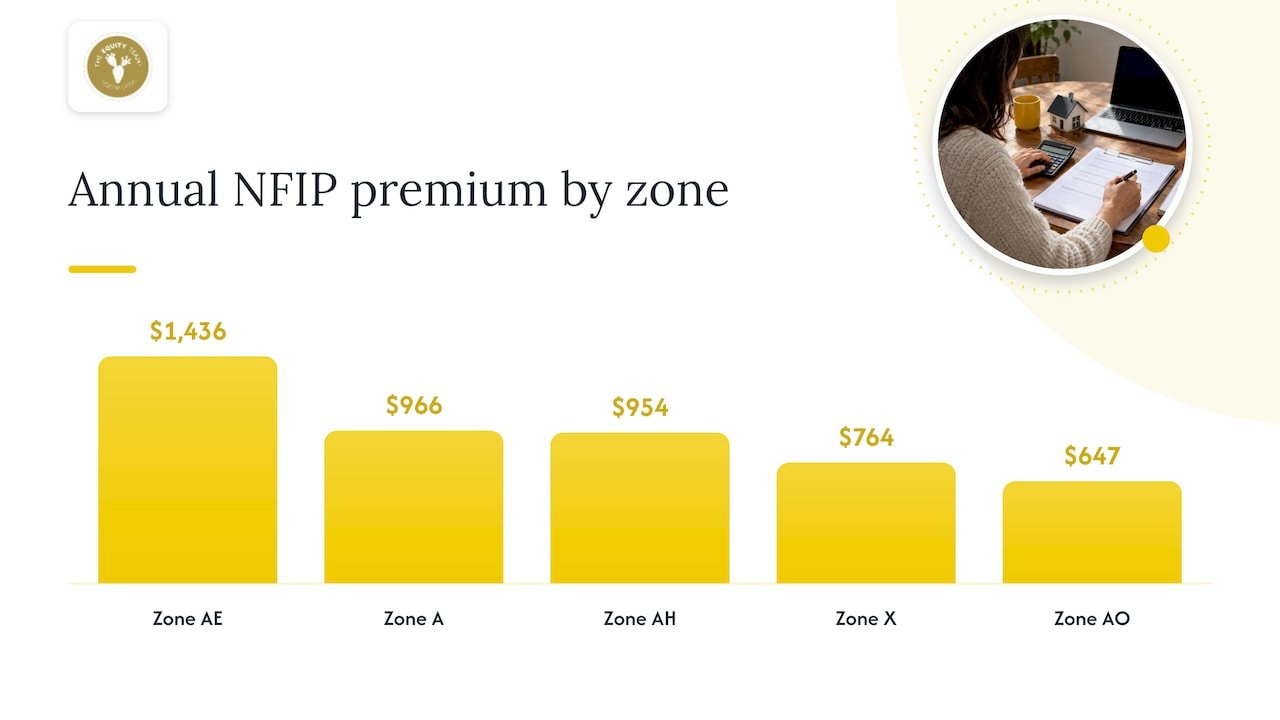
A look at Yavapai County’s NFIP policies written or renewed over a 12-month window, from FEMA’s August 3, 2026 snapshot, shows how much the zone matters:
| Flood zone | Policies | Average annual premium |
|---|---|---|
| AE | 981 | $1,436 |
| A | 82 | $966 |
| AH | 26 | $954 |
| X | 398 | $764 |
| AO | 26 | $647 |
These are published figures for their period and they change as FEMA updates its data. They describe typical policies, not what a particular Sedona rental will cost, since a larger house with higher rebuild cost, different elevation and different coverage amounts will price differently. Get a quote on the specific address. FEMA’s route is to use its NFIP quote tool, then share the result with a local agent or your insurance company to buy the policy.
Private flood policies also exist and are priced by each insurer, so they are not part of FEMA’s records. When you compare a private quote with an NFIP quote, line up the same things: building limit, contents limit, deductible, and whether the policy handles loss of use.
The 30-day clock: timing it with a purchase
FEMA says there is typically a 30-day waiting period, with the policy effective at 12:01 a.m. on the 30th calendar day after application and payment. The NFIP manual also has a flood-in-progress rule: the policy will not pay for a loss from a flood that continues one already underway when the waiting period began.
What this means for a Sedona buyer:
- Start the quote during due diligence. A typical purchase runs on a tight calendar, and you want the quote in hand while you still have time to react. Our Sedona home purchase timeline shows where that fits.
- If your lender requires coverage, the waiting period does not apply, per FEMA’s exception above.
- If you are buying with cash in a moderate-risk zone, start the policy as soon as you are under contract so the clock runs while you inspect.
One more timing note. Congress has been funding the NFIP through short-term extensions, and the real estate industry has been urging a longer reauthorization. Because the authority can lapse and then be renewed, ask the insurance agent handling your policy about the program’s status when your closing date is set.
How this fits into a Sedona STR purchase or sale
For buyers, the flood zone is a line in the same spreadsheet as nightly rate, occupancy and property taxes. A home with a lower premium and a higher zone-X comfort level can beat a prettier one whose insurance eats the margin. Our Sedona vacation rental comparative market analysis page explains how we look at an STR’s performance, and the insurance cost belongs next to it.
For sellers, a buyer’s lender will order the flood determination, so it helps to know your zone and have your premium history ready. A tidy answer to the question “what does flood cover cost here?” keeps a deal moving. If you are thinking about selling, our rental exit strategy conversation is where we map this out, and our five steps to prepare a rental for sale cover the rest of the checklist.
Our view: the insurance question belongs in the offer, not after it
We work on Sedona short-term rental purchases and sales, and our view is simple: flood insurance is part of the property’s real operating cost, so it should be on the table before the offer, not after the inspection.
A Sedona STR is a business that happens to have a view. The monsoon does not care about the booking calendar, and neither does the flood zone label. That is why we like to look at the zone, the likely premium, the lender’s rules and the 30-day clock in the same sitting as the revenue numbers.
When we represent a buyer, we want the flood question answered early enough that it shapes the negotiation. When we represent a seller, we want the same answers ready so the buyer’s team has fewer surprises. Our whole team focuses on Sedona short-term rentals, so these conversations are part of everyday work, not a side topic.
The best Sedona investments are the ones where the numbers hold up on a quiet day and a stormy one.
Chad
Working with us
If you are weighing a Sedona rental purchase, we represent buyers who want a top-performing short-term rental, and we bring the local market data and STR focus to the table. Start with our buyer and seller representation page and tell us what you are looking for.

If you are selling, we offer a Sedona vacation rental CMA, a comparative market analysis, along with a seller prep consultation, so you know what the property can earn on the market before you list.
FAQ
Does homeowners insurance cover flood damage in Sedona?
Most homeowners and renters policies do not cover flood damage, according to FloodSmart. Flood is typically a separate policy, either from the NFIP or from a private insurer. Ask your insurance agent to walk through your current policy before you buy a property.
Do I need flood insurance if my Sedona rental is in Zone X?
There is no federal mandatory purchase requirement in Zone X, but FEMA still encourages coverage outside high-risk areas, and some lenders require it anyway. With about 40% of NFIP claims coming from outside the highest-risk zones, many owners of income properties choose to carry it.
How long until a flood policy starts?
Typically 30 days. The policy takes effect at 12:01 a.m. on the 30th calendar day after application and payment. The wait does not apply when a government-backed lender requires the coverage at purchase, or when the purchase relates to a community flood map change, per FEMA.
Does flood insurance cover lost rental income?
No. The NFIP excludes business-interruption losses, as well as temporary housing and additional living expenses, per FloodSmart. The policy repairs the building and contents up to its limits, so rental owners should plan separately for lost bookings.
Sources
- Flood Insurance Information, Arizona Department of Insurance
- Know Your Flood Risk: Homeowners, Renters or Business Owners, FEMA
- National Flood Hazard Layer, FEMA
- Flood Insurance, FEMA
- Answers to Questions About the NFIP, FEMA
- Buy a Flood Insurance Policy, FloodSmart
- NFIP Flood Insurance Manual, October 2025
- NFIP Flood Insurance Manual (rate and policy forms)
- Sedona, AZ Flood Zone Map
- Oak Creek at Sedona river level
- Flood insurance cost by state and county (FEMA data)
- FAQ: National Flood Insurance Program expiration, NAR
- Does Insurance Cover Tree Removal