

Sedona’s average daily rate (ADR) slipped while the town kept filling up. One market data platform reported a $337 ADR for the 12 months through October 2026, down 4.6% from a year earlier. Over the same stretch, occupancy rose 8.2% to 58% and average annual revenue rose 40.5% to $63.4K. So the red rocks are not getting cheaper to stay near. More nights are simply being booked at slightly softer prices, and that changes how a smart buyer or seller reads a listing.
This guide explains what ADR measures, how it moves through the Sedona year, why every source quotes a different number, and what to check before a nightly rate goes into a purchase or a listing price.
TL;DR
- Sedona’s trailing-12-month ADR was $337 through October 2026, down 4.6% year over year, while occupancy climbed to 58%.
- ADR swings with the seasons: spring and October lead, summer (the desert’s sweaty siesta) trails.
- Sources disagree on the number because they define the market area and the property mix differently.
- ADR alone never tells the story. Pair it with occupancy, RevPAR, and the property’s own booking history.
- Local comps and a property-specific valuation beat any market-wide average.
Table of Contents
- What ADR actually means (and what it leaves out)
- The headline: a softer rate, a fuller calendar
- Why every source quotes a different ADR
- Sedona’s ADR calendar, month by month
- From ADR to income: a worked example
- Five checks before trusting an ADR
- Our take on Sedona ADR
- Put the numbers to work on a specific home
- FAQ
- Sources
What ADR actually means (and what it leaves out)
ADR is the average revenue earned per booked night. Per the analytics provider’s help center, it covers the past 12 months and is total revenue divided by total booked nights. It includes the host’s cleaning fee but not the platform’s service fees. Their example: 5 nights at $250 plus a $200 cleaning fee gives a $290 ADR.
Two things follow from that definition:
- Unbooked nights do not count. A home with a gorgeous $600 rate that books 90 nights a year can have a lovely ADR and a sleepy bank account.
- Cleaning fees nudge the number up. Two homes with the same sticker rate can show different ADRs if their fees differ.
The same help center warns that ADR should not be managed in isolation. Its example is a rental whose ADR rose month over month while occupancy dropped, leaving total revenue lower. The companion metric is RevPAR, revenue per available night, which is occupancy multiplied by ADR. In Sedona’s October 2026 data it was $194 across the trailing 12 months, up 2.9% year over year, per the same market page.
The headline: a softer rate, a fuller calendar
Here is the 2026 picture from that October 2026 data, which covers 3,985 active listings:
| Metric (12 months through October 2026) | Value | Change vs. prior year |
|---|---|---|
| ADR | $337 | down 4.6% |
| Occupancy | 58% | up 8.2% |
| Average annual revenue | $63.4K | up 40.5% |
| RevPAR | $194 | up 2.9% |
The lesson is the oddball one: ADR fell, yet revenue rose sharply. The market data refreshes monthly, so the trailing-12-month figure will keep moving. Treat these as the published numbers for that period, not a permanent yardstick.
Longer history helps. Another market page reports that Sedona-area occupancy has eased from a 2021 high of 70.5% while ADR climbed from $264 in 2021, so growth in recent years has been rate-driven more than occupancy-driven. The 2026 data suggests the pendulum is swinging toward volume. For more on that pattern, the Sedona STR occupancy data analysis digs in.
Why every source quotes a different ADR
Search “Sedona ADR” and the answers range from the low $300s to the mid $400s. Nobody is fibbing. The differences come from three places.
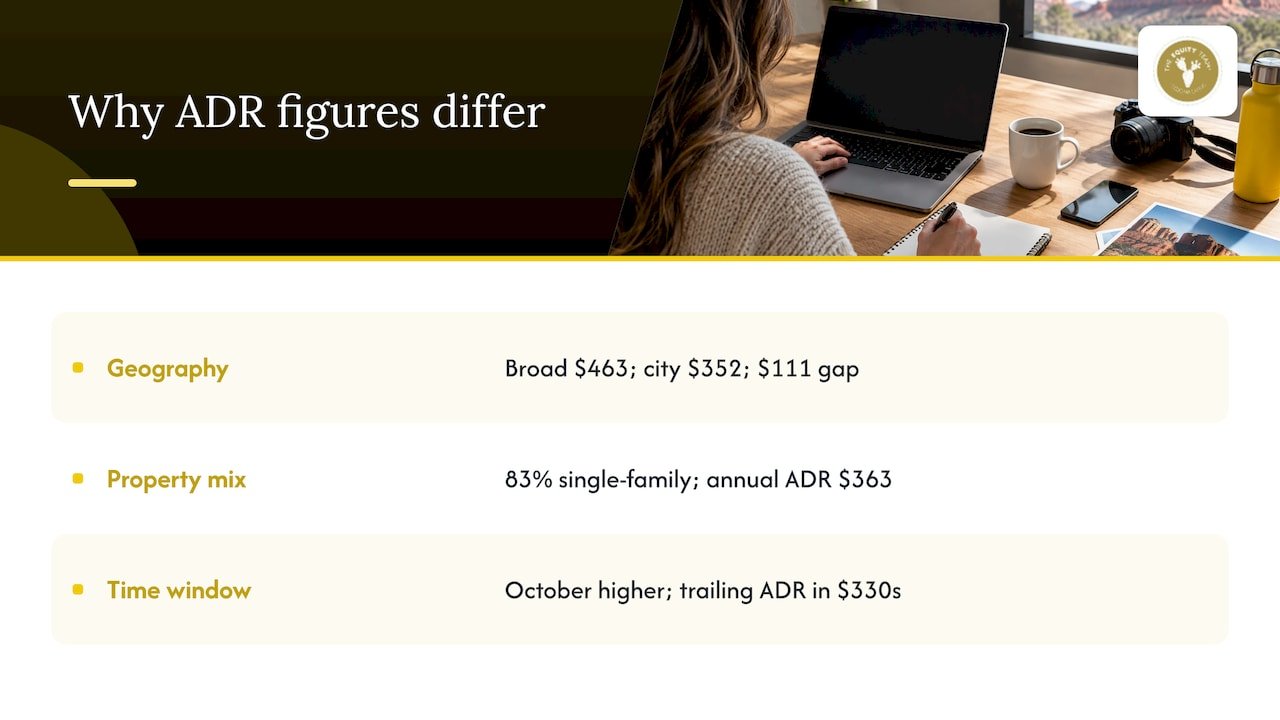
Geography. One dataset covering the broader Sedona area reports a $463 ADR for the 12 months through October 2026. A separate cut limited to the city boundary shows $352 for the same period. Same town, same year, $111 apart. Boundaries, the Village of Oak Creek, and the luxury-heavy outskirts all pull the average.
Property mix. The city’s own annual report, published in April 2026, found that 83% of licensed STRs are entire single-family homes, typically three bedrooms. Its ADR averaged $363 across the year. Larger homes charge more per night, so a dataset heavy in big homes reads higher.
Time window. A single month and a trailing 12-month average are different animals. October 2026 alone ran well above the annual figure in one revenue-management write-up, while the trailing figure stayed in the $330s.
The practical takeaway: when someone hands over an ADR, ask which boundary, which month range, and which property size it describes. Then compare apples to apples.
Sedona’s ADR calendar, month by month
Sedona has two peaks, not one. The city’s annual report notes clear tourist seasons of March to May and October to December. It also reports ADR ranging from $240 a night in low season to $459 in high season, with occupancy from 36% to 71%.
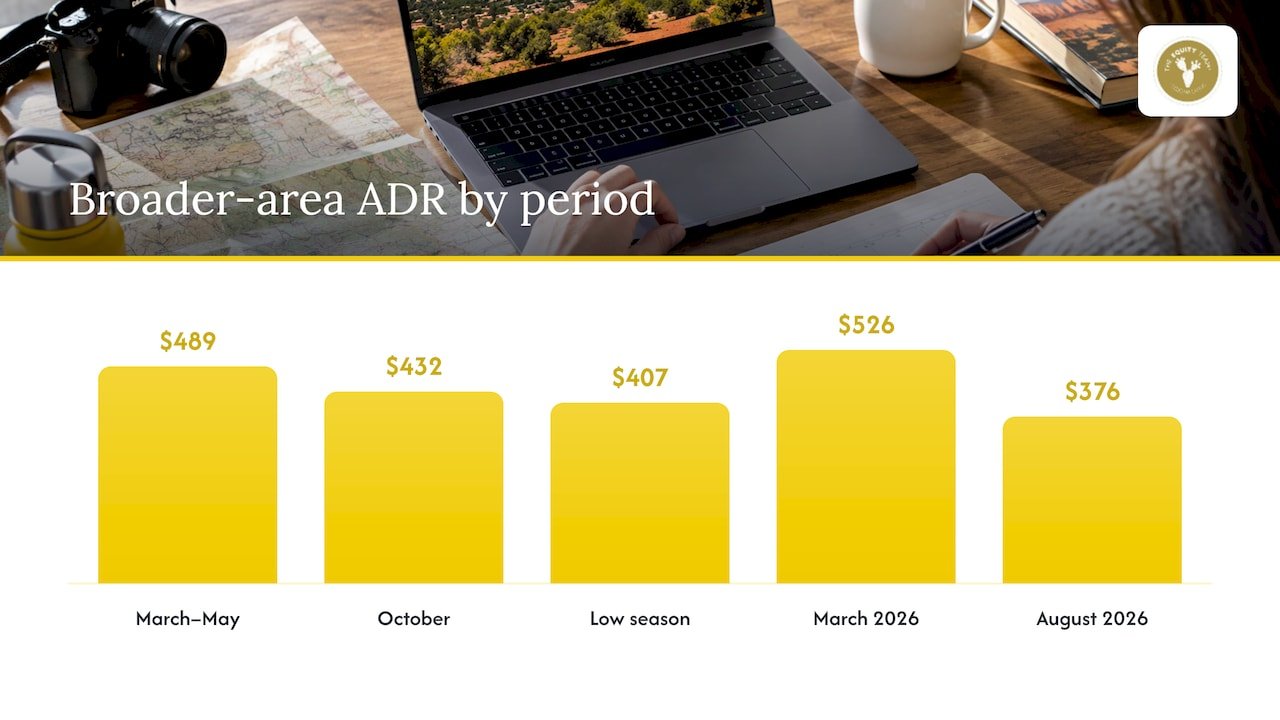
The 12-month data through October 2026 from the broader Sedona area shows the same rhythm:
| Period | ADR | Occupancy |
|---|---|---|
| March to May | $489 | 65% |
| October | $432 | 61% |
| Shoulder months | n/a in summary | 53% |
| Low season (January, June to September) | $407 | 43% |
The strongest single month was March 2026 at a $526 nightly rate and 70.8% occupancy, and the weakest was August 2026 at $376 and 38.7%, according to the same dataset. Restricted to city limits, the seasonal ADRs are lower ($373 in spring, $314 in low season) but the shape is identical.
Another analysis found the December holiday ADR hit $506, and that October carried the year’s highest per-night rate in that dataset at $471. The same page notes a 56-day average booking lead time, which gives owners runway to adjust rates, and a 4.3-night average stay.
What this means for rate strategy: the calendar runs backward from a typical desert vacation market. Heat does not drive demand here. Cooler weather does. Owners who discount October or hold summer at spring prices are fighting the pattern. A month-by-month walk-through lives in our Sedona rental seasonality guide, and the revenue management playbook covers how to price around it.
From ADR to income: a worked example
ADR becomes real only after it meets occupancy and costs. One February 2026 analysis modeled a typical Sedona home at $888,808 with $83,895 in trailing-12-month revenue. That is built from a $440 ADR and 49% occupancy, and it works out to a 9.4% gross yield. After a 25% operating-expense deduction, net operating income came to roughly $62,900.
A few things to notice:
- The same math with a $337 ADR and 58% occupancy gives a very different revenue figure. Pick the dataset first, then do the math.
- The 25% expense assumption is a model, not a promise. Cleaning, management, utilities, supplies, and local taxes all vary by home. Sedona STRs pay 3.5% sales tax and 3.5% bed tax, per the city report.
- Gross yield is not cash flow. Financing terms change the picture, and a guide to rental gross yield and operating expenses shows how the pieces fit together.
To see how the client’s team frames the same numbers on real properties, the Sedona Airbnb valuation guide is the companion read.
Five checks before trusting an ADR
Market averages are a compass, not a map. Buyers and sellers get the most from ADR when they run these five checks.
1. Match the boundary
City limits, the Village of Oak Creek, West Sedona, and the outer red-rock neighborhoods all price differently. One dataset found a +38% location premium for listings near the Red Rocks, in a market where a typical STR earned about $80K a year. Location is baked into ADR.
2. Match the size and the tier
The median city-limit property charges about $270 a night while the top 10% charge $620 or more, per the city-limit data. A property aiming for the top tier needs top-tier features and photos, not an average-market assumption.
3. Check ADR next to occupancy
A rising ADR with falling occupancy can mean lost money. A softer ADR with rising occupancy, as 2026 shows, can mean a healthier calendar. Always read both together, then read RevPAR.
4. Ask for the booking history
Sellers’ projections and market averages are not the same thing as a specific home’s actual calendar and payout reports. Seasonal rate settings, minimum-stay rules, and cleaning fees all shape a property’s own ADR.
5. Confirm the rules
Sedona’s STR count doubled from about 625 licensed units in 2019 to 1,266 in 2025, per the city’s annual report. Permit status, local regulations, and tax registration should be confirmed for any property before an ADR is treated as transferable income. Buyers should have this verified during due diligence, and a licensed attorney or the city’s own offices are the right place to confirm the legal side.
Our take on Sedona ADR
We love an ADR chart as much as the next red-rock nerd, but we never let one number run the show. In Sedona, the nightly rate is a story about a specific street, a specific view, and a specific calendar.
The 2026 data tells a clear tale: rates came down a touch and bookings came up. That favors owners who price by season, who understand that October is a main event, and who treat the quiet summer weeks as a chance to fill gaps instead of a reason to panic.
For buyers, we use ADR as the opening move, then test it against the property: location, amenities, permit status, and how comparable homes actually booked. For sellers, we build the case around what the home truly earns and what comparable homes have actually sold for, so the price reflects the rental performance buyers are paying for.
That is why we specialize in short-term rentals in Sedona. A general market average cannot see the casita, the hot tub, or the sunrise. A local, rental-focused comparison can.
Chad
Put the numbers to work on a specific home
Market-wide ADR gets a conversation started. A property-level view finishes it. Owners thinking of selling can request a Sedona vacation rental CMA, a comparative market analysis built around how short-term rentals perform here, along with a seller prep consultation. Owners weighing an exit can book a rental exit strategy and valuation conversation. Buyers hunting for a top-performing STR can start with buyer representation from the Equity Team.

The Equity Team is a Sedona real estate team specialized in short-term rental investment, representing clients who operate STRs in the top 10% of the rental market.
FAQ
What is a good ADR for a Sedona short-term rental?
It depends on the boundary, size, and season. Published market averages for the 12 months through October 2026 ranged from $337 to $463 depending on the dataset, while city-limit properties in the top 10% charged $620 or more. A good ADR is one that holds up alongside strong occupancy for a comparable home.
Is Sedona ADR going up or down?
The October 2026 market page showed ADR down 4.6% year over year at $337, while occupancy rose 8.2%. Other datasets showed ADR up for their own windows, which shows how much the definition matters. Figures refresh monthly, so check the live pages before making a decision.
Which months have the highest ADR in Sedona?
Spring, October, and the December holidays lead. March 2026 posted a $526 rate in the broader Sedona dataset, and one analysis found the December holiday ADR reached $506. August is typically the softest month.
Should a buyer rely on ADR to value a Sedona STR?
ADR is one input. Buyers should pair it with occupancy, RevPAR, operating costs, permit status, and the property’s own booking history. A rental-focused comparative market analysis helps tie those pieces to a specific home.
Sources
- Sedona, Arizona short-term rental data, October 2026
- How average daily rate (ADR) is calculated
- Sedona, AZ Airbnb data, 12 months through October 2026
- Sedona City Limit, AZ Airbnb data, 12 months through October 2026
- Sedona, AZ market data, September 2026
- Sedona short-term rental market analysis, 2026
- Sedona annual report, published 2026
- Sedona Airbnb data: revenue, occupancy and ROI
- Rental market guide for landlords: yield and operating expenses