

Sedona short-term rental guests book about 58 days before check-in on average, according to AirROI’s Sedona data for the 12 months to October 2026. That average is a bit like Sedona’s famous vortex energy: everyone has a number, and nobody agrees on it. October guests plan about 75 days out, January guests barely 44, and a fast-growing slice of travelers wait until the last week. For owners and buyers, the useful question is not “what is the average?” but “what does my calendar look like against the month I care about?”
TL;DR
- Sedona’s average booking lead time was about 58 days in the 12 months to October 2026, per AirROI. Other trackers report lower or higher figures because they count different platforms and properties.
- Lead time swings by month: October stays were booked about 75 days ahead, January stays about 44.
- Shorter windows are spreading. Greater Sedona’s average window fell to 44 days in one year in StaySTRA’s reading of Key Data research, and last-minute bookings are taking a bigger share.
- An empty date is only a problem if it is inside its normal booking window. Judge the calendar against the month’s own lead time, not a single average.
- For buyers, lead time belongs in the underwriting. For sellers, a booking calendar that fills on schedule is a selling point.
Table of Contents
- What booking lead time means for a Sedona rental
- The numbers: how far ahead Sedona guests book
- Month by month: when Sedona guests plan ahead
- The window is getting shorter
- Reading your own calendar against lead time
- Turnovers: the part guests never see
- What lead time means for buyers and sellers
- How we look at it
- Getting a read on your own Sedona rental
- FAQ
- Sources
What booking lead time means for a Sedona rental
Booking lead time is the number of days between the day a guest reserves and the day they check in. AirROI’s glossary gives it as check-in date minus reservation date, counted in calendar days. It describes the guest’s planning habit, not the host’s.
Why do owners care? Because it tells them whether an open date is an emergency or just a date that has not reached its booking window yet. A Sedona weekend three weeks away that is still open in January may be perfectly normal. The same hole in October is a different story.
The measure is also a moving target. AirDNA notes that lead time shifts with the season, the property type and who the guests are. Resort-area homes book months out, while urban business apartments book late. Sedona is firmly a leisure destination, but even inside Sedona a two-bedroom casita and a six-bedroom red rock estate do not behave alike.
The numbers: how far ahead Sedona guests book
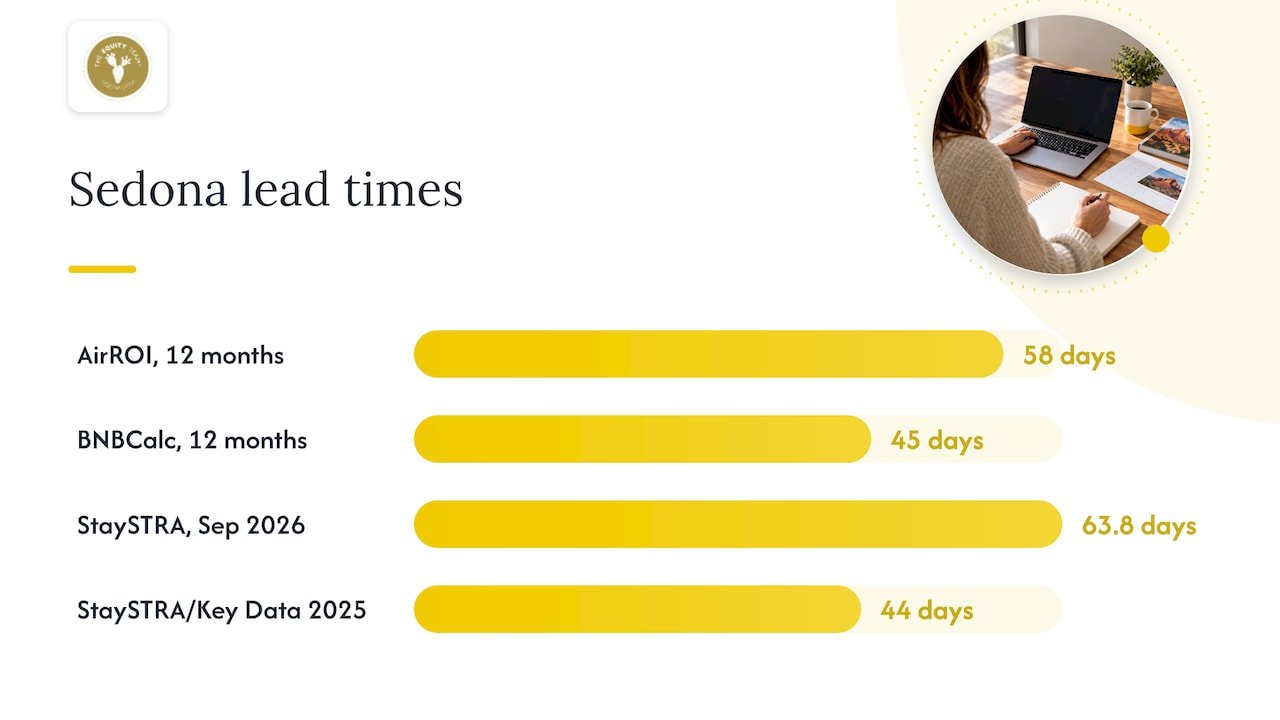
No single figure wins, so here are the main readings side by side. Each tracker uses its own sample and period, which is why they differ.
| Source | Period | Sedona average lead time |
|---|---|---|
| AirROI | 12 months to October 2026 | 58 days (Airbnb stays) |
| BNBCalc | 12 months to October 2026 | 45 days (Airbnb, Vrbo and Booking.com listings) |
| StaySTRA | September 2026 | 63.8 days |
| StaySTRA, citing Key Data | 2025 | 44 days for Greater Sedona, down 21% in a year |
The spread, from the mid-40s to the low 60s, is the real finding. Platform mix, the month measured and whether the sample is stays or reservations all move the result. A sensible reading is that Sedona guests plan roughly six to eight weeks out, with a long tail of last-minute bookers on one side and planners on the other.
BNBCalc also breaks its figures out by size. Its Sedona page reports windows running from 36 days for one-bedroom listings to 59 days for homes with four or more bedrooms. That fits common sense: a group of eight coordinating schedules books earlier than a couple who decided on Thursday that they want a hot tub and a canyon view.
These are published figures for their periods. They will change when the trackers update, so check the live pages before leaning on any of them.
Month by month: when Sedona guests plan ahead
The annual average hides the drama. AirROI’s Sedona tourism statistics list lead time by month of stay for the 12 months to October 2026:
| Month of stay | Lead time (days) |
|---|---|
| October | 75 |
| November | 70 |
| April | 67 |
| September | 65 |
| March | 61 |
| May | 59 |
| February | 56 |
| December | 53 |
| June | 50 |
| July | 50 |
| August | 46 |
| January | 44 |
Three patterns jump out.
Fall is the planner’s season. October and November lead the table. Leaf color, cooler hiking weather and a calendar full of events push travelers to lock in early. Guests aiming for an October weekend are typically reserving in July and August.
Spring is nearly as early. March and April sit in the 60s. Wildflowers, spring break and perfect hiking temperatures make a strong second peak. Our own month-by-month seasonality guide walks through how that rhythm plays out for owners, and the peak season investor guide covers the high-demand stretches in more detail.
Summer and January are the late bookers. Summer heat and winter chill both make Sedona a more spontaneous choice. Guests see a forecast, pick a weekend and go.
Day of the week matters too. BNBCalc’s Sedona data reports that booking demand is highest on Saturday and lowest on Tuesday, with weekend occupancy 55% higher than weekday occupancy (October 2026 reading). So the open dates that deserve attention are usually midweek ones, while the weekends tend to fill first.
The window is getting shorter
The slow shift across the whole country is toward later decisions. StaySTRA reported that the average US short-term rental booking window in 2025 was 60 days, down 11.4% from the year before, and that Greater Sedona’s window shrank by 21% to 44 days. Hotel Online’s analysis found that 41.7% of bookings for top-performing US vacation rental hosts in 2025 came within seven days of check-in, up from 35.8% in 2024.
There is a twist. The same analysis notes that US cancellation volume was down 52% in the first 16 weeks of 2026 compared with 2024. Travelers are deciding later, but once they commit, they stay committed.
What does that mean in plain Sedona terms?
- A calendar that looks thin eight weeks out is less alarming than it used to be.
- Last-minute demand is real money. StaySTRA’s summary of pricing benchmarks says last-minute bookings typically come at a 10% to 25% discount against early ones, so the late bookers fill nights but at a different rate.
- StaySTRA’s Nedra Ellison makes the case that the top earners in compressed markets focus on capturing nights rather than holding out for the highest rate, because a discounted booked night beats an empty one.
Reading your own calendar against lead time
Lead time only becomes useful when it is paired with pacing, meaning how many nights are booked now compared with the same point last year. AirROI’s glossary gives a clear example: being 15% behind pace at 60 days out is a real concern in a market with a 55-day lead time, yet the same gap in a 35-day market just means most bookings have not arrived. Year-over-year changes in the lead-time curve are also early signals that demand is softening or strengthening.
BNBCalc’s glossary puts the owner’s test simply: if guests book about 40 days ahead, an open week two months out is not a warning sign, while an open week next Tuesday probably is.
A practical routine for an owner or a buyer reviewing a listing’s books:
- Pick the month. Use the month’s own lead time from the table above, not the annual average.
- Count back from check-in. If the date is still far outside its window, leave the rate alone.
- Compare with last year’s pace. Same date, same number of days out. Is the gap real?
- Separate weekends from weekdays. Weekends fill first, so a quiet weekend deserves more attention than a quiet Tuesday.
- Adjust in steps. KeyData’s Q3 2026 index warns that reacting too aggressively to slower pacing by discounting early sacrifices revenue unnecessarily. Rely on pickup and competitive benchmarking rather than occupancy alone.
On the pricing side, our guide to Sedona STR pricing during active bookings goes deeper, and the occupancy data analysis shows how booked nights translate into results.
Turnovers: the part guests never see
Shorter windows mean more same-week reservations, and same-week reservations mean tighter gaps between checkout and the next check-in. A home that gets booked on a Wednesday for a Friday arrival needs a clean turn on short notice. Owners who plan the routine in advance, with a clear process for scheduling rental cleanings, keep those late bookings from turning into stressful scrambles. It is the unglamorous side of lead time, and it protects reviews.

What lead time means for buyers and sellers
For buyers. Lead time is a quiet underwriting input. A property that books early in its high-value fall months has revenue that is visible months ahead. Larger homes tend to book earlier, so the size of the property changes the cash flow pattern as well as the income. BNBCalc’s October 2026 data shows Sedona averaging about 4,340 active listings, with average listing revenue of $70,000 a year, high performers at $167,000 and low performers at $25,000. Part of the gap between those groups is exactly this: how well a calendar is priced and filled across the booking window. Our Sedona Airbnb market trends guide and tourism trends overview help put those numbers in context.
For sellers. A buyer of a vacation rental wants to see a calendar that fills on schedule and a pricing history that makes sense for each season. Understanding why a calendar looked soft in January but strong in October lets a seller tell that story honestly and with numbers. That is also why a vacation rental sale benefits from an analysis built on short-term rental performance rather than on nearby home sales alone.
How we look at it
We spend a lot of time with owners who stare at an open Tuesday in March and wonder if the sky is falling. Most of the time it is not. It is a date that has not hit its booking window yet.
Our view is simple: lead time is a tool for reading a Sedona rental, whether the owner is buying one, running one or getting ready to sell one. We are the short-term rental specialists on the Sedona real estate side, and we represent clients operating in the top 10% of the rental market. That is why we look at a calendar by month, by bedroom count and by pace, not as one flat average.
When we help a seller, the booking history is part of the story of the home. When we help a buyer, it is part of the math. Either way, the number that matters is the one for the month in question.
Chad
Getting a read on your own Sedona rental
Owners who are weighing a sale and buyers who are weighing an offer both need the lead-time picture for the specific property. Equity Team offers a Sedona vacation rental CMA, a comparative market analysis built for short-term rental homes, along with a seller prep consultation. Owners who are still deciding can start with a rental exit strategy and valuation conversation. Buyers looking for a top performer can start at owninaz.com.
As Sedona’s STR-specialized real estate team, we focus on high-performing homes, so the booking calendar is something we read every day.
FAQ
How far in advance should guests book Sedona lodging?
For fall and spring, planning about two to three months ahead matches what the data shows: AirROI’s figures put October stays at about 75 days and April at about 67. January and summer stays book closer to arrival, at about 44 to 50 days. Event weekends and holidays often book earlier still.
What is the average booking lead time for a Sedona Airbnb?
AirROI reports about 58 days for the 12 months to October 2026. BNBCalc reports 45 days over the same period, and StaySTRA reported 63.8 days for September 2026. The gap comes from different platforms and samples, so treat the range as the answer.
Is Sedona’s booking window getting shorter?
The national trend says yes. StaySTRA reported the average US window fell 11.4% in 2025, and Greater Sedona’s fell 21% to 44 days. Last-minute bookings are taking a larger share, though cancellations have fallen sharply.
Should an owner discount when the calendar is empty?
Only after checking the date against its normal window. An open date inside the window, compared with last year’s pace, may call for a rate change. A date far outside the window usually does not, and aggressive early discounting can give away revenue.
Sources
- Sedona, AZ Airbnb Data 2026: Revenue & Occupancy, AirROI
- Sedona Tourism Statistics, AirROI
- What Is Booking Lead Time in Short-Term Rentals, AirROI
- Airbnb Booking Lead Time, AirDNA
- Sedona market data, BNBCalc
- STR Booking Window Compression 2026, StaySTRA
- Is Sedona, AZ a Good Airbnb Market, StaySTRA
- The Booking Window Is Collapsing, Hotel Online
- How to Schedule Rental Cleanings: Property Manager Guide