
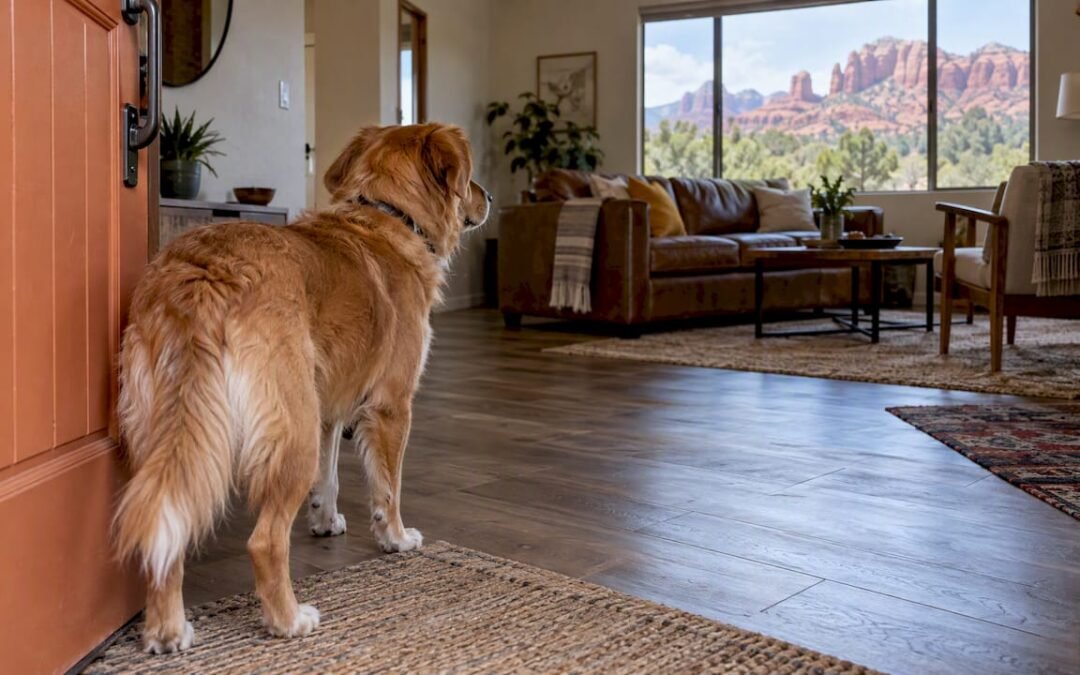
An Airbnb pet policy is a small set of choices with a surprisingly big payoff: whether pets are welcome, how many, what the fee is, and what happens when a guest shows up with a dog nobody mentioned. Hosts who get those choices right collect a fee that covers the extra cleaning, keep a clear path to reimbursement when something goes sideways, and tap into a pool of guests who book with a four-legged co-pilot. Hosts who wing it end up in the message thread arguing about fur.
This guide covers the whole loop: what Airbnb lets hosts set, how pet fees work, what to do about surprise pets, why service animals are a different story, and what pet-friendly rentals actually return in occupancy.
TL;DR
- Airbnb hosts state their pet policy in the house rules and can set the number of pets allowed, from one to five, plus any restrictions.
- Pet fees are set in the listing’s fee settings and can be flat, per night, per pet, or per pet per night, but they cannot exceed the nightly base rate.
- Service animals are not pets: no refusal, no extra fee. Emotional support animals follow the rules that apply to them.
- For an undisclosed pet or pet damage, document everything with photos and go through the Resolution Center.
- AirDNA research puts the average occupancy bump for pet-friendly rentals at 2 to 3%, and about 4% for detached single-family homes.
Table of Contents
- What Airbnb’s pet policy actually lets a host do
- Pet fees: how they work and what they cost
- The “returns” question: refunds, reimbursements and who pays
- What pet-friendly rentals actually return
- Writing the policy: what to put in it
- The turnover loop: keeping pet stays profitable
- Our perspective
- Thinking of buying or selling a Sedona rental?
- FAQ
- Sources
What Airbnb’s pet policy actually lets a host do
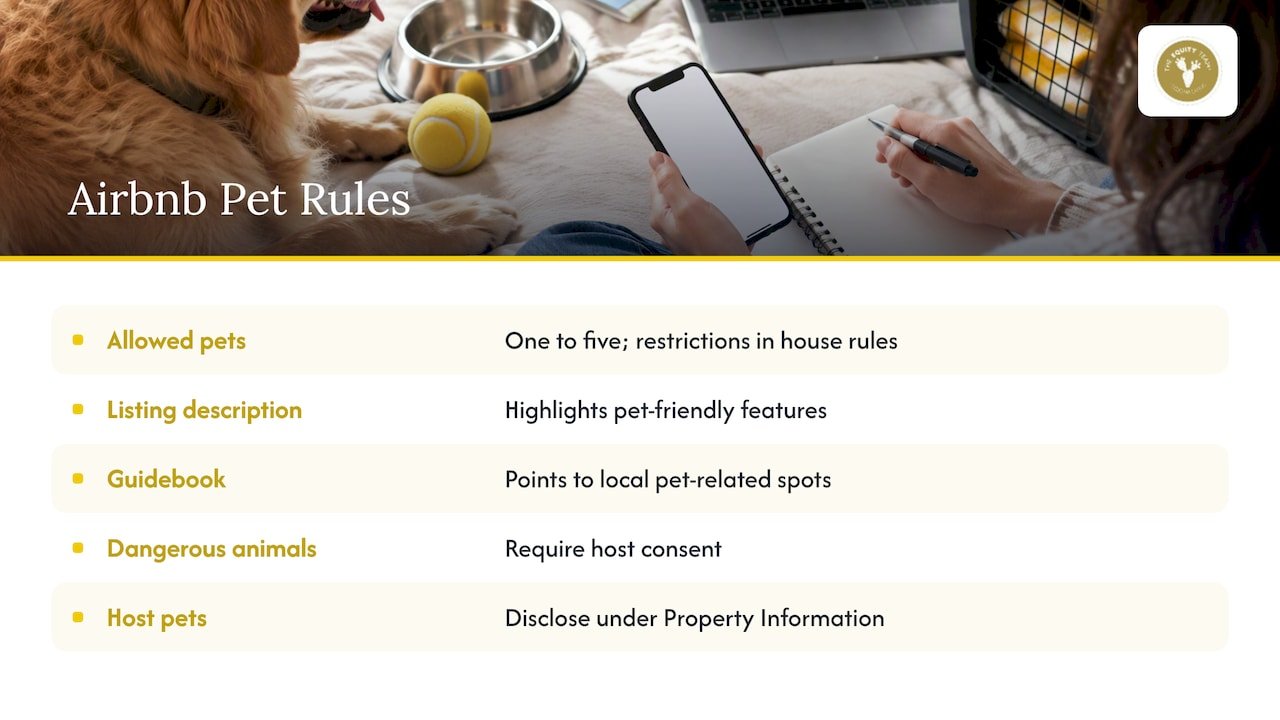
Airbnb keeps the pet rules refreshingly simple. Per Airbnb’s own hosting guidance, a host states the pet policy in the house rules, including how many pets are allowed (one to five) and any restrictions. The listing description can brag about pet-friendly features, and the guidebook can point guests toward local pet-related spots.
That is the whole toolbox: a setting, some house-rule text and a fee. No elaborate pet-profile forms, no weight-class dropdowns. A rental-management guide on writing pet policies notes that Airbnb’s pet settings are limited to a checkbox and house rules text, so the house rules do the heavy lifting. Treat them like a tiny contract, because a guest who agrees to a clear rule has a hard time later claiming surprise.
Two more details are easy to miss. Guests need host consent before bringing a dangerous animal, and hosts who live with their own pets must disclose that under Property Information so guests with allergies can plan accordingly.
Pet fees: how they work and what they cost
Yes, Airbnbs charge pet fees, and the setup is tidy. Hosts add the fee in the Fees section of the listing settings, and it shows up in the guest’s total price at checkout. The fee can be a flat rate per booking, per night, per pet, or per pet per night, provided it does not exceed the nightly base rate.
Airbnb frames the purpose plainly: a pet fee is meant to cover expected cleaning costs, such as removing fur and wiping nose and paw prints. That framing matters, because it tells hosts how to price it. The fee is a cleaning offset, not a toll booth.
What the going rate looks like
AirDNA’s host guide reports that pet charges usually run $10 to $50 per night, or a flat rate per stay. A flat fee tends to suit short stays. A nightly fee feels fairer on longer ones, since a two-week dog visit leaves more fur than a long weekend.
Disclose it before the booking, not after
Airbnb requires all mandatory fees, pet fees included, to be disclosed before booking, in the fee field or baked into the nightly price, with payments staying on Airbnb. This is the reason a “surprise pet fee” collected by message or cash app is a bad idea: it breaks the platform’s rules and invites a dispute nobody wins.
Pricing note: any added fee changes how a listing looks in search. Airbnb’s pricing guidance says extra fees may influence booking decisions and overall earnings, so the goal is a fee that covers the work without making the total look like a hotel in disguise. Sedona hosts who want to see how the whole fee stack fits together can read this guide to pricing cleaning fees to win bookings, and the Sedona cleaning cost benchmarks help set a pet fee against a realistic turnover bill.
The “returns” question: refunds, reimbursements and who pays
Searches around Airbnb pet policy and returns usually mean one of two things: money coming back to a guest, or money coming back to a host. Both deserve a clear answer.
When a guest brings an undisclosed pet
This is the classic scenario. A host allows pets, asks for disclosure and charges a fee, and a guest arrives with a dog that was never mentioned. Airbnb does not hand a clean playbook for the fee itself in the sources used here, so the sensible host approach is built around what is documented:
- Photograph the evidence. Hair, scratches, odor, a chewed baseboard, whatever is there. Timestamped photos win disagreements.
- Point to the house rules. The policy the guest agreed to is the anchor of the conversation.
- Request reimbursement through the Resolution Center. Airbnb says its Host Damage Protection covers unexpected pet damage, and that hosts should document damage and request reimbursement through the Resolution Center.
Keep the tone friendly in the thread. Guests are surprisingly reasonable when the message says “here is the rule you agreed to” rather than “how dare you.”
When a guest wants to cancel over pets
The community threads that rank for this keyword are full of the opposite problem: a host who does not allow pets, a guest who asks anyway, and a non-refundable booking in the middle. The cleanest defense is prevention. A “no pets” rule stated in the house rules, the listing description and a pre-arrival message leaves very little room for argument. A host who is unsure how a particular cancellation or refund will be handled should contact Airbnb support rather than improvising.
When a service animal is involved, the fee goes away
This is where hosts most often get into trouble. Airbnb’s policy states that service animals are not pets, and hosts may not refuse a reservation or charge additional fees for them, subject to exemptions Airbnb has granted. Service animals stay free; if one damages the property, hosts can request payment under AirCover through the Resolution Center.
Emotional support animals sit in a nearby lane. Airbnb says they must be accommodated where applicable law or its policy requires, and otherwise standard pet rules and fees may apply. The same policy page limits hosts to two verification questions for a service animal or ESA:
- Do you require your animal because of a disability?
- What work or task has the animal been trained to perform?
Nothing else. No certificate demands, no vest inspections. A host who charges a pet fee on a service animal booking has made an error, and the practical fix is to remove it and, if it was collected, return it.
What pet-friendly rentals actually return
Now the other meaning of returns: revenue. AirDNA’s research reports that pet-friendly vacation rentals average a 2 to 3% increase in occupancy. The lift is uneven by property type: detached single-family homes see about 4%, while apartments and condos see none.
The same research says nightly rates do not generally rise nationally because of pets, though some urban markets see about a 6% increase. In plain terms, the win is mostly more booked nights from guests who would otherwise skip the listing, and a fee that offsets the cleaning.
| Property type | Occupancy effect from allowing pets (AirDNA) |
|---|---|
| All pet-friendly rentals, average | 2 to 3% increase |
| Detached single-family homes | About 4% increase |
| Apartments and condos | No increase |
That table is why the answer depends on the house. A detached Sedona home with a yard, trails nearby and a patio with red rock views is the sort of property where pet-friendly marketing fits naturally. A shared-wall condo is a different calculation. For Arizona context on how occupancy behaves across the state, the Arizona Airbnb occupancy breakdown is a good companion read.
Writing the policy: what to put in it
Airbnb’s guidance for a solid pet policy covers a short list. State how many and what types of pets are allowed, whether they may be left unattended, where they are not allowed, leash rules and how to dispose of pet waste. That is the skeleton. Flesh it out with the specifics a canyon-country rental needs.
A starter template
Hosts can adapt wording like this, with their own numbers and rules:
- Up to two dogs are welcome with advance notice in the booking message.
- Pets must not be left unattended in the home.
- Pets stay off beds and furniture.
- Pets are not allowed in the hot tub area or bedrooms. (Pick your own off-limits zones.)
- Waste bags are provided; please bag and bin all waste.
- Dogs must be leashed outdoors.
More ready-to-paste wording lives in these Airbnb house rules examples, which pair rules with hazard checklists.
Set the room up for the visitor
The house should win a pet stay before the pet arrives. A few small touches go a long way: washable throws, a water bowl, hard flooring where possible, a labeled spot for waste bags, and a guidebook page listing nearby trails and vets. These also show up in what guests expect from a top-tier rental, as covered in the Sedona vacation rental amenity must-haves.
OwnerRez, a vacation rental software company, suggests a robot vacuum can make turnovers easier, and recommends being upfront about extra cleaning charges to avoid misunderstandings. Both are cheap ways to protect margins.
The turnover loop: keeping pet stays profitable
The bookkeeping side of pets is a turnover problem. Every pet stay needs a cleaning pass that takes the property back to its baseline, and the pet fee exists to pay for it. Hosts who want a framework for reducing that effort can look at how pet screening works, which explains the practice of vetting pets before they arrive.
A simple loop keeps things honest:
- Confirm the pet details at booking: number, type, rough size.
- Send the rules again in the pre-arrival message.
- Photograph the property at turnover, before and after.
- Log extra cleaning time on pet stays so the fee can be adjusted with real data.
- Review the numbers each season and tune the fee.
That last step is the revenue management mindset applied to a tiny line item. The bigger system is laid out in this Sedona vacation rental revenue management playbook.
Our perspective
Sedona is a place where a dog on a red rock trail is practically a local mascot, so pet-friendly is rarely a fringe idea here. In our work with short-term rental buyers and sellers, we see the pet policy as a small lever with a visible effect on how a property performs and how it looks to the next buyer.
For buyers, we look at whether a home suits pet-friendly guests at all: fenced or easy-to-manage outdoor space, durable flooring, a layout where a dog does not have to pass the master bedroom to reach the yard. We would rather you know that before you write an offer than after your first turnover.
For sellers, a clear and consistently enforced pet policy, tidy house rules and documented cleaning records make the listing history easier to explain. A buyer who sees a well-run rental underwrites it with more confidence, and that is what we want for our clients when it comes time to price a home.
Our team focuses on short-term rental investment in Sedona, so we pay attention to details like these. If a policy decision could move your numbers, we would rather talk it through with real local data than guess.
Chad
Thinking of buying or selling a Sedona rental?
Pet policy is one input among many. The Equity Team is a real estate team in Sedona focused on short-term rental investment, representing both buyers and sellers. Buyers get help finding a property that fits their rental plan, and sellers can get a view of what a vacation rental might be worth with a Sedona vacation rental CMA.

Hosts who just want a broader sense of value can start with the Sedona Airbnb valuation guide, or reach out through our main site to talk about buying or selling.
FAQ
Do Airbnbs charge pet fees?
Many do, but it is each host’s choice. Hosts set the fee in their listing’s fee settings, and it appears in the guest’s total at checkout. It can be flat, per night, per pet or per pet per night, and it cannot exceed the nightly base rate. Typical charges run $10 to $50 per night or a flat rate per stay, according to AirDNA.
What can a host do about an undisclosed pet?
Start by documenting any damage with photos, then request reimbursement through Airbnb’s Resolution Center. Airbnb says Host Damage Protection covers unexpected pet damage. A clear pet rule in the house rules makes the conversation with the guest much easier.
Can a host charge a pet fee for a service animal?
No. Airbnb treats service animals as non-pets, so hosts cannot refuse the booking or add fees, apart from exemptions Airbnb has granted. If a service animal damages the property, the host can request payment through the Resolution Center under AirCover. Emotional support animals are handled under the rules that apply to them.
Does allowing pets increase bookings?
On average, yes, modestly. AirDNA reports a 2 to 3% occupancy increase for pet-friendly rentals, about 4% for detached single-family homes and none for apartments and condos. Nightly rates do not generally rise nationally.
Where should a host state the pet policy?
In the house rules, where Airbnb lets hosts set the number of pets and any restrictions. Repeat it in the listing description and the pre-arrival message so no guest can say they missed it.
Sources
- What you need to know about hosting pets, Airbnb Resource Center
- Airbnb Help: pet fees and service animal damage
- Airbnb Help: fee disclosure
- Airbnb Help: service animals and emotional support animals
- Airbnb Help: dangerous animals and resident pets
- Using Airbnb pricing tools, Airbnb Resource Center
- How to Make Your Airbnb Pet-Friendly, AirDNA
- Designing a Great Pet Policy for Your Vacation Rental, OwnerRez
- Pet Screening in Real Estate Explained