

A title insurance endorsement is an add-on page stapled to a title policy. It changes what the policy covers, usually by widening protection or by turning a listed exception into coverage. Think of the base policy as a sturdy hiking boot and endorsements as the extra traction for the trail you are actually walking. Some come bundled, some cost extra, and a handful can matter a great deal on a Sedona short-term rental, where a property’s use, access and boundaries are part of the income story.
TL;DR
- An endorsement amends a title policy, often to cover a risk the base policy excludes or lists as an exception. Once issued, it becomes part of the policy.
- The most common ALTA forms cover zoning (ALTA 3), variable-rate mortgages (ALTA 6), environmental protection liens (ALTA 8), restrictions, encroachments and minerals (ALTA 9), and access (ALTA 17 and 17.1).
- Lenders often require certain endorsements, and the title or escrow company orders them automatically. Owner-side endorsements are worth asking about, because availability and pricing differ by state and by insurer.
- For an STR buyer, the useful questions are about access, boundaries, restrictions and recorded documents. Zoning and deed restrictions deserve their own homework too.
Table of Contents
- What an endorsement actually is
- Owner’s policy vs. lender’s policy endorsements
- The common ALTA endorsements, in plain English
- What endorsements cost
- A practical checklist for a Sedona STR buyer
- When title issues show up on the sell side
- Perspective
- How we help STR buyers and sellers
- FAQ
- Sources
What an endorsement actually is
Endorsements are amendments or additions to a title insurance policy. They typically expand coverage, and they are often issued to negate an exclusion or exception, according to a uniform list of title endorsements prepared by real estate attorneys. Once approved, an endorsement becomes part of the policy and is subject to all of the policy’s terms and provisions. So it is not a separate product. It is a rider that lives inside the policy.
Why do they exist at all? The American Land Title Association explains that standard ALTA policy forms, including standard endorsements, cover typical real estate transactions. As financing and development grew more complicated, specialized endorsements were created to address specific risks.
There is also a practical, almost lawyerly angle. When a title commitment shows a specific risk, and the insurer is willing to cover it without making the seller remove it, an endorsement can be the tool that makes the title insurable. The risk stays on the record, but the insurer stands behind it.
Owner’s policy vs. lender’s policy endorsements
Two policies often show up at a closing. The lender’s policy protects the loan. The owner’s policy protects the buyer’s ownership. Endorsements attach to either, and the same-sounding form can read differently depending on which policy carries it.
A few ground rules help:
- Lender endorsements tend to be required. The California Department of Insurance notes that lenders often require specific endorsements as a condition of the loan, and the title or escrow company orders them automatically.
- Owner endorsements are usually optional, so the buyer has to ask. A buyer who never asks may never hear about them.
- Availability varies. Chicago Title’s endorsement handbook notes that endorsements may address special concerns in a transaction and that availability may vary by state or locality.
A cash buyer has no lender, so no lender endorsements. That makes the owner-side menu the only menu. Plenty of STR investors buy with cash or bridge financing, so it is worth asking early.
The common ALTA endorsements, in plain English
The American Land Title Association publishes the standard forms, and most insurers build their versions from them. The following are the ones that come up most often, drawn from the uniform list of endorsements.
| Endorsement | What it is aimed at | Typical use |
|---|---|---|
| ALTA 3 series (zoning) | Risks tied to the property’s zoning classification and specified permitted uses | Land or buildings where use matters |
| ALTA 6 series (variable-rate mortgage) | Loans whose interest rate can adjust | Lender policy |
| ALTA 8 series (environmental protection lien) | Certain environmental liens recorded against the land | Lender policy, often residential loans |
| ALTA 9 series (restrictions, encroachments, minerals) | Covenants and restrictions, encroachments, and damage to improvements from mineral extraction | Owner and lender policies |
| ALTA 17 and 17.1 (access) | Lack of vehicular and pedestrian access to a named street | Owner and lender policies |
| ALTA 12 (aggregation) | Multiple insured parcels or loans, so coverage is aggregated | Commercial deals |
| ALTA 24 (doing business) | Statements about the insured entity’s business at the property | Commercial deals |
| ALTA 31 (severable improvements) | Certain personal property attached to the real estate | Commercial deals |
Two cautions. First, the wording of each form is what counts, so the real answer lives in the actual endorsement text, not in a table. Second, naming conventions shift. Series numbers get revised, which is why you will see forms with a “-06” or later suffix.
Access: ALTA 17 and 17.1
Access sounds boring until a property has none. ALTA 17 and 17.1 insure against loss if the land lacks vehicular and pedestrian access to a named street. Form 17 covers direct access, and 17.1 covers access through an identified easement, per the uniform list.
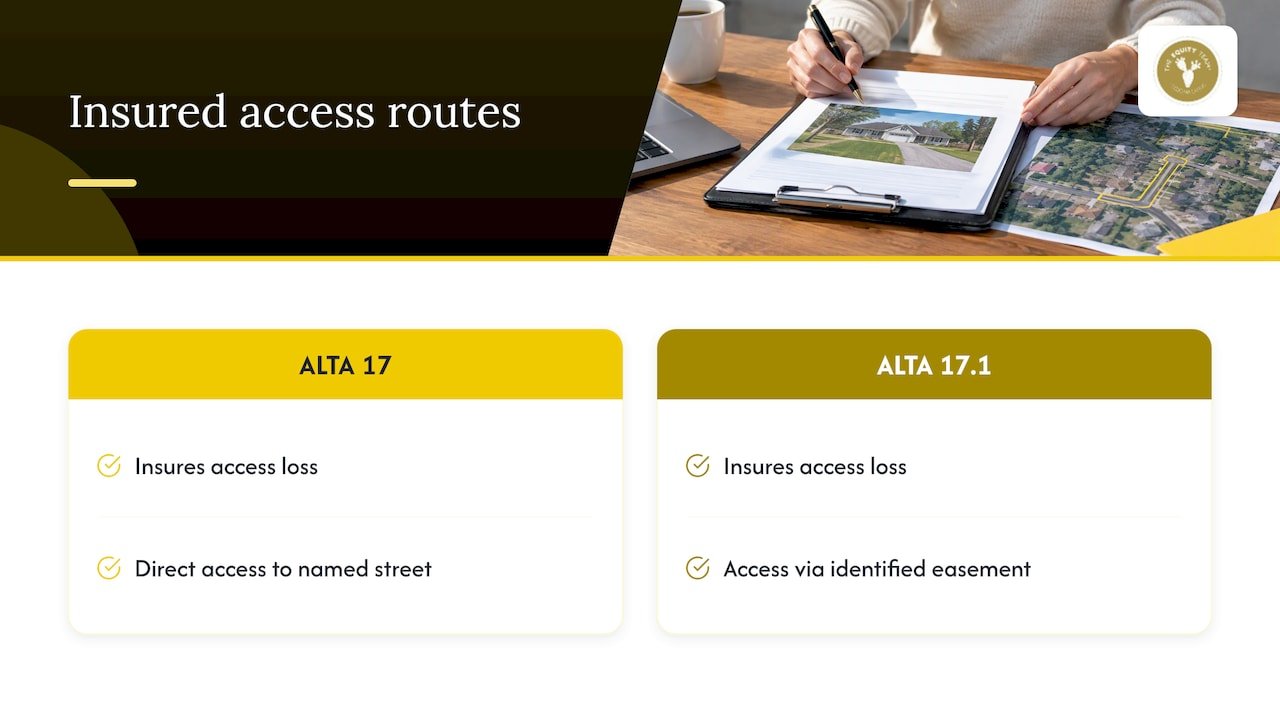
Sedona is a town of red-rock backdrops, winding roads, shared driveways and private lanes. A view home at the end of a shared drive may rely entirely on an easement. For a rental, where guests arrive in rental cars at all hours and need a legal, usable way in, that is a line item worth reading closely.
Zoning: the ALTA 3 series
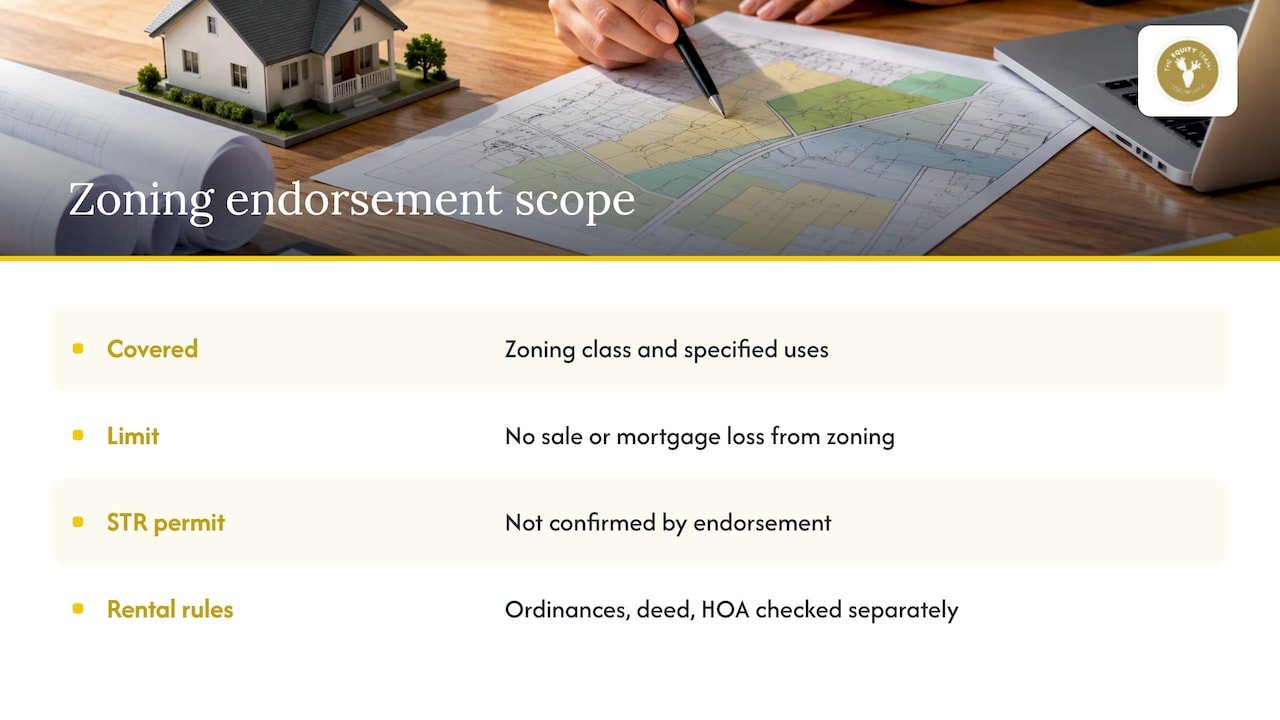
Zoning endorsements cover risks related to the property’s zoning classification and the specified permitted uses. They also carry limits. For example, the endorsement typically does not insure against loss when the land cannot be sold or mortgaged because of a zoning issue, again per the uniform list.
Here is the catch for STR buyers: a zoning endorsement speaks to zoning classification. It does not tell anyone whether a short-term rental permit exists, whether a local ordinance allows rentals, or whether a deed restriction or HOA rule bans them. Those are separate checks. Our own guide to deed restriction checks for Sedona STR investors walks through that part of the homework.
Survey, boundaries and improvements
This family covers survey or property-description mismatches, encroachments and the forced removal of improvements, and damage to improvements from mineral or subsurface extraction. In practice, ALTA 9 is the workhorse. If a neighbor’s fence, a casita or a retaining wall sits across a line, this is the family of coverage that speaks to it. For a hillside lot with decks, hot tubs and casitas built over the years, that can get interesting.
Commercial and loan-side extras
In commercial deals, aggregation (ALTA 12) and doing business (ALTA 24) are commonly requested, and loan modifications and assignments have their own endorsements. A buyer of a single-family vacation rental will rarely meet these. A buyer of a multi-unit lodging property or a small portfolio might.
What endorsements cost
The honest answer is that it depends on the state and the insurer. A consumer title insurance shopping guide states that some endorsements are included in the insurance cost while others cost extra, and it suggests asking which are available and comparing estimated costs between companies.
Some real filings show how different the pricing models are:
- A Kansas title agency filing, effective February 1, 2025, sets most residential loan endorsements at $25 and approved owner’s policy endorsements at $100.
- Nevada’s rate manual says that when several endorsements in the same series are requested for one chain of title, a single rate may sometimes be calculated on the aggregate amount.
Those are other states, so they are examples of how filings work, not Arizona prices. In Arizona, ask the title company for its current rate schedule and for a line-by-line estimate that lists every endorsement before closing. The estimate is the number that matters.
A practical checklist for a Sedona STR buyer
Nobody needs every endorsement. The goal is to match coverage to the property’s quirks. A sensible order:
- Read the title commitment first. The exceptions listed there are the risks the base policy will not cover. Each one is a candidate for a question.
- Ask what the lender will require. Those endorsements arrive automatically, so buyers should simply see them on the estimate.
- Ask what is available for the owner’s policy. Request the list in writing, with prices.
- Check access. If the property is reached by shared drive, easement or private road, ask whether access coverage is available.
- Check boundaries. Order a survey where it makes sense, then ask about coverage for encroachments and restrictions.
- Separate title from rental rules. Zoning coverage, deed restrictions, HOA rules and rental licensing are different questions with different answers.
- Guard the closing itself. Title coverage does not recover a wire sent to a fraudster. Our piece on stopping wire fraud when closing Arizona deals remotely covers that.
One more worked example. Say a buyer likes a four-bedroom rental on a private lane. The commitment shows a recorded road maintenance agreement and an easement. The buyer asks the title officer whether access coverage is available through the easement, requests the price in writing, and has an attorney read the maintenance agreement. That is one email and one phone call, and it settles a question that would otherwise sit unnoticed until a guest GPS fails.
When title issues show up on the sell side
Sellers meet endorsements too, often indirectly. A buyer’s request for an endorsement can prompt the title company to ask the seller for an affidavit, a survey or a clean-up of an old recorded document. A seller who knows the property’s recorded history in advance moves faster. We cover typical snags in Sedona home sale title issue examples. Generally, the sooner a title surprise is found, the cheaper it is to fix.
Wildfire season adds its own wrinkle during escrow, and that is about insurance and risk on the structure, not title. Our wildfire plan for Sedona STR escrows explains how buyers and sellers protect a deal.
Perspective
Title work is the least glamorous part of buying a vacation rental, right up until it is the most important part. Sedona is a place where a gorgeous view can sit on a very complicated lot, and STR investors are underwriting income, not just a house.
We specialize in short-term rental purchases and sales, so we read title commitments with the rental use in mind. We ask early who maintains the shared road, whether the deed carries any rental restrictions, and whether anything on the survey looks off. Then we get the questions in front of the title officer and an attorney before the inspection period runs out.
Endorsements are not a magic shield, and the form wording rules. But a buyer who asks what is available, in writing, with prices, is already ahead of most. That is the kind of detail that protects an STR’s income story.
Chad
How we help STR buyers and sellers
The Equity Team is a Sedona real estate team focused on short-term rental investment. For buyers, that means a property search built around how a home performs as a rental, plus a clear-eyed look at the paperwork before the deadline arrives. For sellers, it means pricing and preparing a rental so the sale goes smoothly, including a Sedona vacation rental CMA and seller prep consultation.

If a purchase is on the horizon, start with our buyer and seller representation, and read how to find the right short-term rental investment. We are not title insurers or attorneys, so for coverage terms the title officer and a real estate attorney have the final word.
FAQ
Are title insurance endorsements required?
Lender endorsements often are. They are a condition of the loan, and the title or escrow company orders them automatically, per the California Department of Insurance. Owner’s policy endorsements are generally optional, so a buyer has to ask what is available. A cash buyer has no lender requirements at all.
Do endorsements cost extra?
Sometimes. Some endorsements are included in the policy cost, and others carry a separate charge, according to a consumer title shopping guide. Ask for a written estimate that lists each endorsement and compare companies.
What is the difference between ALTA 17 and ALTA 17.1?
Both insure against loss if the land lacks vehicular and pedestrian access to a named street. ALTA 17 covers direct access, while 17.1 covers access through an identified easement, per the uniform endorsement list. Shared Sedona driveways make the second one worth asking about.
Does a zoning endorsement tell me whether I can run a short-term rental?
No. Zoning endorsements address the zoning classification and specified permitted uses, and they carry limits, such as not insuring against loss when the land cannot be sold or mortgaged because of a zoning issue. Rental permits, local ordinances, HOA rules and deed restrictions are separate checks to do before making an offer.
Can an endorsement fix a title problem?
It can make a known risk insurable. Practitioners use endorsements when a commitment lists a risk the insurer is willing to cover without it being removed. It does not erase the underlying issue, so a real estate attorney should review anything significant.
Sources
- A Uniform List of Title Endorsements (Fall 2018)
- Title Insurance: A Comprehensive Overview, American Land Title Association
- Chicago Title Endorsement Handbook
- Consumer guide to title insurance, NAIC
- Kansas Insurance Department title rate filing
- California Department of Insurance, Title Insurance
- Nevada Title Rate Manual