
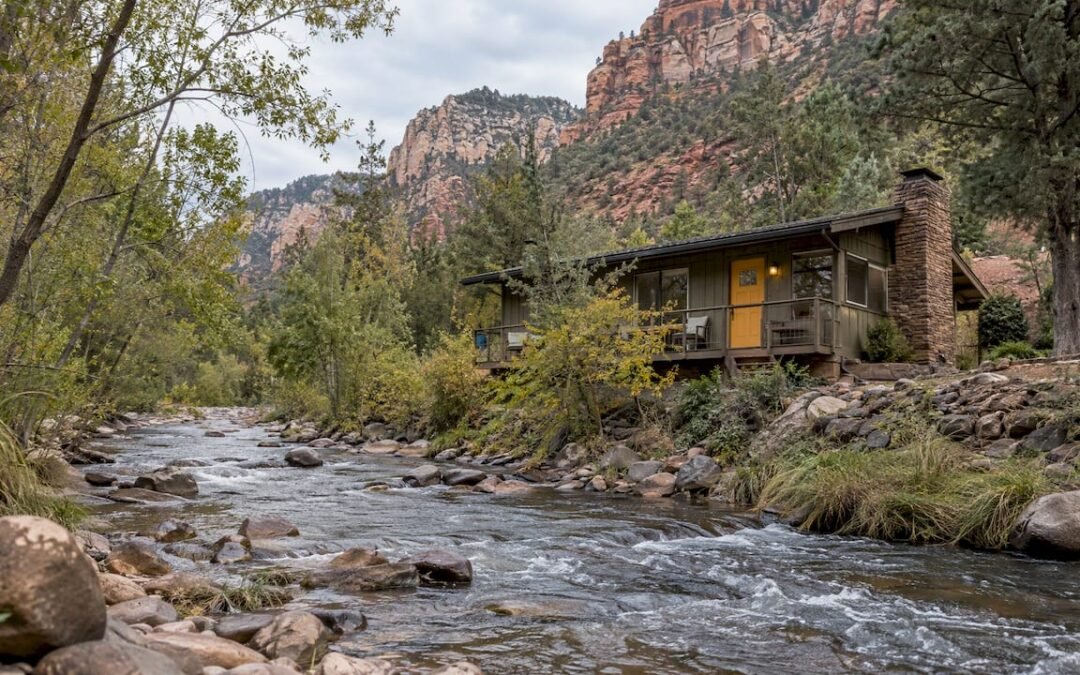
Oak Creek Canyon is one of the most photogenic places to own a short-term rental in Arizona. It is also one of the trickiest. The creek, the pines and the red walls sell the stay, but the rules, the access, the wildfire exposure and the numbers decide whether the investment works. This guide covers what to check before buying a canyon Airbnb, and how the canyon stacks up against Red Rock Loop, the Chapel area, Flagstaff and Rimrock.
TL;DR
- Airbnbs across the Oak Creek Canyon and Sedona/Flagstaff area average about $422 a night at 57% occupancy as of October 2026. That is a starting point, not a forecast for any one house.
- Rules come first. Yavapai County, for example, limits STRs to permitted habitable structures and requires registration with the assessor. Confirm which jurisdiction a parcel sits in before you fall in love with it.
- Underwrite the property, not the neighborhood. Access roads, water, insurance and wildfire planning can change the math more than a nightly rate does.
- Red Rock Loop, Chapel, Flagstaff and Rimrock each reward a different kind of owner. Match the market to your goal.
Table of Contents
- Why Oak Creek Canyon gets investors daydreaming
- What the numbers say, and what they hide
- Rules and registrations to check before you make an offer
- The true cost stack for a canyon Airbnb
- Risks specific to the canyon (and how to plan for them)
- Oak Creek Canyon vs. Red Rock Loop vs. Chapel: picking your corner of Sedona
- Flagstaff and Rimrock: the neighbors worth comparing
- A simple checklist before you offer
- Our perspective
- Ready to compare your options?
- FAQ
- Sources
Why Oak Creek Canyon gets investors daydreaming
Picture a creek that chuckles past your back deck while the canyon walls turn pink at sunset. Guests picture it too, and they book it. That is the whole pitch, and it is a good one.
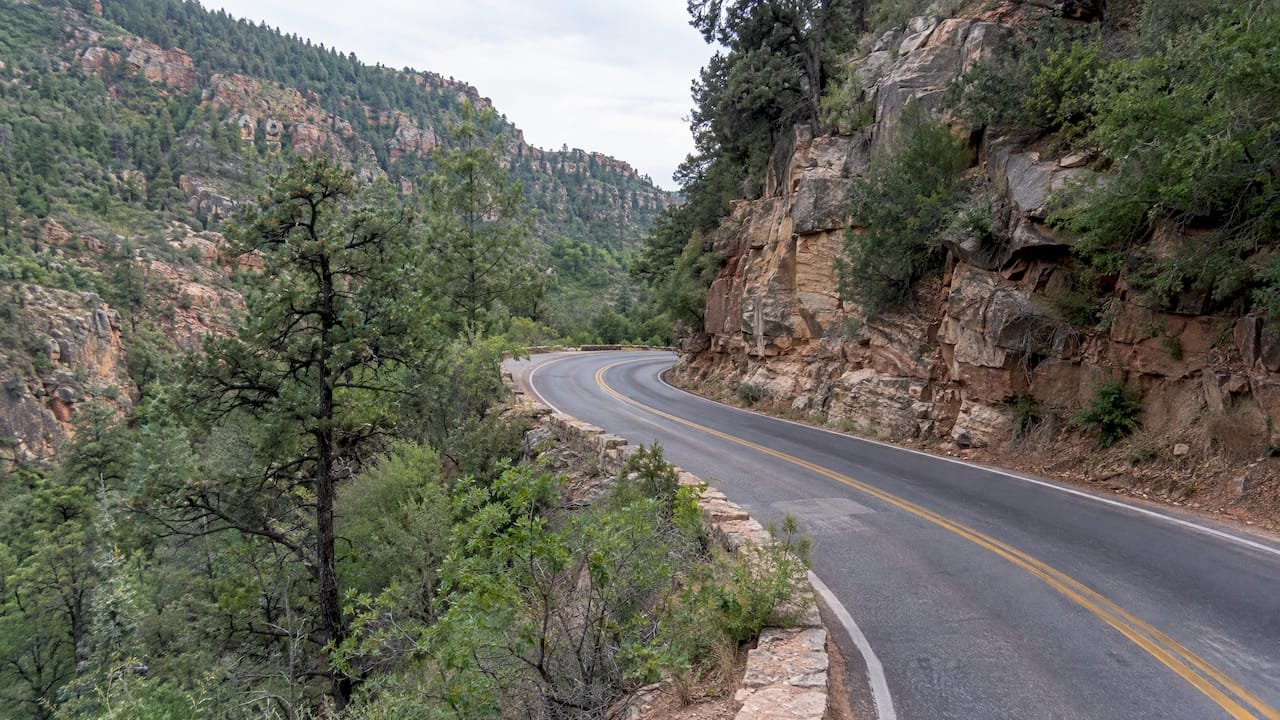
The catch is that the canyon is a narrow, scenic, slightly moody place. Lots are small, roads wind, and the same trees guests love are the ones fire officials worry about. A canyon rental can be a standout, and it can also be a very pretty way to lose money if the purchase is not underwritten carefully.
For the bigger picture, our look at the current short-term rental climate in Sedona and our 2026 Sedona Airbnb market trends give the wider context. This article zooms in on the canyon and its neighbors.
What the numbers say, and what they hide
The figure most investors see first is the average daily rate (ADR). For the Oak Creek Canyon and Sedona/Flagstaff area, one aggregator puts it at $422 with 57% occupancy in October 2026.
Nice round numbers. Now a reality check: an average blends tiny cabins with large luxury homes, so it describes nobody’s actual house. Industry commentary on 2026 pricing points the same way: smart investors look past headline ADR to booking windows, minimum stays and how crowded their specific submarket is.
A quick way to use the average without being fooled by it:
- Start with the headline. $422 at 57% is the rough ceiling of the conversation, not the floor.
- Compare like with like. Match bedrooms, view, hot tub, parking and creek access to real comparable rentals.
- Haircut the occupancy. Many buyers model a conservative case below the market average, then see what a good manager might add.
- Check the booking calendar. Look at how far ahead comparable homes fill and how many one-night gaps they leave.
The second half of that process is where a local CMA earns its keep. Our guide to evaluating Sedona rental income potential walks through it, and our Sedona cash flow examples for 2026 show what the math looks like in practice.
Income is more than the nightly rate
The nightly rate is the shiny part. The rest of the income picture is less glamorous: cleaning fees that actually cover cleaning, turnover speed, and how many nights you lose to gaps between stays. A reliable Airbnb turnover cleaning routine protects your reviews, and reviews protect your rate. Whatever crew you use, price the turnover into your model as a real line item rather than a footnote.
Rules and registrations to check before you make an offer
Short-term rental rules in Arizona depend heavily on where the parcel sits. A home with a Sedona mailing address may fall under city rules, a county’s rules, or neither the way you assumed. Before anything else, find out which jurisdiction governs the exact address.
Some starting points:
- County rules. Yavapai County’s planning FAQ says STRs are limited to permitted habitable structures, commercial activities such as events are prohibited, and owners must register with the county assessor for any rental use. If a parcel is in a different county, ask that county’s planning office for its own version.
- City rules inside Sedona. Hosts inside city limits generally need a city permit and an Arizona Transaction Privilege Tax (TPT) license, with details laid out in this overview of Sedona STR regulations. Confirm the current fee and requirements on the City of Sedona’s own page before you budget.
- Taxes. Lodging is taxed through TPT, and combined rates in tourist-heavy Arizona cities run high. Ask a CPA who knows Arizona lodging tax to model it for your address.
- HOA and deed restrictions. Some communities restrict rentals regardless of what the city allows. Read the CC&Rs during your due diligence period, not after closing.
- Septic, permitted structures and casitas. An unpermitted guest house is not a rental unit. Verify what is legal to rent, not just what is listed.
The point is simple: a rental you cannot legally operate is a very expensive second home. Our purchase contract guide explains where due diligence contingencies fit in, so you can protect yourself while you verify.
The true cost stack for a canyon Airbnb
Buyers who stop at the mortgage payment are in for a surprise. A realistic model includes:
| Cost category | What to include |
|---|---|
| Acquisition | Down payment, closing costs, inspections, furnishing and staging |
| Financing | Rate and terms for an investment or second-home loan |
| Fixed carrying costs | Property tax, insurance, HOA dues if any |
| Operating costs | Utilities, cleaning, laundry, supplies, hot tub and landscaping upkeep |
| Platform and management | Booking fees, property management or your own time |
| Taxes and licensing | TPT, local permit or registration, income tax planning |
| Reserves | Roof, HVAC, water system, wear on furniture |
We do not publish a one-size number here because every house is different, and a made-up number would do you no favors. What we can say is that insurance and reserves are the two lines buyers most often underestimate in a canyon setting.
For financing ideas beyond a standard loan, take a look at how seller carry financing works in Sedona, and our critical tips for buyers and borrowers cover the lender side.
Risks specific to the canyon (and how to plan for them)
The canyon is gorgeous because it is wild. Wild has a price tag.
- Wildfire. Forested, narrow terrain raises the stakes. Ask about defensible space, roof and vent materials, evacuation routes and what your insurer requires. We put together six wildfire steps for STR buyers and sellers that fit directly into an escrow timeline.
- Access. Narrow, winding roads and limited parking affect guest comfort, emergency access and your listing’s reviews. Drive in and out at night and in bad weather before you buy.
- Water and utilities. Confirm the water source, well or utility service, septic capacity and internet quality. A guest without Wi-Fi in a canyon is a guest who writes about it.
- Flood and runoff. Creekside is lovely until the creek has opinions. Ask about flood history and insurance requirements.
- Regulatory drift. Rules change. Underwrite a deal that still works if your permit costs rise or your tax bill grows.
None of these are reasons to skip the canyon. They are reasons to price it accurately and to buy the property that handles them well.
Oak Creek Canyon vs. Red Rock Loop vs. Chapel: picking your corner of Sedona
Sedona is a collection of micro-markets, each with its own personality (and, frankly, its own parking situation). The right one depends on what you want from the investment.
| Area | Vibe | Typical investor fit |
|---|---|---|
| Oak Creek Canyon | Creek, forest, cabin character | Owners who want a distinctive, nature-first rental and accept access and fire planning |
| Red Rock Loop | Red rock views, west Sedona feel, larger homes in many parts | Investors who want view-driven listings and group-friendly layouts |
| Chapel area | Close to the Chapel of the Holy Cross, central and scenic | Owners who value walkable-feeling proximity to Sedona’s most photographed spots |
Treat this as a framework for conversations, not a set of promises. Revenue in each area depends on the specific house, the view, the layout and the rules at that address, so a local vacation rental CMA is the right tool to compare them. That is exactly what our Sedona vacation rental CMA is built to do for owners and prospective sellers, and our rental marketing channel examples show how listings in each area get in front of guests.
If your budget sits in the middle of the market, our $500k to $1M Sedona market breakdown is worth a read. If you are shopping the top of it, see Sedona luxury rental investing, where high occupancy still needs a local CMA to back it up.
Flagstaff and Rimrock: the neighbors worth comparing
Flagstaff
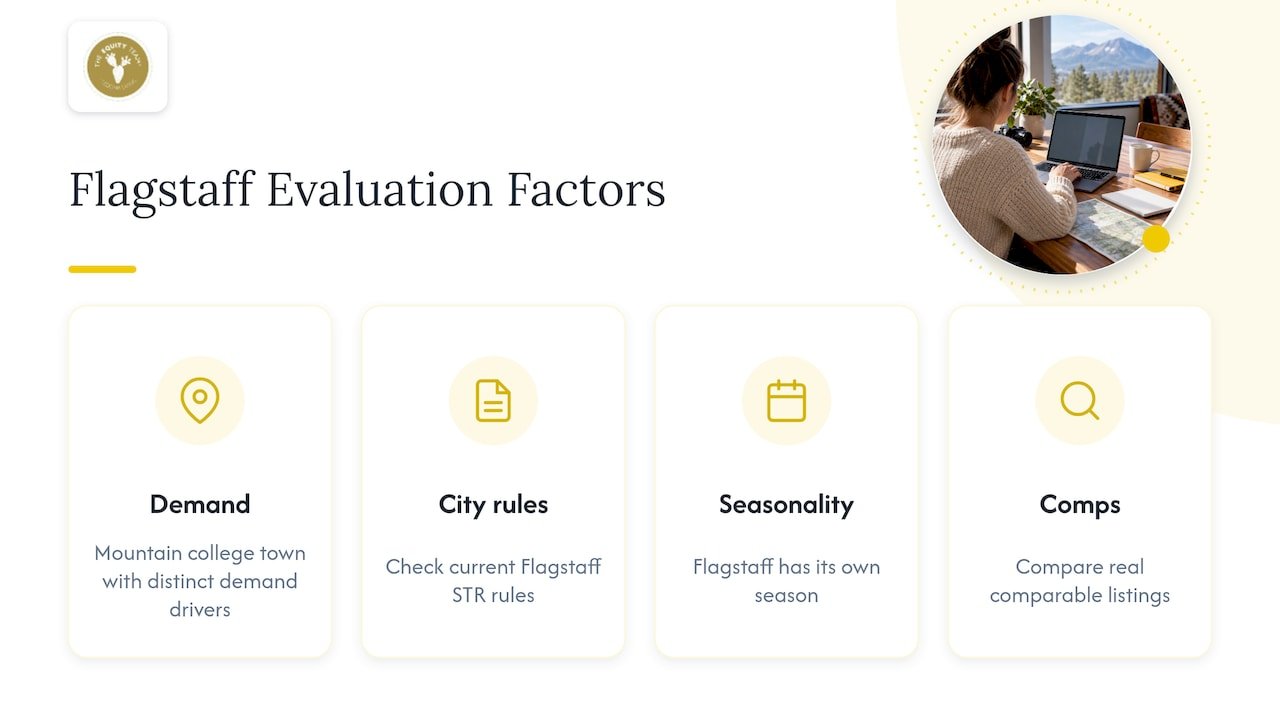
Flagstaff is a different animal: a mountain college town with its own demand drivers, its own city rules and its own season. The research above lumps the Sedona and Flagstaff area together for averages, which is exactly why you should not assume Flagstaff performs like Sedona. Check Flagstaff’s current city rules for STRs and compare real comparable listings before you treat it as a swap for a canyon property.
Rimrock
Rimrock sits in the Verde Valley, and it appeals to investors who want more land or a lower entry point than Sedona proper, with a shorter drive to the headline attractions. Before buying a Rimrock Airbnb, look at:
- Which jurisdiction governs the parcel and what its STR rules require. Yavapai County, for instance, requires assessor registration for any rental use.
- Whether the guest experience (views, quiet, amenities) justifies the nightly rate you are modeling.
- Well and septic details, which are common on rural lots.
- How your calendar compares to rentals closer to Sedona’s core.
A good rule of thumb: the farther you move from the headline attractions, the more the property itself, not the address, must sell the stay. Our guide to Sedona vacation rental amenity must-haves covers the features that tend to carry a listing.
A simple checklist before you offer
- Confirm the jurisdiction and the exact STR rules for the parcel.
- Verify permits for every structure you plan to rent.
- Pull comparable rentals and build a conservative, base and strong-case income model.
- Get insurance quotes early, including wildfire and flood questions.
- Inspect the roof, water, septic, heating and cooling carefully.
- Drive the access road in different conditions.
- Plan your exit. Every smart purchase has a resale story. Our Sedona Airbnb resale strategy shows how to benchmark income against market occupancy when it is time to sell.
Our perspective
Chad’s team has watched buyers fall for a canyon cabin in a single afternoon, and honestly, we get it. The creek is charming and the light is ridiculous.
Here is what we tell every investor: the best Sedona short-term rental is the one whose numbers still make sense after the romance wears off. That is why we look at the property as a business, with the permit status, the access, the comps and the exit all on the table before an offer goes in.
We built our team around short-term rental investing in Sedona and Northern Arizona. We represent clients who operate STRs in the top tier of the rental market, so we know what a strong listing looks like and what a lookalike lacks. For buyers, that means finding a property with real earning potential. For sellers, it means presenting a rental in a way that gets top dollar.
If Oak Creek Canyon is on your list, bring us the address and we will help you stack it up against Red Rock Loop, Chapel and beyond, with real comps rather than guesses.
Chad
Ready to compare your options?
Whether you are buying your first canyon cabin or deciding whether to sell a rental you already own, we can help you see the numbers clearly. Our team handles buyer and seller representation for Sedona and the Verde Valley, and owners can start with a Sedona vacation rental CMA to learn what a home could earn or sell for.

Thinking of an exit instead? Our rental exit strategy and valuation conversation is a good first step.
FAQ
Is Oak Creek Canyon a good place to invest in an Airbnb?
It can be, if the specific property is legal to rent, well maintained and priced right. Area-wide data shows about $422 average nightly rates at 57% occupancy, but individual homes vary widely. A local CMA for the exact address is the best test.
What rules apply to a short-term rental near Sedona?
It depends on the jurisdiction. Yavapai County, for example, limits STRs to permitted habitable structures and requires registration with the assessor. Properties inside the City of Sedona have their own permit and tax requirements, so confirm the rules for your exact parcel.
How does Flagstaff compare with Sedona for STR investing?
They are separate markets with different guests, seasons and city rules. Averages that combine the two areas hide those differences, so compare actual local listings and current regulations before treating one as a substitute for the other.
What should I check before buying a Rimrock Airbnb?
Start with jurisdiction and permits, then well, septic and access. Next, test whether the property’s views and amenities can support the nightly rate in your model. Compare its calendar against comparable rentals closer to Sedona.
Sources
- Oak Creek Canyon, Arizona Airbnb Occupancy, October 2026
- State of STR Pricing 2026
- Yavapai County Planning FAQ, 2025
- Sedona Short-Term Rental Regulations: What Hosts Need to Know