
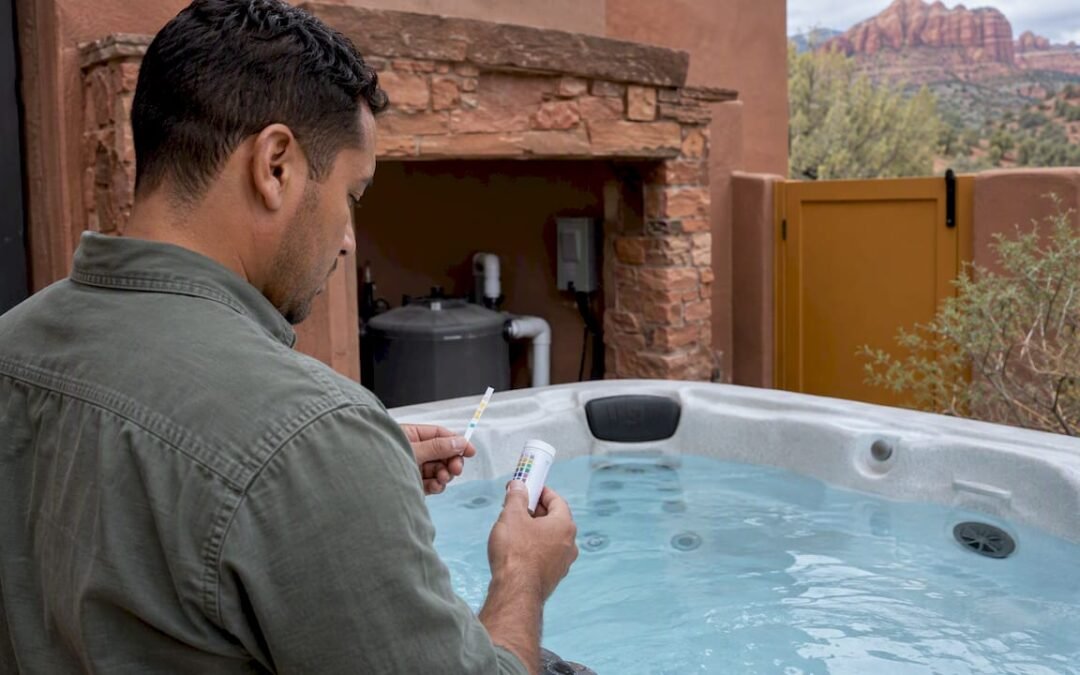
A hot tub is a bubbling little money fountain, except the money flows out. The good news is that the bill is predictable. Typical operating costs land between $350 and $1,100 per year, averaging about $700, which works out to roughly $30 to $90 a month. Add a repair cushion and a few optional extras, and the number climbs. Here is where every dollar goes, and how to keep more of them.
TL;DR
- Most owners spend about $350 to $1,100 per year on routine upkeep, with a broader possible range of $250 to $1,500.
- Electricity is usually the biggest line, at $20 to $60 per month, and a good cover is the cheapest way to shrink it.
- Chemicals, water testing and filters add roughly $25 to $70 per month, and a professional service plan can add $350 to $600 per year.
- Rental hot tubs work harder: short-term rental operating costs typically run $900 to $1,800 per year.
- A repair reserve of $100 to $300 per year keeps a dead pump from turning into a surprise.
Table of Contents
- The big picture: what a hot tub costs per month and per year
- Electricity: the quiet heavy hitter
- Water, chemicals and testing
- Filters and covers: small parts, real money
- Professional service: optional, but popular
- Repairs and the rainy-day fund
- Is it cheaper to leave a hot tub on or turn it off?
- The short-term rental twist
- Ways to trim the bill without trimming the fun
- Our perspective on hot tub costs in Sedona rentals
- Thinking of buying or selling a Sedona rental with a hot tub?
- FAQ
- Sources
The big picture: what a hot tub costs per month and per year
Published estimates do not agree to the penny, and that is fine. Tub size, insulation, climate, local power rates and how often the lid comes off all move the total. Here is how a few sources frame it.
| Source | Estimate |
|---|---|
| Angi, 2026 guide | $350 to $1,100 per year, about $700 on average |
| Jacuzzi maintenance guide | $40 to $80 per month for routine upkeep; $100 to $200 or more per month for a professional plan |
| Hydropool U.S. guide, November 2024 | About $40 per month, or $480 per year, all-in for power and water care |
| RentTools, May 2026 | $900 to $1,800 per year for a short-term rental tub |
The pattern is simple. A lightly used, well-insulated tub in a mild spot sits at the low end. A big tub, a cold winter and a busy guest calendar push toward the top.
Electricity: the quiet heavy hitter
The hot tub’s appetite for power is mostly about staying warm, not about the soaking itself. Much of the electricity is used while the tub is covered and idle, which is why insulation and the cover matter more than how many soaks happen.
Numbers to know:
- Angi estimates $20 to $60 per month for electricity, plus $10 to $40 per month for extra heating in colder stretches.
- Jacuzzi’s guide puts typical electricity at $20 to $40 per month.
- Jacuzzi also notes that California Energy Commission ratings for many major-brand tubs suggest roughly $10 to $21 per month, with the most efficient models at $15 or less. That is electricity only, not a full budget.
Portable electric spas are even a regulated product category. The U.S. Department of Energy covers them in a test procedure meant to measure representative energy use or operating cost, which is a polite way of saying hot tub efficiency is something the government measures.
Water, chemicals and testing
The water is where the routine lives. A tub that is tested, balanced and rinsed on schedule is a happy tub. A neglected tub turns into a science fair project.
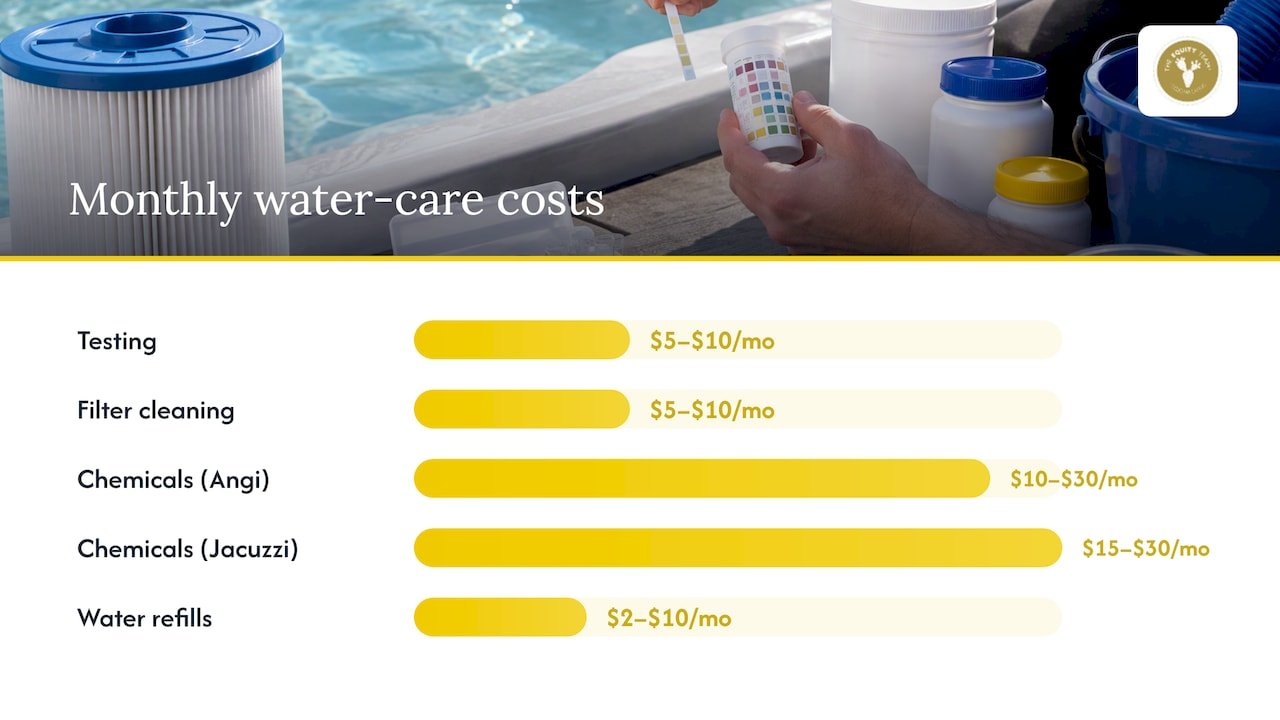
Angi’s 2026 maintenance table lists water testing at $5 to $10 per month, filter cleaning at $5 to $10 per month and chemicals at $10 to $30 per month. Water refills add another $2 to $10 per month. Jacuzzi’s range for chemicals is a touch higher, at $15 to $30 per month.
The routine itself is not dramatic. One roundup of owner data recommends checking chemical levels several times a week, rinsing filters weekly, and doing a full drain, clean and refill every 3 to 4 months. Time-wise, that is a few short sessions a month, not a second job.
Filters and covers: small parts, real money
Filters are the unsung heroes. Clean ones keep water flowing, and proper filter care is the first defense for pumps and heaters against the strain of restricted flow. Skimp here and the expensive parts pay for it later.
What they cost:
- Replacement filters run $20 to $60 each, swapped every 6 to 12 months.
- Jacuzzi lists filters at $30 to $120, replaced every 1 to 2 years, which shows how much brand and size matter.
- A new cover costs $300 to $800. It is a one-time hit every few years, and it pays back through lower power bills.
Professional service: optional, but popular
Plenty of owners happily hand off the chores. Others hire help only for the big jobs.
- Angi prices a professional cleaning at $100 to $250 per quarterly visit, or $350 to $600 per year on a service plan.
- Jacuzzi lists professional service at $75 to $150 per visit, and monthly plans at $100 to $200 or more.
- A roundup of owner data says a one-off maintenance visit typically costs $100 to $300 nationally, and a professional drain and refill $150 to $400. Premium or vacation-market areas can cost two to three times more.
That last point is worth a pause for anyone near a resort town. Red rock country is not a bargain-bin zip code for service calls, so budget toward the upper end.
Repairs and the rainy-day fund
Hot tubs rarely break on a convenient Tuesday. Pumps and heaters tend to fail after the warranty has quietly expired. Sundance suggests setting aside $100 to $300 per year as a repair reserve.
When something does fail, the national average professional repair is $350, with most homeowners paying $181 to $567. Labor typically runs $75 to $150 per hour, and some pros charge a minimum service call.
Plumbing leaks around a tub are their own genre of surprise. A look at plumbing repair costs helps set expectations for the supply lines, drains and fixtures that sit around the tub.
Is it cheaper to leave a hot tub on or turn it off?
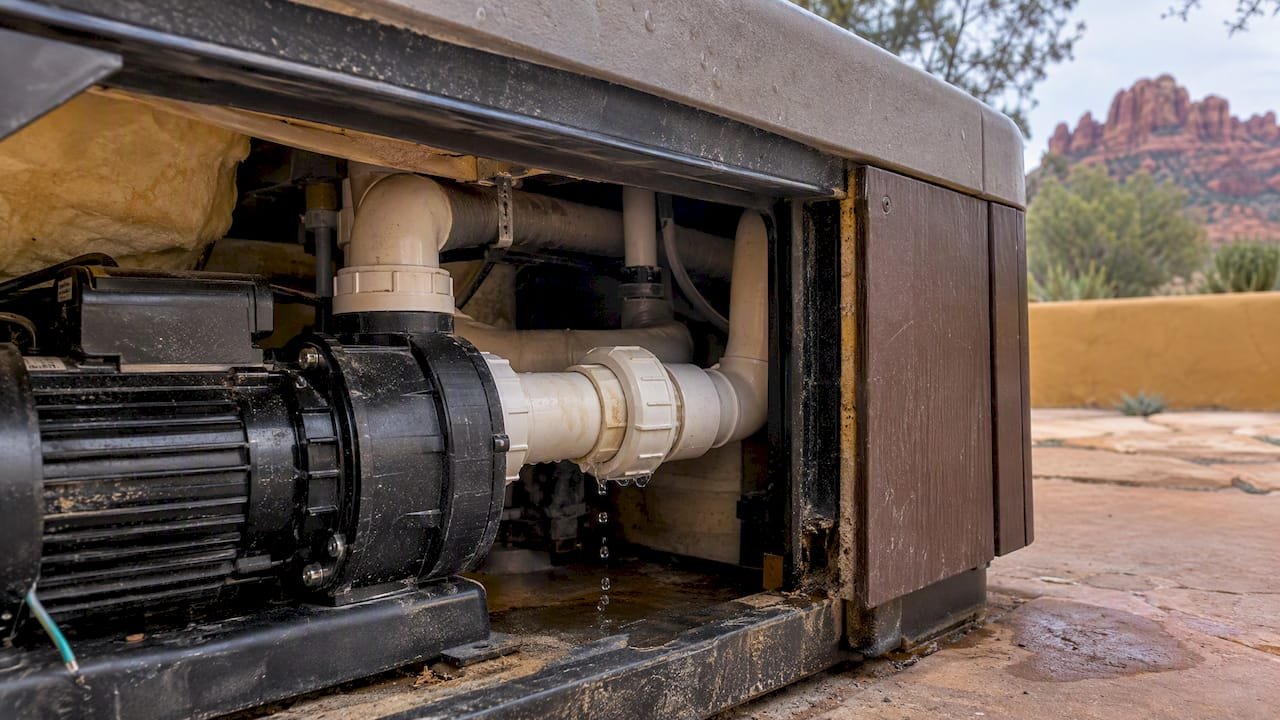
The tub-on-or-tub-off debate is a classic. The short version from Jacuzzi: lowering the temperature or using economy mode when the tub is idle reduces energy use. For frequent users, a lower standby setting can beat reheating from cold every time.
For a weekly soaker in a mild stretch, a longer shutdown can make sense. For a daily soaker, or a tub that guests expect to be hot on arrival, the steady setting wins on convenience, and a good cover keeps the cost sensible.
The short-term rental twist
Sedona is a place where a hot tub under a sky full of stars is practically a job requirement for a vacation rental. Guests love it, and they use it hard. That changes the math.
- Total operating costs for a rental tub typically run $900 to $1,800 per year.
- Electricity is often the largest line, at $30 to $100 per month depending on climate, use and insulation.
- Drain-and-refill service, with labor and water, generally costs $120 to $220 a year at three to four changes annually.
- Filters need more attention too. For rental tubs, the guidance is to rinse every 2 to 3 days and deep clean every 3 to 4 weeks.
A tub that earns its keep still has a bill. To see how the revenue side stacks up, the role of a hot tub in Sedona STR revenue is the next stop, and the list of Sedona vacation rental amenity must-haves shows where a tub ranks against the other guest favorites.
Come tax time, the tub also matters beyond the utility bill. The depreciation benefits of a Sedona vacation home and the rules around cost segregation for Arizona Airbnbs are worth a conversation with a tax professional.
Ways to trim the bill without trimming the fun
Savings are mostly about heat and filters.
- Cover it well. An insulated, well-fitted cover and thermal blanket are essential to cut heat loss and wasted electricity, especially for rentals.
- Pick efficient gear. Efficient circulation pumps, quality thermal covers and proactive filter care reduce energy use, sanitizer demand and equipment strain.
- Rinse filters on schedule. It is the cheapest insurance policy in the whole hot tub universe.
- Lower the setpoint when idle. Economy mode earns its name.
- Budget the reserve. A planned $100 to $300 a year beats a panicked $567 repair.
Our perspective on hot tub costs in Sedona rentals
We work with short-term rental owners and buyers in Sedona every day, and the hot tub comes up in almost every conversation. Buyers ask whether it is worth keeping. Sellers ask whether it helps the price. Our answer is the same: treat it as a line in the operating budget, not a mystery.
When a buyer is underwriting a Sedona rental, we want the tub’s age, cover condition, service history and power bill on the table next to the nightly rate. A tidy, well-maintained tub tells us the owner ran the property carefully. A tired one tells us to budget for a replacement and to negotiate accordingly.
For sellers, the same records help. A binder showing regular service, clean filters and a recent cover is a quiet selling point, and it supports the story of a rental that performs. We would rather see an owner spend a few hundred dollars a year on upkeep than lose a booking over cloudy water and a bad review.
The cost figures in this article are national ranges from published guides. Your own numbers will depend on the tub, the season and your utility rates, so use them as a starting point and replace them with your actual bills.
— Chad
Thinking of buying or selling a Sedona rental with a hot tub?
We are a team of agents focused on short-term rental investing in Sedona, so a hot tub’s real cost is something we help buyers and sellers sort out in the numbers. If a home is on the market soon, a Sedona vacation rental CMA and seller prep consultation is a good place to start.

Buyers can see how we think about finding the right short-term rental investment, and owners weighing next steps can check how to evaluate Sedona rental income potential and our take on vacation rental revenue management.
FAQ
How much does it cost to run a hot tub for a year?
Most owners spend about $350 to $1,100 per year, with an average near $700, according to Angi’s 2026 guide. Some sources land lower, around $480 per year for power and water care. Rental tubs typically run $900 to $1,800.
How often should you service a hot tub?
Owners should test the water several times a week, rinse filters weekly and do a full drain, clean and refill every 3 to 4 months. Professional cleaning is often scheduled quarterly. Rental tubs need filter rinses every 2 to 3 days.
What does a hot tub service cost?
A one-off professional maintenance visit typically costs $100 to $300, and a drain and refill $150 to $400. Resort areas can run two to three times higher. Repairs average $350 nationally.
Is it cheaper to leave a hot tub on or turn it off?
It depends on use. Lowering the temperature or using economy mode when idle reduces energy consumption, and for frequent users a lower standby setting can beat reheating from cold. A good cover helps either way.
Sources
- How Much Does It Cost to Run a Hot Tub? (Angi)
- How Much Does Hot Tub Repair Cost? (Angi)
- Essential Guide to Hot Tub Maintenance Costs (Jacuzzi)
- How much electricity does a hot tub use? (Jacuzzi)
- Hot Tub Filter Cleaning Made Easy (Jacuzzi)
- Cost to keep a hot tub running all the time (Jacuzzi)
- Monthly cost to maintain a hot tub in the United States (Hydropool)
- Hot tub ROI for short-term rentals (RentTools)
- Hot Tub Costs in a Short-Term Rental (MMCGINVEST)
- The Hidden Costs of Hot Tub Ownership (Sundance Spas)
- Portable electric spa test procedure (U.S. Department of Energy)
- How Much Does It Cost to Run a Hot Tub? Real Owner Data (Home In Depth)
- Plumbing Repair Costs: A Complete Price Guide