

Vacation rental revenue management is the habit of deciding what to charge, where to sell, and when to adjust, so the whole year earns more, not just the best Saturday in April. Pricing is one lever. Distribution, guest experience and a steady review rhythm pull the others. Sedona, a town where red rocks glow at sunset and occupancy still wobbles with the seasons, makes a very good classroom.
This guide walks through the metrics, the five-step loop, the pricing traps, the channel question and the moment an owner might decide the smartest revenue move is a sale.
TL;DR
- Revenue management is more than dynamic pricing: it blends price, availability, distribution and operations, and it is judged by revenue per available night, not by the highest nightly rate.
- Set a floor and a ceiling, review booking pace weekly and dig into the numbers monthly.
- Do not surge prices close to arrival without testing: research found that it can hurt revenue on many Airbnb listings.
- Amenities, design and guest experience often lift pricing power more than endless manual tweaks.
- If the numbers keep disappointing after real effort, a valuation conversation is also revenue management.
Table of Contents
- What revenue management actually means
- The numbers that matter
- The five-step loop
- Pricing strategy without the drama
- Revenue levers beyond the nightly rate
- Channels, calendars and direct bookings
- Should you hire a revenue manager or property manager?
- Taxes can quietly rewrite the math
- Our perspective: when revenue management becomes a real estate question
- Work with a team that reads both the calendar and the comps
- A simple monthly routine
- FAQ
- Sources
What revenue management actually means
The textbook version is selling the right room to the right guest at the right time, for the right price, on the right channel. Rentals United frames it exactly that way, and it is a handy cure for a common mix-up: revenue management is not a synonym for dynamic pricing. Pricing software is the speedometer. The strategy is the whole road trip.
The same source points out that chasing the highest nightly rate can backfire. Push the average daily rate (ADR) too high, lose bookings, and revenue per available night slips. A home that is full at a bargain rate is not winning either. The sweet spot sits between the two.
The numbers that matter
Three metrics do most of the talking:
| Metric | What it tells you | How to read it |
|---|---|---|
| Occupancy | Share of available nights booked | High occupancy at a low price can signal underpricing |
| ADR | Average price of nights actually sold | Rising ADR with falling occupancy needs a second look |
| RevPAN / RevPAR | Revenue per available night | The best single health check for the asset |
RevPAN (revenue per available night) multiplies the two earlier numbers together, which is why RedAwning’s guide treats it as the health metric and warns owners against staring at ADR alone.
Sedona’s yardstick
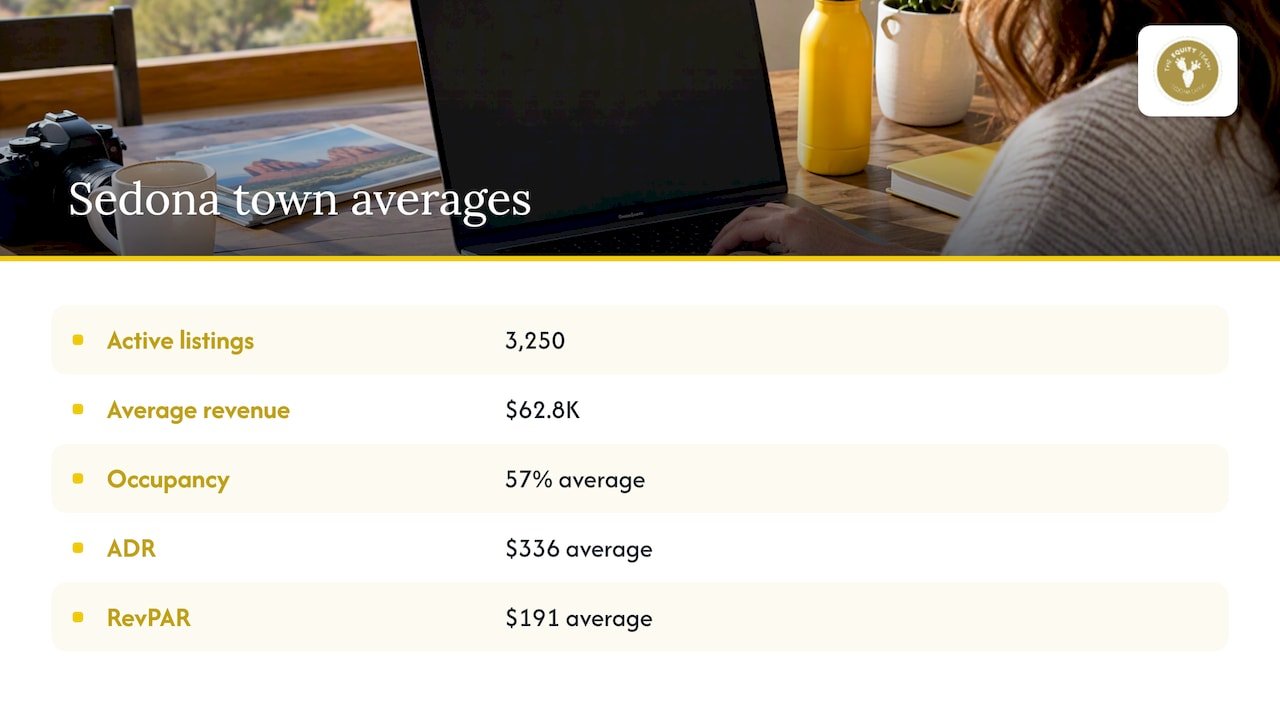
According to AirDNA’s Sedona data, updated September 2026, the town has 3,250 active listings, with average revenue of $62.8K, 57% occupancy, a $336 ADR and a RevPAR of $191. Treat those as the town-wide average, not as a target. The Equity Team works with owners aiming for the top of the market, and a listing in a quiet cul-de-sac with a tired kitchen will not behave like a rim-view home with a hot tub and a stargazing deck.
If you want the local read on occupancy, our own breakdown of Arizona Airbnb occupancy in the mid 50s shows how to turn that kind of benchmark into a decision.
The five-step loop
Good revenue management is a loop, not a setup screen you finish once. The five steps below follow the RedAwning framework, with Sedona flavor added.
- Build a baseline. Calculate ADR, occupancy and RevPAN for the past 12 months. Honest numbers, even the grumpy ones.
- Benchmark. Compare against genuinely similar homes: same bedroom count, similar views, similar amenities. A true comp set matters more than a big one.
- Set seasonal base rates with a floor and a ceiling. The floor protects you from giveaway nights. The ceiling stops an algorithm from getting starry-eyed during spring break.
- Turn on dynamic pricing. Let software nudge rates daily from demand signals, inside the guardrails you set.
- Review on a cadence. Check booking pace weekly to catch early trends, then do a monthly deep dive into RevPAN, as the same guide recommends.
Comp sets: the part everyone skips
Sedona is a patchwork. West Sedona, the Village of Oak Creek, Uptown and the Verde Valley towns each have their own guest type and seasons. A comp set that mixes them can tell a flattering story that your calendar will not repeat. Our Sedona vacation rental comparative market analysis page explains how we build the comparison on the property side, and the same discipline applies to nightly rates.
Pricing strategy without the drama
Dynamic pricing tools are powerful, and they still need a human who knows the home. Airbnb’s own host guidance says to review tool suggestions against your property’s amenities and local demand. Software has never seen your sunrise view. You have.
We compare the two approaches in detail in dynamic pricing vs manual pricing. The short version: most owners do best with automation inside rules they set, plus a human glance at big event weekends and slow stretches.
Do not surge at the last minute
Airline logic says price climbs as the date nears. Airbnb listings are not airplane seats. A peer-reviewed study of Airbnb listings examined price surges as the stay date approaches, and AirDNA’s revenue guide summarizes the lesson: for many listings, last-minute hikes can have a negative effect on revenue. Decide whether you prefer steady early bookings or a gamble on late premiums, then set floors and ceilings to match.
If you are mid-booking-window and wondering whether to touch the calendar, see our guide to Sedona STR pricing during active bookings.
Little habits, real money
- Update often. Airbnb reports that listings updating prices at least four times a year had over 30% more nights booked than those that did not.
- Use rules for gap nights. An automatic discount on one or two orphan nights between longer stays fills holes without manual fiddling.
- Think in total cost. Guests compare the full price with fees, so a low nightly rate with a hefty cleaning fee is not the bargain it looks like. Airbnb’s hosting advice makes this point under value for guests.
Revenue levers beyond the nightly rate
Here is the plot twist: sometimes the best pricing move is a better home. Airbnb Host Advisory Board member Katie Kay says that design and in-demand amenities often improve pricing power and occupancy more than manual adjustments alone, as the Airbnb guidance notes.
In Sedona, that can mean a hot tub positioned for the stars, a proper outdoor dining spot, blackout curtains for the early hikers, or a kitchen that makes guests want to cook rather than drive to dinner. Even small comforts count. Sleep quality shows up in reviews, and reviews show up in rankings, so something as ordinary as the right bedding for Airbnb hosts is a cheap place to start.

Style matters at purchase time too. Our piece on why Sedona architectural style affects value shows how the look of a home feeds both the nightly rate and the resale number.
Channels, calendars and direct bookings
Distribution is the quiet half of revenue management. Listing on more than one platform widens the audience, but it creates a risk: double bookings. That is the reason many owners add a channel manager, meaning software that syncs calendars and rates between platforms such as Airbnb and Vrbo. When comparing options, look for:
- two-way calendar sync that updates quickly
- rate rules that can differ per channel when needed
- unified messaging
- fees that make sense at your volume (one home does not need a portfolio-grade tool)
Direct bookings are the other prize. Repeat guests who return through your own site or a simple link save platform fees, though building that audience takes steady work: good photos, a clear brand, a guest list and a reason to return. Our Sedona rental marketing channel examples show how investors mix platforms with other sources.
Should you hire a revenue manager or property manager?
Some owners enjoy the spreadsheet. Others would rather watch a canyon wren. Full-service managers typically charge 15% to 30% of gross rental revenue, with luxury or niche locations climbing higher and a la carte or co-hosting setups often landing at 10% to 20%. Always ask whether the fee applies to gross bookings or net income.
AirDNA’s analysts argue that professional management can raise occupancy and revenue enough to offset the fee, and that short-term rental work is more intensive than long-term leasing, which is why the percentage is higher. Both can be true: a manager can pay for themselves, or can fail to. Ask for a trailing 12-month record on a comparable home before signing.
Taxes can quietly rewrite the math
Revenue is not profit, and tax treatment depends on how the property is used. The IRS explains in Topic 415 that renting your home fewer than 15 days in a year generally means you do not report that income, and that personal use above the greater of 14 days or 10% of days rented at fair market value makes the property a residence for deduction limits. The so-called 7-day rule is not a tax exemption. It relates to passive activity loss classification under section 469, and it does not decide whether income is subject to self-employment tax.
That is a conversation for a CPA who knows short-term rentals, especially before a purchase or sale. For Arizona specifics, start with our guide to Arizona Airbnb taxes and the page on cost segregation and local TPT rules.
Our perspective: when revenue management becomes a real estate question
We are real estate agents who specialize in Sedona short-term rentals, so we see revenue management from the side most software dashboards cannot: the day a home changes hands.
Here is what we have learned. A buyer who underwrites a purchase with rosy occupancy is borrowing trouble. The better habit is to work backward from realistic ADR and occupancy for that specific property type and location, then check whether the price still makes sense. The town-wide averages are a start, and our Cottonwood underwriting example shows how different the inputs look one town over.
Owners should also know that a strong income year does not automatically raise what an appraiser will say. Our page on Sedona appraisals for Airbnb explains why revenue and appraised value often travel on separate roads. Income helps tell the story to a buyer, but the comparable sales write the number.
And sometimes the numbers say the best revenue move is to stop. If the loop above has been run honestly for a season or two and the home still lags, that is information, not failure. A valuation and exit conversation costs nothing but an hour of attention, and it can reveal whether selling now beats another year of tinkering.
— Chad
Work with a team that reads both the calendar and the comps
If you are buying, we help you test a Sedona short-term rental against realistic performance before you commit. If you are selling, we start with a vacation rental CMA and a prep consultation so the listing shows the income and the home at their best. Start at our vacation rental selling page, or talk through your options in a rental exit strategy and valuation conversation.
A simple monthly routine
A workable rhythm for one home looks like this:
- Weekly, 15 minutes: check booking pace for the next 30, 60 and 90 days against the same point last year. Look for gaps, not just full weekends.
- Monthly, 45 minutes: compute occupancy, ADR and RevPAN. Compare them with your comp set and note what changed: new listings, events, reviews, a price tweak.
- Quarterly: revisit floors, ceilings, minimum stays and fees. Check whether a small upgrade could justify a higher base rate.
- Yearly: ask the bigger question. Is this home earning what the market says it should? If not, is the fix operational, physical or a sale?
Write the results down. A simple note beside each month turns hunches into a memory, and memory is what makes next spring’s pricing smarter.
FAQ
What is revenue management for a vacation rental?
It is the ongoing practice of setting price, availability and distribution to maximize revenue per available night over the year. Dynamic pricing is one tool inside it. Guest experience, channel mix and a regular review cycle matter just as much.
What are the five steps in revenue management?
Build a 12-month baseline of ADR, occupancy and RevPAN, then benchmark against comparable homes. Next, set seasonal base rates with a floor and ceiling, turn on dynamic pricing, and review monthly. The loop never really ends.
What is the 7-day rule for vacation rentals?
Under IRS rules, if the average guest stay is 7 days or less, the activity is generally not treated as a rental activity for passive loss purposes. It is not a tax exemption and does not settle self-employment tax questions, so check with a tax professional about your situation.
What percentage does vacation rental management take?
Full-service management commonly runs 15% to 30% of gross rental revenue, and sometimes more for luxury homes. Co-hosting or a la carte arrangements often cost 10% to 20%. Confirm whether the percentage applies to gross or net.
Sources
- Sedona, Arizona Airbnb and short-term rental data, AirDNA
- Vacation Rental Revenue Management Guide, RedAwning
- Vacation Rental Revenue Management: A Complete Guide, Rentals United
- Review your price, Airbnb Resource Center
- Controlling your pricing, Airbnb Resource Center
- Dynamic pricing and revenues of Airbnb listings, ScienceDirect
- Airbnb Revenue Management Secrets, AirDNA
- How much do property managers charge, AirDNA
- IRS Topic 415, Renting residential and vacation property
- Bedding for Airbnb hosts: practical buying guide