

In Sedona, buyer closing costs typically run about 2% to 3% of the purchase price, a bit lighter than Arizona’s broader 3% to 6% range reported by Rocket Mortgage. Buyers usually cover lender fees, appraisal, and their share of title costs, while sellers typically handle the commission and certain prorations. Your exact numbers show up on two documents: the Loan Estimate and the Closing Disclosure.
TL;DR:
- A $400,000 financed purchase typically brings $8,000 to $12,000 in fees; all cash buyers avoid lender charges, while jumbo deals can cost more dollars.
- Lenders must send a Loan Estimate within three business days of application and deliver the Closing Disclosure at least three business days before signing.
- Earnest money is credited toward cash to close, not added as a fee; your down payment and seller or lender credits change your amount due.
- Loan programs cap seller contributions, so confirm your specific limit with your lender before negotiating credits toward closing costs.
- Vacation rental buyers should check HOA restrictions, permit status, insurance requirements, and lender reserve rules early, since each can add paperwork or prepaid costs.
Table of Contents
- Typical Closing Cost Percentages by Price Range
- What’s Actually Inside Your Closing Costs
- Who Pays What, and What’s Negotiable
- When You’ll See the Numbers and What to Double-Check
- Sample Math: A $400,000 Home and a $1 Million Sedona Property
- Smart Ways to Trim Your Closing Bill
- Sedona-Specific Closing Quirks Worth Knowing
- Primary Residence Versus Short-Term Rental Closing Costs
- How Seller Concessions Change What You Walk Away With
- Earnest Money and How It Fits Into Your Closing Costs
- Local Incentives That Might Offset Your Closing Costs
- Why Local Guidance Still Matters at the Closing Table
- Getting Sedona Closing Support From The Equity Team
- FAQ
- Sources
Typical Closing Cost Percentages by Price Range
Sedona’s red rocks might make everything feel a little dreamier, but math is still math. The gap often comes down to local title and escrow pricing and the kinds of loans common in this market.
Here’s the quirky part: as prices climb into luxury territory, the percentage usually shrinks even though the dollar figure grows.
- Typical Sedona financed purchase: roughly 2% to 3% of price
- Broader Arizona average: 3% to 6% of price
- Luxury and jumbo purchases: lower relative percentage but higher total dollar closing costs
A quick rule of thumb: multiply your target purchase price by 2% to 3% to get a ballpark closing cost figure for a typical Sedona financed deal, a method consistent with how closing costs are generally estimated before you receive formal disclosures.
What’s Actually Inside Your Closing Costs
Your Loan Estimate splits everything into two tidy buckets: Loan Costs and Other Costs, a structure spelled out in the TILA-RESPA integrated disclosure guide. Loan Costs cover what your lender charges to originate and underwrite the loan. Other Costs cover everything else that makes the transaction legally real.
- Loan Costs: origination fee, appraisal, credit report, underwriting
- Other Costs: title insurance, escrow fees, recording fees, prepaid interest, initial escrow deposit for taxes and insurance
- HOA items: transfer fees or prorated dues where applicable
You can shop around for some of these, like the title company or a survey, while others, like the appraisal, are typically assigned by the lender. The Loan Estimate flags which is which, so you’ll know where comparison shopping can actually save you money.
Who Pays What, and What’s Negotiable
Sedona closings follow fairly standard Arizona conventions, though plenty is still up for negotiation.
- Buyers typically pay lender fees, the appraisal, and their portion of title insurance.
- Sellers typically pay the real estate commission, their loan payoff costs, and prorated property taxes up to closing.
- Seller credits can offset buyer costs when written into the purchase contract, reducing the buyer’s cash to close.
- Loan programs cap how much a seller can contribute, so buyers should confirm limits with their lender before negotiating.
A seller eager to close quickly might offer a credit toward your closing costs instead of a price cut, which can be a smarter move for your immediate cash needs. For a seller’s view on how these allocations shape final proceeds, our seller net proceeds guide breaks it down further.
When You’ll See the Numbers and What to Double-Check
Timing here isn’t flexible, and that’s good news for you. Lenders must deliver a Loan Estimate within three business days of your application, and a Closing Disclosure at least three business days before you sign, both required under federal disclosure rules.
Closing costs and cash to close aren’t the same thing. Cash to close factors in your earnest money, any seller or lender credits, and your down payment, not just the fees themselves.
- Compare your Closing Disclosure against your Loan Estimate line by line
- Check services you shopped for versus those assigned to you
- Confirm the seller credit amount matches your contract
- Verify the loan amount, interest rate, and recording fees
Pro Tip: Request your Closing Disclosure early and read it the same day it arrives, since catching an error with three days to spare beats discovering it at the signing table.
Sample Math: A $400,000 Home and a $1 Million Sedona Property
Numbers make this less abstract. On a $400,000 financed purchase, a 2% to 3% range puts closing costs between roughly $8,000 and $12,000, consistent with calculator-based estimates used across the industry. Add your down payment and subtract any earnest money or seller credit, and that’s your cash to close.
On a luxury purchase, total closing costs often amount to a lower percentage of price but a higher total dollar amount, driven by jumbo underwriting requirements and larger prepaid escrow deposits rather than price alone.
- $400,000 home: roughly $8,000 to $12,000 in closing costs
- $1,000,000 home: closing costs as a lower percentage but higher total dollar amount, influenced by jumbo loan complexity
All-cash buyers skip lender fees entirely, often trimming total costs by thousands, and buyers with larger down payments typically see smaller prepaid escrow requirements. For investors comparing financed deals, our Sedona Airbnb cash-to-close breakdown walks through a short-term rental scenario with reserves included.
Smart Ways to Trim Your Closing Bill
Nobody loves writing a bigger check than necessary, so here’s where you have actual leverage.
- Shop around for title insurance and any service your lender allows you to choose yourself.
- Compare a lender credit against a slightly higher rate to see which saves more over your expected time in the home.
- Ask the seller for a credit toward specific line items or a general closing cost allowance.
- Consider rolling some costs into your loan balance, understanding this raises your interest cost over time.
For buyers weighing a legal perspective on how these costs get calculated, Fornaro Legal’s breakdown of buyer closing cost math is worth a look.
Pro Tip: Always verify wire instructions by phone using a number you already know is correct, never one from an email, since closing fund scams remain a real risk flagged by the CFPB.
Sedona-Specific Closing Quirks Worth Knowing
Short-term rental purchases in Sedona carry their own wrinkles. Occupancy-related disclosures, HOA rules restricting vacation rentals, and permit transfer questions can all surface late if nobody checks early.
Jumbo and luxury transactions bring their own underwriting timelines, often requiring more documentation and a longer appraisal window than a standard loan.
- We flag title exceptions and unreleased liens before they become closing-week surprises.
- We check HOA documents for short-term rental restrictions ahead of the purchase contract.
- We confirm permit and licensing status for active or planned vacation rentals.
As Sedona’s first short-term rental specialized real estate team, we built our process around exactly these quirks, because a surprise HOA rule two days before closing helps no one.
Primary Residence Versus Short-Term Rental Closing Costs
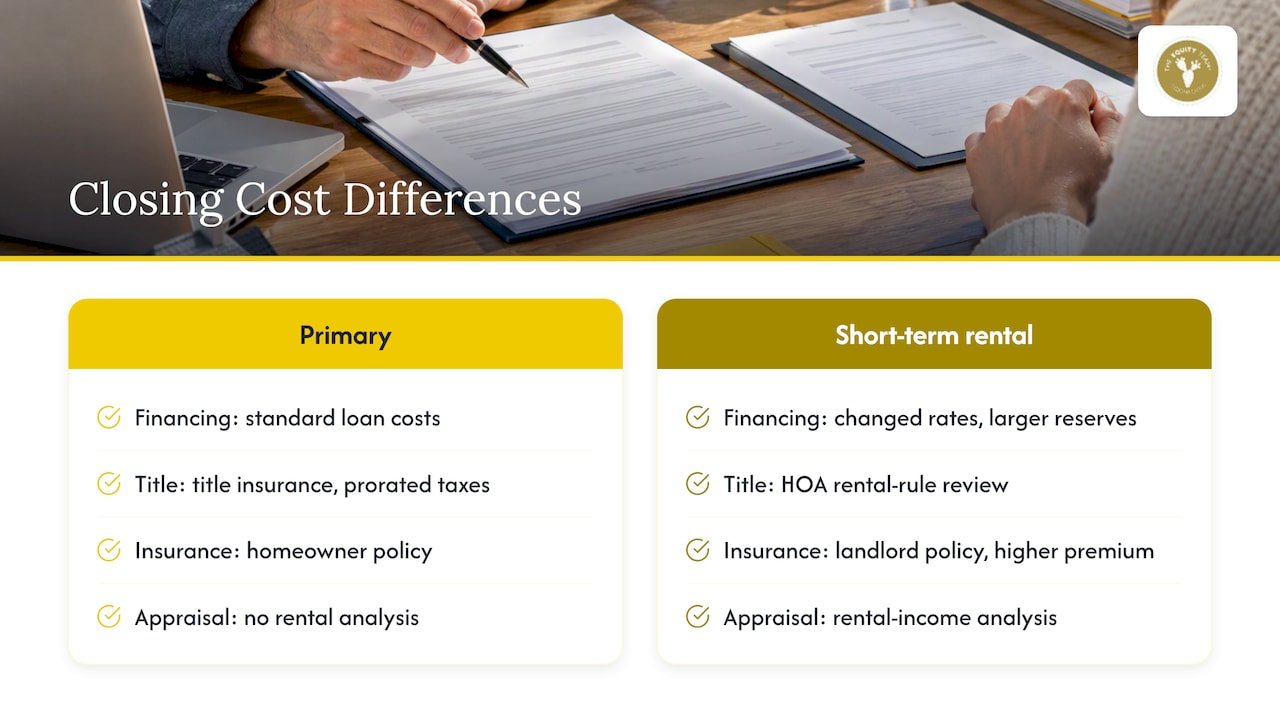
Buying a home to live in and buying a Sedona short-term rental investment share the same basic closing cost categories, but the dollar amounts and the paperwork can diverge quickly. A primary residence closing typically involves standard loan costs, title insurance, and prorated taxes, with few surprises beyond the usual.
A short-term rental purchase often adds extra steps. Lenders may classify the property differently depending on whether you’re financing it as an investment property, which can mean a different rate structure and larger reserve requirements at closing. Title work may also take longer if the property sits within an HOA that regulates or restricts vacation rentals, since those documents need review before you can close with confidence.
Insurance is another divergence point. A short-term rental often requires a commercial or landlord policy rather than a standard homeowner’s policy, and your lender’s prepaid escrow deposit will reflect that higher premium. Appraisals for income-producing properties sometimes include a rental income analysis, adding a step that a primary residence purchase skips entirely.
None of this means an STR purchase costs dramatically more in percentage terms, but it does mean more moving pieces to track, and more reasons to have someone checking the file for Sedona-specific red flags before you’re locked into a closing date.
How Seller Concessions Change What You Walk Away With
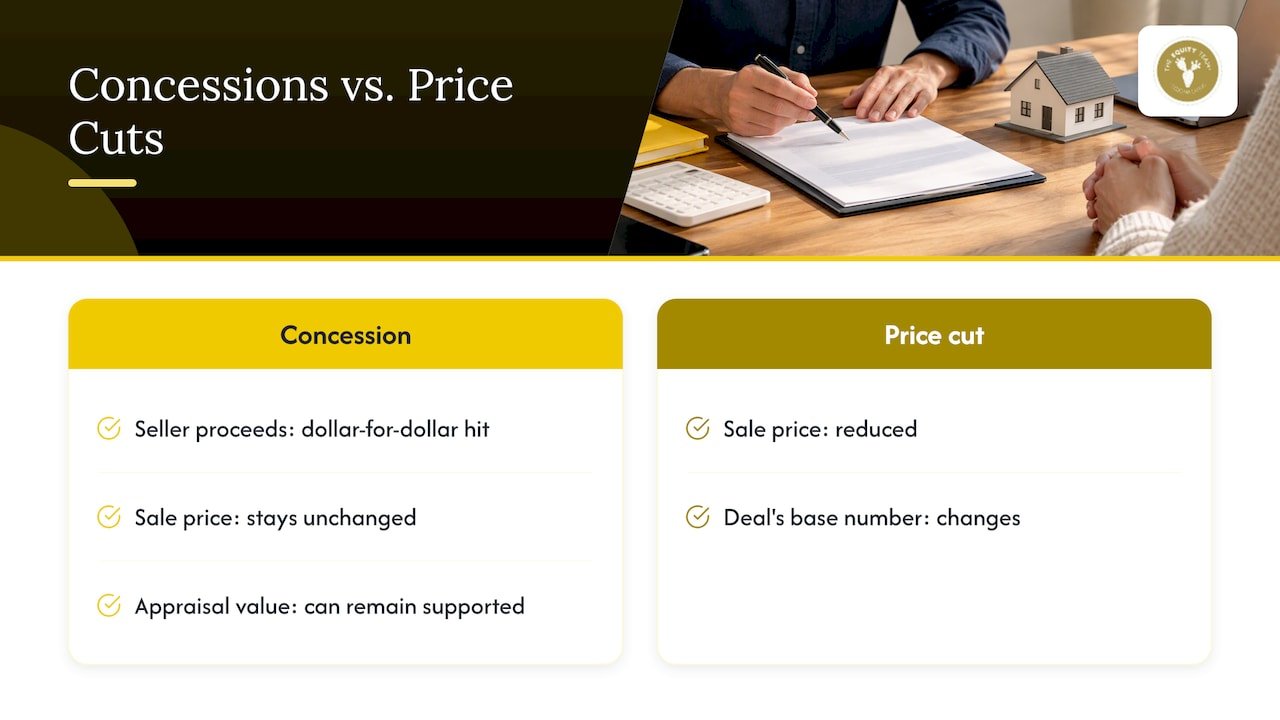
A seller concession is simply money or value a seller agrees to give up to make a sale happen, and it comes straight out of net proceeds. The most common form is a credit toward the buyer’s closing costs, often used to bridge a gap when a buyer’s cash is tight but the offer price works for the seller.
Concessions can also take the shape of covering specific repairs instead of making them, paying for a home warranty, or offering a rate buydown credit that lowers the buyer’s monthly payment for a year or two. Each of these reduces what lands in the seller’s pocket at closing, even though the sale price on paper stays the same.
Sellers sometimes prefer a concession over a price reduction because it can make the math work for a buyer’s lender without changing the appraisal-supported value of the home. The trade-off is straightforward: a concession is a direct dollar-for-dollar hit to net proceeds, while a price cut affects the number the whole deal is built around. Our Sedona seller net proceeds guide walks through how these choices show up on a seller’s final settlement statement.
Earnest Money and How It Fits Into Your Closing Costs
Earnest money often gets lumped in with closing costs in casual conversation, but it works differently. It’s a deposit you put down shortly after your offer is accepted to show you’re serious, and it’s held in escrow rather than spent on any fee.
At closing, your earnest money is credited toward your cash to close, a treatment confirmed in the CFPB’s Loan Estimate overview. That means the deposit effectively reduces the amount you need to bring at the closing table, rather than adding to your expenses.
The practical takeaway is that earnest money isn’t an extra cost sitting on top of your closing costs. It’s money you’ve already committed that gets folded back into the final tally, so a bigger earnest money deposit simply means less cash due later, not more cash spent overall.
Local Incentives That Might Offset Your Closing Costs
Sedona itself doesn’t maintain a dedicated municipal closing cost grant program the way some larger cities do, so buyers here typically rely on broader options available to Arizona buyers. State and national down payment assistance programs can sometimes be paired with a qualifying loan to reduce upfront cash needs, though eligibility and availability shift over time and depend on loan type, income, and property use.
Lender credits remain the most consistently available option in Sedona’s market, where a buyer accepts a slightly higher interest rate in exchange for the lender covering part of the closing costs. Seller credits, discussed earlier, function similarly from the other side of the table.
Because dedicated local grant programs aren’t a fixture of the Sedona market the way they are elsewhere, your best strategy is usually a combination of seller negotiation, lender credit comparison, and loan program selection, verified directly with your lender before you’re locked into final numbers.
Why Local Guidance Still Matters at the Closing Table
Every closing has a surprise or two, even when the numbers look clean on paper. We’ve found that the Closing Disclosure rewards a careful second read, and a quick question to your lender or agent can catch a mismatch before it becomes a delay. Verify your numbers, ask what you don’t understand, and don’t assume silence means everything’s fine.
— Chad
Getting Sedona Closing Support From The Equity Team
Closing costs are easier to manage when someone’s already walked this exact road in this exact market. We offer buyer and seller representation across Sedona and the Verde Valley, along with a Sedona Home CMA for sellers who want a clear starting number and a Sedona vacation rental CMA for owners weighing an exit.

A typical first conversation covers your goals, a property or market snapshot, and what your closing timeline realistically looks like. If you’re sizing up a rental exit, our Sedona rental exit strategy session is a good next step. Ready to talk specifics? Start here.
FAQ
How much are closing costs on $400,000?
On a $400,000 Sedona purchase, closing costs typically fall between $8,000 and $12,000, based on a 2% to 3% rate for typical Sedona financed deals. Your exact figure depends on your loan type, down payment, and any seller credits negotiated into the contract.
Is it expensive to live in Sedona, Arizona?
Sedona carries a reputation for higher home prices than the Arizona average, which affects total closing costs in dollar terms even when the percentage stays moderate. Day-to-day living costs vary by lifestyle, but housing is generally the biggest factor buyers weigh before relocating.
What are the average closing costs in Arizona?
Arizona closing costs typically run between 3% and 6% of the purchase price statewide, according to Rocket Mortgage.
Is 10% closing cost normal?
A high closing-cost figure usually signals an unusual fee, a miscalculation, or costs that have been bundled incorrectly, worth reviewing with your lender right away.
What’s the difference between closing costs and cash to close?
Closing costs are the fees tied to the loan and transaction itself, while cash to close also factors in your down payment, earnest money credit, and any seller or lender credits. The CFPB’s Closing Disclosure guide outlines exactly how these numbers combine on your final paperwork.
Sources
- Closing disclosure explainer | Consumer Financial Protection Bureau
- TILA-RESPA INTEGRATED DISCLOSURE guide to the Loan Estimate and Closing