
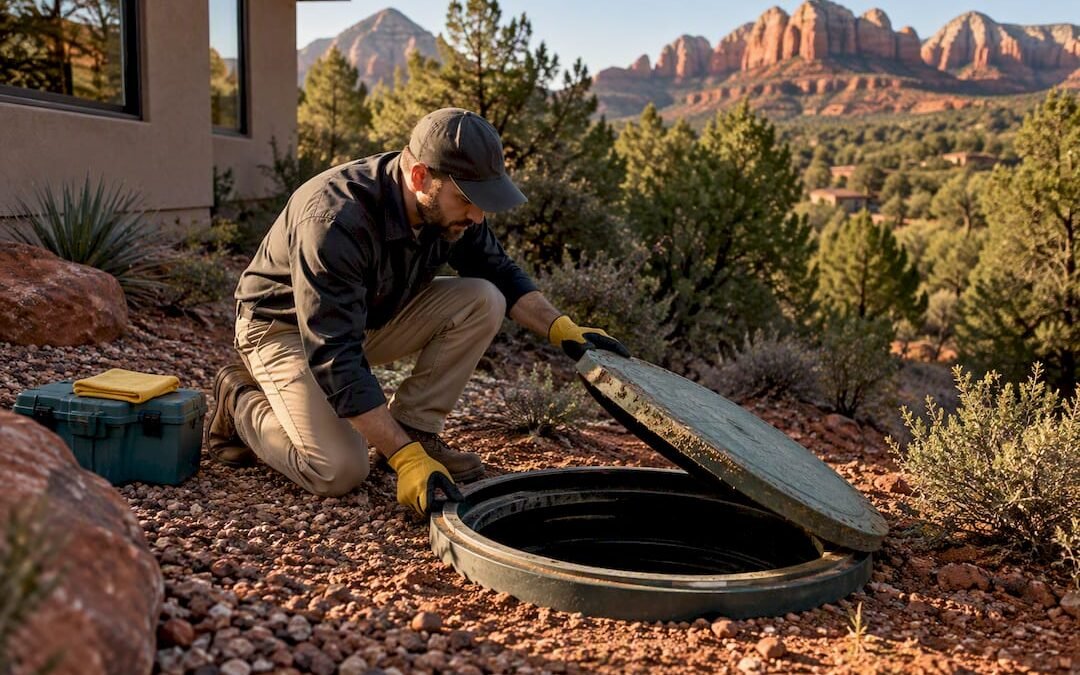
Yes, you can run a short-term rental on a Sedona property with a septic system, but the septic rules dictate what you can build, expand, or advertise. Sedona bans new private septic where city sewer is available, and your permitted bedroom count (not your imagination) sets your legal guest capacity. Before you list or buy, verify the septic permit, confirm the building permit matches actual bedrooms, and lock down your City of Sedona short-term rental permit.
TL;DR:
- Private septic systems are allowed in Sedona only if sewer service is unavailable, but new septic construction is prohibited where city sewer exists.
- The legal guest capacity depends on the permitted bedroom count and septic system size, not the number of guests advertised or furniture arrangements.
- Confirm the property’s septic permit, building permit, and maintenance records before buying or listing, and consider a certified inspection if records are missing or outdated.
- Short-term rental permits require proof of health and sanitation compliance, which includes a functioning septic system and can trigger inspections following complaints or permit issues.
- Noncompliance with septic and permit regulations can lead to notices, fines, permit suspension, or even legal charges, making proper due diligence essential for ownership and operation.
Table of Contents
- City vs. County: Who Actually Regulates Your Septic System?
- What Sedona’s Septic Code Actually Prohibits
- How Septic Capacity Sets Your Legal Guest Limit
- Your Septic Due Diligence Checklist Before Buying or Listing
- The City’s STR Permit and Its Health Code Teeth
- What Happens When You Get It Wrong: Enforcement and Penalties
- How Equity Team Weighs Septic Risk in a Sedona STR Deal
- Three Moves to Make Before You List or Close
- Let Equity Team Handle the Paperwork Maze for You
- Where to Verify These Rules Yourself
- Sources
- FAQ
City vs. County: Who Actually Regulates Your Septic System?
Sedona sits in a strange administrative pocket. Part of the city straddles Yavapai County and part touches Coconino County, and which office governs your septic system depends entirely on whether your parcel falls inside city limits or out in the county.
Inside Sedona’s city limits, the municipal code governs wastewater. That means the Sedona City Code controls whether you can have a private septic system at all, and whether you’re required to connect to city sewer instead. Outside city limits, in unincorporated Yavapai County territory, the Yavapai County Environmental Services division takes over. This is the office that issues septic permits, sizes drain fields, and enforces septic maintenance for properties beyond Sedona’s municipal reach.
Layered on top of both is state law. Arizona’s A.R.S. 9-500.39 statute prevents Sedona from banning short-term rentals outright, but it does not touch septic or wastewater authority. That stays firmly local. The city can require permits, inspections, and fees for STRs; it just can’t say “no vacation rentals, period.”
Here’s the quick reference for who to call first:
- Inside Sedona city limits: Start with the City of Sedona Community Development Department for septic and building permit history.
- Outside city limits (unincorporated Yavapai County): Contact Yavapai County Environmental Services directly for septic permit records and sizing requirements.
- Uncertain which jurisdiction applies: Pull your parcel number and check it against the county assessor’s map before making a single phone call. It saves you from bouncing between two offices.
- STR permit legality questions: These run through the city regardless of septic jurisdiction, since A.R.S. 9-500.39 governs STR operation statewide.
Get this jurisdiction question wrong and you’ll spend a week on hold with the wrong department. Sedona’s oak-covered canyons might feel like one seamless red-rock wonderland, but bureaucratically, it’s split down the middle.
What Sedona’s Septic Code Actually Prohibits
Sedona’s municipal code doesn’t dance around the subject. Sedona City Code 13.15.010 makes it unlawful to construct, install, or operate a new private sewage disposal system, meaning septic, unless city sewer service isn’t yet available to the property. If sewer lines run past your lot, the city expects you to hook up. No exceptions granted just because the existing septic tank “still works fine.”
The code carves out one meaningful exception: properties in areas where the city hasn’t extended sewer infrastructure can keep operating an existing septic system, provided it’s maintained in a sanitary condition and holds valid permits. This exception is exactly why so many older Sedona neighborhoods, especially those tucked into red rock terrain where sewer lines are expensive to run, still rely on septic decades after being built.
Here’s what this means in practice for an STR owner:
- If sewer becomes available near your property, the city can issue a notice requiring you to connect within a set timeframe, and ignoring that notice creates a code violation independent of your STR permit status.
- If you’re already on septic with no sewer access, you can keep operating it, but you’re on the hook for sanitary maintenance and permit compliance the whole time.
- If you’re buying a property, check whether a sewer-availability notice has ever been issued. A notice sitting unresolved is the kind of thing that surfaces during a title search and stalls closing.
A sewer-availability notice matters more than most buyers realize. It’s not a suggestion, it’s a legal trigger, and an unresolved one can turn into fines that accumulate while your Airbnb calendar keeps filling up with bookings you may not legally be able to honor for long.
How Septic Capacity Sets Your Legal Guest Limit
Sedona doesn’t publish a flat citywide occupancy cap for short-term rentals. Instead, occupancy gets tied to two things: your building permit’s documented bedroom count and your septic system’s rated capacity, a practice confirmed by county-level occupancy guidance for the surrounding area.
Here’s the mechanism. Yavapai County sizes septic systems based on projected wastewater flow, and that projection is built from bedroom count, not guest headcount. A three-bedroom home gets a septic system engineered for roughly the flow of six occupants sleeping there regularly, give or take local sizing formulas. If you’ve quietly converted a den into a fourth “bedroom” without pulling a permit, your septic system was never rated for that extra load, and neither was your legal occupancy.
The math that trips people up: a homeowner buys a home permitted for three bedrooms, converts a bonus room into a fourth sleeping space, lists it on Airbnb as “sleeps 10,” and never touches the septic or building permit. The listing platform doesn’t check permits. The county eventually might, especially if a neighbor complains about the number of cars in the driveway every weekend.
Set your advertised guest limit to match your permitted bedroom count, not your optimistic furniture arrangement. If you want to legally sleep more guests, that requires a permitted bedroom addition, which triggers a septic capacity review under the same code covering private sewage disposal systems. If the existing system can’t handle the added flow, you upgrade the septic or the permit gets denied. There’s no way around that sequence.

Your Septic Due Diligence Checklist Before Buying or Listing
Septic compliance isn’t something you eyeball from the driveway. It’s paperwork, and specifically, paperwork that sellers sometimes don’t have handy because it was filed decades ago with an office that’s since reorganized twice.
Here’s the sequence that actually protects you:
- Request the original septic permit and as-built diagram. This document shows the system’s rated capacity, tank size, and drain field layout, filed with either the city or Yavapai County depending on jurisdiction.
- Pull the building permit and certificate of occupancy. Compare the documented bedroom count against what the seller is advertising as the sleeping capacity. Mismatches here are the single biggest red flag in Sedona STR deals.
- Ask for septic service and maintenance records. A well-documented history of pumping and inspection tells you the system has been cared for; a blank file tells you nothing, which is its own kind of warning.
- Order a certified septic inspection. A licensed inspector checks tank integrity, drain field function, and signs of surfacing effluent, and this inspection typically runs alongside a standard home inspection, though it’s a separate line item.
- Request a soil or percolation test if records are missing entirely. This confirms whether the existing drain field can even support current or expanded use, which matters enormously in Sedona’s rocky, low-permeability terrain.
Watch for these red flags during the process: missing permits with no county record on file, a system older than 25 to 30 years with no documented upgrades, patchy or unusually green grass over the drain field (a classic sign of surfacing effluent), and any evidence of recent unpermitted repairs. Each one is a reason to negotiate price, request a contingency, or walk away entirely.
Pro Tip: Order the septic inspection before you fall in love with the view. Sedona’s red rock terrain makes some drain field repairs dramatically more expensive than a flat-lot equivalent, and that number should shape your offer, not surprise you after closing.
For a fuller walkthrough of what a Sedona inspection should cover beyond septic, the Sedona investment property inspection guide breaks down the full checklist. And if you’re the seller, the Sedona property disclosure requirements guide covers exactly what you’re obligated to hand over.
The City’s STR Permit and Its Health Code Teeth
Every advertised short-term rental unit in Sedona needs its own annual permit, and that permit application asks for more than just your name and address. You’ll typically need proof of a valid Transaction Privilege Tax (TPT) license, liability insurance meeting the city’s minimum, current contact information for someone who can respond to complaints, and confirmation that the property meets applicable health and sanitation standards.
That last item is where septic circles back into the conversation. Under Sedona City Code 5.25.050, STR operators must comply with health, safety, and sanitation standards, and the code authorizes the city to inspect a property when there’s reason to suspect noncompliance. A failing septic system, sewage odor complaints, or visible drain field issues are exactly the kind of thing that triggers that authority.
Inspections don’t happen randomly. They generally get triggered by:
- A neighbor or guest complaint about odor, sewage backup, or visible system failure.
- Incomplete or inconsistent permit applications, where something in your paperwork doesn’t add up (bedroom count versus septic records, for instance).
- Permit renewal irregularities, especially if a previous violation was never formally closed out.
To prepare for either a first-time application or a renewal inspection, gather your septic permit, your building permit and CO, your most recent pumping and maintenance receipts, and your TPT license, and keep them in one folder, digital or otherwise. If the city ever asks, “can you show us this system was properly permitted and maintained,” you want the answer to be a folder, not a shrug. Recent restriction changes to Sedona’s STR program have made the city more attentive to permit accuracy overall, so sloppy paperwork carries more risk now than it did a few years back.
What Happens When You Get It Wrong: Enforcement and Penalties
Sedona’s enforcement path follows a fairly predictable sequence, and it rarely starts with a fine. It starts with a complaint, usually from a neighbor tired of a septic odor drifting over the fence line or a driveway packed with more cars than a three-bedroom permit should allow.
From there, the city typically investigates, issues a notice of violation with a correction deadline, and only escalates to fines or permit suspension if the issue goes unaddressed. Under the framework governing STR use regulations, repeated or unresolved violations can lead to civil penalties, and in more serious cases, misdemeanor charges tied to health and sanitation noncompliance under SCC 5.25.050.
The escalation ladder generally looks like this:
- First violation: notice of violation with a correction window, often 10 to 30 days depending on severity.
- Uncorrected or repeat violations: civil fines, which can accumulate per day the violation continues.
- Severe or repeated noncompliance: STR permit suspension or revocation, which takes the listing offline entirely.
- Serious incidents (confirmed sewage contamination, hosting banned events tied to septic overload from excess guests): these carry the steepest consequences and the least patience from the city.
If you receive a notice, the smart move is immediate, documented response. Fix the issue, keep receipts, and communicate proactively rather than waiting to see if the city forgets about it. Cities rarely forget about septic complaints. Neighbors remind them.
How Equity Team Weighs Septic Risk in a Sedona STR Deal
Septic issues change the math on a Sedona STR purchase more than almost any other single factor, and Equity Team treats it that way during every acquisition review. The checklist is consistent: pull septic and building permits first, coordinate a certified inspector before the inspection contingency closes, verify the permitted bedroom count against the advertised sleeping capacity, and write contingency language that protects the buyer if records come back incomplete.
Septic replacement costs vary widely depending on terrain and drain field access, and Sedona’s rocky lots often push costs toward the higher end of that range. When records are missing or a system shows its age, that uncertainty belongs in the offer itself, either as a price reduction or a repair escrow, not as a surprise discovered after closing. Owning short-term rentals in the top tier of Sedona’s market means treating septic due diligence as seriously as revenue projections.
Three Moves to Make Before You List or Close
Septic paperwork in Sedona has a way of hiding until the worst possible moment, usually during a permit renewal or right before closing. Getting ahead of it isn’t complicated, it just requires doing it before you’re forced to.
First, collect your records now, not when a buyer or the city asks for them. Pull the septic permit, building permit, and CO today, whether you’re selling, buying, or simply renewing an existing STR permit.
Second, if records are incomplete or missing, order a certified inspection immediately. Don’t wait for a complaint to force the issue. Treat septic verification as a purchase contingency if you’re buying, and as a disclose-and-remedy item if you’re selling.
Third, confirm your STR permit status with the city before you advertise a single night. A Sedona STR specialist who understands both the zoning rules and the septic side of due diligence can coordinate local inspectors and county contacts faster than most owners can on their own.
— Chad
Let Equity Team Handle the Paperwork Maze for You
An experienced local real estate team can help you navigate Sedona’s septic and STR compliance maze, pairing local permit knowledge with transaction experience to avoid being overwhelmed by multiple agencies as your closing date approaches.

Whether you’re buying a property with an aging septic system or selling one and want top dollar despite the paperwork, our services are built around exactly this kind of due diligence. We offer buyer representation that includes STR-specific due diligence coordination, a Sedona vacation rental CMA that accounts for septic condition in your valuation, and seller prep consultations that get your permit file in order before a buyer ever asks. If you’re weighing whether to sell now or hold, our rental exit strategy conversation walks through the numbers with septic risk already factored in. Reach out through OwnInAZ to schedule a review of your property’s compliance picture before you list, buy, or renew.
Where to Verify These Rules Yourself
Every rule in this guide traces back to a primary source, and you should bookmark these rather than take anyone’s word for it, ours included.
The private sewage disposal prohibition and its exceptions live in Sedona City Code 13.15.010. The STR use regulations covering health, safety, and sanitation inspections sit in Sedona City Code 5.25.050. For properties outside city limits, Yavapai County Environmental Services handles septic permitting and sizing directly. A consolidated (though secondary) summary of Sedona’s STR permit fees and enforcement mechanics is available through ShortRentalRules’ Sedona guide, though you should always confirm specific fees and deadlines with the city directly before relying on them.
This article is general information, not a substitute for advice from a qualified lawyer. Consult a qualified legal professional about your own circumstances before acting on anything here.
Sources
- 13.15.010 Private sewage disposal systems prohibited
- Yavapai County official website
- Sedona, AZ Short-Term Rental Laws (ShortRentalRules)
FAQ
Can I operate a short-term rental on a property with septic in Sedona?
Yes, septic systems don’t disqualify a property from STR use, but the property still needs a valid septic permit, a matching building permit, and a City of Sedona STR permit. If sewer service is available to your lot, new private septic construction is prohibited under SCC 13.15.010.
Why is yellow not allowed in Sedona, Arizona?
Sedona’s sign and building color code restricts bright colors like yellow on structures and signage to preserve the muted, earth-tone aesthetic that blends with the surrounding red rock landscape. This is a zoning and design ordinance, separate from septic or STR rules, but it’s part of the same broader city code framework that governs what you can build and display on your property.
What is the “secret 7” in Sedona?
There’s no officially documented secret number tied to Sedona’s municipal code or STR regulations. If you’ve heard phrases regarding local legend, they fall outside verified regulatory sources and aren’t something this guide can confirm.
What are the legal requirements for short-term rentals in Sedona?
Operators need an annual City of Sedona STR permit per advertised unit, a valid TPT license, minimum liability insurance, and compliance with health and sanitation standards under SCC 5.25.050. Arizona’s A.R.S. 9-500.39 prevents the city from banning STRs outright, but local permit, occupancy, and septic rules still apply in full.
Which celebrity lives in Sedona?
Sedona has attracted various celebrities and public figures over the years drawn to its scenery and privacy, though specific current residents aren’t something this guide can verify with certainty. If you’re researching the neighborhood for investment purposes, working with a local agent who tracks the luxury market gives you a far more reliable read than celebrity rumors.