

“Sedona self managing Airbnb” is really about self-directed investing, not solo hosting: it means buying, selling, or underwriting a Sedona short-term rental with an STR-specialist agent guiding the deal instead of a generic realtor. The Equity Team fills that role locally. Before anything else, know two facts: every advertised unit needs a City of Sedona Short-Term Rental Permit, and every operator needs a state Transaction Privilege Tax (TPT) license.
TL;DR:
- Sedona short-term rental permits cost $210 per unit annually, with late renewal fees starting at $50 in 2026, and are required for legal operation.
- An STR-specific agent verifies permit status, analyzes actual rental income, and connects buyers to lenders and insurers familiar with Sedona’s rental market.
- Sedona cannot ban short-term rentals outright due to state law, but permits and zoning restrictions heavily influence a property’s profitability and legality.
- Successful marketing depends on professional photos, dynamic pricing, fast response times, and amenities that justify premium rates, all vital for maximizing occupancy.
Table of Contents
- What Does “Self-Managing” Actually Mean for Sedona Buyers?
- What Permits and Zoning Rules Govern Sedona Short-Term Rentals?
- What Taxes and Insurance Costs Affect Sedona STR Returns?
- How Does The Equity Team Reduce Risk for Sedona STR Buyers and Sellers?
- How Do You Choose the Right Sedona STR Agent?
- Ready to Talk to a Sedona STR Specialist?
- What Does It Really Cost to Self-Manage a Sedona Airbnb?
- How Do You Market a Sedona Airbnb for Maximum Occupancy?
- How Do You Keep Neighbors Happy and Avoid Enforcement Action?
- What Tools Help You Run a Sedona Airbnb Without Losing Your Mind?
- Where Can You Verify Sedona STR Rules Yourself?
- Sedona STR Representation: What the Data Actually Supports
- Work With Sedona’s First STR-Specialist Real Estate Team
- Sources
- FAQ
What Does “Self-Managing” Actually Mean for Sedona Buyers?
This guide is not about cleaning schedules or dynamic pricing software. It’s about the real-estate side of the equation: how a buyer or seller navigates a Sedona STR transaction without getting steamrolled by red rock views and rosy projections. That’s a different job than hosting, and it needs a different kind of expert.
An STR-specialist agent earns their fee by doing things a standard buyer’s agent typically skips. They vet a listing’s permit status before you write an offer. They pull STR-specific comparables, not generic three-bedroom comps that ignore rental income entirely. They negotiate price against actual trailing revenue data, and they connect you to lenders, insurers, and cleaners who already understand how Sedona STRs work.
The ideal client here isn’t hunting for a weekend getaway. It’s an investor chasing yield, or a seller who wants their listing marketed to buyers who actually understand what a $272 average daily rate means for a mortgage payment. That distinction shapes everything downstream, from which properties get shown to how an offer gets structured.
What Permits and Zoning Rules Govern Sedona Short-Term Rentals?
Arizona law gets involved before city hall does. Under A.R.S. 9-500.39, the state preempts cities from banning short-term rentals outright. Sedona can regulate how STRs operate. It cannot simply outlaw them, which is why the city leans hard on permitting and operational rules instead.
That permitting shows up in City Code Chapter 5.25, and it applies per advertised unit, not per property. A duplex advertised as two separate listings needs two permits.
- Annual permit fee: $210 per unit, non-negotiable and renewed yearly.
- Late renewal penalties starting January 1, 2026: $50 for filings 2 to 90 days late, $100 beyond that.
- Eligible structures generally include single-family homes and dwellings with one to four units; casitas and ADUs carry their own eligibility quirks worth checking against Sedona’s ADU rules before assuming a guesthouse can legally list.
- Weddings and retreats are banned outright as STR uses under city rules.
- Owner or designee contact information must be publicly posted, and neighbor complaints route through a 24-hour hotline at 928-203-5110, with a dedicated enforcement process tracking violations.
Quick fact: A property with an active, transferable STR permit and no history of code complaints is worth more to an investor than one without, even at an identical list price. Verify permit status with the city before you get emotionally attached to a listing.
What Taxes and Insurance Costs Affect Sedona STR Returns?
Budget around a little over one-fifth of gross revenue for combined occupancy taxes. That figure blends the state transaction tax with county and city bed and hotel taxes, and it’s the single most underestimated line item in amateur STR underwriting.
Every operator needs a state TPT license before advertising or accepting a single reservation. That part is non-negotiable, and it has to happen before the first booking, not after.
- Yavapai County’s portion runs 6.325%, layered with a 3.5% city hotel tax and a 3.5% city bed tax. Coconino County parcels calculate slightly differently, so confirm the exact split for your specific address.
- Platforms like Airbnb often remit some tax lines automatically, but direct bookings, personal websites, and phone reservations still require the host to file and remit personally.
- Minimum liability insurance is at least half a million dollars aggregate, or equivalent coverage supplied through an online lodging marketplace under state law.
- Market data from mid 2025 put Sedona’s roughly 1,847 active listings at about 70% occupancy with a $272 average daily rate, useful context, but a citywide average, not a promise for your specific block.
Treat that occupancy and rate figure as a starting point, then ask an agent for actual trailing 12-month comps on the property you’re considering. Citywide averages flatten the huge gap between a west-side view home and a condo near Uptown traffic.
How Does The Equity Team Reduce Risk for Sedona STR Buyers and Sellers?
The Equity Team was the first agency to specialize in short-term rental representation in Northern Arizona, and the client roster reflects it: buyers and sellers operating in the top 10% of Sedona’s rental market. That’s not a general real-estate practice with an STR page bolted on. It’s the core focus.
The concrete deliverables look like this:
- STR-specific comparative market analyses that weigh trailing revenue, not just square footage and bedroom count.
- Deed restriction and HOA reviews, since plenty of Sedona neighborhoods quietly prohibit or restrict short-term use regardless of city permitting.
- Hands-on permit navigation, including guidance on ADU eligibility and renewal timing.
- Introductions to local lenders who understand STR income for underwriting, plus insurers and cleaning networks already vetted for the market.
- Staging and marketing built around STR buyers, including Chad’s video walkthroughs that show a property’s actual rental potential instead of a generic listing slideshow.
A typical buyer engagement starts with an intake call, moves into STR comp pulls within days, and reaches offer-ready analysis before most agents finish their first showing. Sellers get a revenue-backed listing strategy instead of a guess dressed up as a price.
Pro Tip: In your first conversation with any agent, ask them to pull trailing 12-month revenue data and occupancy comps for a specific address, not a neighborhood average. If they can’t produce it within a day or two, that tells you how deep their local rental expertise actually goes.
How Do You Choose the Right Sedona STR Agent?
Vetting an agent for STR work takes about fifteen minutes and a short list of pointed questions. Ask these before signing anything:
- How many STR-specific transactions have you closed in Sedona in the past 12 months?
- Can you show a sample STR comparative market analysis for a property similar to what I’m considering?
- Walk me through a recent permit or HOA complication you helped a client resolve.
- Which local lenders, insurers, or property managers do you regularly refer STR clients to?
- Can I speak to a past client who bought or sold a Sedona STR through you?
Request documentation, not just answers. A real STR specialist should hand over a sample CMA, occupancy and ADR figures for comparable listings, and at least one example of a permit issue they’ve navigated firsthand.
Red flags are easy to spot once you know what to look for: an agent who can’t produce STR-specific comps, who seems unfamiliar with the $210 permit fee, or who has no answer when you ask about deed restrictions. Weigh three factors when deciding: regulatory risk (is the property’s permit status airtight?), yield confidence (do the comps hold up against citywide averages?), and operational readiness (does the agent’s network cover insurance, lending, and cleaning)? A property that scores well on all three is worth moving fast on. One that fails even one deserves a harder look.
Ready to Talk to a Sedona STR Specialist?
Contacting The Equity Team starts with a straightforward viability check on any property you’re eyeing, whether you’re buying or getting ready to list. That first conversation typically produces an STR-specific comparative market analysis and a clear read on permit status, zoning fit, and realistic revenue expectations, not a generic sales pitch.

Expect a document checklist up front (deed, HOA info if applicable, any existing permit records) and a turnaround of a few business days on the initial analysis. From there, you’ll know whether a property clears the bar for top performing Sedona STR investment territory or needs a second look. Reach out, share the address you’re considering, and get the numbers before you get attached to the view.
What Does It Really Cost to Self-Manage a Sedona Airbnb?
Underwriting a Sedona STR means stacking every recurring cost against realistic revenue, not just the mortgage. The permit fee is fixed and predictable: $210 per unit annually, plus a possible $50 or $100 late fee starting in 2026 if renewal slips past deadline. That part is easy to model.
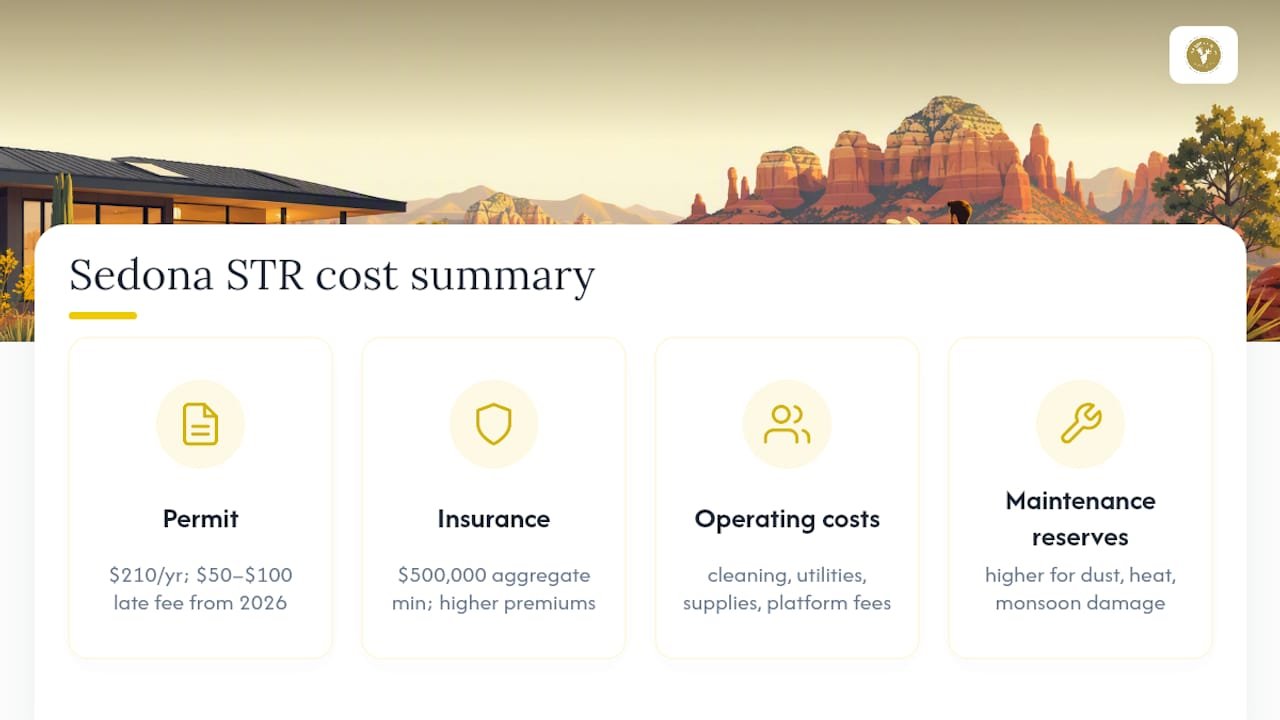
The bigger swing items are taxes and insurance. Liability insurance meeting the $500,000 aggregate minimum typically runs higher than a standard homeowner policy, since STR use carries more foot traffic and turnover risk than a full-time residence; learn more about tree service liability and homeowner risks to understand related insurance considerations.
Beyond those fixed obligations, self-managing owners typically absorb cleaning and turnover costs between guest stays, utility bills that run higher than long-term rentals due to constant HVAC and hot tub use, supply restocking, and platform fees on booking sites. Maintenance reserves matter more in Sedona than in milder climates, since dust, heat, and monsoon season all take a toll on desert properties faster than owners expect.
Compare that full picture against what professional property management actually costs in Sedona before deciding whether self-management genuinely saves money or just shifts the work onto your own calendar.
How Do You Market a Sedona Airbnb for Maximum Occupancy?
Sedona’s red rock scenery does a lot of marketing on its own, but relying on that alone leaves money on the table against listings that optimize deliberately. Professional photography that captures golden hour light on the rocks consistently outperforms flat daytime shots, since Sedona buyers are shopping the view as much as the square footage.
Pricing strategy matters more here than in most markets because demand swings hard between shoulder season and peak fall foliage weeks. Static nightly rates leave occupancy gaps during slow stretches and undercharge during high-demand weekends. Listings that adjust pricing weekly based on local event calendars and booking pace tend to fill faster and earn more per available night.
Guest communication speed influences both booking conversion and review scores. Quick, warm responses to inquiry messages consistently correlate with higher booking rates on major platforms. Highlighting proximity to specific trailheads, vortex sites, or Uptown shopping in listing descriptions helps a property stand out among Sedona’s dense inventory of roughly 1,847 active short-term rentals.
Amenities that read well in photos, think hot tubs, fire pits, or mountain-facing decks, tend to justify premium rates far more than interior square footage does in this market.

How Do You Keep Neighbors Happy and Avoid Enforcement Action?
Sedona’s code enforcement leans on complaints, which means neighbor relations directly affect whether a property stays trouble-free or ends up flagged. The city’s 24-hour hotline exists specifically because noise, parking, and trash complaints are the most common triggers for STR investigations.
Posting clear house rules about quiet hours, parking locations, and trash pickup days heads off the most predictable friction points. Guests who don’t know local norms are the ones most likely to generate a neighbor’s call, not malicious renters, just uninformed ones.
A quick introduction to immediate neighbors when you first start operating, sharing contact information and inviting them to reach out directly before calling the city, defuses a surprising amount of tension. Neighbors who feel heard tend to call the host first and the hotline second, if at all.
Since owner or designee contact information is a public requirement under city code, make sure whoever holds that role actually answers the phone. A complaint that escalates because nobody responded is far more damaging than the original noise issue ever was.
What Tools Help You Run a Sedona Airbnb Without Losing Your Mind?
Self-managing a Sedona STR without the right systems turns a manageable side investment into a second full-time job. A dedicated property management platform for scheduling, messaging, and calendar syncing across booking sites prevents the double-booking disasters that plague hosts juggling spreadsheets.
Smart lock systems paired with unique guest codes eliminate physical key handoffs entirely, which matters when your property sits an hour from where you actually live. Automated messaging sequences, check-in instructions, local recommendations, checkout reminders, cut down on repetitive guest questions without sacrificing responsiveness.
Noise monitoring devices that track decibel levels rather than recording audio give hosts an early warning on parties before a neighbor’s complaint reaches the hotline. Dynamic pricing tools that adjust nightly rates based on local demand data help capture the revenue swings Sedona’s seasonal patterns create.
None of this replaces the underwriting and legal groundwork an STR-specialist agent handles before you even own the property. Technology manages the day-to-day; representation determines whether the day-to-day is even worth managing in the first place.
Where Can You Verify Sedona STR Rules Yourself?
Before finalizing any offer or listing, confirm the current rules directly rather than trusting secondhand summaries, including this one.
- City of Sedona Municipal Code Chapter 5.25, the primary source for permit and operational requirements.
- ShortRentalRules’ Sedona STR law breakdown, covering permit fees, insurance minimums, and 2026 late-fee updates.
- Arizona Daily Press coverage of Sedona’s enforcement shift, for current market and policy context.
Sedona STR Representation: What the Data Actually Supports
The conventional advice floating around Sedona real estate circles treats STR permitting as a checkbox: pay the $210, get the license, done. That framing undersells how much risk sits in the details, deed restrictions that override city permitting, HOA rules that predate the current STR ordinance, and revenue assumptions borrowed from citywide averages instead of a specific block.
What actually separates a good Sedona STR purchase from a regretted one isn’t the permit fee. It’s whether someone pulled real trailing revenue data before the offer went in, and whether someone checked deed history against current zoning before the wire transfer cleared. Generic buyer’s agents skip both steps because they’ve never had to think about occupancy rates or ADR data as core parts of a real-estate transaction.
Prioritize the agent relationship before the property search, not after. A buyer who finds “the one” and then scrambles to find STR expertise is negotiating from a weaker position than one who had comps and permit answers ready before the offer deadline hit.
— Chad
Work With Sedona’s First STR-Specialist Real Estate Team
Equity Team built its practice around one gap in the market: generic agents who treat a Sedona STR purchase like any other home sale, missing the permit checks, revenue comps, and zoning nuances that actually determine whether a property performs.
If you’re evaluating a specific property or getting ready to list one, that specialization shows up immediately: STR-focused comps instead of generic ones, permit and deed checks before you’re financially committed, and introductions to lenders who actually understand STR income underwriting.
Start by exploring current Sedona STR investment opportunities or reviewing what the local rental market looks like right now before reaching out for a property-specific consult.
Sources
- Sedona Municipal Code Chapter 5.25 — Sedona City Code
- Sedona officials restrict short-term rentals — Arizona Daily Press
FAQ
What Does “Self-Managing Airbnb” Mean in a Sedona Real Estate Context?
In this context, it refers to hiring an STR-specialist real estate agent, like The Equity Team, to guide a buy, sell, or investment decision on a Sedona short-term rental, not day-to-day hosting operations.
How Much Does a Sedona Short-Term Rental Permit Cost?
The City of Sedona charges $210 annually per advertised unit, with late fees of $50 or $100 introduced starting January 1, 2026, depending on how far past deadline the renewal falls.
Can Sedona Ban Short-Term Rentals Entirely?
No. A.R.S. 9-500.39 preempts Arizona cities from banning STRs outright, though Sedona can and does regulate permits, insurance, and operational conduct.
Why Work With an STR-Specialist Agent Instead of a General Realtor?
An STR-specialist agent like The Equity Team provides revenue-based comps, permit and deed verification, and introductions to lenders and insurers who understand short-term rental income, reducing the risk of an uninformed purchase or underpriced sale.