
Yes, unincorporated Coconino County requires a short-term rental permit, and it comes with an annual $250 application fee that resets every single year. If your property sits outside Flagstaff, Sedona, or another incorporated town, your first move is confirming that jurisdiction, then heading to the county’s online portal to gather your Transaction Privilege Tax proof and emergency contact information before you file.
TL;DR:
- Every unincorporated Coconino County short-term rental application costs $250 annually, with no discounts or prorates for renewals.
- Permits are only required for habitable structures on land outside city limits, and existing structures must have proper permits and Certificates of Occupancy.
- Owners must notify neighbors, display the permit number, and follow rules on parking, occupancy, and noise to avoid enforcement actions.
- Violations can lead to permit suspension for up to 12 months, with monthly civil penalties of up to $1,000 for operating without a permit.
- Property owners must register for and maintain a Transaction Privilege Tax license, as tax compliance is crucial for permit renewal and legal operation.
Table of Contents
- What Are Coconino County Airbnb Rules for Permits and Fees?
- How Do You Apply for a Coconino County Rental Permit?
- What Counts as a Legal Short-Term Rental Dwelling?
- What Operating Rules Apply to Coconino Airbnb Hosts?
- What Happens if You Violate Coconino Short-Term Rental Laws?
- What Tax Rules Apply to Coconino Vacation Rentals?
- Do City or County Rules Apply to Your Sedona Property?
- Equity Team’s Compliance Checklist for Coconino Operators
- What Should Coconino STR Investors Prioritize Right Now?
- How Equity Team Helps You Navigate Coconino STR Purchases
- Sources
What Are Coconino County Airbnb Rules for Permits and Fees?
The county requires a permit for any short-term rental operating in unincorporated territory, meaning the desert stretches, forested lots, and rural parcels that fall outside city limits. That covers most vacation-home terrain around Flagstaff’s outskirts and the Verde Valley backcountry, and it applies to any residential dwelling being rented for stays under 30 days.
The fee structure is refreshingly simple, even if the amount catches new owners off guard. Every application, whether it’s your first filing or your fifth renewal, runs $250 per submission. There’s no prorated discount for returning hosts.
- Permits apply only to unincorporated county land, not city-governed parcels
- The $250 fee is charged per application, including every annual renewal
- Listings must display the permit number or tax license as required by state statute
- Owners should carry adequate liability coverage, since the county references insurance expectations tied to the property’s rental use
Coconino County’s short-term rental ordinance spells out these obligations in detail, and it’s worth reading the full text if your property has any unusual features, like a detached casita or a shared driveway.
How Do You Apply for a Coconino County Rental Permit?
Filing happens through the county’s online system, and the process is more paperwork than mystery. Coconino County built a visual step-by-step registration guide specifically because so many first-time applicants got tripped up on document order.
- Create or log into your county portal account.
- Upload proof of Transaction Privilege Tax registration.
- Provide a 24/7 emergency contact who can respond to guest or neighbor issues.
- Attest to your identity and complete the felony-conviction disclosure step.
- Submit payment and wait for confirmation before advertising the listing.
That fourth step surprises a lot of owners. The county vets applicants for certain felony convictions, and it’s easy to overlook if you’re rushing through the form. Treat renewal like a brand-new application every year, because that’s exactly what the county treats it as.
Pro Tip: Set a calendar reminder 60 days before your permit expires. Gathering TPT documentation and emergency contact updates always takes longer than owners expect.
What Counts as a Legal Short-Term Rental Dwelling?
Arizona defines a vacation or short-term rental as a dwelling rented for fewer than 30 days at a time, and Coconino County holds owners to that same transient-use standard. The key word is “dwelling.” The county’s vacation rental brochure makes clear that the structure must be a legally permitted, habitable residence, not a creative workaround.
- Tents, yurts, sheds, and converted garages without proper permits do not qualify
- The structure needs a valid building permit and, in most cases, a Certificate of Occupancy
- Vehicles or temporary structures on the property cannot be advertised as guest units
- Owners undergo a felony-conviction check as part of the permit application
This habitable-dwelling requirement trips up buyers more than any other rule. A property can look Airbnb-ready in photos and still be legally ineligible if the original construction never received final sign-off from the building department.
What Operating Rules Apply to Coconino Airbnb Hosts?
Arizona state law, specifically A.R.S. §11-269.17, keeps counties from banning short-term rentals outright or forcing owner-occupancy. But it does let Coconino County impose health, safety, and neighbor-notification rules, and the county has used that authority fully.
- Owners must notify adjacent neighbors before listing the property and attest to that notice on the application, according to county STR guidance
- Special events, including weddings, are prohibited without a separate Temporary Use Permit
- Listings must display parking guidance, occupancy limits, and quiet hours expected of guests
- Advertising must include the permit number so code enforcement can trace complaints back to a registered property
Noise and parking complaints are usually what start an enforcement case, not the permit paperwork itself. A guest parking three cars on a narrow forest road or blasting music past 10 p.m. is what draws a sheriff’s deputy, not a filing error.
Pro Tip: Hire a local co-host or property manager who can respond in person within an hour. Most verified violations start as a neighbor complaint that escalates because nobody answered the phone.
What Happens if You Violate Coconino Short-Term Rental Laws?
Enforcement moves through documented, verified violations rather than snap judgments. The county logs complaints, investigates, and builds a case file before taking action, which gives compliant owners room to correct course early.
- The county can suspend a permit for up to 12 months following verified violations
- State law allows civil penalties of up to $1,000 per month for operating without a required permit after notice
- Owners typically get a 30-day window to cure the violation before penalties compound
- Repeated violations at the same address make future renewal applications harder to approve
If you get a notice, respond immediately and in writing. Most enforcement actions stem from ignored complaints, not from a single bad weekend of guest behavior.
What Tax Rules Apply to Coconino Vacation Rentals?
Every short-term rental operator needs a Transaction Privilege Tax license before the county will process a permit application. The Arizona Department of Revenue administers TPT, and it functions like a state sales tax on rental income.
- Register for TPT before submitting your county permit application, since proof is required documentation
- The county assessor may reclassify a property as residential rental rather than a standard homestead, which changes the tax rate applied
- Failing to record rental use with the assessor can trigger back-assessments and penalties once discovered
- Keep TPT filings current year over year. A lapsed license can delay permit renewal
Owners juggling both TPT and county permitting often underestimate how the two systems talk to each other. The Arizona Airbnb tax guide breaks down filing frequency and rate details if you want the fuller picture beyond permit paperwork.
Do City or County Rules Apply to Your Sedona Property?
This is the question that trips up more buyers than any fee or form. Coconino County’s rules only govern unincorporated land. Step inside Flagstaff or Sedona city limits, and a completely different rulebook takes over, often with tighter restrictions.
- Incorporated cities can impose their own licensing, insurance minimums, and per-unit permit caps that override county guidance
- Confirm jurisdiction through a parcel lookup, the county assessor’s office, or a call to county planning staff
- Sedona in particular has tightened its own rules in recent years, layering city requirements on top of anything the county allows
- HOA covenants and deed restrictions can ban short-term rentals entirely, regardless of what any government permit allows
Sedona’s evolving short-term rental restrictions and its HOA rules are worth reading in full before you assume county rules apply. A property one mile outside city limits and a property one mile inside it can face entirely different rulebooks, and buyers routinely confuse the two.
Equity Team’s Compliance Checklist for Coconino Operators
Owners who treat compliance as a once-a-year scramble tend to get caught by something small. A digital renewal folder, updated as documents change rather than assembled in a panic each January, solves most of this.
- Save your TPT registration certificate and renewal date.
- Log your emergency contact and confirm they still answer calls.
- Keep neighbor-notification attestation records from your original filing.
- File building permits and Certificate of Occupancy copies for the actual structure listed.
- Track your permit expiration date 60 days out, not 60 hours out.
- Log every guest incident, no matter how minor, in case a pattern emerges.
- Confirm parking and occupancy limits match what’s posted on your listing.
- Review your insurance coverage annually against current guest volume.
- Check HOA covenants for changes, especially after any board turnover.
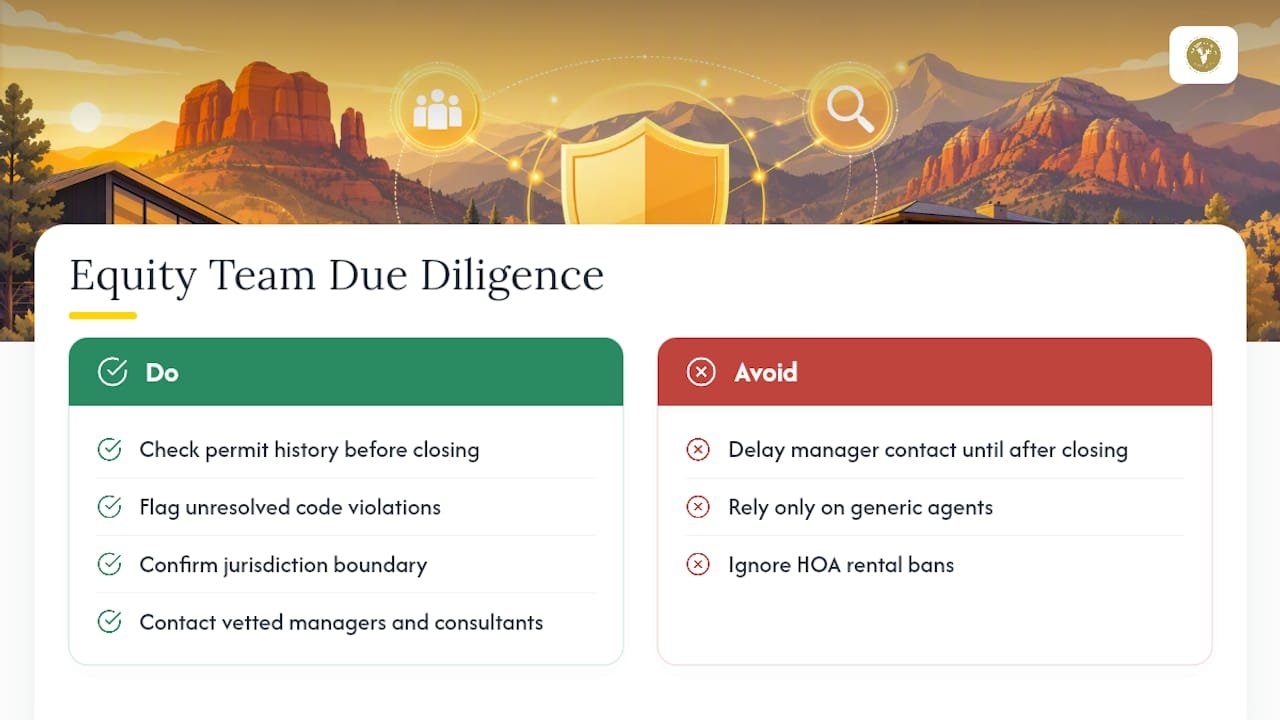
Pro Tip: Buyers evaluating an existing short-term rental should request the seller’s full permit history, not just the current certificate. A gap in renewal dates often signals a past violation that never made it into casual conversation.
Equity Team walks buyers through exactly this kind of due diligence before closing, because a beautiful listing photo means nothing if the dwelling never received a Certificate of Occupancy.
What Should Coconino STR Investors Prioritize Right Now?
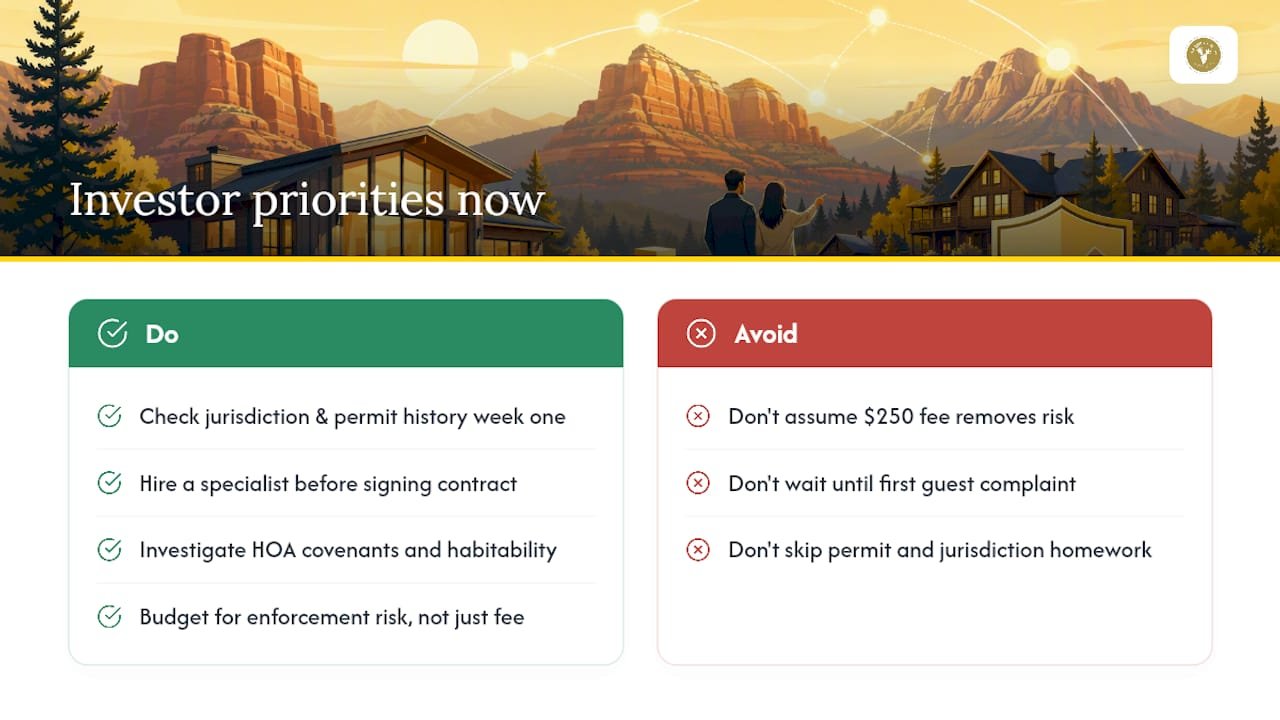
Permit cost is the least of your worries when you’re underwriting a Coconino County short-term rental. A $250 annual fee barely registers against nightly rates in this market. The real risk sits in enforcement exposure and jurisdictional confusion, both of which can quietly erode a deal’s projected returns if you skip the homework.
Get specialist help before you sign a purchase contract, not after your first guest complaint. A property that looks compliant on paper can still carry a habitability gap or an HOA covenant nobody mentioned during the showing. We’ve walked enough buyers through this exact scenario to know it’s cheaper to check jurisdiction and permit history in week one than to discover a problem in month six.
— Chad
How Equity Team Helps You Navigate Coconino STR Purchases
Generic real estate agents can tell you square footage and lot lines. They can’t tell you whether a property’s permit history has a gap, whether it sits on the wrong side of a jurisdiction line, or whether the HOA quietly banned rentals last spring. Equity Team specializes in exactly that layer of due diligence for Sedona and Verde Valley short-term rental buyers.

We check permit-history records, flag properties with unresolved code violations, and connect buyers with vetted property managers and compliance consultants before closing, not after. That kind of front-loaded homework is the difference between a rental that cash-flows from day one and one that sits dark while you sort out a permit dispute.
If you’re evaluating a short-term rental purchase anywhere in the Sedona area, start with our guide on finding the right short-term rental investment and reach out for a property-specific compliance check before you make an offer.
This article is general information, not a substitute for advice from a qualified lawyer. Consult a qualified legal professional about your own circumstances before acting on anything here.
Sources
- Short-Term Rental(STR) Information | Coconino County
- STR Ordinance draft — Coconino County
- A.R.S. §11-269.17 — Limits on regulation of vacation rentals and short-term rentals