
Yes, an ADU can be an Airbnb in Sedona, but only if it clears three hurdles: the right paperwork, the right tax registration, and a certificate of occupancy dated before the state’s big cutoff. That last one is the trickiest, and the most commonly missed. Before you list a casita or guest quarters on any booking platform, check the ADU’s certificate of occupancy date and confirm who actually lives in the main house.
Here’s what to lock down before your first guest checks in:
- Verify the CO date. ADUs certified on or after September 14, 2024, have a much narrower path to becoming short-term rentals.
- Get a City of Sedona short-term rental permit for the specific unit you’re advertising, separate from any permit on the main house.
- Register for a state Transaction Privilege Tax (TPT) license before you post a single listing.
- Confirm your insurance coverage meets the city’s liability threshold or relies on qualifying marketplace protection.
Miss any one of these and you’re not running an Airbnb. You’re running a code violation with good photos.
Key Takeaways
An ADU can legally operate as an Airbnb in Sedona only when it holds a valid city permit, a state TPT license, required insurance, and a certificate of occupancy issued before September 14, 2024, or an owner-occupancy arrangement that satisfies the exception.
| Point | Details |
|---|---|
| Check the CO date first | ADUs certified before September 14, 2024 have far more flexibility than newer ones. |
| Get a per-unit permit | Each advertised unit needs its own annual city permit, roughly $210 currently. |
| Register for TPT before listing | Arizona requires a state tax license before any booking goes live. |
| Confirm insurance coverage | Carry $500,000 in liability coverage or rely on qualifying platform protection. |
| Work with local specialists | Equity Team helps buyers verify ADU compliance before closing on a Sedona property. |
Where to confirm official rules and complete required registrations
- Sedona Land Development Code, ADU standards
- City of Sedona short-term rental FAQ
- Arizona TPT license application guidance
- Permit fees and operational rules summary
- State law preempting outright STR bans
- Local reporting on ongoing STR policy debate
This article is general information, not a substitute for advice from a qualified lawyer. Consult a qualified legal professional about your own circumstances before acting on anything here.
Table of Contents
- Sedona ADU Airbnb Permits: What the City Actually Requires
- The Sept 14, 2024 Rule: Why Your ADU’s Paperwork Date Is Everything
- Do You Need a Business License to Airbnb an ADU in Sedona?
- What Insurance and Safety Rules Apply to Sedona ADU Rentals?
- Land Development Code Standards That Decide If Your Casita Even Qualifies
- Your Pre-Listing Checklist for a Sedona ADU Airbnb
- How The Equity Team Helps You Navigate Sedona ADU Rules
- Sources
Sedona ADU Airbnb Permits: What the City Actually Requires
Sedona treats every rentable unit as its own animal, permit-wise. If you’re renting out the main house and the casita out back, that’s two separate applications, two separate fees, and two separate compliance files with the city.
Here’s how the process actually works:
- Apply per unit. The City of Sedona’s short-term rental program requires a distinct permit for each address or unit advertised on any platform, ADU included.
- Pay the annual fee. Current guidance puts the permit fee at roughly $210 per unit, a bump from the previous $200 rate. Renewal is annual, and the permit doesn’t transfer with a sale.
- Post it visibly. The permit number, an owner or property manager’s emergency contact, and basic house rules need to be posted inside the unit, not buried in a welcome email.
- Notify the neighbors. Sedona’s program includes a neighbor notification component, since ADUs often sit closer to adjoining lots than the main house does.
- Submit through Community Development. Applications and questions route through the city’s Community Development office, which also handles renewal and late-fee tracking. Starting January 1, 2026, late renewals carry tiered penalty fees, so mark your calendar.
Pro Tip: Renew before your permit lapses, not after. A gap in coverage, even a short one, can trigger a fresh review of your ADU’s eligibility, and that review now includes the CO cutoff rule.
The Sept 14, 2024 Rule: Why Your ADU’s Paperwork Date Is Everything
Here’s the line in the sand. Under Sedona’s Land Development Code, any ADU issued a certificate of occupancy on or after September 14, 2024 cannot operate as a short-term rental unless the property owner’s primary residence is the main structure on that same lot.
Translation: brand-new casitas built after that date are, in most cases, off the table for Airbnb unless you’re living next door full-time. Older guest quarters and ADUs with a CO predating that mark are generally grandfathered in, free to operate as standalone rentals without the owner-occupancy string attached.
That single date has effectively split Sedona’s ADU inventory into two markets: pre-cutoff units that can run as independent income properties, and post-cutoff units that only work if you’re planning to live there yourself.
For buyers, this isn’t a detail to skim past.
- Request the recorded certificate of occupancy directly, not a seller’s summary of it.
- Ask for permit history if the CO date is ambiguous or the ADU was added in phases.
- Build a CO verification contingency into your purchase contract, an approach OwnInAZ has flagged as essential due diligence for Sedona investors right now.
An ADU with a clean, pre cutoff CO and no owner-occupancy restriction is worth meaningfully more to an investor than an identical unit built six months later. Same square footage, same finishes, completely different income ceiling.
Do You Need a Business License to Airbnb an ADU in Sedona?
You need a state tax registration, and it’s non-negotiable. Arizona requires a Transaction Privilege Tax (TPT) license before you advertise or accept a single booking, and this applies whether you’re renting the main house, the ADU, or both. Applications go through the Arizona Department of Revenue, and the process is straightforward if you do it before, not after, your listing goes live.
Combined lodging tax in Sedona (state, county, and city components together) generally lands in the low double digits as a percentage of your nightly rate, though exact figures depend on your specific location and should be confirmed directly with azdor.gov. Some platforms collect and remit a portion of these taxes automatically on your behalf; direct bookings almost never get that convenience, which means the filing responsibility lands squarely on you.
- Register for your TPT license before your first listing goes live, not after your first booking.
- Track which platforms remit taxes for you and which leave it entirely in your hands.
- Loop in a tax professional familiar with Arizona lodging tax rules if you’re running units across multiple platforms.
What Insurance and Safety Rules Apply to Sedona ADU Rentals?
Sedona expects hosts to carry serious liability protection: a minimum aggregate of $500,000 per rental unit. State law does allow an alternative here. If your booking platform’s own coverage meets or exceeds that threshold, you can rely on it instead of a separate policy, which is worth confirming directly with your insurer or platform.
Beyond insurance, a handful of operational basics apply across the board:
- Post your permit number and an emergency contact inside the unit, visible to guests.
- Manage trash collection so bins aren’t sitting curbside outside pickup windows.
- Keep posted occupancy limits accurate. Overbooking a small casita is a fast way to draw a complaint.
- Skip the wedding and event bookings. Sedona restricts special events at short-term rentals, ADUs included.
Pro Tip: Keep your insurance declarations page and TPT license in the same folder as your city permit. When Community Development or a platform asks for proof, you want to hand over everything in one email, not three.
Land Development Code Standards That Decide If Your Casita Even Qualifies
Not every backyard structure gets to call itself an ADU, and that distinction matters enormously for STR eligibility. Sedona’s Land Development Code sets specific technical thresholds for accessory structures, and falling outside them can disqualify a building from habitable, rentable status altogether.
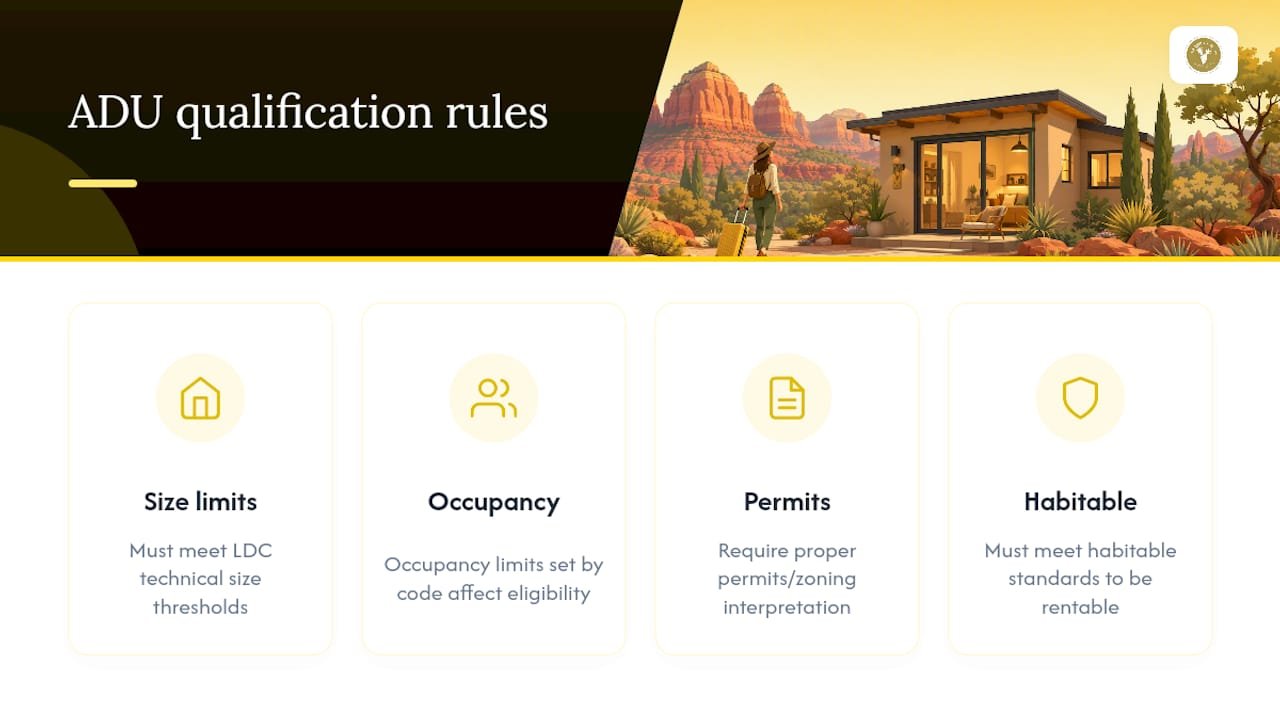
A shed converted into a “casita” without meeting these standards isn’t a legal ADU no matter how good it looks on a listing photo. If your situation sits anywhere near these limits, request an official zoning interpretation from the city rather than guessing, and review how zoning shapes STR eligibility before you make an offer.
Your Pre-Listing Checklist for a Sedona ADU Airbnb
Run through this before you touch a listing platform:
- Pull the certificate of occupancy from municipal building records or the county assessor to confirm the exact issue date.
- Look up the parcel’s zoning through the city’s GIS mapping tool to confirm ADU eligibility.
- Call Community Development to confirm current permit status, since older records sometimes lag behind reality.
- Apply for your TPT license through azdor.gov before advertising anywhere.
- Secure insurance documentation and post required contact information inside the unit.
- Check HOA covenants, if applicable. An HOA can still prohibit short-term rentals even when the city and state allow them.
Pro Tip: Call the city before you call a contractor. A five-minute conversation with Community Development can save you months of renovation work on a structure that was never going to qualify as a legal ADU anyway.
How The Equity Team Helps You Navigate Sedona ADU Rules
Verifying a CO date sounds simple until you’re staring at conflicting permit records from three different renovation phases. Equity Team walks investors through that exact process, helping confirm ADU eligibility, flag pre-cutoff properties with real STR upside, and separate compliant setups from expensive guesses.

Chad’s background in Sedona’s short-term rental market shapes how Equity Team evaluates every ADU listing that crosses the desk, and the team’s transaction history reflects properties that cleared this exact compliance maze successfully.
A market built on paperwork, not just curb appeal
Compliant, pre-cutoff ADUs are getting scarcer by the month, and scarcity in Sedona tends to show up in price fast. Post-cutoff casitas still carry value, just a narrower one, tied to owner-occupancy. Either way, CO verification belongs in your purchase contingency, right alongside your inspection and financing terms.
Ready to find a Sedona ADU that actually works as an Airbnb?
Equity Team is the difference between guessing at a casita’s rental potential and knowing it, because verifying that CO date, checking zoning, and cross-referencing city permit records is exactly the kind of groundwork a general buyer’s agent rarely thinks to do.

That’s the gap Equity Team closes. As agents who specialize exclusively in Sedona short-term rental investments, the team sources properties with documented compliance history, runs zoning checks before you fall in love with a listing, and can walk you through video tours of active ADU rental properties so you see the numbers before you make an offer. If you’re ready to find the right short-term rental investment in Sedona, reach out to schedule a consult and start with properties that already have their compliance paperwork sorted.
Sources
- 3.4.C General Standards for All Accessory Uses and Structures | Sedona Land Development Code
- Short-Term Rental Laws in Sedona, AZ (2026): Permits, Taxes & Airbnb Rules | STR Rule Watch
- Arizona Department of Revenue — Transaction Privilege Tax (TPT) license guidance
- Short-Term Rentals Frequently Asked Questions | City of Sedona