

Yes, Sedona requires a written neighbor notice before you host your first short-term rental guest, and skipping it is one of the fastest ways to land on the city’s radar. If you’re staring down a launch date, here’s your single most urgent move: send written notice by certified mail or hand delivery to every qualifying neighbor, and make sure it lists your rental’s address, your City STR permit number, and a live 24-hour contact.
Sedona’s canyons might inspire a lot of dreamy, slow-down-and-breathe energy, but the city’s short-term rental paperwork is not a place to wing it.
- Notice must go out in writing before your first booking, delivered by certified mail or by hand.
- Confirm your annual City STR permit and Arizona Transaction Privilege Tax (TPT) license are active before you list the property anywhere.
- Keep a dated copy of every notice and its delivery proof. You’ll want it if a neighbor ever calls the complaint line.
Key Takeaways
Sedona requires written neighbor notice by certified mail or hand delivery before your first STR booking, and updated notices must go out within five days of any change to permit or contact information.
| Point | Details |
|---|---|
| Notice is mandatory | Written notice by certified mail or hand delivery is required before your first rental, not optional or informal. |
| Know your neighbor radius | Adjacent, directly across, and diagonally across properties all qualify for notice under city rules. |
| Include every required field | Address, City STR permit number, 24-hour contact, and owner address must all appear in the notice. |
| Budget for permits and taxes | An annual City STR permit runs about $210 per unit, plus a required state TPT license. |
| Document everything | Keep certified mail receipts or signed acknowledgments for the full length of your permit term. |
Table of Contents
- Does Sedona STR Neighbor Notice Have Legal Teeth?
- How Do You Prepare and Deliver a Compliant Notice?
- What Should a Sedona Neighbor Notice Actually Say?
- What About ADUs, Casitas, and Multiple Units?
- What Happens If a Host Skips or Botches the Notice?
- What’s the Fastest Way to Check Your Compliance Right Now?
- How Does Equity Team See Neighbor Notice Compliance Play Out?
- What Actually Matters Most in This Process?
- Sources
- FAQ
Does Sedona STR Neighbor Notice Have Legal Teeth?
It does, and it’s baked directly into the Sedona City Code, not just a “best practice” some blog invented. Short-term rentals are legal throughout Sedona, largely because Arizona state law bars cities from banning them outright. But that state-level protection comes with a trade: cities like Sedona get to set the operational rules, and neighbor notice sits near the top of that list.
The Sedona City Code’s use regulations for short-term rentals establish the legal foundation, with SCC §5.25.060 specifically addressing neighbor notification and SCC §5.25.080 covering posted house rules inside the unit. Violations of either can trigger enforcement under SCC §5.25.120, which we’ll get into later.
Who actually counts as a “neighbor” here? It’s not everyone within a five-minute walk. Sedona’s rule targets the properties that share a fence line or a sightline with your rental: anyone directly adjacent, anyone directly across the street, and anyone diagonally across from your parcel. If your rental sits on a corner lot, that diagonal neighbor is easy to forget. Don’t.
Your notice has to include specific, checkable information, not a friendly heads-up scrawled on a Post-it:
- The short-term rental’s physical address
- Your City STR permit number
- A 24-hour contact name, phone number, and email address
- The owner’s physical mailing address
Delivery method matters just as much as content. According to guidance on Sedona’s short-term rental regulations, notification must be written and delivered either by certified mail or by hand. A text message, a group email, or a note taped to someone’s mailbox doesn’t satisfy the requirement. And this isn’t a one-and-done task: if any piece of that information changes (new property manager, new phone number, a permit renewal with a new number), you have five days to send updated notice to the same neighbor list.
By the numbers: Sedona’s annual STR permit runs about $210 per unit, and starting January 1, 2026, the city began applying late fees to renewals that miss their window. That’s a real cost that stacks fast if you’re managing more than one unit.
Before you even think about neighbor notices, three prerequisites need to be locked in:
- An active annual City of Sedona STR permit for each rental unit
- A state Transaction Privilege Tax (TPT) license registered with the Arizona Department of Revenue
- Liability insurance and posted house rules inside the unit, covering occupancy limits, parking, noise, trash, and a firm no-fireworks policy
Skip any one of these, and the neighbor notice becomes almost beside the point. You can’t legally advertise or rent until the permit and TPT license are both active.
How Do You Prepare and Deliver a Compliant Notice?
Treat this like a small project with a paper trail, because that paper trail is exactly what protects you later. Here’s the process that keeps hosts out of trouble.
- Pull your neighbor list first. Check county parcel records or your title paperwork to identify every property that’s directly adjacent, directly across, or diagonally across from your rental. Don’t rely on memory or a quick walk around the block. Parcel maps catch the awkward corner-lot neighbor that a casual glance misses.
- Verify current mailing addresses. Absentee owners are common in Sedona, especially with second-home properties. If the neighbor’s address on file is out of state, that’s still where the notice goes.
- Draft the notice with every required field. Address, permit number, 24-hour contact, and your mailing address. Nothing optional gets left out.
- Choose your delivery method. Certified mail gives you a green return receipt as proof of delivery. Hand delivery works too, but only if you get a signed acknowledgment from the neighbor.
- File your proof immediately. Scan the certified mail receipt or signed acknowledgment the same day you get it back. Don’t let it sit in a glove box.
- Set a five-day reminder trigger. Any time your contact info, ownership structure, or permit number changes, treat it as a fresh notice event with a five-day clock.
Pro Tip: Deliver neighbor notices during escrow or right after your permit is issued, before your first guest ever checks in. Waiting until launch week means you’re racing certified mail transit times against a booking calendar, and that’s a stressful race to lose.
On documentation, don’t get fancy. A simple, dated digital folder beats a shoebox of receipts every time.
The strongest compliance record combines a certified-mail return receipt or a signed hand-delivery acknowledgment, a scanned copy stored the same day it arrives, and a backup kept for the full length of your permit term.
Retention matters more than most hosts assume. Keep every notice and its proof for as long as the permit tied to it stays active, plus a buffer. If a complaint surfaces eight months into your first rental year, you want that receipt one click away, not buried in an old email thread.
What Should a Sedona Neighbor Notice Actually Say?
You don’t need a lawyer to write this. You need the required fields in a format that’s easy to read and easy to file. Here are two versions that satisfy the code, aimed at different tones.
Formal version:
Subject: Notice of Short-Term Rental Operation at [Property Address]
This letter serves as formal notice under Sedona City Code that the property at [full address] is licensed and operated as a short-term rental under City of Sedona STR Permit #[number]. The designated 24-hour contact for this property is [name], reachable at [phone number] and [email address]. The owner’s mailing address is [owner address]. Please retain this notice for your records. Any changes to this information will be communicated within five days as required.
Neighbor-friendly version:
Hi [Neighbor Name],
Just a heads-up that we’ve started renting our place at [address] as a short-term vacation rental, permit #[number] with the City of Sedona. If anything ever comes up, day or night, call or text [name] at [phone number] or email [email]. We’re at [owner address] if you ever need to reach us directly. Thanks for being a great neighbor, and please don’t hesitate to reach out.
Both versions hit the same four legal checkpoints: address, permit number, 24-hour contact, and owner address. The friendly version just wraps them in warmer language, which tends to head off complaints before they start.
A couple of quick notes on filling these out. Use the exact permit number from your City-issued certificate, not a pending application number. And consider attaching your posted house rules or a simple parking map as an optional courtesy. It’s not required, but it answers the exact questions (“where do their guests park?”) that generate most neighbor friction in the first place.

What About ADUs, Casitas, and Multiple Units?
Sedona’s layered lot sizes and older properties mean plenty of hosts are juggling more than one rentable structure on a single parcel, and the rules don’t get more forgiving just because the units share a driveway.
- Each advertised unit, whether it’s the main house, a detached casita, or an accessory dwelling unit (ADU), needs its own City STR permit and its own neighbor notice.
- Sharing one parcel doesn’t mean sharing one notice. If you’re renting the main house and the casita separately, expect to prepare distinct notices referencing each unit’s specific permit number.
- Owners can designate a property manager or another qualified individual as the required 24-hour contact and the person responsible for sending notices, as long as that contact information is accurate and reachable around the clock.
- Any change to that designee’s phone number, email, or role triggers the same five-day update window that applies to owner-managed properties.
If you’re weighing whether a property’s zoning even supports multiple STR units, it’s worth reviewing Sedona’s zoning framework for investors before you assume two structures automatically means two income streams.
What Happens If a Host Skips or Botches the Notice?
Enforcement in Sedona is complaint-driven, which means your neighbors are effectively the first line of oversight, whether you like it or not.
Penalties for noncompliance range from civil fines to misdemeanor charges under SCC §5.25.120, and repeated or serious violations can lead to permit suspension or outright revocation. That’s not a slap on the wrist. Losing your permit mid-season means losing bookings, income, and possibly your listing’s review history if you have to relaunch under a new permit.
By the numbers: the city runs a 24/7 complaint hotline at 928-203-5110, and complaints filed there commonly trigger inspections and formal enforcement review.
A few patterns tend to escalate faster than others:
- Repeated noise or parking complaints from the same neighbor, which signal an unresolved pattern rather than a one-off bad night
- Large gatherings or events that violate posted occupancy limits
- Safety incidents, like fire code violations or unpermitted structures being used as sleeping space
If a complaint does land against your property, respond fast. Contact the guest immediately if the issue is active, document what you find, and reach out to the reporting neighbor directly if you can identify them. A quick, respectful response often resolves things before the city even opens a file.
What’s the Fastest Way to Check Your Compliance Right Now?
Print this, tape it to your fridge, whatever it takes.
- Confirm your City STR permit is active and matches the unit you’re advertising.
- Confirm your Arizona TPT license is registered and current.
- Confirm liability insurance is in place.
- Confirm neighbor notices went out by certified mail or hand delivery, with proof on file.
- Confirm house rules are physically posted inside the unit.
- Confirm your 24-hour contact information is accurate everywhere it appears, including the notice itself.
The mistakes that trip up otherwise careful hosts tend to repeat themselves:
- Sending notice only by email or text, which doesn’t meet the written-and-certified-or-hand-delivered standard
- Forgetting to re-notify neighbors within five days after swapping property managers or phone numbers
- Treating a casita and the main house as one unit when the city requires separate permits and notices for each
- Letting a permit renewal slide past its date and eating a late fee that didn’t exist before January 1, 2026
If you hit a gray area, the City of Sedona’s STR program office can clarify specifics faster than guessing based on a forum post. When zoning questions come up, reviewing how vacation rental zones work before you buy or convert a property saves a lot of backtracking later. Zoning designations also intersect with general permit categories, and the distinction between a zoning permit and a building permit trips up plenty of first-time hosts, a gap explained well by local legal resources.
How Does Equity Team See Neighbor Notice Compliance Play Out?
Sedona’s STR rules read cleanly on paper, but Equity Team sees the gaps show up during actual transactions, not in the code itself. When we’re scouting a purchase for an investor client, verifying permit eligibility and past code enforcement history on a parcel comes before we ever talk price. A property with an unresolved violation can complicate both permit approval and the neighbor-notice timeline for a new owner.
On the operational side, here’s what tends to separate smooth launches from messy ones:
- Compiling the neighbor list from county parcel data during escrow, not after closing, so notices go out the same week the permit gets issued
- Preferring certified mail with return receipts over hand delivery when neighbors are absentee owners, since a signed acknowledgment isn’t possible if nobody’s home
- Building a simple, dated digital folder for every property at intake, so proof of notice lives in the same place as the permit and insurance documents
If you’re weighing whether a specific property pencils out as a compliant, high-performing STR before you make an offer, finding the right short-term rental investment starts with exactly this kind of due diligence, not with the listing photos.
What Actually Matters Most in This Process?
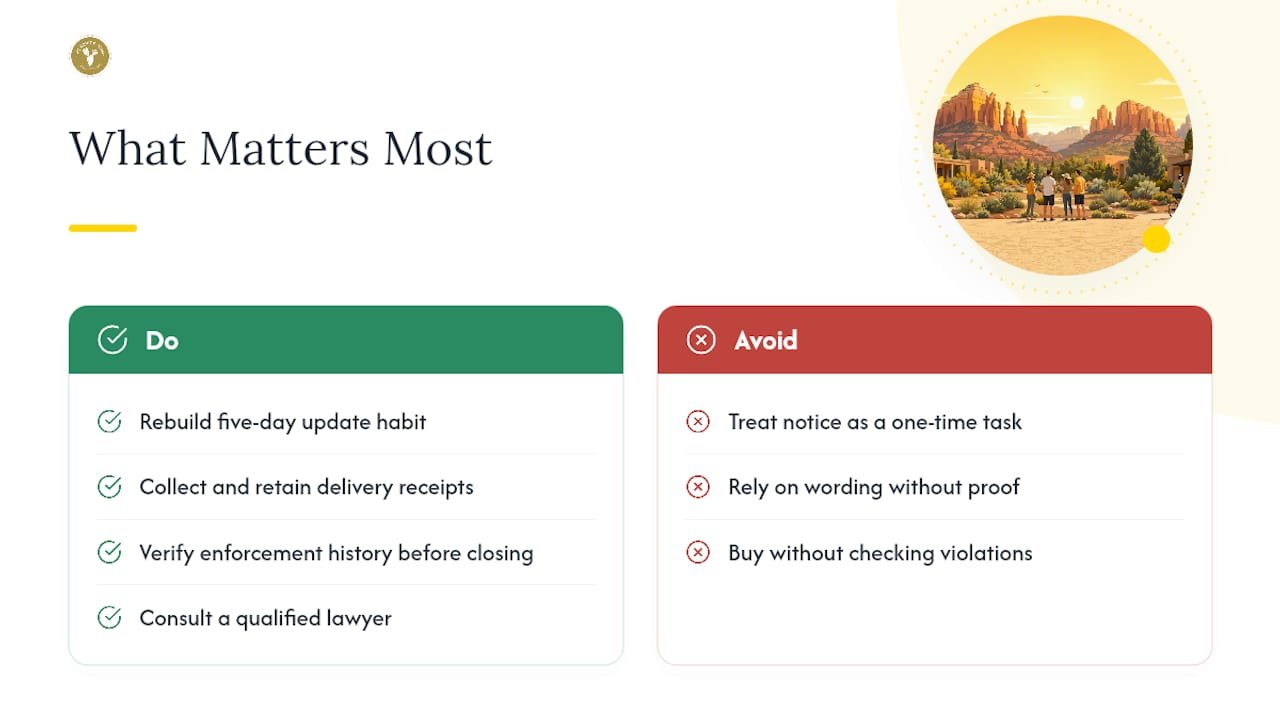
Most guides treat neighbor notice as a box to check once and forget. That’s the wrong instinct. The five-day update rule is the part hosts underestimate most, because life doesn’t stop after your first mailing. Property managers change. Phone numbers change. If you don’t rebuild that habit into your routine, you’re one staffing change away from a technical violation you didn’t even notice.
The conventional advice also overweights the notice itself and underweights the proof. A perfectly worded letter that you can’t prove was delivered is nearly as risky as no letter at all. Prioritize the receipt, not just the wording.
If you’re buying into Sedona’s STR market rather than already operating in it, the smartest move is verifying a property’s enforcement history before closing, not after. A clean notice process on a property with a hidden violation still starts you off behind.
This article is general information, not a substitute for advice from a qualified lawyer. Consult a qualified legal professional about your own circumstances before acting on anything here.
Sources
- Sedona Short-Term Rental Regulations: What Hosts Need to Know
- 5.25.050 Use regulations | Sedona City Code
- TPT license application guidance | Arizona Department of Revenue
- A.R.S. 9-500.39 | Arizona Legislature
FAQ
Does every Sedona short-term rental need a separate neighbor notice?
Yes. Each advertised unit, including a casita or ADU on the same parcel, needs its own permit and its own neighbor notice referencing that specific permit number.
Can I email my neighbors instead of using certified mail?
No. Sedona requires written notice delivered by certified mail or hand delivery, and email alone does not satisfy the requirement.
What if a neighbor refuses to accept the notice?
Document the delivery attempt, including the certified mail tracking record showing refusal or non-delivery, since that record demonstrates you attempted good-faith compliance.
How quickly must I send updated notice after a change?
Within five days of any change to your permit number, 24-hour contact information, or owner address, per SCC §5.25.060.
What’s the fastest way to report a problem property or file a complaint?
Call Sedona’s 24/7 short-term rental complaint hotline at 928-203-5110, which the city uses to trigger inspections and enforcement review.