

An appraisal gap happens when your contract price beats the lender’s appraised value, and it can stall or sink a Sedona short-term rental purchase before you ever get the keys. Right now: confirm your lender’s appraisal expectations, pull tight local comps (not the Zillow flavor), and line up backup financing before you’re staring down a shortfall at closing. A licensed Sedona appraiser typically wraps the on-site visit in under an hour, and OwnInAZ’s market data can tell you whether your offer price is grounded in reality before you sign anything.
- Verify your lender’s appraisal contingency language today, not the week of closing.
- Gather STR revenue history, reviews, and booking calendars. These often carry more weight than a generic comp.
- Line up a second financing option (bridge loan, seller carry) in case the gap shows up anyway.
Key Takeaways
Appraisal gaps in Sedona are driven by view premiums, county-line effects, and thin comps, and STR revenue history is the strongest lever investors have to close them.
| Point | Details |
|---|---|
| Know the number gap | Contract price minus appraised value is the cash you’ll need to cover, finance, or negotiate away. |
| Budget for the timeline | Expect a 30 to 45 minute on-site visit, a three to four day report, and roughly $500 and up in cost. |
| Package STR revenue | Documented income, reviews, and bookings often move an appraisal more than another comp does. |
| Separate tax from appraisal | County assessments and lender appraisals use different methods and can diverge significantly. |
| Work with Sedona specialists | Equity Team builds comps and STR revenue documentation into every offer to reduce gap risk upfront. |
Table of Contents
- What an Appraisal Gap Means for Sedona Investors
- The Sedona Appraisal Process: Timeline and Cost
- How an Appraisal Gap Hits Your STR Cash Flow
- Property Tax Assessments and What They Don’t Tell You
- Why Sedona’s Vacation Rental Market Confuses Appraisers
- A Local Investor’s View on Managing Appraisal Risk
- How Equity Team Helps You Close the Gap
- Frequently Asked Questions
- Sources
What an Appraisal Gap Means for Sedona Investors
The math is simple even when the situation isn’t. You offer $850,000. The bank sends out an appraiser, and the report comes back at $800,000. That $50,000 difference is the appraisal gap, and your lender will only finance a percentage of the lower number, not your contract price. You’re now responsible for covering the difference in cash, renegotiating with the seller, or walking away if your contract has the right language protecting you.
For a primary residence buyer, this is annoying. For a Sedona short-term rental investor, it’s a math problem with real cash-flow consequences. You’ve likely built a return projection around a specific purchase price, and every dollar of gap you cover in cash is a dollar not earning yield elsewhere. That’s the core tension every Sedona STR buyer needs to internalize before writing an offer in a market this particular about its comps.
The Sedona Appraisal Process: Timeline and Cost
Sedona’s appraisal process runs on a predictable clock, even if the number that comes out the other end can surprise you. A licensed local appraiser typically spends 30 to 45 minutes on-site, walking the property, checking condition, noting upgrades, and photographing anything that might justify a value adjustment. From there, expect a written report in roughly three to four days.
Cost runs about $500 and up, depending on the property’s size, complexity, and whether it needs a specialized report for financing, refinancing, or a contested valuation. Firms like 3:16 Appraisal Services hold Certified Residential Appraiser credentials (license CRA1017721 is one example), which matters if you ever need to challenge a low number with a second opinion that carries real weight.
Unique properties change the timeline. If your target home sits on a septic system, has a private well, or backs up to national forest land, the lender may request extra inspections, which stretches things out. Budget extra float in your closing timeline for anything that isn’t a straightforward subdivision home, and don’t assume the standard three to four day turnaround applies once specialty inspections enter the picture.
How an Appraisal Gap Hits Your STR Cash Flow
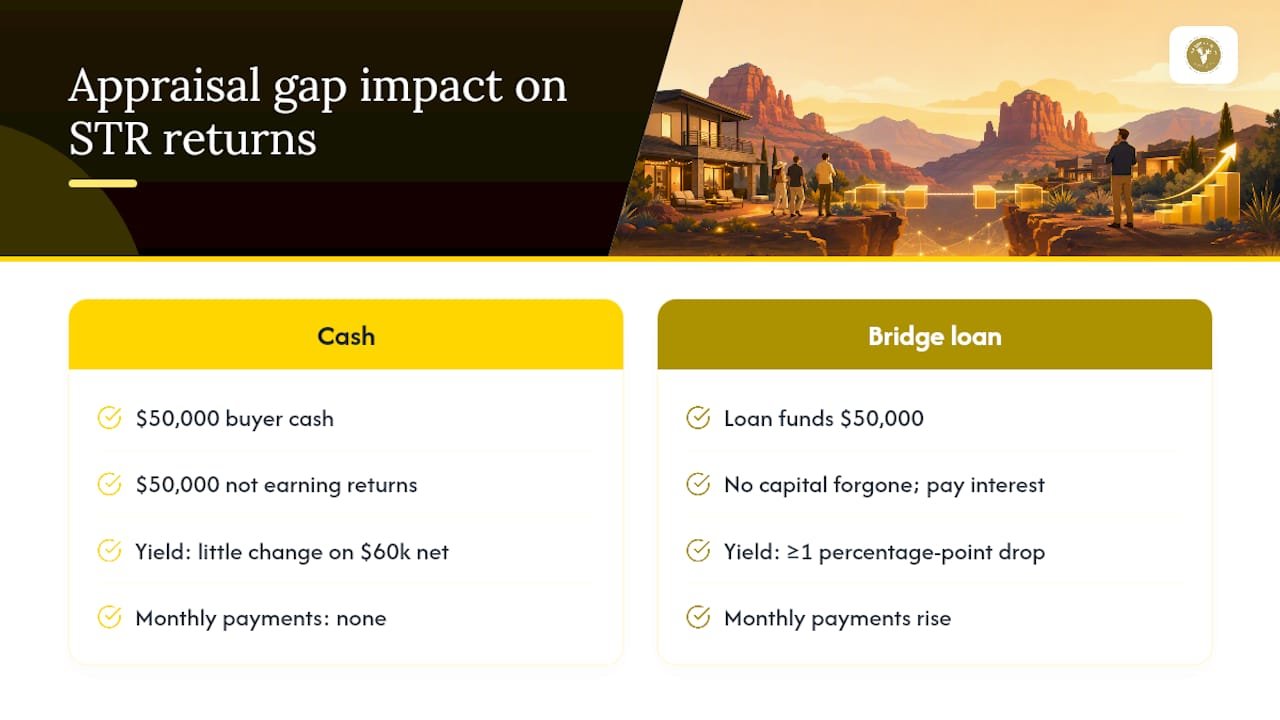
An appraisal gap doesn’t just cost you money at closing. It reshapes your entire return model for the life of the investment. Cover a $50,000 shortfall in cash, and that’s $50,000 no longer generating a return anywhere else. Finance it through a higher-rate bridge loan instead, and your monthly carrying costs climb right when you’re trying to ramp up occupancy and reviews on a new listing.
Run the numbers before you decide how to cover a gap, not after. A property projected to net $60,000 annually in STR income can absorb a modest gap covered in cash without wrecking your return. The same property financed at a steep short-term rate to cover that same gap might see its effective yield drop by a point or more, depending on the loan terms you land.
This is where STR-specific evidence becomes your best negotiating tool. Documented rental revenue, platform reviews, and existing bookings are transferable assets even though the STR permit itself is not. If the seller has two years of solid Airbnb or Vrbo performance, package that history as an exhibit for your lender and the appraiser. It often does more to close a value gap than another round of comps ever could, because it shows income the property is already earning rather than income you’re projecting.

Property Tax Assessments and What They Don’t Tell You
Here’s a mistake investors make more than they should: assuming the county’s assessed value and the lender’s appraised value are pulling from the same playbook. They aren’t. Property tax assessments in Arizona are calculated on a different schedule and methodology than a fee appraisal ordered for a purchase transaction, and the two numbers can diverge by a wide margin without either one being wrong.
A low assessed value doesn’t mean you should expect a low appraisal, and a high one doesn’t protect you from a gap either. Treat the tax assessment as one data point among several, not a stand in for the appraisal you’ll actually need to close your loan.
Where the assessment does matter is in your ongoing carrying cost math. Sedona spans parts of Yavapai and Coconino counties, and tax treatment differs across that line, which affects your net cash flow even after the sale closes. Before you finalize an offer, confirm which county the parcel sits in and check the current assessment history. It’s a five-minute lookup that can meaningfully change your annual expense projection, and it’s the kind of detail an out-of-state investor can easily miss until the first tax bill arrives.
Why Sedona’s Vacation Rental Market Confuses Appraisers
Standard appraisal methodology leans hard on recent comparable sales. Sedona’s vacation rental and second-home segment makes that harder than it sounds, and the reasons are specific to this market rather than generic real estate friction.
Inventory is thin and idiosyncratic. Two homes half a mile apart can carry wildly different values because one has an unobstructed red rock view and the other doesn’t, and automated valuation tools routinely miss that kind of premium entirely. Add in the county-line tax variation mentioned above, custom architecture that resists easy comparison, and lot characteristics like privacy or outdoor living space built for the climate, and you’ve got a recipe for appraisals that lag genuine buyer demand.
Sedona’s micro-markets also move independently of each other. A “Sedona average” price per square foot means very little when you’re comparing a move-in-ready home in one pocket against a custom build on acreage in another. Appraisers working from a countywide dataset can undervalue properties that don’t fit neatly into a standard comp set, which is exactly the scenario where a documented STR income history and a well-argued rebuttal packet earn their keep.
A Local Investor’s View on Managing Appraisal Risk
Sedona’s smallest details tend to move the biggest numbers. Protected views, which side of the county line a parcel sits on, and a documented STR track record shift value more here than in most markets I’ve watched. Before writing an offer, I want comparable sales and the property’s actual rental performance. Investors who bring both to the table close with fewer surprises, and The Equity Team builds every offer around that same local comps and revenue picture.
How Equity Team Helps You Close the Gap
Equity Team gives you something a generic buyer’s agent can’t: a team that specializes exclusively in Sedona short-term rentals and treats appraisal risk as part of the offer strategy from day one, not an afterthought after the report comes back low.

Before you write an offer, we’ll walk the comps with you, factoring in view premiums, county placement, and micro-market pricing that a countywide dataset tends to flatten out. We package STR revenue history, reviews, and forward bookings into lender-ready documentation designed to support your contract price, not just describe the property. If a gap shows up anyway, we help negotiate contingency language upfront and coordinate a formal appraisal challenge when the data supports one, while also connecting you with bridge and seller-carry financing options if you need to move fast.
OwnInAZ’s market statistics back every recommendation with real Sedona data, including deep coverage of the $500,000 to $1,000,000 segment where a large share of STR purchases land. If you’re ready to move on a property, start with a property-specific evaluation and let us build the appraisal-ready case before you’re locked into a contract.
Frequently Asked Questions
What is an appraisal gap in a Sedona real estate deal?
It’s the difference between your contract price and the lender’s appraised value. Your loan is based on the lower number, so you cover the difference in cash, renegotiate, or exit under contingency terms.
Why are appraisal gaps more common for Sedona investors?
Limited comparable sales, view premiums, county-line tax differences, and STR revenue that generic appraisal tools don’t account for all push Sedona valuations further from contract prices than in more uniform markets.
How can I protect my offer from an appraisal gap?
Verify lender expectations early, pull tight local comps, document STR revenue history if the property has it, and negotiate an appraisal contingency or gap-coverage clause before you’re under contract.
When should I cover a gap versus walk away?
If documented STR income still supports a healthy return after covering the gap in cash, it’s often worth proceeding. If covering it requires high-cost financing that erodes your projected yield below your target, walking away or renegotiating usually makes more sense.
Does a low property tax assessment mean the appraisal will come in low too?
No. County tax assessments and lender appraisals use different methods and timelines, and the two figures can differ substantially without indicating anything about your appraisal outcome.
This article is general information, not a substitute for advice from a qualified financial advisor. Consult a qualified financial professional about your own circumstances before acting on anything here.
Sources
- What Your Sedona Home Is Actually Worth (Why Zillow Is Wrong)
- Property Appraisal Sedona – 3:16 Appraisal Services