

The quick answer: a typical active Sedona Airbnb is worth somewhere between $475,000 and $950,000, depending on which cap rate and revenue figure you trust. That is a wide canyon of a range, we know, but Sedona’s short-term rental market is a little like the red rocks themselves: dramatic, variable, and occasionally impossible to pin down with a single number. The AirDNA trailing 12-month figures put the average active listing at $47,600 in annual revenue, 53% occupancy, a $371 average daily rate (ADR), and $197 RevPAR across 4,339 active listings. Run that $47,600 through a simple income approach with a 40% expense ratio and a 6% cap rate, and you land at roughly $476,000. Swap in AirROI’s higher benchmark of $69,869 in average annual revenue, and the same math produces a value closer to $699,000.
That gap between data providers is not a mistake. It is the whole game. Here is the math laid out plainly:
- Take gross annual revenue (use a blended figure between $47,600 and $69,869, depending on your property’s caliber).
- Subtract estimated operating expenses (a 35 to 45% ratio is typical for Sedona STRs).
- Divide the resulting net operating income (NOI) by a market cap rate (5 to 7% is a reasonable band for Sedona STR-zoned properties).
A property earning $60,000 gross, with a 40% expense ratio, nets $36,000 in NOI. Divide that by a 6% cap rate and you get a $600,000 valuation. Adjust the cap rate down to 5% (a hotter market assumption) and the same NOI produces $720,000.
Core assumptions behind this quick math:
- Expense ratio: 35 to 45% of gross revenue
- Cap rate range: 5 to 7% for Sedona STR-permitted properties
- Occupancy baseline: 48 to 53%, per AirDNA and AirROI
- Data sourced primarily from AirDNA, AirROI, and Airbtics
That is the 60-second version. Now let’s get into the details that separate a rough guess from a valuation you can actually defend to a lender, a partner, or a skeptical buyer.
Key Takeaways
A defensible Sedona Airbnb valuation combines blended revenue benchmarks, a realistic expense ratio, a market-appropriate cap rate, and confirmed STR permit status.
| Point | Details |
|---|---|
| Blend your revenue inputs | Use a figure between AirDNA’s $47,600 and AirROI’s $69,869 averages, adjusted for your property’s features. |
| RevPAR is the fastest comparison metric | It combines ADR and occupancy into one number for benchmarking your listing against the market. |
| Run three valuation methods | Cross-check the income approach, GRM, and a simplified DCF before settling on a number. |
| Stress-test your cap rate | A one-point cap rate shift can move valuation by roughly 20%, so model at least two scenarios. |
| Confirm permit status first | A transferable, compliant STR permit materially affects both value and marketability in Sedona’s tightening market. |
Table of Contents
- Sedona Short-Term Rental Market Snapshot for 2026
- How Are ADR, Occupancy, and RevPAR Actually Calculated?
- When Does Sedona’s Airbnb Season Actually Peak?
- Which Sedona Properties and Neighborhoods Earn the Most?
- What Expenses Actually Eat Into Sedona Airbnb Revenue?
- Three Methods to Value a Sedona Airbnb, Step by Step
- A Full Worked Example: Valuing a Sedona 2BR Cottage
- What Regulatory Checks Affect a Sedona STR’s Value?
- What Do Recent Sedona STR Sales Actually Tell Us?
- Editorial Take: Sedona Airbnb Valuation for Investors
- Where to Verify Sedona Short-Term Rental Data
- Frequently Asked Questions
- Sources
Sedona Short-Term Rental Market Snapshot for 2026
Sedona’s STR market is smaller and pickier than it looks from the highway. There are 4,339 active listings tracked by AirDNA, a number that is actually shrinking. That combination (fewer listings, higher rates, lower total revenue) tells you demand softened slightly while pricing power held up. It is the kind of nuance that a single headline number will never show you.
Here is how the two major data providers stack up against each other, since any credible sedona airbnb valuation should account for both:
Why the gap? AirDNA samples every active listing, including part-time hosts and underperformers dragging the average down. AirROI tends to weight toward established, higher-performing units. Airbtics publishes its own revenue bands that generally sit between the two, useful as a tiebreaker when you are triangulating a number for a specific property.
A few trends worth flagging before you build a spreadsheet:
- Revenue is down, occupancy is down, but ADR is up. Hosts are charging more per night for fewer bookings, a classic sign of a market correcting after a supply surge.
- Active listings shrank 6.2% year over year, likely tied to Sedona’s tightening permit environment, which we cover later in this guide.
- Some models, including the STR ROI Calculator, show a much rosier $103,000 average annual revenue with 71% occupancy. Treat that as an upper-bound scenario for top-quartile properties, not a market average.
How Are ADR, Occupancy, and RevPAR Actually Calculated?
Every valuation stands or falls on how well you understand the metrics feeding it. Get sloppy here and your $700,000 estimate could really be a $500,000 property wearing a nicer spreadsheet.
Average daily rate (ADR) is total room revenue divided by nights booked. It tells you what guests actually pay, but it says nothing about how often the property sits empty.
Occupancy rate is the percentage of available nights that were actually booked. This is where seasonality hides most of its damage, since a strong summer and a dead February can average out to a number that flatters neither season.
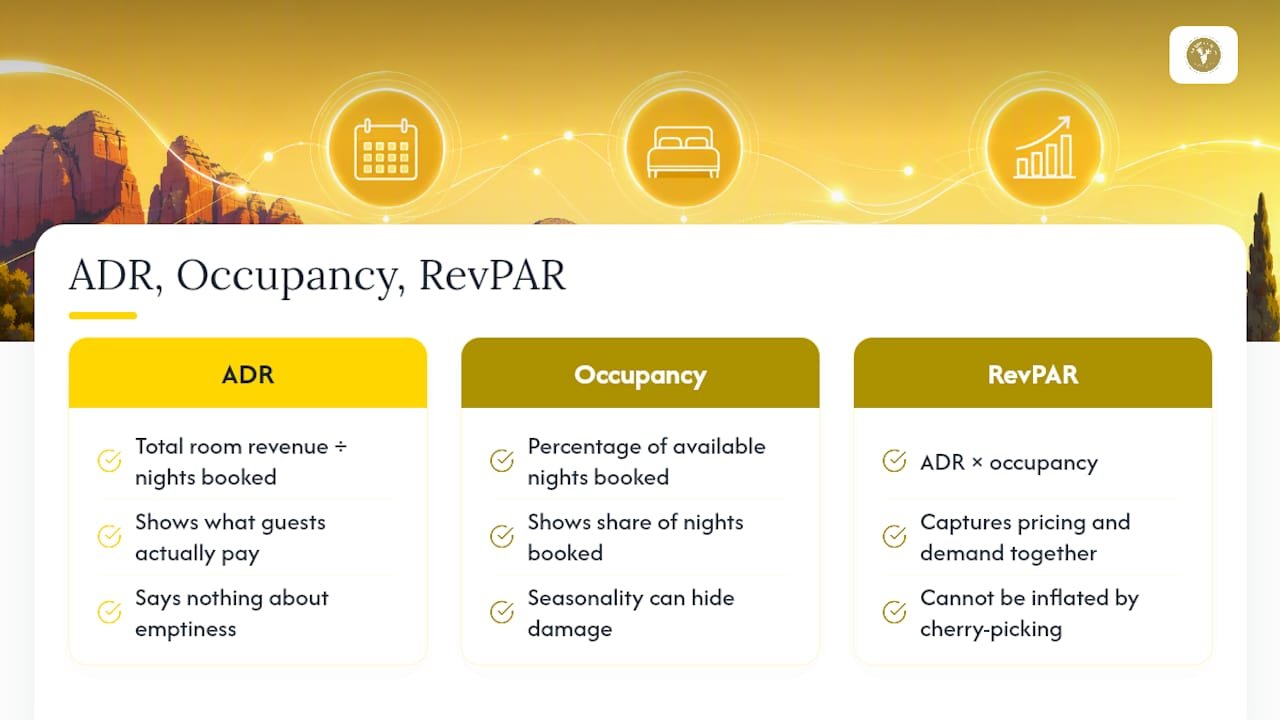
RevPAR (revenue per available room) multiplies ADR by occupancy, giving you a single figure that captures pricing and demand together. It is generally the most useful metric for comparing properties or benchmarking your own listing against the Sedona average, because it cannot be inflated by cherry-picking either variable alone.
Annual revenue for an “active listing” varies more than people expect. Some providers count any listing with at least one night booked in the trailing period; others require a minimum number of nights or exclude listings dormant for several months. That distinction alone can swing a market average by thousands of dollars.
RevPAR tends to be the more honest metric when you’re sizing up a Sedona property, because it captures how well a listing turns raw demand into cash, not just what it charges when someone books.
A practical note on data windows: AirROI’s dataset runs August 2025 through July 2026, while AirDNA reports a straight trailing 12-month window. If you are pulling numbers from either source months from now, adjust for seasonal drift rather than treating the figures as frozen in time.
When Does Sedona’s Airbnb Season Actually Peak?
Sedona does not have an off-season so much as a “still gorgeous, just quieter” season. According to AirROI, RevPAR peaks in March, when spring wildflowers and mild hiking weather draw crowds before the summer heat sets in, and dips to its lowest point in July, when 100-degree afternoons send visitors toward cooler climates.
That seasonal swing matters enormously for valuation because averaging a year of wildly different months can either overstate or understate what a buyer should actually expect.
| Season | Typical Months | Relative Demand |
|---|---|---|
| Peak | March, October, November | Highest RevPAR of the year |
| Shoulder | April, May, September | Solid but moderating demand |
| Low | June, July, August | Lowest occupancy, heat-driven dip |
The practical takeaway: if a seller hands you a single month’s revenue and tells you to annualize it, ask which month. A March figure multiplied by 12 will wildly overstate value. A July figure will just as badly understate it.
Pro Tip: Pull at least 12 consecutive months of revenue data before valuing any Sedona property, and if you only have partial-year numbers, weight them against the seasonality pattern above rather than a flat monthly average.
Minimum-stay requirements during shoulder months, paired with modest rate discounts, tend to smooth occupancy without gutting ADR. It is a small operational lever, but it directly affects the annual revenue figure that feeds every valuation method in this guide.
Which Sedona Properties and Neighborhoods Earn the Most?
Not every Sedona Airbnb is created equal, and the market rewards specific features with a heavy hand. Two and three-bedroom cottages with outdoor living space, a hot tub, and a red rock view routinely outperform larger but view-less homes on a per-night basis.

Location matters just as much as the property itself. Units within easy reach of trailheads like Cathedral Rock or Bell Rock, or with unobstructed views of the formations, command a premium that shows up directly in ADR. Uptown Sedona proximity helps too, though walkability trades off against the quieter privacy that many guests are specifically paying for.
Here is a rough performance map based on property size, using STR ROI Calculator per-bedroom bands cross-referenced against AirDNA and AirROI averages:
Larger luxury properties often show lower occupancy but much higher ADR, since they book fewer nights at a much bigger check. That is why RevPAR, not ADR alone, should guide any comparison between property sizes.
Pro Tip: If you are deciding where to put renovation dollars, prioritize outdoor amenities (hot tubs, fire pits, covered patios) over interior upgrades. In a market defined by scenery, guests pay for the view and the porch to enjoy it from, not necessarily the granite countertops.
What Expenses Actually Eat Into Sedona Airbnb Revenue?
Gross revenue is the headline number everyone quotes, but net operating income is the number that actually determines value. The gap between the two, in Sedona, tends to run wider than first-time investors expect.
Typical expense categories for a Sedona short-term rental include:
- Platform fees (roughly 3% for hosts on most booking platforms)
- Cleaning and turnover costs (often $100 to $250 per stay depending on property size)
- Property management fees (20 to 30% of revenue if you are not self-managing)
- Utilities, internet, and streaming services
- Property taxes and any applicable transient occupancy tax remittance
- Insurance, including short-term rental endorsements
- HOA dues where applicable
- Marketing, professional photography, and dynamic pricing software
- Repairs, maintenance, and a reserve fund for larger capital items
A simplified NOI calculation, using a blended $58,000 gross revenue figure between the AirDNA and AirROI averages, reflects current expense expectations in the market as explained in Understanding Today’s Real Estate Market Trends.
- Start with $58,000 gross annual revenue.
- Subtract a 40% expense ratio (a reasonable midpoint for a professionally managed, self-cleaned Sedona property): $23,200 in expenses.
- NOI equals $34,800.
Local taxes, HOA restrictions, and insurance costs in Sedona and unincorporated Yavapai County vary meaningfully by property, and they can shift your NOI by thousands of dollars. Verify actual figures for your specific parcel before finalizing any valuation.
Three Methods to Value a Sedona Airbnb, Step by Step
Serious buyers rarely lean on just one valuation method. They triangulate across three, and check whether the answers land in the same neighborhood.
Method 1: Income approach (cap rate).
- Calculate gross annual revenue using a blended, seasonality-adjusted figure.
- Subtract expenses to find NOI.
- Divide NOI by a market cap rate (5 to 7% for Sedona STR-zoned properties).
Method 2: Gross rent multiplier (GRM).
- Establish a GRM appropriate for Sedona STRs, typically 8 to 12 based on comparable sales.
- Multiply gross annual revenue by the GRM.
Example: $58,000 revenue times a GRM of 10 equals $580,000, a useful sanity check against the income approach.
Method 3: Simplified discounted cash flow (DCF).
- Project revenue across 3 to 5 years, factoring in expected occupancy or rate shifts.
- Discount future cash flows back to present value using a discount rate slightly above your cap rate.
- Add a terminal value based on a projected exit cap rate.
DCF is the most defensible method for a serious purchase decision because it captures trend, not just a snapshot. GRM works well for a fast seller-side ballpark. The income approach sits in between, solid enough for most negotiations but sensitive to the assumptions behind it.
That sensitivity is worth quantifying. Small assumption changes move real money.
A Full Worked Example: Valuing a Sedona 2BR Cottage
Let’s build a complete example from scratch, using a hypothetical two-bedroom Sedona cottage with a red rock view and a private hot tub.
Assumptions:
- ADR: $400 (between the AirDNA and AirROI averages, reflecting a well-positioned property)
- Occupancy: 55% (slightly above market average due to view and amenities)
- Gross annual revenue: $400 × 365 × 0.55 = $80,300
- Expense ratio: 38%
- Cap rate range: 5.5 to 6.5%
The math:
- Gross revenue: $80,300
- Expenses (38%): $30,514
- NOI: $49,786
- Conservative valuation (6.5% cap rate): $766,000
- Base valuation (6.0% cap rate): $829,767
- Optimistic valuation (5.5% cap rate): $905,200
| Scenario | Cap Rate | Resulting Valuation |
|---|---|---|
| Conservative | 6.5% | $766,000 |
| Base case | 6.0% | $829,767 |
| Optimistic | 5.5% | $905,200 |
Every input here is adjustable. Swap in your property’s actual ADR from your own booking history, or a comparable listing’s public calendar, and rerun the math. If your property lacks a hot tub or view, pull the ADR assumption down toward the market average of $371 to $443 rather than this example’s premium-positioned $400.
What Regulatory Checks Affect a Sedona STR’s Value?
A gorgeous cottage with a great RevPAR is worth nothing on paper if it cannot legally operate as a short-term rental. Sedona and Yavapai County have tightened STR permitting in recent years, and that regulatory reality belongs in your valuation, not as an afterthought after closing.
Before you finalize any valuation, verify:
- Permit and registration status. Confirm the property holds a valid, transferable STR permit, and understand whether new permits are currently being issued in that jurisdiction.
- Transient occupancy tax (TOT) compliance. Confirm the property has a clean remittance history; unpaid TOT can become the buyer’s problem post-close.
- HOA and CC&R restrictions. Some Sedona-area HOAs restrict or ban short-term rentals outright, which can instantly zero out an STR-based valuation.
- Insurance endorsements. Standard homeowner policies typically will not cover short-term rental activity; confirm a proper STR endorsement exists.
- Wildfire and hazard disclosures. Sedona’s surrounding forest terrain carries real wildfire exposure that can affect insurability and, in turn, financing.
Given how tightly permits are now regulated, a property in an area where Sedona has limited STR inventory with an active, transferable permit can be worth a real premium over an otherwise identical unit still waiting in a permitting queue.
Pro Tip: Ask the seller for a complete TOT remittance history and permit renewal record going back at least two years. A clean paper trail here often moves negotiations faster than any revenue spreadsheet ever will.
What Do Recent Sedona STR Sales Actually Tell Us?
Numbers on a data dashboard only mean so much until you see how they translated into an actual closing price. Here is an anonymized look at how recent Sedona STR sales tracked against revenue performance:
The GRM band across these three deals clusters between 9.8 and 10.8, a tighter range than the 8 to 12 band typically cited for STR-zoned Sedona properties generally, suggesting well-documented, permit-clean listings trade at a premium multiple.
In one case, a client came to the Equity Team convinced their revenue history alone justified a top-of-market asking price. A closer review of comparable closings showed the property’s HOA restrictions on rental minimum-stay length were quietly capping guest demand, and pricing was adjusted before listing to reflect a more defensible multiple. In another, a buyer nearly passed on a property because its trailing revenue looked mediocre, until a permit and location review revealed the prior owner had never optimized pricing calendar or photography, an operational fix rather than a market problem.
The Equity Team has represented Sedona STR investors on both sides of the table, and that pattern, where the real value driver is buried in permit status or management quality rather than the headline revenue number, comes up more often than most buyers expect. If you are weighing a purchase or preparing to list, a property search through our local listings is a practical next step for seeing how these numbers play out on active Sedona inventory today.
Editorial Take: Sedona Airbnb Valuation for Investors
The conventional advice on valuing a Sedona Airbnb treats it like a stocks-and-bonds exercise: plug revenue into a formula, apply a cap rate, done. That approach undersells how much permit scarcity and seasonality distortion actually drive Sedona-specific value, in ways a generic STR valuation framework simply was not built to capture.
Here is what gets overlooked most often: the gap between AirDNA’s $47,600 average and AirROI’s $69,869 average is not noise you should average away. It is a signal about property quality dispersion in this specific market. A blended midpoint flatters bottom-quartile properties and shortchanges top performers. If your property has a view, a hot tub, and a clean permit history, lean toward the higher end of the benchmark range. If it is missing all three, the lower end is the honest starting point, not a conservative one.
The other thing that gets underweighted: permit status is functionally a scarcity multiplier now that active listings have dropped 6.2% year over year. A transferable, compliant STR permit in a jurisdiction no longer issuing new ones is worth real money beyond whatever the revenue math suggests, and most DIY valuations do not price that in at all.
If there is one thing to prioritize above the spreadsheet work, it is this: verify permit transferability and TOT compliance before you fall in love with a cap rate. Get that wrong, and every other number in this guide is theoretical.
Where to Verify Sedona Short-Term Rental Data
Every figure in this guide came from a small set of specialized providers, and you should pull your own current numbers before finalizing any purchase or listing decision.
- AirDNA: best for trailing 12-month market averages across all active listings, including supply trend data.
- AirROI: strongest for seasonality breakdowns and RevPAR benchmarking among established listings.
- Airbtics: useful for triangulating revenue bands when AirDNA and AirROI diverge.
- STR ROI Calculator: helpful for per-bedroom revenue bands and upper-bound scenario modeling.
- Realtor.com’s Sedona market data: grounds your revenue-based valuation against comparable home sales and local price trends.
- Zumper’s Sedona rent data: useful when comparing STR yield against long-term rental alternatives, which currently average $3,250 a month in Sedona.
For local permit status, TOT rates, and zoning specifics, confirm directly with the City of Sedona or Yavapai County offices rather than relying on secondhand summaries, since these rules change and directly affect marketability.
This article provides general market information, not professional financial, tax, or legal advice; confirm current regulations and figures with the appropriate local authority or a licensed professional before making an investment decision.
Frequently Asked Questions
What is a good cap rate for a Sedona Airbnb?
How much revenue does the average Sedona Airbnb make?
Estimates vary by data source: AirDNA reports $47,600 annually across all active listings, while AirROI reports $69,869 for its sample set. A blended, property-specific figure usually lands somewhere between those two numbers.
Is RevPAR or ADR more important for valuation?
RevPAR is generally the more reliable single metric because it accounts for both pricing and occupancy together, while ADR alone can be misleading if occupancy is low.
Do I need an active STR permit to get an accurate valuation?
Yes.
How does seasonality affect my annual revenue estimate?
Sedona’s RevPAR typically peaks in March and bottoms out in July, so a valuation based on a single month’s revenue, without adjusting for seasonality, can significantly overstate or understate annual performance.
Should I use gross revenue or net operating income to value my property?
Use NOI.
This article is general information, not a substitute for advice from a qualified financial advisor. Consult a qualified financial professional about your own circumstances before acting on anything here.
Sources
- Sedona, Arizona Airbnb & Short-Term Rental Data (2026) | AirDNA
- Sedona, Arizona Airbnb Data 2026: Occupancy, Revenue & STR Market Report | AirROI
- Sedona Airbnb Data 2026: Revenue, Occupancy & ROI … | Airbtics