

Top-quartile operators in Sedona can clear substantially higher annual revenue than average listings, according to StaySTRA’s 2026 market data. The honest verdict: Sedona is a scarcity-premium market where appreciation and cash flow can coexist, but only if you buy at the right price and operate like a professional. The immediate next step is running a property-specific pro-forma using current AirDNA, AirROI, and StaySTRA data before you make any offer.
Key Takeaways
| Point | Details |
|---|---|
| Current cap rate range | Sedona STRs trade at roughly 4%–7% net cap rates; top-quartile operators reach the higher end. |
| Primary cap rate driver | Purchase price is the single biggest lever; a $100,000 price difference can significantly change the cap rate on a typical Sedona property. |
| Occupancy assumption to watch | Model conservatively at 44%–50% occupancy; AirDNA reports less than 50%, but Rabbu’s snapshot shows 44% at the low end. |
| Regulatory risk | HB 2429 passed the Arizona House in March 2026 and could allow Sedona to cap permits; verify current status before closing. |
| Equity Team next step | Request a property-specific pro-forma from Equity Team to replace market averages with address-level data before making an offer. |
Table of Contents
- 1. Sedona’s short-term rental market by the numbers (2026)
- 2. How cap rates vary by property type and neighborhood
- 3. Sedona’s seasonality and what it does to your cap rate
- 4. How to calculate net cap rates for Sedona STRs
- 5. Investor checklist: how to evaluate a Sedona STR deal before making an offer
- 6. Does Sedona allow Airbnb? STR rules, permits, and compliance costs
- 7. Anonymized Equity Team pro-formas from real Sedona deals
- 8. Data sources, dates, and how to update the numbers for your address
- 9. What Sedona STR investing actually looks like from the inside
- Equity Team helps you find and underwrite Sedona STR investments
- Sources
1. Sedona’s short-term rental market by the numbers (2026)
Sedona’s STR market is one of those places where the data tells two stories at once, and both are true. The market is softening slightly on occupancy, yet ADR keeps climbing. That combination means revenue per available night (RevPAR) is holding up better than raw occupancy would suggest.
AirDNA’s July 2026 snapshot reports the number of active listings, average listing revenue, occupancy, ADR, and RevPAR with changes year-over-year; revenue decreased slightly, occupancy declined, and ADR increased. Supply growth outpaced demand, contributing to the occupancy decrease.
AirROI’s June 2025–May 2026 dataset estimates higher average annual revenue, ADR, and RevPAR but lower occupancy for listings that tend to be more professionally managed. The gap between AirDNA and AirROI reflects different sample sets and weighting methodologies. AirROI tends to capture more active, professionally managed listings; AirDNA captures the full universe including sporadic hosts.
Rabbu’s snapshot indicates a lower occupancy rate, providing a conservative estimate for underwriting purposes.
RevPAR is the single most useful metric for comparing listings across Sedona’s price tiers because it combines realized occupancy and ADR into one efficiency number. AirROI’s $233 RevPAR signals a healthy premium market even as raw occupancy softens.
2. How cap rates vary by property type and neighborhood
Not all Sedona zip codes are created equal, and neither are all property types. The red rocks don’t care which neighborhood you buy in, but your cap rate absolutely does.
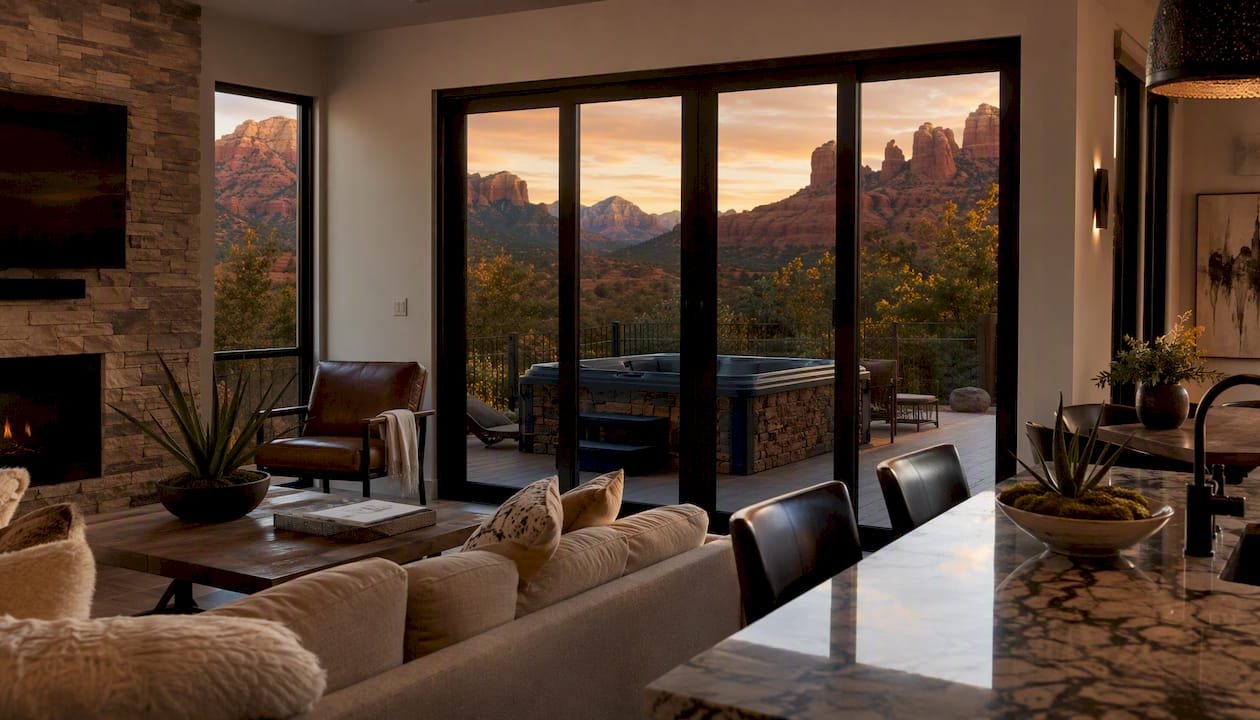
Single-family homes with views in the $700,000–$1,200,000 range are the sweet spot for STR investors. They command ADRs well above the market average, attract longer stays, and tend to have fewer HOA complications. A well-located 3-bedroom home with a private hot tub and unobstructed red rock views can routinely earn $100,000–$130,000+ per year, as Awning’s 2026 Sedona analysis documents for top performers.
Condos and townhomes in the $400,000–$650,000 range look attractive on paper because the entry price is lower. The catch: many Sedona condo associations restrict or outright prohibit STRs, and those that allow them often impose rules that limit revenue (no hot tubs, noise curfews, parking limits). Always verify HOA bylaws before running any numbers. Sedona’s luxury market dynamics also show that condo appreciation tends to lag detached homes, which matters if appreciation is part of your thesis.
Neighborhood breakdown:
- Uptown Sedona / near vortex sites (Airport Mesa, Bell Rock corridor): Premium ADRs driven by spiritual tourism and walkability to trailheads. Higher purchase prices compress cap rates to the 4%–5.5% range, but appreciation has been strong.
- West Sedona: More residential, slightly lower ADRs, but also lower purchase prices. Cap rates can reach 5.5%–7% for well-priced detached homes. Better for cash-flow-focused buyers.
- Oak Creek Canyon outskirts / Village of Oak Creek: Scenic, quieter, and often priced below central Sedona. Occupancy can lag the core market slightly, but the lower entry price can push cap rates toward the higher end of the range.
- Luxury tier ($1.5M+): Sedona’s high-end market features stunning properties, but cap rates often compress to 3%–4.5% net. These are appreciation plays first, cash-flow plays second.
Who should buy what:
- Cash-flow investors: target West Sedona or Village of Oak Creek, detached homes, $600,000–$900,000 price band, 5.5%–7% net cap rate target.
- Appreciation investors: target Uptown or Airport Mesa corridor, accept 4%–5.5% net cap rates, underwrite conservatively on revenue.
- Hybrid investors: 3-bedroom with a view, $800,000–$1,100,000, professional management from day one.
3. Sedona’s seasonality and what it does to your cap rate
Sedona has two peaks and one soft belly, and if you don’t model all three, your pro-forma will lie to you with a straight face.

Spring (March–May) is the strongest stretch of the year. AirROI identifies March as the highest-revenue month, driven by perfect hiking weather, the Sedona Film Festival, and spring break travelers. Fall (October–November) is the second peak, fueled by foliage, cooler temperatures, and the Sedona Arts Festival.
Summer (July–August) is the soft season. Temperatures in the Verde Valley regularly exceed 100°F, and AirROI flags August as the softest month. Occupancy can drop meaningfully below the annual average, and some operators lower ADRs to compensate. The good news: Sedona’s elevation (4,350 feet) keeps it cooler than Phoenix, so the dip is less severe than in lower-elevation Arizona markets.
Winter (December–February) is shoulder season with pockets of strength around the holidays. Occupancy is moderate, but ADRs hold up because Sedona draws visitors escaping colder climates.
For pro-forma modeling, use these practical guardrails:
- Conservative occupancy floor: 44% annually (Rabbu’s lower estimate), stress-tested against a 40% scenario for lender underwriting.
- Effective blended ADR: weight March and October at 130%–140% of base ADR; July–August at 80%–85%.
- Seasonality reserve: budget 2–3 months of operating expenses as a cash reserve to cover the summer soft period without touching your DSCR.
- Minimum stay strategy: 3-night minimums during peak months protect ADR; 2-night minimums in shoulder months protect occupancy. Dropping to 1-night minimums in summer can fill gaps but increases cleaning costs.
For a deeper look at how occupancy data breaks down month by month, Sedona STR occupancy analysis is worth bookmarking.
4. How to calculate net cap rates for Sedona STRs
The cap rate formula is simple: Net Operating Income (NOI) ÷ Purchase Price = Cap Rate. The hard part is getting NOI right for a short-term rental, because the expense stack looks nothing like a long-term rental.
The formula unpacked for STRs:
- Start with Gross Potential Revenue (ADR × 365 days × target occupancy %)
- Subtract vacancy/soft-season losses to get Effective Gross Revenue
- Subtract all operating expenses to reach NOI
- Divide NOI by purchase price
Expense table (conservative STR assumptions):
| Expense Line | Typical % of Gross Revenue | Notes |
|---|---|---|
| Property management | 25%–35% | Full-service STR management in Sedona |
| Cleaning & turnover | 8%–12% | Higher for frequent short stays |
| Utilities | 4%–6% | Electric, water, gas, internet, streaming |
| Insurance (STR/liability) | 2%–3% | $500K liability minimum per StaySTRA |
| Property tax | 3%–5% | Arizona primary vs. non-primary rates vary |
| Repairs & maintenance | 3%–5% | Higher for older homes or heavy guest use |
| Capital reserves | 2%–3% | Roof, HVAC, appliances |
| Platform fees (Airbnb) | 3% | Host service fee |
| Permit, TPT, license | 1%–2% | Annual STR permit fee plus TPT |
| Total operating expenses | 44% annually conservative occupancy floor | Use 50%–55% as a midpoint |
StaySTRA reports typical operating expenses at 25%–35% of gross revenue for well-run operations, but that figure often excludes property tax and capital reserves.
Worked Example 1: Cash purchase
- Purchase price: $850,000
- ADR: $400 | Occupancy: 50% | Gross revenue: $73,000
- Operating expenses (52%): $37,960
- NOI: $35,040
- Net cap rate: 4.1%
The Arizona Living Guide’s worked example shows a similar dynamic: a $750,000 property with $48,000 NOI yields a 6.4% cap rate, which requires either a lower purchase price or stronger-than-average revenue.
- Purchase price: $850,000 | Down payment: $212,500
- Mortgage (7.25% rate, 30-year): ~$4,630/month = $55,560/year
- NOI (same as above): $35,040
- Cap rate: 4.1% (unchanged; cap rate ignores financing)
- Cash-on-cash return: ($35,040 – $55,560) ÷ $212,500 = -9.7% (negative cash flow)
- DSCR: $35,040 ÷ $55,560 = 0.63 (well below lender minimums of 1.0–1.25)
Financing at current rates compresses investor returns sharply. Most Sedona STR buyers using conventional financing need either a larger down payment, a lower purchase price, or top-quartile revenue to achieve positive cash-on-cash. Mashvisor’s city-level analysis confirms that high purchase prices in resort markets like Sedona consistently compress STR cap rates relative to cheaper Arizona markets.
The three assumptions that move the cap rate most: purchase price (the biggest lever), management fee percentage, and effective occupancy. A 5-point occupancy swing changes NOI by roughly $3,500–$4,000 on a typical Sedona property.
For more Sedona cash flow examples, the OwnInAZ resource library has worked scenarios across multiple price bands.
5. Investor checklist: how to evaluate a Sedona STR deal before making an offer
Sedona deals move fast, and the red rocks won’t wait for you to figure out the permit situation. Here’s the sequence that separates smart buyers from sorry ones.
- Verify the STR permit status. Confirm the property has an active, valid Sedona STR permit. Ask for the permit number and verify it directly with the City of Sedona. Permits are non-transferable in many cases, meaning you may need to reapply after purchase.
- Confirm TPT and occupancy tax obligations. Arizona’s Transaction Privilege Tax (TPT) applies to STR income. Budget for this in your expense stack and confirm the seller is current on filings.
- Pull 12 months of actual booking data. Request calendar exports and owner payout statements from the seller’s Airbnb or VRBO account. Third-party market data is a starting point; actual payout statements are the truth.
- Run your own pro-forma. Use the expense table in Section 4 and replace market averages with the property’s actual historical ADR and occupancy. Don’t use the seller’s pro-forma without verifying every line.
- Order a local market comp analysis. Ask a Sedona-specialized agent to pull comparable active listings and recent sales with STR revenue history. Generic AVM tools miss the STR premium entirely.
- Confirm insurance and liability coverage. STR-specific insurance (not standard homeowner’s) is required. Budget for $500,000 minimum liability coverage as a baseline.
- Estimate capex and renovation needs. Sedona guests expect premium finishes. A dated kitchen or tired bathrooms will suppress ADR. Get a contractor walkthrough before closing.
- Talk to a specialized local agent and lender. A Sedona STR-focused agent knows which neighborhoods have pending HOA rule changes and which lenders offer DSCR loans for STR properties. General real estate agents often miss STR-specific due diligence items entirely.
Questions to ask the seller:
- What percentage of bookings are repeat guests?
- Is revenue concentrated on one platform (Airbnb only, or also VRBO and direct)?
- Has the property ever had a permit violation or noise complaint?
- What is the current management arrangement, and is the manager willing to stay on?
Red flags that should pause or kill a deal:
- Non-transferable permit with no clear reapplication path
- Revenue that can’t be verified with actual payout statements
- HOA restrictions that weren’t disclosed upfront
- Pending ordinance changes in the neighborhood
- Unusually high revenue claims with no calendar data to back them up
Pro Tip: *Cross-reference the seller’s claimed annual revenue against AirDNA’s listing-level data for that specific address.
6. Does Sedona allow Airbnb? STR rules, permits, and compliance costs
Short answer: yes, Sedona allows short-term rentals, and Arizona’s state preemption law has historically prevented cities from banning them outright. That said, the regulatory picture is shifting, and new investors need to budget for compliance and watch the legislative calendar.
Current rules and compliance checklist:
- State preemption: Arizona law has historically prevented municipalities from banning STRs entirely, which is why Sedona’s supply grew rapidly. However, HB 2429 passed the Arizona House in March 2026 and, if enacted into law, could allow cities to impose occupancy formulas and permit caps. This is a material regulatory risk for investors buying today.
- Annual STR permit: Required from the City of Sedona. The annual STR permit fee is about two hundred dollars. Permits are property-specific and may not transfer to a new owner automatically.
- Transaction Privilege Tax (TPT): STR hosts must collect and remit Arizona TPT on rental income. Failure to comply is a common and costly mistake for new operators.
- Liability insurance: StaySTRA documents a $500,000 minimum liability insurance requirement for Sedona STR operators. Standard homeowner’s policies do not cover commercial STR activity.
- Noise and nuisance rules: Sedona enforces noise ordinances actively. Violations can jeopardize permit renewal.
- HOA restrictions: Not a city rule, but a deal-killer in many condo complexes. Always review CC&Rs before making an offer.
Airbtics’ Sedona STR rules summary is a useful starting point for verifying current permitting requirements, though always confirm directly with the City of Sedona for the most current fee schedule and application process.
For context on how Sedona’s supply has changed under these rules, this local analysis of STR inventory shifts explains the permit dynamics driving recent supply changes.
7. Anonymized Equity Team pro-formas from real Sedona deals
Numbers from a spreadsheet are one thing. Numbers from an actual Sedona deal are another. Here are two anonymized pro-formas based on properties Equity Team has underwritten.
Pro-Forma A: West Sedona 3-bedroom, $775,000
- ADR used: $385 | Occupancy: 52% | Gross revenue: $73,100
- Operating expenses (54%): $39,474
- NOI: $33,626
- Net cap rate: 4.3%
- Notes: Standard management arrangement, no view premium, solid but not exceptional location. Consistent performer with low variance.
Pro-Forma B: Airport Mesa-adjacent 3-bedroom with views, $1,050,000
- ADR used: $495 | Occupancy: 56% | Gross revenue: $101,200
- Operating expenses (50%): $50,600
- NOI: $50,600
- Net cap rate: 4.8%
- Notes: Premium location drove above-market ADR. Professional management and a hot tub contributed to a top-quartile occupancy rate. This is the type of property Awning highlights when documenting $100,000–$130,000+ annual revenue for well-managed 3-bedroom Sedona homes.
What separates top-quartile from median performance:
- Professional photography and listing optimization (ADR impact: 10%–15%)
- Dynamic pricing tools (occupancy impact: 5%–8%)
- Responsive management with fast guest communication (review scores drive repeat bookings)
- Unique amenities: hot tub, outdoor fireplace, stargazing deck
For a visual walkthrough of how Equity Team analyzes actual Sedona STR properties, video walkthroughs and analyses from local experts are available on OwnInAZ.
8. Data sources, dates, and how to update the numbers for your address
Market averages are a starting point, not a finish line. Here’s where the numbers in this article come from and how to replace them with property-specific data.
Primary data sources used:
- AirDNA: Best for market-level occupancy, ADR, RevPAR, and active listing counts. July 2026 TTM data used here. Pulls from Airbnb and VRBO listing data; tends to include all hosts including sporadic ones, which can pull averages down.
- AirROI: June 2025–May 2026 dataset. Weighted toward active, frequently booked listings. Better for modeling what a professionally managed property can earn.
- StaySTRA: Useful for expense benchmarks, permit fee documentation, and regulatory risk flags (HB 2429). 2026 market report.
- Mashvisor: City-level cap-rate comparisons and traditional vs. STR return context.
- Airbtics: Regulatory summaries and occupancy/ADR benchmarks for cross-checking.
- Awning: Top-performer revenue examples and property-type narratives.
Known limitations:
- Listing revenue (what a listing shows as potential earnings) differs from owner payout (what the host actually receives after platform fees and cancellations). Always use payout statements for underwriting.
- Sample bias: datasets that pull from active listings overstate performance relative to the full market including dormant or poorly managed listings.
- AirDNA and AirROI use different date ranges and weighting, which explains the $47,600 vs. $73,713 revenue gap. Neither is wrong; they measure different slices of the market.
How to update numbers for a specific address:
- Pull the AirDNA listing-level report for the exact address or the closest comparable active listings.
- Request 12 months of Airbnb payout statements from the seller.
- Export the property’s booking calendar and calculate actual occupancy from blocked vs. available nights.
- Replace market ADR and occupancy assumptions in the pro-forma with property-specific figures.
Re-underwrite whenever: a permit change occurs, HB 2429 advances in the legislature, occupancy drops more than 5 points year-over-year, or a major supply event (new hotel, large HOA STR ban) affects the submarket.
9. What Sedona STR investing actually looks like from the inside
Most market reports on Sedona cap rates treat the numbers as if they exist in a vacuum. They don’t.
What gets missed in the headline data is that Sedona’s STR market is genuinely bifurcated. There’s a large group of casual hosts earning $35,000–$50,000 per year on properties that could earn $75,000 with professional management and better pricing. The market averages reflect both groups equally, which is why the median listing revenue ($54,000 per StaySTRA) looks so different from what top-quartile operators earn ($95,000+).
The regulatory picture deserves more attention than most investors give it. HB 2429 is not a certainty, but it’s not a rumor either. It passed the Arizona House in March 2026. If it becomes law and Sedona gains the ability to cap permits or impose occupancy formulas, the supply side of the equation changes materially. That’s not a reason to avoid Sedona, but it is a reason to buy a property that would hold its value as a primary residence or long-term rental if the STR rules tighten.
The investors who do best in Sedona are the ones who treat it like a business from day one: professional photos, dynamic pricing, a responsive management team, and a realistic pro-forma that doesn’t assume peak-season occupancy year-round. The red rocks are breathtaking, but they don’t manage your calendar.
Equity Team helps you find and underwrite Sedona STR investments
Sedona’s STR market rewards buyers who know exactly what they’re buying. We don’t just help you find a property; we build the pro-forma, validate the permit, run the comps, and connect you with STR-experienced lenders who understand DSCR underwriting for vacation rental properties.

Whether you’re evaluating your first Sedona STR or adding to an existing portfolio, the next step is a property-specific pro-forma built on real local data, not market averages. Request a customized Sedona STR analysis from Equity Team, or browse current Sedona investment opportunities to see what’s available in your target price band.
Sources
- Sedona, Arizona Airbnb & Short-Term Rental Data (2026) | AirDNA
- Sedona Arizona Airbnb Data 2026: Occupancy, Revenue & STR Market Report | AirROI
- Staystra
- Sedona investment property guide | Mashvisor
- Best Places to Invest in STR in Sedona, AZ (2026) – Awning
This article is general information, not a substitute for advice from a qualified financial advisor. Consult a qualified financial professional about your own circumstances before acting on anything here.