
Yes, a DSCR loan can absolutely finance a Sedona Airbnb — but three things need to line up first. The lender must accept short-term rental income (not all do), the Sedona municipal permit must be verified at the address level before closing, and the property’s debt-service coverage ratio must clear the lender’s minimum threshold, typically a DSCR amount that falls between a low threshold and a moderate target. Get all three right, and you have a financing path that never asks for a W-2.
Before you go any further, check these three items:
- Permit status: Sedona’s STR permits are non-transferable at sale. The new owner must apply fresh, and there can be a 2–8 week gap between closing and the day the property legally earns Airbnb income.
- Lender STR acceptance: Confirm the lender underwrites to trailing 12 months of actual bookings or an AirDNA projection, not just long-term market rent.
- DSCR math: Run the numbers at a conservative occupancy rate before you make an offer. A gross DSCR above 1.25 gives you pricing leverage; anything below 1.0 is a hard stop at most programs.
Key Takeaways
A DSCR loan works for a Sedona Airbnb when the permit is confirmed, the lender accepts STR income, and the net-revenue DSCR clears 1.0 after conservative expense overlays.
| Point | Details |
|---|---|
| Verify the permit first | Sedona STR permits are non-transferable; confirm address-level status before making an offer. |
| Run conservative DSCR math | Use 80% of AirDNA gross and a 32% expense overlay; target 1.15x net DSCR or higher. |
| Confirm lender STR acceptance | Not all lenders accept Airbnb income; non-QM programs are the most STR-friendly option. |
| Budget for the permit gap | A 2–8 week activation window after closing must be funded from reserves, not projected income. |
| Use Equity Team for local vetting | Equity Team verifies permit, HOA, and jurisdiction status before any offer is submitted. |
Table of Contents
- What are the real pros and cons of a DSCR loan for a Sedona Airbnb?
- How is DSCR calculated for an Airbnb property?
- What DSCR thresholds and occupancy assumptions do lenders use?
- What types of lenders offer DSCR loans, and what terms should you expect?
- What does a lender require from a DSCR borrower?
- What does the application checklist and timeline look like?
- Worked DSCR example for a Sedona Airbnb
- What Chad at Equity Team has learned about underwriting Sedona STRs
- How Equity Team helps you get DSCR financing for a Sedona Airbnb
- Sources
What are the real pros and cons of a DSCR loan for a Sedona Airbnb?
Pros
- No W-2 required. Many DSCR programs qualify on property cash flow alone, making them ideal for self-employed investors or those with complex tax returns.
- LLC-friendly closings. You can take title in an entity, which simplifies portfolio scaling.
- Sedona’s high nightly rates help the DSCR math when bookings are strong, since gross revenue is the starting point for underwriting.
- Arizona’s SB 1350 and SB 1168 prevent municipalities from banning STRs outright, so the legal baseline for Sedona Airbnb investing remains solid.
Cons
- Sedona’s permit is non-transferable. That gap between closing and operational income is real and must be modeled into your reserves.
- Seasonal volatility means lenders often apply conservative occupancy assumptions, which can shrink the underwritten revenue figure significantly.
- HOA or CC&R restrictions can override the municipal permit entirely. A property can be city-permitted and HOA-prohibited at the same time.
- Lower credit scores or thin booking history push rates up and down payment requirements higher.
How lenders compare on key DSCR dimensions
| Dimension | Portfolio / Community Bank | Non-QM / Private Lender |
|---|---|---|
| Minimum DSCR | 1.25 | 1.0–1.15 |
| Down payment / LTV | 25–30% down | 20–25% down |
| STR income accepted | Sometimes, with restrictions | Yes, with documentation |
| Documentation required | Full income docs + STR history | STR leases or AirDNA + bank statements |
| Speed of funding | 30–45 days | 14–30 days |
| Typical fees | Lower origination | Higher origination (1–3 points) |
How is DSCR calculated for an Airbnb property?
The formula is straightforward:
DSCR = Gross Monthly Rental Income ÷ Monthly PITIA (Principal, Interest, Taxes, Insurance, and HOA)
Lenders underwrite STR income conservatively. They typically use the lesser of trailing 12-month actual revenue or an appraiser’s long-term market rent, then apply an operating expense overlay of around one-third to arrive at net revenue.
A Sedona-adjacent worked example from Village of Oak Creek shows the math clearly: AirDNA projected $145,000 gross annually, underwritten to 80% = $116,000. Monthly PITIA on the $985,000 purchase was $5,734. That 1.15x still clears most lender minimums, but it leaves little cushion if occupancy dips.
What DSCR thresholds and occupancy assumptions do lenders use?
Most programs set their floor at 1.0, meaning income equals the payment. Pricing improves meaningfully at 1.25, and some lenders reserve their best rates for 1.35 and above. For STRs specifically, lenders rarely underwrite to peak-season occupancy. Expect them to model seasonal Sedona occupancy patterns at 60–70% annual average, not the 80%+ a strong property might actually achieve.
Expense overlays matter just as much as occupancy.
What types of lenders offer DSCR loans, and what terms should you expect?
Three categories dominate the DSCR market for Sedona vacation rentals:
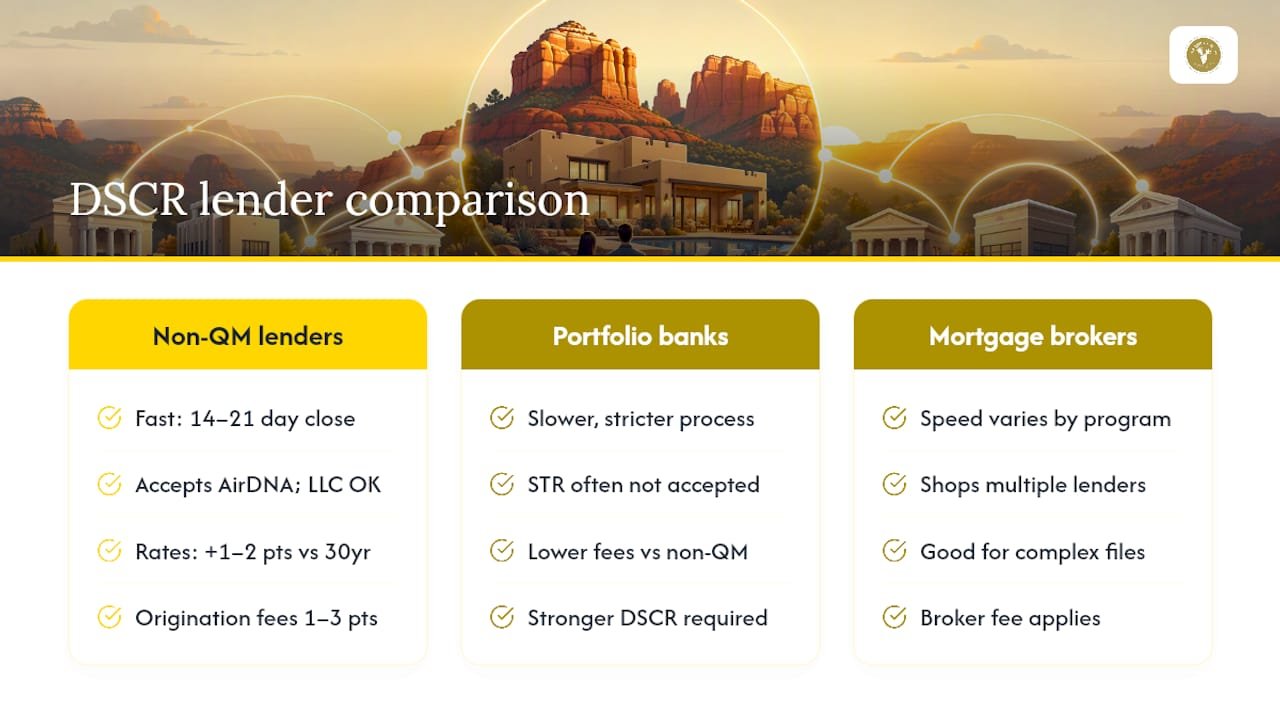
Non-QM lenders are the most STR-friendly. They accept AirDNA projections, allow LLC closings, and move fast — sometimes 14–21 days to close. Rates run higher than conventional (often 1–2 points above 30-year fixed), and origination fees of 1–3 points are common.
Portfolio banks and credit unions occasionally offer DSCR-style products with lower fees, but they tend to require stronger DSCR ratios and may not accept STR income at all without a long operating history.
Mortgage brokers who specialize in non-QM can shop your file across multiple programs simultaneously, which is worth the broker fee when your deal has any complexity (short booking history, LLC title, high purchase price).
Loan amounts typically start at $75,000–$100,000, with most Sedona deals falling in the $500,000–$1,000,000 range given local property pricing.
What does a lender require from a DSCR borrower?
Typical minimums across Arizona DSCR programs:
- Credit score: 620 minimum; 680+ gets meaningfully better pricing
- Down payment: 20–25% for most programs; 25–30% for lower credit or thin STR history
- Reserves: 6–12 months of PITIA in liquid accounts after closing
- Documentation: STR lease or platform history, AirDNA report, property insurance (including WUI coverage for Sedona’s wildfire zone — worth confirming with a local Sedona insurance broker), entity docs if closing in an LLC
No W-2 or personal tax returns are required on most non-QM DSCR programs, which is the single biggest advantage for investors with complex income structures.
What does the application checklist and timeline look like?
Documents to gather before applying:
- Last 12 months of STR booking statements or AirDNA report
- Entity formation docs (if using an LLC)
- 2 months of bank statements showing reserves
- Property insurance quote (hazard + liability + WUI)
- Sedona STR permit status confirmation at the address
Typical timeline: Pre-approval in 3–5 days, appraisal ordered at contract (7–14 days), underwriting 7–14 days, closing 21–30 days from contract for non-QM lenders. Budget 30–45 days total.
Estimated costs: Origination fee 1–3% of loan amount, appraisal $600–$1,200 for STR properties, title and escrow $1,500–$3,000, lender reserves requirement varies.
Worked DSCR example for a Sedona Airbnb
Here is how the math plays out on a realistic Sedona property, modeled on the Village of Oak Creek AirDNA example:
| Line Item | Amount |
|---|---|
| Purchase price | $985,000 |
| Down payment (20%) | $195,000 |
| Loan amount | $785,000 |
| AirDNA gross annual projection | $145,000 |
| Lender underwritten revenue (80%) | $116,000 |
| Monthly underwritten income | $9,600 |
| Monthly PITIA | $5,734 |
| Gross-revenue DSCR | 1.7x |
| Net revenue after 32% expense overlay | $6,500/month |
| Net-revenue DSCR | 1.15x |
The permit gap matters here: if the new owner needs 4 weeks to get the Sedona STR permit activated, that is roughly $9,000 in projected income that does not materialize. Model it into your reserve calculation, not your income projection.
What Chad at Equity Team has learned about underwriting Sedona STRs
DSCR loans are genuinely useful for Sedona Airbnb investors — when the property cash flows. The tool works. What trips people up is not the loan structure; it is the permit gap and the HOA fine print that nobody reads until after the offer is accepted.
The City of Sedona and Yavapai County (which governs Village of Oak Creek and much of the surrounding area) operate under different permit frameworks. A property that looks identical on Zillow can have completely different regulatory exposure depending on which side of the jurisdiction line it sits on. Lenders do not always catch this distinction, which means the buyer’s agent needs to.
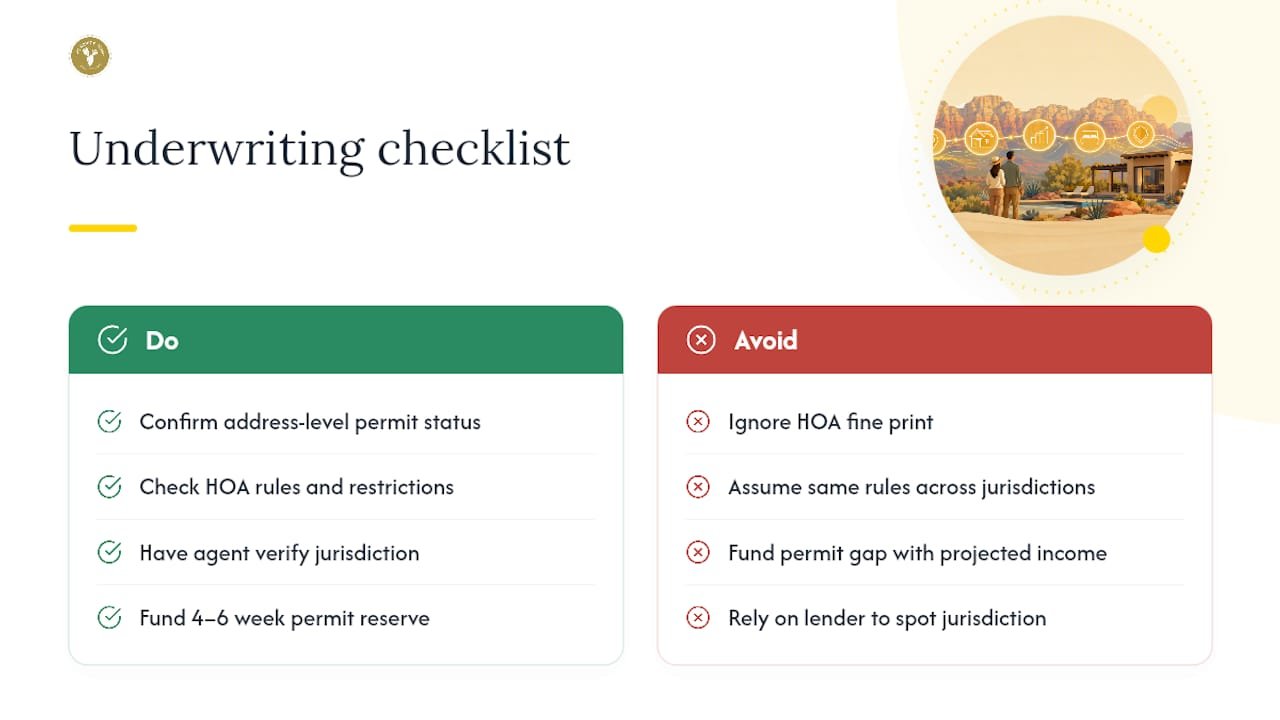
Modeling the permit-to-operational gap into the offer is standard practice at Equity Team. If a property needs 4–6 weeks to get permitted after closing, that window needs to be funded from reserves, not from projected Airbnb income. Confirm address-level permit and HOA status before making any offer — not after.
How Equity Team helps you get DSCR financing for a Sedona Airbnb
Sedona’s STR market rewards investors who do the homework before the offer, not after. Equity Team is the local shortcut for that homework.
Equity Team works exclusively with STR investors and is the first agent group in Northern Arizona specialized in short-term rental acquisitions. Here is what that means for a DSCR buyer:
- Property vetting for DSCR viability before you make an offer
- Permit and HOA verification at the address level
- Video walkthroughs and property analyses by local STR experts
- Lender referral coordination for STR-friendly non-QM programs
- Full buyer representation through closing
Pro Tip: Budget a 2–8 week permit-to-operational gap for any Sedona purchase and fund it from reserves, not projected income.
Ready to run the DSCR numbers on a specific property? Find the right Sedona STR investment and connect with Equity Team to get started.
Sources
- DSCR Loans in Arizona | Rental Property Financing AZ Investors
- DSCR Loans in Arizona: 2026 Investor’s Guide
- DSCR Loans in Arizona 2026: STR Friendly, Low Property Tax
Municipal permit rules change. Verify current Sedona STR permit requirements directly with the City of Sedona or Yavapai County before closing on any property.
This article is general information, not a substitute for advice from a qualified financial advisor. Consult a qualified financial professional about your own circumstances before acting on anything here.