

As an Arizona Airbnb host, you are ultimately responsible for Transaction Privilege Tax (TPT) on your short-term rental income, even when Airbnb collects and remits it on your behalf. The Arizona Department of Revenue (ADOR) is clear: the obligation sits with the operator. Airbnb acting as an online lodging marketplace (OLM) handles the remittance mechanics, but you still need a TPT license, and you still need to file returns.
Two things to do right now:
- Register for a TPT license at Aztaxes and include that license number on every listing and advertisement.
- Obtain Form 5018 from Airbnb as proof that the marketplace remitted taxes for your reservations, and keep a copy for every booking period.
Key Takeaways
Arizona Airbnb hosts are responsible for TPT filing even when Airbnb remits the tax, and the TPT license, Form 5018, and deduction code 775 are the three non-negotiables that keep you compliant.
| Point | Details |
|---|---|
| TPT license is mandatory | Register at AZTaxes.gov and display your license number on all advertising before your first booking. |
| Form 5018 is your proof | Obtain and retain Form 5018 from Airbnb for every period; it is your evidence that the marketplace remitted taxes. |
| File returns even with OLM remittance | Report gross receipts and claim deduction code 775 on every return where Airbnb collected and remitted. |
| 30-day threshold changes tax treatment | Stays under 30 consecutive days are taxed as transient lodging; longer stays shift to residential rental codes at the state and county level. |
| Equity Team | Equity Team works with Sedona STR investors to verify compliance and connect hosts with the right local resources before buying or selling. |
Table of Contents
- Which Arizona Airbnb taxes apply to your short-term rental?
- What counts as taxable income, and how do you calculate it?
- How Airbnb collects and remits Arizona taxes — and what you still must do
- How to register, file, and pay on AZTaxes.gov
- Exemptions, long-term stays, and other cases that change the math
- Records to keep and how to survive an audit
- Where to find official rates and build a repeatable calculator
- Sedona and Northern Arizona: what local hosts actually run into
- What Sedona’s STR tax reality actually teaches you
- Equity Team helps Sedona hosts get compliant and invest smarter
- Sources
Which Arizona Airbnb taxes apply to your short-term rental?
Arizona short-term rental taxes stack up in layers, and the combined rate for your property depends exactly on where it sits. Three components typically apply:
State TPT is the foundation. Arizona imposes Transaction Privilege Tax on transient lodging, reported under business code 025 for state and county, and code 044 (or 144 for additional hotel tax) for city filings. Think of it as Arizona’s version of a sales tax on the privilege of renting.
County excise tax adds another slice. According to Airbnb’s occupancy tax help page for Arizona, county excise rates range from approximately 0.28% to 6.5% depending on the county.
City transient occupancy taxes are where things get genuinely quirky. Always verify against official ADOR sources. Always verify these figures against the official ADOR TPT rate tables or the Tax Rate Look-Up Tool, since city rates shift and third-party summaries can lag behind.
Sedona hosts, take note: the combined lodging tax rate in Sedona is among the highest in Northern Arizona, which means the dollar impact of a miscalculation is larger than it looks on a spreadsheet.
To find the exact combined rate for your property address, use ADOR’s Tax Rate Look-Up Tool, which returns state, county, and city components by address. That address-level precision matters because two properties on the same street can occasionally fall under different municipal jurisdictions.
What counts as taxable income, and how do you calculate it?
The taxable base is broader than most hosts expect. Under ADOR rules, gross receipts for the lodging transaction include the listing price, cleaning fees, security fees, and any other charges the operator collects from the guest. The ADOR OLM factsheet confirms that cleaning fees and guest fees are included in the taxable base, so you cannot subtract them before calculating what you owe.
The 30-day rule is the other big variable. Stays under 30 consecutive days are taxed as transient lodging at the state, county, and city levels. Stays of 30 or more consecutive days are generally treated as residential rentals for state and county purposes, which changes the applicable business codes and often reduces the tax burden. City rules on this threshold have historically varied, so always confirm the local treatment with ADOR’s rate tables.
Here is how a sample reservation calculation works:
| Component | Amount |
|---|---|
| Nightly rate (3 nights × $250) | $750 |
| Cleaning fee | $85 |
| Taxable base | $835 |
| State TPT | $47 |
| County excise (approx. 3%) | $25 |
| City transient tax (approx. 3%) | $25 |
| Estimated total tax | $97 |
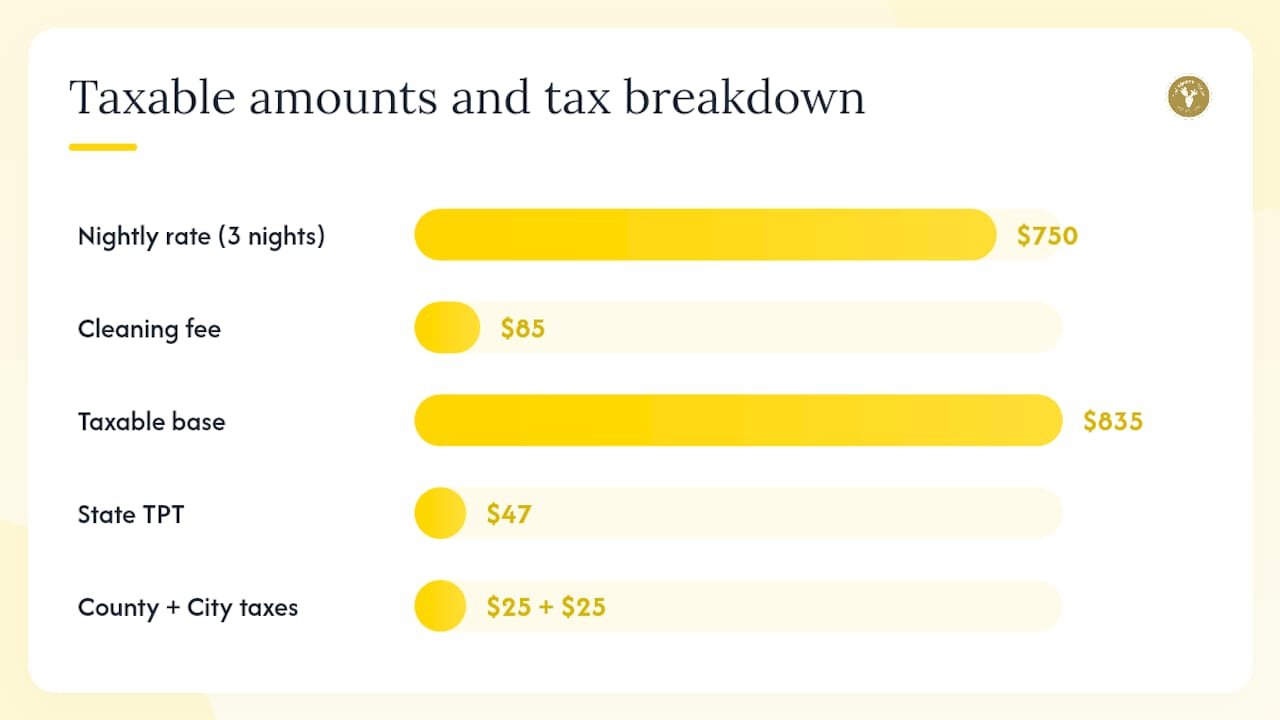
When Airbnb collects and remits as an OLM, the guest pays this tax through the platform. When you take a direct booking, you collect it yourself and remit it on your return. Either way, the taxable base calculation is identical.
How Airbnb collects and remits Arizona taxes — and what you still must do
Airbnb has been operating as a registered OLM in Arizona since January 1, 2019, when A.R.S. §42-5070 took effect, requiring marketplaces to register, collect, and remit TPT on online lodging transactions. That is genuinely helpful for hosts. But marketplace remittance does not mean you can ignore your filing obligations. Here is the full picture:
- Form 5018 is the document Airbnb issues to you as evidence that it remitted taxes for your reservations. Retain a copy for every period. Without it, you have no proof the tax was paid, and ADOR can hold you liable.
- Form 5019 is the class-one property exemption certificate, relevant when a property is classified as a hotel or class-one property rather than a residential rental. Most individual Airbnb hosts will encounter Form 5018 far more often than Form 5019.
- Deduction code 775 is what you claim on your own return to avoid being taxed twice. You still report the gross receipts Airbnb collected, then deduct them using code 775 to show the marketplace already remitted the tax. The ADOR OLM guidance walks through this reporting flow in detail.
- Not every jurisdiction is fully covered. Some municipalities or special assessments may fall outside what Airbnb remits. Check your Airbnb dashboard and the platform’s help page to confirm which taxes it collects for your specific listing location.
Pro Tip: Download your Airbnb remittance report each month and staple it (digitally) to your Form 5018 for that period. If ADOR ever asks, you will have a clean paper trail in about 30 seconds.
How to register, file, and pay on AZTaxes.gov
Getting licensed and filing correctly is a five-step sequence, and none of the steps are particularly painful once you know the order.
- Create an account on AZTaxes.gov. Go to AZTaxes.gov and set up a login. This is the ADOR portal for everything: licensing, filing, and payment.
- Apply for a TPT license. Select the transient lodging classification during the application. ADOR will assign you a license number, which you must display on all advertising for your rental.
- Choose your filing frequency. ADOR offers monthly, quarterly, and seasonal options. Most active STR hosts file monthly or quarterly. Seasonal filing is available if your rental operates only part of the year.
- File your return and claim the right deductions. For reservations booked through Airbnb, report the full gross receipts and then claim deduction code 775 for the amounts the OLM remitted. For direct bookings, report gross receipts with no deduction and remit the tax yourself.
- File zero returns when you have no income. If your property sits vacant for a period, you still must file a return showing zero income. Skipping a zero return is a common mistake that triggers penalty notices.
Payment is made directly through AZTaxes.gov at the time of filing. Late payment carries penalties and interest, so calendar your due dates as soon as you know your filing frequency.
Exemptions, long-term stays, and other cases that change the math
Not every reservation triggers the full transient lodging tax stack, and knowing the exceptions can save real money.
Stays of 30 or more consecutive days are the most common exemption. At the state and county level, these shift from the transient lodging classification to residential rental, which carries different business codes and generally a lower combined rate. City treatment of long-term stays has historically varied, so verify the local rule for your municipality via ADOR’s rate tables before assuming the exemption applies.
Class-one property classification applies to hotels and similar commercial lodging operations. Individual residential STR hosts typically do not fall into this category, but if your property is commercially zoned or structured as a hotel-type operation, Form 5019 documents the exemption from certain OLM remittance requirements.
Historical city rules are worth a mention for Sedona hosts specifically. Some Arizona cities previously taxed residential rentals under their own local codes before January 1, 2025 rule changes took effect. If your property has a history of long-term rentals mixed with short-term stays, verify which business codes applied in prior periods before amending any returns.
Pro Tip: When a guest extends a stay past 29 days mid-booking, document the extension in writing and adjust your return accordingly. The 30-day threshold is measured by consecutive nights, not calendar month, so a booking that crosses a month boundary still counts as one continuous stay.

Records to keep and how to survive an audit
ADOR audits of STR hosts tend to zero in on three things: missing TPT licenses, absent Form 5018 documentation, and incorrect business code reporting. Keeping the right records eliminates all three vulnerabilities.
Retain these documents for at least the ADOR statute of limitations period (generally four years for TPT, though ADOR guidance recommends erring on the longer side):
- Your TPT license
- Form 5018 copies for every reservation period Airbnb remitted
- Reservation receipts showing gross receipts, cleaning fees, and any other charges
- Platform remittance reports (downloadable from your Airbnb host dashboard)
- Bank deposit records matching remittance amounts
- Filed returns from AZTaxes.gov
Pro Tip: Build one spreadsheet per property that links each reservation to its Form 5018, the return it was reported on, and the deduction code used. Update it monthly. If an auditor calls, you hand over one file instead of hunting through two years of emails.
For hosts thinking about the broader financial picture of their Sedona property, the depreciation benefits available to vacation home owners are worth understanding alongside your TPT obligations.
Where to find official rates and build a repeatable calculator
The ADOR Tax Rate Look-Up Tool is the only source you should trust for address-level combined rates. Third-party summaries are useful for ballpark estimates, but ADOR’s official rate tables are what an auditor will reference, and city-level rates change more often than most guides update.
How to use the Tax Rate Look-Up Tool:
- Navigate to the ADOR website and open the Tax Rate Look-Up Tool.
- Enter the property’s street address.
- Read the state, county, and city rate components and note the region/city codes.
- Cross-reference the business codes (025 for state/county transient lodging; 044 or 144 for city) to confirm you are pulling the right rate column.
Spreadsheet formula for any reservation:
Tax owed = Taxable Base × (State Rate + County Excise Rate + City Rate + Additional Hotel Tax Rate)
Where Taxable Base = nightly rate + cleaning fee + any other operator charges.
Here is how the same reservation looks under two scenarios:
| Scenario | Taxable Base | Combined Rate | Tax Owed | Who Remits |
|---|---|---|---|---|
| OLM (Airbnb) collects | $835 | combined rate | tax owed | Airbnb (host claims deduction 775) |
| Direct booking | $835 | combined rate | tax owed | Host remits via AZTaxes.gov |
The tax owed is identical. The only difference is who writes the check and how the return is filed. Update your rate inputs every time ADOR publishes new rate tables, which typically happens at the start of each calendar year.
For hosts tracking Arizona legislation changes that could affect STR tax statutes, a legislative monitoring tool can flag relevant bill activity before rate changes take effect.
Sedona and Northern Arizona: what local hosts actually run into
Sedona’s STR market is one of the most vibrant in Arizona, and the tax environment reflects that. The combined lodging tax rate in Sedona sits among the highest in the state, which means even a small classification error produces a noticeable dollar gap at audit time.
A few things Sedona and Northern Arizona hosts commonly miss:
- City business license requirements separate from TPT. Sedona requires a city business license for STR operators in addition to the state TPT license. These are two different filings with two different agencies.
- TPT license number on advertising. Arizona law requires the license number to appear on all advertising for the rental. Many hosts list on Airbnb without ever adding this number to their profile or listing description.
- Incomplete Form 5018 retention. Hosts often confirm that Airbnb is collecting taxes through the dashboard but never download or save the actual Form 5018 documentation. The dashboard confirmation is not a substitute for the form.
- Confused classification of 30-day stays. A guest who books 28 nights and then extends by 3 days mid-stay crosses the threshold. The tax treatment for the entire stay may change, and the return needs to reflect that.
Sedona’s short-term rental restriction changes have also introduced zoning and permit nuances that interact with tax registration. If your property’s permit status has changed recently, verify that your TPT license still reflects the correct property classification. When in doubt, contact the City of Sedona’s finance department or a local STR specialist directly.
What Sedona’s STR tax reality actually teaches you
Most hosts who get tripped up on Arizona vacation rental taxes are not cheating. They just assumed that because Airbnb was collecting the tax, the whole obligation was handled. That assumption is the single most expensive mistake in this space.
The filing obligation never disappears. A host who skips filing because “Airbnb handles it” is technically non-compliant, and that non-compliance shows up the moment a property goes under contract and a buyer’s agent requests tax records. Sedona STR properties transact at premium prices, and a gap in TPT filing history can complicate or kill a sale.
The practical recommendation: treat your TPT return like a monthly utility bill. It takes about 15 minutes on AZTaxes.gov once you have the system set up. The Form 5018 goes in a folder. The deduction code 775 goes on the return. Done. The hosts who build this habit in month one never scramble at audit time or at closing.
Equity Team helps Sedona hosts get compliant and invest smarter
Sedona’s STR market rewards hosts who run a tight operation, and tax compliance is part of that tightness. Equity Team works exclusively with STR investors in Sedona and Northern Arizona, which means every client conversation includes a practical check on whether the property’s TPT license is current, whether Form 5018 documentation is in order, and whether the listing is set up to perform in the top tier of the market.

Whether you are buying your first compliant STR property or selling one that needs its records buttoned up before closing, Equity Team connects you with the right local resources, including tax and accounting specialists who know Sedona’s specific rate structure. Start with a look at how to find the right Sedona STR investment property and reach out to schedule a consultation. The compliance check is part of the conversation, not an add-on.
Sources
Bookmark these authoritative sources and check them whenever rates or rules change.
- Short-Term Lodging | Arizona Department of Revenue
- Occupancy tax collection and remittance by Airbnb in Arizona | Airbnb Help
- Aztaxes
This article provides general information about Arizona short-term rental tax obligations and is not a substitute for professional tax or legal advice. Confirm current rates and rules with ADOR or a qualified tax professional before filing.