

Sedona is a genuine yes for disciplined, top-quartile short-term rental operators. AirDNA’s 2026 data puts the market at roughly 4,351 active listings, a $370 ADR, 54% occupancy, and $199 RevPAR, with a Market Score of 75/100. Arizona state law prevents any outright ban, so the red rocks keep generating returns for investors who do the homework. Three moves to make right now:
- Order an address-level comp and revenue projection before you fall in love with a listing.
- Confirm your permit, TPT registration, and $500,000 liability insurance are lined up under Sedona City Code Ch.5.25.
- Run DSCR and cash-flow scenarios using top-quartile operating assumptions, not market averages.
Key Takeaways
Sedona is a high-return STR market for investors who target top-quartile properties, run address-level comps, and meet every permit and TPT requirement before the first guest checks in.
| Point | Details |
|---|---|
| Market metrics (2026) | AirDNA reports $370 ADR, 54% occupancy, $199 RevPAR across ~4,351 active listings. |
| Operator skill drives returns | Top-quartile listings materially outperform the median; model with top-quartile assumptions, not averages. |
| Permit and TPT are non-negotiable | Ch.5.25 requires an annual permit via MUNIRevs, TPT registration, and $500,000 liability insurance before renting. |
| Ownership transfer needs a new permit | The STR permit does not transfer with the deed; buyers must apply through MUNIRevs at closing. |
| Equity Team | Sedona’s only STR-specialist investor team; provides address-level comps, permit guidance, and acquisition or sale representation. |
Table of Contents
- How does Sedona’s STR market actually perform right now?
- How do you evaluate one specific Sedona property?
- What does permitting, licensing, and closing actually cost?
- How do you push occupancy and ADR higher?
- What are the real risks and red flags?
- What financial metrics matter beyond gross revenue?
- What does the full purchase or sale timeline look like?
- How do you legally transfer ownership of a Sedona STR?
- How do you choose the right local STR specialist?
- Why top-quartile focus is the only Sedona strategy worth running
- Equity Team brings address-level precision to Sedona STR deals
- Primary sources worth bookmarking
- Sources
How does Sedona’s STR market actually perform right now?
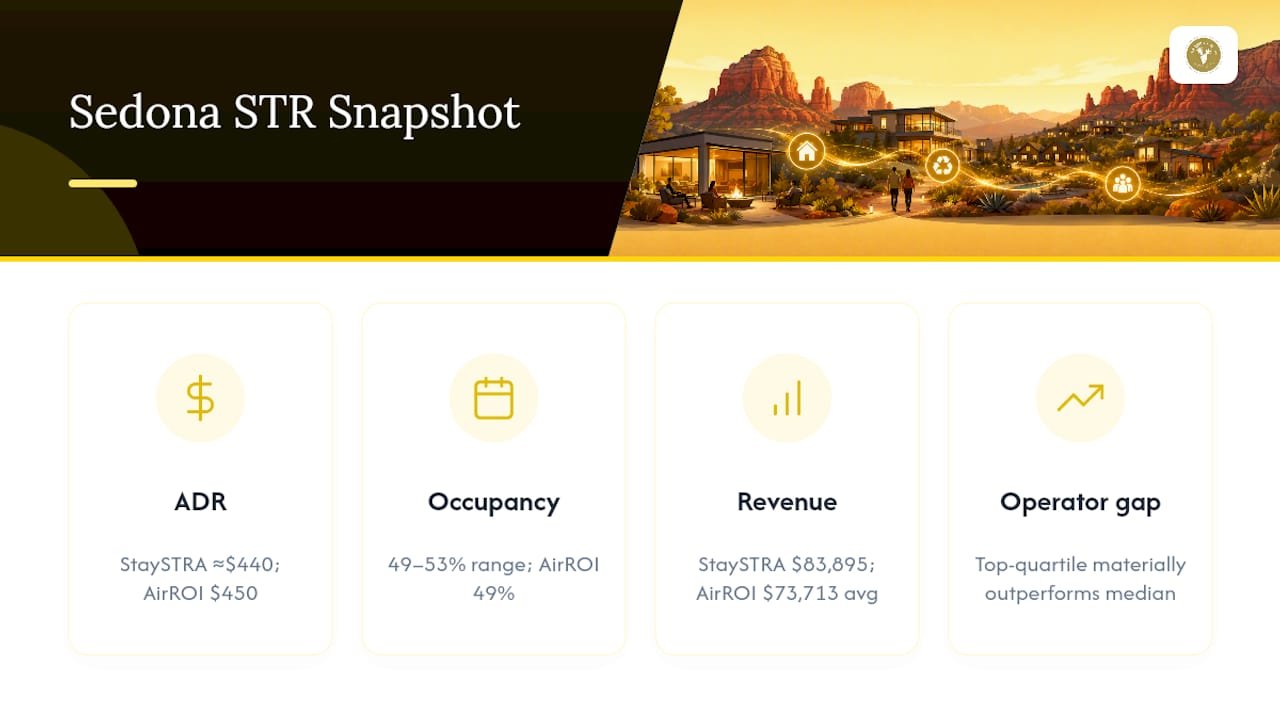
The numbers tell a vivid story. StaySTRA’s 2026 report clocks ADR near $440, trailing 12-month revenue per listing around $83,895, and occupancy in the 49–53% range. Supply has grown roughly 62% since 2021, so competition is real. Spring and fall are peak seasons, with March and October driving the sharpest booking windows. AirROI’s analysis puts average annual revenue around $73,713 at a $450 ADR and 49% occupancy, and flags wide performance dispersion between top and bottom tiers. That gap is the whole story: top-quartile operators materially outperform the median, making operator skill the decisive factor for DSCR viability. Check the current STR climate breakdown for deeper neighborhood-level context.
How do you evaluate one specific Sedona property?
Pull neighborhood-level comps first, not market-wide averages. Tools like AirDNA and AirROI let you filter by bedroom count, proximity to trailheads, and booking window length. Estimate ADR and occupancy for that specific address, then model monthly swing across seasons. A property that looks fine on annual averages can show a brutal January trough. Run the Sedona rental income evaluation framework before making an offer.
What does permitting, licensing, and closing actually cost?
Sedona City Code Ch.5.25 requires an annual STR permit, neighbor notification before the first rental, a 24/7 emergency contact, permit display in all advertising, and $500,000 aggregate liability insurance. Renewals run through MUNIRevs, Sedona’s online permit portal. Arizona Department of Revenue Transaction Privilege Tax registration is separate and mandatory. Arizona Revised Statutes §9-500.39 confirms cities can regulate but not ban. Budget 30–60 days for permit approval, TPT setup, and insurance binding alongside a standard 30–45 day escrow. Median listing prices in Sedona run near $1.15M–$1.2M, so closing costs and agent commissions are meaningful line items in your pro forma.
How do you push occupancy and ADR higher?
Dynamic pricing tools that adjust nightly rates against real-time demand are the fastest lever. Professional photography, a listing that names the nearest trailhead, and amenities like a hot tub or outdoor fireplace consistently lift ADR. Respond to inquiries within an hour. A Sedona landscape and pool upgrade can meaningfully improve guest appeal and justify higher nightly rates.

What are the real risks and red flags?
Permit suspension for a neighbor complaint is not theoretical. Arizona Daily Press reporting from May 2026 documents Sedona tightening enforcement, adding a 24/7 complaint hotline, and pushing annual renewals through MUNIRevs. Insurance gaps are the other landmine: a standard homeowner policy rarely covers STR liability. Pending state legislation (HB 2429) could shift permit density rules, per StaySTRA’s regulatory analysis. Verify current permit advice with a local specialist before closing.
What financial metrics matter beyond gross revenue?
Gross revenue is a vanity number. Net operating income (NOI), cash-on-cash return, and cap rate are what actually tell you whether a property pencils. Subtract management fees (typically 20–30% of revenue), cleaning, utilities, insurance, HOA, and property tax from gross revenue to get NOI. Divide NOI by purchase price for cap rate. For DSCR financing, lenders typically want a ratio above 1.25, so model with 25–35% total expense assumptions against top-quartile revenue, not median. Sedona real estate market trends and high acquisition prices mean cap rates are compressed; the upside lives in appreciation and top-tier operator performance.
What does the full purchase or sale timeline look like?
Search and underwriting take two to four weeks when you have address-level comps ready. Negotiation and accepted offer add another one to two weeks. Escrow in Arizona typically runs 30–45 days and covers title search, inspection, appraisal, and lender review. Post-closing, plan two to four weeks to permit, furnish, photograph, and list. Sellers need a comparative market analysis, STR-specific pricing strategy, and permit transfer documentation. The full cycle from first showing to first guest check-in is realistically 90–120 days for a buyer.
How do you legally transfer ownership of a Sedona STR?
The STR permit does not automatically transfer with the deed. The buyer must apply for a new permit through MUNIRevs under Ch.5.25 and register separately for TPT with the Arizona Department of Revenue. The seller should cancel their existing permit and TPT account at close. Title transfers via a standard Arizona warranty deed recorded with Yavapai County. Arizona Revised Statutes §11-269.17 governs county-level regulatory continuity. Budget for a gap period between closing and first legal rental night while the new permit processes.
How do you choose the right local STR specialist?
Not every real estate agent understands STR underwriting. Look for these criteria:
- STR-specific transaction history in Sedona, not just general residential sales.
- Address-level revenue modeling capability using AirDNA, AirROI, or Airbtics, not just MLS comps.
- Regulatory fluency: can they walk you through Ch.5.25, MUNIRevs, and TPT registration without hesitation?
- Investor-only focus: agents who also work with primary-home buyers often lack the DSCR and cap-rate fluency STR deals require.
- Transparent commission structure and clear scope: acquisition, permit support, and post-close optimization are different services.
Why top-quartile focus is the only Sedona strategy worth running
Sedona’s STR market is genuinely exciting, but the averages are misleading. The spread between a top-quartile operator and a median one is wide enough to flip a deal from cash-flowing to cash-burning at current acquisition prices. Most investors who underperform here made the same mistake: they modeled on market averages instead of address-level, top-quartile assumptions. The permit and TPT requirements are not the hard part. The hard part is identifying the specific properties and neighborhoods where top-quartile performance is structurally achievable, not just theoretically possible. That requires local data fluency, not just a Zillow search.
Equity Team brings address-level precision to Sedona STR deals

Equity Team is the first STR-specialized real estate group in Northern Arizona, and the only team that works exclusively with investors. Every client gets address-level revenue modeling, permit and TPT guidance, and representation built around top-10% performance benchmarks, not market averages. Whether you’re acquiring your first Sedona STR or selling a high-performer at peak value, the process starts with a right-fit property analysis. Reach out through OwnInAZ to get your address-level comp and revenue projection started today.
Primary sources worth bookmarking
- AirDNA Sedona Market Overview — active listings, ADR, occupancy, RevPAR, and Market Score in one dashboard.
- AirROI Sedona 2026 Report — revenue distribution by tier and neighborhood-level variation.
- StaySTRA Sedona 2026 Market Report — DSCR sensitivity, seasonality peaks, and supply growth data.
- Sedona City Code Ch.5.25 — the full permit rulebook: requirements, renewals, enforcement, and prohibitions.
- MUNIRevs — Sedona’s online portal for STR permit applications and annual renewals.
- Arizona Revised Statutes §9-500.39 — state preemption law confirming cities can regulate but not ban STRs.
- Arizona Revised Statutes §11-269.17 — county-level equivalent of the same preemption framework.
This article is general information, not a substitute for advice from a qualified financial advisor. Consult a qualified financial professional about your own circumstances before acting on anything here.
Sources
- Chapter 5.25 Short-Term Rental Regulation | Sedona City Code
- Arizona Revised Statutes §9-500.39 (local regulation of short-term rentals)
- Arizona Revised Statutes §11-269.17 (county regulation of short-term rentals)
- Sedona, Arizona Airbnb & Short-Term Rental Data (2026) | AirDNA
- Staystra
- Sedona, Arizona Airbnb Data 2026: Occupancy, Revenue & STR Market Report | AirROI
- Sedona officials move to restrict short-term rentals after neighborhood complaints and tourism pressure – Arizona Daily Press