
Sedona wildfire risk is a direct driver of home value because it shapes buyer demand, insurance eligibility, and financing access — the three pillars of property marketability. Most buyers and investors focus on views and rental income, but a property that cannot be insured cannot be financed, and a property that cannot be financed loses most of its buyer pool overnight. The Wildland-Urban Interface zones that cover most of Sedona’s residential parcels create real, measurable consequences for pricing and sales velocity. Understanding those consequences is the first step toward protecting your investment.
Why Sedona wildfire risk affects home value: the core mechanics
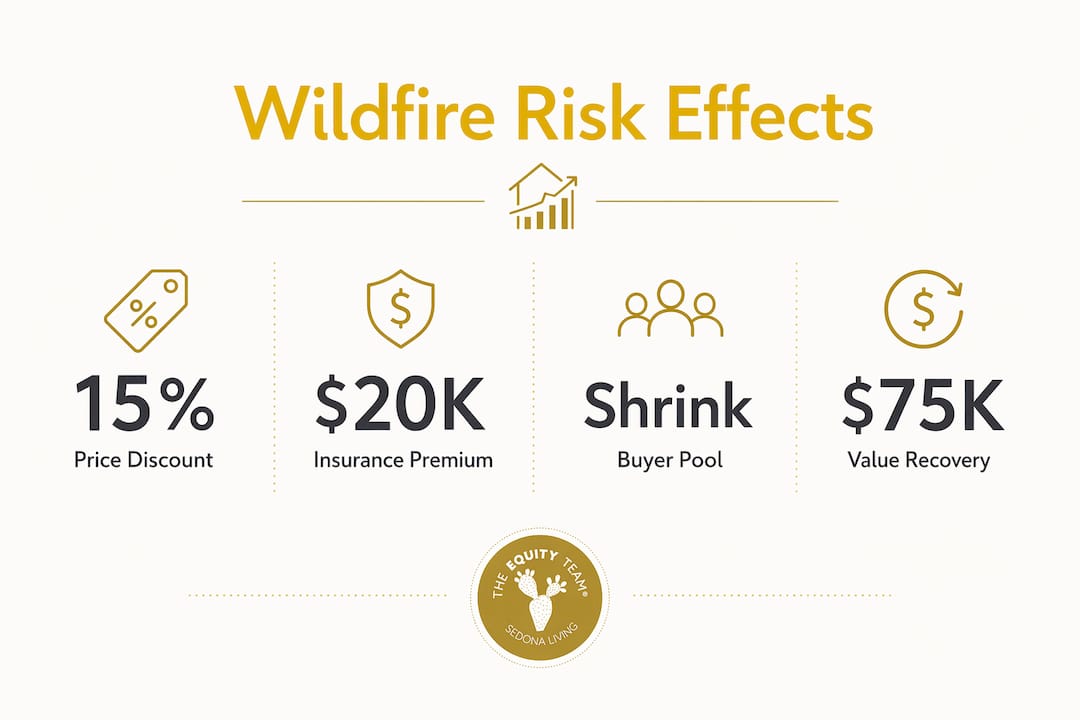
Wildfire risk reduces home values through three compounding forces: price discounts, slower sales, and shrinking buyer pools. Properties in high-fire-hazard zones in Sedona experience 5–15% market value discounts and take 15–30% longer to sell. That is not a minor inconvenience. A $900,000 home with a 10% wildfire discount loses $90,000 in value before a single negotiation begins.
The buyer pool shrinks because financing disappears when insurance disappears. A home that cannot be insured cannot be financed through conventional mortgage products, removing the vast majority of buyers from consideration. Cash buyers remain, but they demand steeper discounts to absorb the risk. The result is a self-reinforcing cycle where risk perception drives down demand, demand drives down price, and lower prices attract only the most risk-tolerant buyers.

Sedona’s unique geography amplifies this dynamic. The red rock terrain is breathtaking, but it also creates natural fire corridors that accelerate spread. Buyers who fall in love with the views quickly sober up when they see the insurance quotes.
What does the data say about Sedona property values in fire zones?
The numbers tell a clear story about Sedona real estate risks. Insurance premiums in high-risk areas run 2–4 times higher than standard metro equivalents. That premium gap directly reduces what buyers can afford to spend on the property itself, since lenders calculate affordability based on total housing costs including insurance.
Here is how wildfire risk translates into concrete market impacts:
- Price discounts: 5–15% below comparable properties outside high-risk zones
- Days on market: 15–30% longer sales cycles than non-WUI properties
- Insurance premiums: 2–4x higher than standard coverage in metro areas
- FAIR Plan costs: Annual premiums can add $5,000–$20,000 or more for high-risk homes
- Buyer pool reduction: Financing restrictions eliminate most conventional buyers
The 2026 Pocket Fire added a fresh layer of market anxiety. Local hospitality businesses in Sedona and Flagstaff reported reduced occupancy and revenue losses even after the fire was largely contained. That kind of event reshapes buyer sentiment for months, sometimes years, after the smoke clears.
Pro Tip: Request a fire hazard severity zone designation report for any Sedona property before making an offer. This single document tells you which insurance market the home falls into and what financing options realistically exist.
How does wildfire risk affect insurance and financing for Sedona homes?
Insurability has become the dominant financial indicator in Sedona real estate, overtaking traditional factors like square footage and lot size. The sequence works like this:
- Risk assessment: Insurers evaluate the property’s WUI zone designation, roof material, vent type, and defensible space clearance.
- Voluntary market decision: If the home meets minimum standards, a standard insurer may offer coverage at elevated but manageable premiums.
- FAIR Plan fallback: If no voluntary market insurer will cover the property, the owner must use Arizona’s FAIR Plan, which carries significantly higher premiums.
- Lender response: Mortgage lenders require proof of insurance before closing. FAIR Plan coverage satisfies this requirement, but the higher cost reduces buyer purchasing power.
- Price adjustment: Buyers factor the insurance cost into their offer, pushing the effective purchase price down.
The gap between voluntary market insurance and FAIR Plan coverage creates what analysts call an “insurability premium.” Homes that qualify for voluntary market insurance command significantly better prices than similar homes restricted to FAIR Plan coverage. That gap can represent tens of thousands of dollars in effective value, even between two properties on the same street.
FAIR Plan premiums add $5,000–$20,000 or more annually in wildfire risk zones. A buyer financing a $750,000 home who faces $15,000 in annual insurance costs will offer less for the property to keep their total monthly payment manageable. The math is unforgiving.
Pro Tip: Ask sellers to provide their current insurance policy and premium before entering escrow. If they are on the FAIR Plan, budget accordingly and get your own insurance quotes before removing contingencies. A home valuation that ignores insurance costs is incomplete.
How do Sedona’s wildfire codes and mitigation standards affect home value?
Sedona’s building standards are not suggestions. Most residential parcels fall within Wildland-Urban Interface zones requiring 2018 International Wildland-Urban Interface Code compliance. That means specific, non-negotiable construction requirements.
Key WUI compliance requirements include:
- Class A roofing: The highest fire-resistance rating, required for new construction and major remodels
- Ember-resistant vents: Vents must prevent ember intrusion, which is the primary ignition source in most WUI fires
- Defensible space: A 5-foot noncombustible zone immediately around the foundation, plus cleared vegetation zones extending outward
- Noncombustible materials: Decks, fences, and attachments within the ember zone must meet fire-resistance standards
Noncompliance carries real consequences. Permit denial for new construction or remodeling projects is a direct risk for properties that do not meet current standards. A home that cannot be legally expanded or renovated loses a meaningful portion of its long-term value.
The upside is equally concrete. Documented wildfire hardening can recover $30,000–$75,000 in market value despite overall risk discounts in the area. Hardening investments in the $20,000–$50,000 range can yield a 3–6x return in preserved market value. That is a compelling case for proactive mitigation, especially for investors managing short-term rental properties where insurability directly affects operating viability.
Community-wide fire hardening programs also improve insurer confidence across entire neighborhoods. Active Fire Safe Councils and coordination with local fire departments contribute to neighborhood-level risk profile improvements. A single well-hardened home in a poorly managed neighborhood still faces elevated risk. A neighborhood where most homes meet WUI standards sees measurably better insurance availability and pricing.
Documentation of specific upgrades, including ember-resistant vents and defensible space zones, often weighs more heavily with insurers than broad landscape clearing alone. Insurers want to see specific, verifiable measures. Keep records, photos, and contractor receipts for every mitigation investment.
What are the broader wildfire impacts on Sedona’s real estate market?
Fire damage is the obvious concern, but the indirect effects on Sedona real estate reach further than most buyers realize. The wildfire-induced reputational damage affects homes well beyond direct burn zones, reducing short-term rental occupancy and seasonal market activity across the region.
The ripple effects include:
- Smoke and air quality: Extended smoke events reduce the appeal of outdoor-focused properties and drive cancellations in the short-term rental market
- Access disruptions: Road closures during active fires cut off entire neighborhoods, making properties temporarily unleasable and reducing buyer confidence
- Reputational spillover: Buyers searching online during or after a fire event see news coverage that colors their perception of the entire area, not just the burn zone
- STR occupancy declines: The 24% drop in short-term rentals in Sedona reflects how wildfire fears compound with other market pressures to reduce rental income potential
Investors evaluating short-term rental properties need to model occupancy scenarios that include wildfire disruption periods. A property that generates strong revenue in a normal year may underperform significantly during a fire season with extended smoke events or access restrictions. The current STR climate in Sedona rewards properties with verified wildfire defenses because those homes maintain insurability and guest confidence even in challenging seasons.
Key Takeaways
Sedona wildfire risk reduces home values by compressing buyer pools, inflating insurance costs, and restricting financing, but documented mitigation investments can recover significant value and preserve long-term marketability.
| Point | Details |
|---|---|
| Price discounts are real | High-risk zone properties sell at 5–15% discounts and take 15–30% longer to close. |
| Insurability drives value | Homes qualifying for voluntary market insurance command meaningfully higher prices than FAIR Plan properties. |
| Mitigation pays off | Documented hardening investments of $20,000–$50,000 can recover $30,000–$75,000 in market value. |
| WUI codes are non-negotiable | Noncompliance with 2018 IWUIC standards risks permit denial and reduces long-term property value. |
| Indirect impacts matter | Smoke, access disruptions, and reputational spillover reduce STR occupancy and buyer demand beyond burn zones. |
What I have learned about wildfire risk and Sedona property values
Working with buyers and investors in Sedona, I have watched wildfire risk quietly reshape the market in ways that most people do not see until they are already in escrow. The conversation used to be about views and rental income. Now it starts with insurance.
The buyers who get hurt are the ones who fall in love with a property before checking its insurability status. They make an offer, get into escrow, and then discover the home is FAIR Plan only. The numbers stop working, and they either walk away or overpay for a property that will be harder to sell later.
The investors who do well are the ones who treat wildfire mitigation as a financial investment, not a chore. A $25,000 hardening project that moves a property from FAIR Plan to voluntary market coverage can add far more than $25,000 in effective value. It also expands the buyer pool when it is time to sell, which is the real prize.
My honest take is that wildfire risk is a permanent feature of Sedona real estate, not a temporary problem. The red rocks are not going anywhere, and neither is the fire season. The buyers and investors who thrive here are the ones who price risk accurately, invest in mitigation early, and document everything. The ones who ignore it are the ones who call me later wondering why their property is sitting on the market.
— Chad
Sedona wildfire-aware property search with Equity Team
Equity Team specializes in Sedona short-term rental investments, and wildfire risk sits at the center of every property analysis. Buyers who work with Equity Team get a clear picture of each property’s WUI zone status, insurance market position, and mitigation history before making an offer.
Equity Team’s clients operate STRs in the top 10% of the Sedona rental market. That performance does not happen by accident. It starts with selecting properties that are insurable, financeable, and positioned to maintain occupancy even during challenging fire seasons. If you are evaluating Sedona STR investment properties, Equity Team can walk you through the wildfire risk factors that separate a resilient investment from a costly mistake. The Sedona real estate market trends page offers current data to help frame your search.
FAQ
How much does wildfire risk lower Sedona home prices?
Properties in high-fire-hazard zones in Sedona typically sell at 5–15% discounts compared to similar homes outside those zones. They also take 15–30% longer to sell, which compounds the financial impact for sellers.
Can you get a mortgage on a Sedona home in a wildfire zone?
Yes, but only if the home can be insured. Lenders require homeowners insurance, and homes restricted to FAIR Plan coverage face higher annual costs of $5,000–$20,000 or more, which reduces buyer purchasing power and effective offer prices.
What is the FAIR Plan and why does it matter for Sedona buyers?
The FAIR Plan is a state-backed insurance option for properties that no voluntary market insurer will cover. It satisfies lender requirements but carries significantly higher premiums, making it a key factor in how wildfires affect house prices in Sedona.
Does wildfire mitigation actually increase Sedona home values?
Documented hardening investments can recover $30,000–$75,000 in market value despite overall risk discounts in the area. Specific upgrades like ember-resistant vents and defensible space documentation carry the most weight with insurers and buyers.
Do wildfires affect Sedona homes outside the burn zone?
Yes. Smoke events, access disruptions, and reputational spillover reduce short-term rental occupancy and buyer demand across the broader Sedona area, not just in directly affected neighborhoods.