

A Sedona STR deed restriction check is the process of reviewing recorded legal documents to determine whether a property carries private contractual limits that prohibit or restrict its use as a short-term rental. This check is the single most critical step in due diligence for any Sedona STR investment, because a deed restriction can render a $500,000-plus purchase completely un-rentable as an STR. Sedona’s red rock scenery draws millions of visitors each year, making it a genuinely exciting market for rental investors. But the legal terrain beneath those breathtaking views is surprisingly layered. Arizona state law protects STR rights from city zoning bans, yet private deed restrictions operate on an entirely different legal track. Knowing what is sedona str deed restriction check means, and how to run one, separates savvy investors from costly surprises.
What are deed restrictions and how do they affect short-term rentals in Sedona?
Deed restrictions are private contractual rules recorded against a property’s title. They are not city ordinances or zoning codes. They are agreements written into the chain of title by a developer, prior owner, or homeowners association, and they travel with the property forever.
The legal term for this permanence is that restrictions “run with the land.” That phrase means a deed restriction from decades ago still applies to the current owner, even if the original parties are long gone and even if the restriction was never enforced before. Buyers cannot negotiate them away at closing, and sellers cannot waive them on a buyer’s behalf.

In Sedona, deed restrictions most commonly appear in two forms. The first is a standalone restriction recorded in the county records, often placed by the original subdivision developer. The second is a set of Covenants, Conditions, and Restrictions, commonly called CC&Rs, created by a homeowners association. Both carry the same legal weight.
Here is where Sedona gets a little quirky. Arizona’s SB 1350 prevents the city from using zoning laws to ban or cap STR permits. That sounds like great news for investors. The catch is that state preemption only covers government zoning. It does not touch private contracts. So a neighborhood can effectively ban STRs through its CC&Rs even when the city cannot.
Common deed restriction scenarios that affect Sedona STRs include:
- Minimum rental duration clauses that prohibit rentals shorter than 30 days
- Owner-occupancy requirements that restrict non-owner rentals entirely
- Commercial use prohibitions that courts have interpreted to include STR activity
- HOA board resolutions that add STR restrictions between formal CC&R amendments
Pro Tip: Never assume a property is STR-eligible just because the neighborhood looks like a vacation rental hub. Some of Sedona’s most popular areas carry decades-old deed restrictions that nobody has bothered to enforce until a new investor shows up.
How to perform a Sedona STR deed restriction check
Running a thorough deed restriction check follows a clear sequence. Skipping steps is where investors get burned.
-
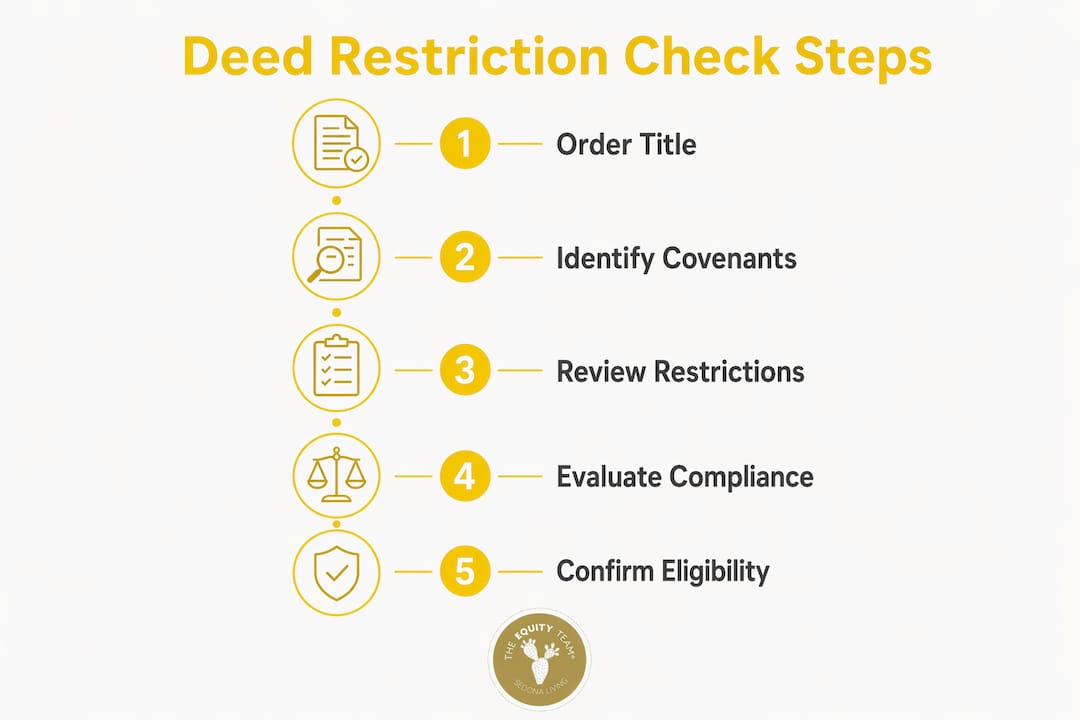
Order a preliminary title report early. Request this before making an offer, not after. The title report lists every recorded document against the property. Look specifically for entries coded as “PROP RSTR” in the document index. These codes flag recorded property restrictions that require a closer read.
-
Pull and read every flagged document. A code in the index is just a pointer. The actual restriction language lives in the recorded document itself. Read it word for word. Vague language about “residential use only” has been used successfully to block STR activity in Arizona courts.
-
Request all HOA documents and amendments. CC&Rs are the starting point, but HOA boards can amend them through officially recorded changes that alter rental eligibility. An amendment passed last year could restrict what the original CC&Rs allowed. Ask for every amendment, not just the original document.
-
Verify with the HOA directly. Call or write to the HOA management company and ask specifically whether STR activity is permitted under current governing documents. Get the answer in writing. Verbal assurances from a seller or listing agent carry zero legal weight.
-
Consult a local real estate attorney or title specialist. When restriction language is ambiguous, a qualified attorney can interpret it in the context of Arizona case law. This is a few hundred dollars well spent against a six-figure investment.
-
Check the city’s voluntary deed restriction program. Sedona offers property owners the option to voluntarily record an STR restriction in exchange for certain benefits. Knowing which properties have entered this program helps investors avoid surprises.
Pro Tip: Ask your title company to flag every document with “RSTR,” “COVENANT,” or “DECLARATION” in the document type field. Title officers often default to summarizing restrictions rather than flagging every one. Insist on the full list.
Sedona STR regulatory context: city rules, state law, and private restrictions
Understanding how city rules, state law, and deed restrictions interact is what separates a confident investor from one who is guessing. These three layers operate independently, and each one can block an STR on its own.
Sedona’s city permit requirements
Sedona defines a short-term rental as any stay under 30 consecutive days. Properties rented for 30 days or more fall outside this definition and do not require an STR permit. For properties that do qualify as STRs, the city requires:
- An annual STR permit with a $210 annual fee
- A minimum of $500,000 in liability insurance
- A Transaction Privilege Tax license from the state of Arizona
- A designated emergency contact available around the clock
How state law and private restrictions interact
Arizona’s state preemption law stops Sedona from using zoning to ban STRs outright. That protection is real and meaningful. But deed restrictions and HOA covenants override city permits entirely. A city-issued STR license does not give an owner permission to violate a private deed restriction. The two legal systems run on parallel tracks, and a green light from the city means nothing if the deed says no.
Enforcement and penalties
Sedona’s enforcement program targets permit compliance, not deed restrictions. The city does not police private covenants. That job falls to HOA boards and neighboring property owners who have standing to sue. On the city side, violations can trigger fines starting at $500 and permit suspensions of up to one year. Unauthorized events and missing emergency contact information are among the most cited violations. The current STR climate in Sedona reflects growing enforcement attention, making compliance more important than ever.
How deed restrictions affect Sedona STR investment potential
Deed restrictions do more than create legal headaches. They directly shape the economics of Sedona’s STR market in ways that investors need to understand before writing any offers.
The most immediate effect is supply reduction. Restrictions eliminate a portion of Sedona’s housing stock from STR eligibility. That is actually good news for owners of unrestricted properties, because limited STR inventory in Sedona keeps competition lower and nightly rates stronger. Scarcity has real value in a market this popular.
The risks of getting it wrong are serious:
- Financial penalties from city enforcement starting at $500 per violation
- Permit suspension for up to one year, eliminating all rental income during that period
- HOA-initiated lawsuits seeking injunctions and attorney fee recovery
- Reduced resale value if a restriction makes the property unmarketable as an STR to future buyers
Because restrictions run with the land, they affect every future sale too. A property bought without a proper deed restriction check can become difficult to sell to another STR investor, narrowing the buyer pool and suppressing the eventual sale price.
Investors who focus on STR-eligible properties in Sedona from the start avoid all of this. The deed restriction check is not a bureaucratic formality. It is the filter that separates a profitable investment from an expensive mistake.
Key Takeaways
A Sedona STR deed restriction check is the first and most critical step in due diligence, because private deed restrictions legally override city STR permits and can make any property un-rentable as a short-term rental.
| Point | Details |
|---|---|
| Deed restrictions override city permits | A city STR license does not protect owners from private deed restriction violations. |
| Restrictions run with the land | A decades-old restriction still binds current and future owners unless formally amended. |
| HOA amendments change eligibility | Always request every CC&R amendment, not just the original governing document. |
| Enforcement carries real costs | City violations start at $500 and can include permit suspension for up to one year. |
| Supply limits benefit compliant investors | Deed restrictions reduce eligible inventory, supporting stronger nightly rates for unrestricted properties. |
Why I always check deed restrictions before anything else
Most investors come to Sedona focused on the city permit process. They research the $210 annual fee, the insurance requirement, and the tax license. That is all fine, but it is the wrong starting point. I have seen buyers fall in love with a property, get the city permit approved, and then discover a 1987 deed restriction that prohibits rentals under 30 days. The city permit was real. The restriction was also real. The restriction won.
The uncomfortable truth about Sedona’s STR market is that investors routinely overestimate their rental rights because they focus on what the city allows and ignore what the deed says. These are not the same thing, and confusing them is an expensive lesson.
My honest recommendation is to treat the deed restriction check like a structural inspection. You would never skip a home inspection on a $600,000 purchase. Do not skip the title review either. Pull the full title report, read every flagged document, call the HOA, and get a local attorney to interpret anything ambiguous. That process takes a week and costs a few hundred dollars. Skipping it can cost everything.
The other thing worth knowing is that HOA rules are not static. HOA boards can amend CC&Rs at any time through a recorded vote. A property that is STR-eligible today could face new restrictions next year if the HOA membership shifts. Ongoing monitoring of HOA meeting minutes and recorded amendments is part of responsible ownership, not a one-time task.
Sedona is a genuinely wonderful market for STR investment. The demand is real, the scenery sells itself, and the right property can perform beautifully. Getting the deed restriction check right is what makes all of that possible.
— Chad
Equity Team can help you find the right Sedona STR property
Buying an STR property in Sedona without a deed restriction check is a bit like hiking Cathedral Rock without checking the weather. The view might be spectacular, but the conditions can turn on you fast.

Equity Team specializes exclusively in Sedona STR investments and has been the first STR-focused real estate team in Northern Arizona. The team guides investors through title report analysis, HOA document review, and deed restriction verification before any offer goes in. Equity Team represents clients operating in the top 10% of Sedona’s rental market, and that track record starts with getting the due diligence right. If you are ready to find the right STR property with full deed restriction clarity, Equity Team is the place to start.
FAQ
What is a Sedona STR deed restriction check?
A Sedona STR deed restriction check is a review of recorded title documents and HOA governing papers to determine whether a property carries private restrictions that prohibit short-term rental use. It is a required step in due diligence before purchasing or renting out any Sedona property as an STR.
Can Arizona state law override deed restrictions on STRs?
No. Arizona’s SB 1350 prevents cities from using zoning to ban STRs, but it does not affect private deed restrictions or HOA covenants. Those private contracts remain fully enforceable regardless of state preemption.
How do I find deed restrictions on a Sedona property?
Order a preliminary title report and look for documents coded as “PROP RSTR” in the index. Also request all HOA CC&Rs and every recorded amendment, then verify current rules directly with the HOA management company in writing.
What happens if I rent an STR in violation of a deed restriction?
An HOA or neighboring owner can sue for an injunction to stop the rental activity and recover attorney fees. On the city side, permit violations carry fines starting at $500 and permit suspensions of up to one year.
Do deed restrictions affect a property’s resale value?
Yes. Because restrictions run with the land, a property encumbered by an STR prohibition is harder to sell to another STR investor, which narrows the buyer pool and can suppress the eventual sale price.