

Sedona’s off-season short-term rental listing strategy is defined by one core advantage: less competition, more serious buyers, and stronger pricing control. Most investors assume spring is the only time to list or sell a Sedona STR property. That assumption leaves real money on the table. The Sedona rental market follows a dual-peak seasonal pattern with spring and fall peaks, a summer trough, and a modest winter bump. Understanding why Sedona STR off-season listing works means reading those cycles correctly and acting when others are sitting still.
How does Sedona’s seasonal rental market shape off-season listing opportunities?
Sedona’s short-term rental market does not follow a single peak. It runs on two of them, which makes the off-season story more interesting than most investors expect. Spring occupancy hits 72% and fall lands at 61%, while summer drops to 39%. Monthly revenues exceed $10,000 during peak months but fall to around $4,610 during the summer trough. That is a significant swing, and it shapes every listing and pricing decision a smart owner makes.
Summer in Sedona is genuinely hot. The desert heat keeps casual visitors away, which pulls occupancy down fast. Winter brings a modest recovery, driven by holiday travelers and snowbirds escaping colder states. Neither summer nor winter matches spring or fall, but both periods carry real opportunity for owners who know how to position a property correctly.

The average booking lead time in Sedona is 56 days. That window gives hosts enough runway to adjust rates before demand shifts, which is a genuine pricing advantage during off-season months. Owners who ignore that lead time window tend to react too late and leave revenue behind.
Sedona STR seasonal performance snapshot
| Season | Occupancy | Monthly Revenue |
|---|---|---|
| Spring (peak) | 72% | $10,000+ |
| Fall (peak) | 61% | $10,000+ |
| Summer (trough) | 39% | ~$4,610 |
| Winter (moderate) | Moderate | Varies |
The table above shows why off-season periods are not dead zones. They are pricing and positioning opportunities with a predictable structure that rewards preparation.
What are the strategic advantages of listing Sedona STR properties off-season?
Off-season listings face less pricing pressure and smoother deal closings compared to peak seasons. That is not a minor perk. When fewer properties compete for buyer attention, a well-prepared listing stands out without needing to discount aggressively. The Sedona STR market saw a 30.4% supply increase in recent data, yet demand remained strong and revenue rates held. That signals pricing power for owners who list with the right strategy, regardless of season.
The operational side of off-season listing also gets easier. Support services including photographers, inspectors, and contractors are more available during slower months. Booking a professional photographer in april during peak season can mean a two-week wait. In january, the same photographer is often available within days. Faster preparation means faster listing, which means faster results.
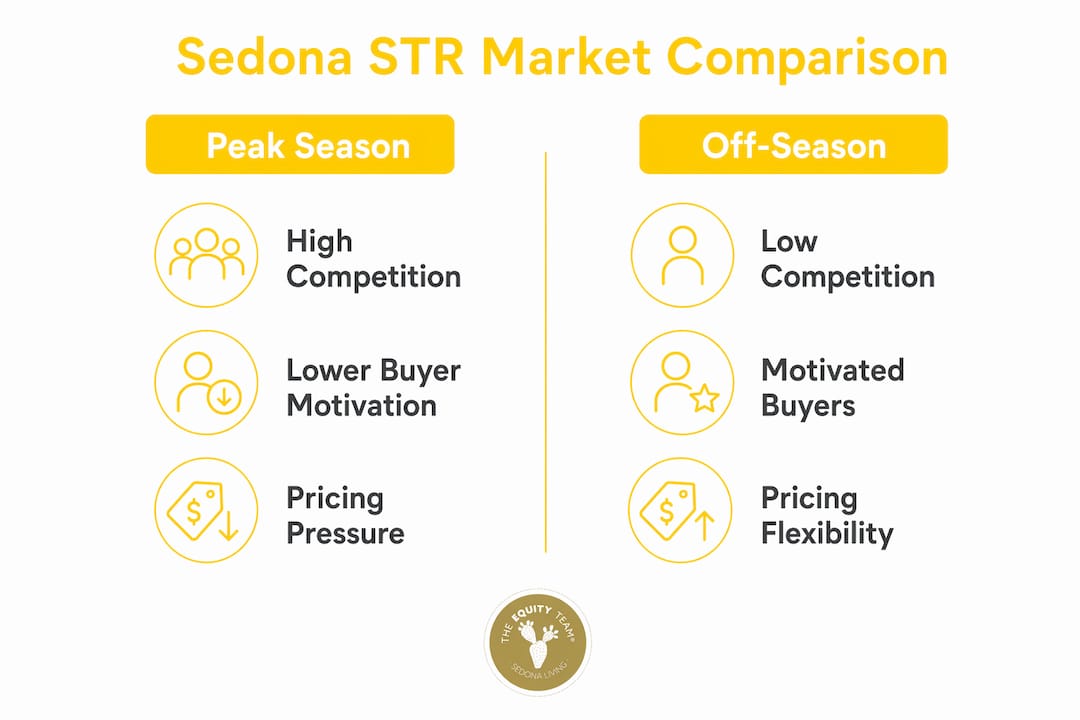
Here is a quick look at how peak and off-season listing conditions compare:
| Condition | Peak season | Off-season |
|---|---|---|
| Listing competition | High | Low |
| Buyer motivation | Mixed | High |
| Support service availability | Limited | Strong |
| Transaction speed | Slower | Faster |
| Pricing pressure | High | Reduced |
Pro Tip: List your Sedona STR property in january or february to capture motivated buyers before spring inventory floods the market. You get the attention without the competition.
Key advantages of off-season listings at a glance:
- Fewer active listings mean your property gets more views per listing
- Motivated buyers act faster, reducing time on market
- Contractors and inspectors have open schedules, speeding up due diligence
- Pricing negotiations tend to be cleaner with fewer competing offers clouding the picture
- Sellers retain more control over terms when buyer urgency is high
How do buyer behaviors and motivations differ in Sedona’s off-season market?
Winter buyers are typically serious and motivated, often relocating for jobs or life changes, which results in faster negotiations and fewer casual lookers. That distinction matters enormously for STR sellers. A spring buyer might be browsing five properties with no deadline. A winter buyer often has one. That urgency shifts negotiating power toward the seller in a meaningful way.
Digital search behavior reinforces this pattern. Buyers searching for Sedona real estate market trends in december or january are not window shopping. They are researching with intent. The browsing crowd thins out in colder months, leaving a pool of buyers who have already done their homework and are ready to move.
Off-season buyers in Sedona also skew toward investors rather than lifestyle buyers. Investors care about numbers, not curb appeal in the sunshine. They want occupancy data, revenue history, and a clear picture of why Sedona STR timing affects sale price. That makes off-season the ideal time to lead with performance data rather than staging photos.
Pro Tip: Build a one-page revenue summary showing your property’s trailing 12-month occupancy and ADR before listing. Off-season investor buyers respond to numbers faster than any staging trick.
- Investor buyers dominate off-season search activity
- Job relocation and life-change buyers have firm timelines and act quickly
- Fewer casual browsers means higher conversion from inquiry to offer
- Digital-first research behavior peaks year-round, so listings stay visible even in slow months
Which pricing and marketing strategies maximize returns when listing Sedona STRs off-season?
Dynamic pricing is the single most effective tool for stabilizing off-season rental income. Using dynamic pricing and marketing to remote workers keeps occupancy stable even during low-demand months. Static pricing in a market with a 56-day average booking window is essentially leaving rate adjustments to chance. Dynamic pricing lets owners respond to demand signals weeks before a booking window opens or closes.
Here is a practical off-season pricing and marketing playbook:
- Switch to dynamic pricing immediately. Set floor and ceiling rates based on your trailing 12-month data, then let a dynamic pricing tool adjust within that range daily.
- Target remote workers with extended-stay discounts. Offer a 15–20% discount for stays of 14 nights or longer. Remote workers book longer, damage less, and generate steadier cash flow during slow months.
- Adjust your cancellation policy for off-season. A flexible cancellation policy lowers the perceived risk for off-season bookers who are less certain about travel plans. More bookings at a slightly lower rate beats zero bookings at a premium rate.
- Market the off-season experience directly. Sedona in winter is quieter, cooler, and genuinely beautiful. The red rocks do not care what month it is. Market the serenity and the lack of crowds as a feature, not a consolation prize.
- Use extended-stay promotions to anchor your calendar. One 21-night booking in january fills a gap that would otherwise require seven separate three-night bookings to cover.
Top quartile STR performers in Sedona achieve 72%+ occupancy and $546+ ADR, significantly beating market averages. That gap between top performers and average operators is not luck. It is dynamic pricing, targeted marketing, and consistent guest experience management applied year-round, including the slow months.
Pro Tip: Pair your extended-stay discount with a “work from Sedona” marketing angle on listing platforms. Remote workers actively search for quiet, scenic destinations with reliable wifi. Sedona checks every box.
The benefits of off-season listings extend beyond just filling nights. Owners who maintain steady occupancy through winter arrive at spring peak with better review counts, stronger listing algorithms, and a property that has been actively managed rather than sitting dormant.
Chad’s take on what most investors get wrong about off-season
Most investors I talk to treat off-season like a waiting room. They pull back on marketing, freeze their pricing, and count the days until spring. That mindset is the single biggest missed opportunity in the Sedona STR market.
The traditional tendency to wait for spring listings is outdated. Off-season markets offer superior visibility and attract serious buyers with less competition. I have watched properties sit on the market for 90 days in april because they launched into a crowded field. The same property, listed in january with a clean revenue summary and a motivated seller, closes in three weeks. The math is not complicated.
What most investors also overlook is the financing angle. Buyers purchasing off-season often have more time to secure favorable loan terms because lenders are less busy. That translates to smoother closings and fewer last-minute financing hiccups. Cash flow management during the trough months also separates serious operators from casual ones. Owners who use dynamic pricing and extended-stay discounts in summer and winter arrive at spring peak with full calendars and strong review scores, not a property that has been dark for four months.
The Equity Team works exclusively with clients in the top 10% of the Sedona STR market. The pattern is consistent: the operators who perform best year-round are the ones who treat off-season as a competitive advantage, not a problem to survive.
— Chad
Equity Team’s approach to Sedona STR off-season investment
Sedona’s off-season rental market rewards preparation and local knowledge. Equity Team specializes in Sedona short-term rental investment, representing buyers and sellers who operate in the top 10% of the market.

Whether the goal is finding a top-performing STR property before spring inventory arrives or selling at the right moment to capture motivated buyers, Equity Team brings the market data and timing expertise to make it happen. The team also provides access to profitable STR investment strategies tailored specifically to Sedona’s seasonal cycles. Off-season is not a gap in the calendar. With the right team, it is the best time to move.
Key Takeaways
Sedona STR off-season listing works because reduced competition, motivated buyers, and dynamic pricing combine to produce faster sales and steadier annual revenue.
| Point | Details |
|---|---|
| Dual-peak seasonal structure | Spring and fall peak at 72% and 61% occupancy; off-season periods offer predictable positioning windows. |
| Motivated off-season buyers | Winter buyers relocate for jobs or investment, act faster, and negotiate with fewer competing offers. |
| Operational advantages | Photographers, inspectors, and contractors are more available off-season, speeding up listing preparation. |
| Dynamic pricing is non-negotiable | Top Sedona STR performers use dynamic pricing to maintain occupancy and ADR well above market averages. |
| Off-season visibility beats spring crowds | Fewer listings mean more buyer attention per property, giving well-prepared sellers a clear edge. |
FAQ
Why does off-season listing work in Sedona’s STR market?
Off-season listings face less competition and attract more motivated buyers, resulting in faster closings and stronger pricing control. Sedona’s dual-peak seasonal structure creates predictable windows where prepared sellers hold a clear advantage.
What is Sedona’s occupancy rate during the summer trough?
Summer occupancy in Sedona drops to 39%, with monthly revenues falling to around $4,610. Owners who use dynamic pricing and target remote workers can stabilize income during this period.
How does dynamic pricing help Sedona STR owners off-season?
Dynamic pricing adjusts nightly rates based on real-time demand signals within a 56-day average booking window. This keeps occupancy stable during slow months without permanently discounting the property’s rate floor.
Who buys Sedona STR properties in the off-season?
Off-season buyers are typically investors or relocating buyers with firm timelines and high purchase intent. They respond to revenue data and occupancy history faster than lifestyle buyers who dominate spring searches.
How do top Sedona STR performers beat market averages year-round?
Top quartile operators achieve 72%+ occupancy and $546+ ADR by combining dynamic pricing, targeted guest marketing, and consistent property management across all seasons, including the slow months.