

Home condition is the single most controllable factor in Sedona real estate pricing, with well-maintained properties commanding premiums and deferred maintenance triggering discounts of up to 14% below comparable sales. The role of home condition in Sedona pricing is especially sharp in the short-term rental market, where guests expect move-in-ready spaces and lenders scrutinize property condition before approving financing. Appraisers use a formal C1–C6 condition rating scale to quantify these differences, and even a one-step drop on that scale can shave thousands off a final sale price. For investors buying or selling in Sedona, understanding how condition translates to dollars is not optional. It is the difference between a profitable exit and a frustrating negotiation.
How do appraisers and buyers quantify home condition in Sedona pricing?
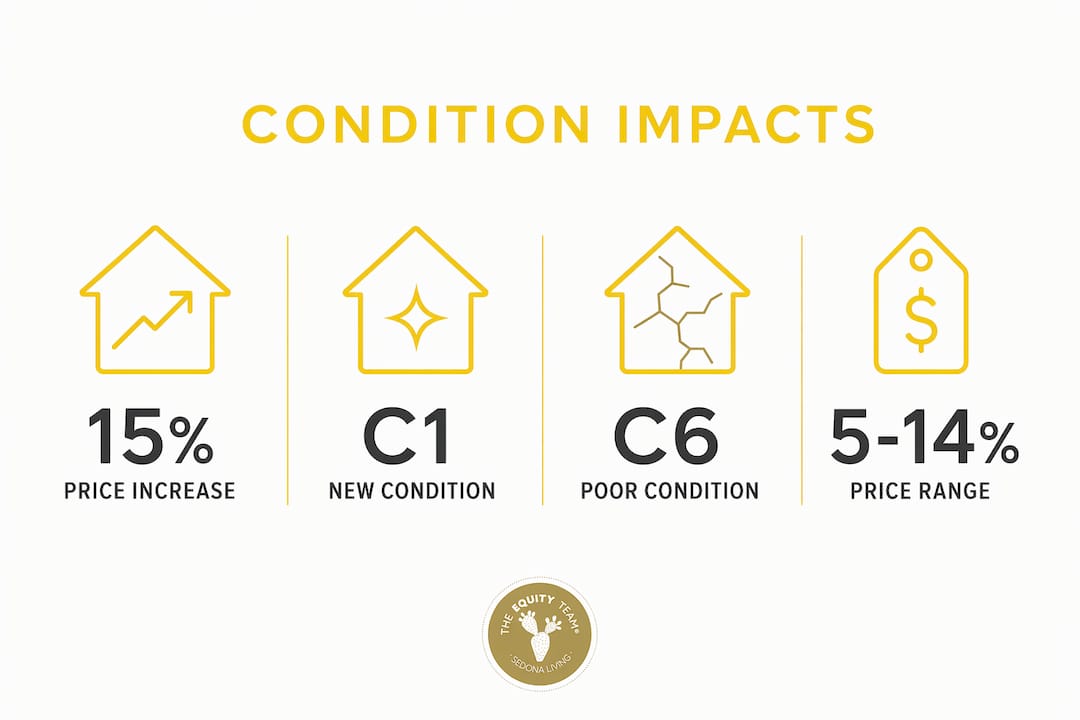
Appraisers use the C1–C6 condition rating scale to assign a numeric grade to every home they evaluate. C1 represents new construction, while C6 describes properties with severe deferred maintenance or structural issues. The gap between ratings matters: condition ratings C1–C6 carry a valuation adjustment of 2–5% between “adequately maintained” and “well maintained” homes, and deferred maintenance often causes discounts of 5–15%. That spread can represent $30,000 to $90,000 on a $600,000 Sedona property.
Major system lifespans are the backbone of any condition assessment. Appraisers pay close attention to roofs (20–25 year lifespan), HVAC systems (15–20 years), and water heaters (10–15 years). A roof at year 22 with no documentation of recent service is a red flag that will appear explicitly in the appraisal report. Buyers and their lenders see that flag and adjust their offers accordingly.
Cosmetic updates and deferred maintenance are not the same thing, and appraisers treat them very differently. Cosmetic improvements like fresh paint or new light fixtures affect buyer interest but do not significantly raise appraised value. Structural condition and system maintenance drive the actual rating. An investor who spends $8,000 on staging but ignores a 22-year-old roof is spending money in the wrong place.
- C1–C2: New or nearly new construction. Maximum value within comparable sales range.
- C3: Well maintained with minor wear. Typical premium pricing territory.
- C4: Adequately maintained. Standard market pricing, minor adjustments possible.
- C5: Obvious deferred maintenance. Expect 5–15% discounts and longer listing periods.
- C6: Severe issues. Financing restrictions likely, cash buyers only in many cases.
Pro Tip: Ask your appraiser which specific systems triggered a C4 or C5 rating before listing. Addressing those items first often costs far less than the resulting price reduction.
What specific home condition factors most influence pricing in Sedona’s short-term rental market?
Move-in-ready condition is the gold standard for Sedona short-term rental properties, and the numbers back that up. Homes requiring over $15,000 in immediate repairs typically sell for 5–8% below move-in-ready comparables, and fixer-uppers can sell for as much as 14% less. Turnkey homes sell for roughly 2.9% more than average, and lifestyle-driven updates can push that premium to 5.4%. For a $700,000 Sedona STR property, that gap between a fixer-upper and a lifestyle-updated home can exceed $130,000.
Sedona’s STR market adds a layer of complexity that standard residential sales do not face. Guests booking a Sedona vacation rental expect a property that feels polished and ready. A leaky faucet or a dated HVAC unit does not just annoy a guest. It generates a negative review that suppresses future bookings and, by extension, the property’s income potential. Lower income potential means lower valuation when the time comes to sell.
Landscaping and curb appeal also carry real pricing weight in Sedona’s market. The red rock backdrop raises buyer expectations for outdoor presentation. A property with drought-tolerant native plants, clean pathways, and maintained exterior finishes photographs better, attracts more online bookings, and signals to buyers that the owner takes maintenance seriously.
Loan eligibility is another condition-driven factor that investors often underestimate. Deferred maintenance reduces the pool of eligible buyers and can halt loan approvals until issues are resolved. FHA and VA loans have strict property condition requirements. A home that disqualifies conventional financing is a home that only cash buyers will touch, and cash buyers negotiate hard.
- Move-in-ready status: Commands the highest price and the widest buyer pool, including financed buyers.
- Lifestyle updates: Upgraded kitchens, spa-style bathrooms, and outdoor entertainment areas push prices above standard comps.
- Curb appeal and landscaping: Directly affects online listing performance and first impressions for both buyers and guests.
- Critical system condition: Roof, HVAC, and plumbing age determine appraisal rating and financing eligibility.
- Deferred maintenance: Shrinks buyer pool, invites aggressive price negotiations, and extends days on market.
How does home condition affect pricing strategy and sale timing for Sedona investment properties?
Well-maintained Sedona homes spend less time on the market and attract fewer concession requests. Average days on market in Sedona sits at 38 days, with seller concessions averaging 2.1%, up from 1.3% in prior years. Properties with visible condition issues consistently land at the higher end of that concession range. Every extra week on the market adds carrying costs, and every concession dollar comes straight off the seller’s net proceeds.

Deferred maintenance also weakens a seller’s negotiating position in a way that is hard to recover from. Once a buyer’s inspector identifies a failing HVAC unit or a roof past its useful life, the seller has two choices: reduce the price or fix the problem. Fixing it mid-transaction is expensive and stressful. Reducing the price often costs more than the repair would have. Neglected systems lead to longer listing periods and increased carrying costs, compounding the financial damage.
Here is how condition plays out in two realistic Sedona scenarios:
- Well-maintained property: A $750,000 STR with a 5-year-old roof, recently serviced HVAC, and updated bathrooms lists and receives a full-price offer within 30 days. Seller concessions: zero. Net proceeds match the listing price minus standard closing costs.
- Deferred maintenance property: A comparable $750,000 STR with a 23-year-old roof and an aging HVAC lists at the same price. The inspection report triggers a $40,000 price reduction request. The sale closes at $710,000 after 65 days on market, with an additional 1.5% in concessions. The seller nets roughly $50,000 less than the well-maintained neighbor.
Pro Tip: Budget for a pre-listing inspection before setting your asking price. Knowing your property’s condition rating before buyers do gives you the power to fix, price, or disclose on your own terms.
Timing also intersects with STR sale timing in Sedona’s seasonal market. A property in excellent condition listed during peak buyer activity in spring or fall will outperform a condition-challenged property listed at any time of year.
What maintenance and improvement investments deliver the best returns on Sedona home pricing?
Budgeting 1–3% of a property’s market value annually for upkeep acts as a hedge against appraised value depreciation. On a $700,000 Sedona property, that is $7,000 to $21,000 per year. That range sounds wide, but older homes with aging systems sit at the higher end, while newer builds with warranties can stay at the lower end. Skipping this budget does not save money. It defers costs that grow larger and more disruptive over time.
The table below shows which improvement categories deliver the strongest returns relative to cost in Sedona’s market.
| Improvement type | Return profile | Notes |
|---|---|---|
| Roof replacement | High | Directly affects appraisal rating and financing eligibility |
| HVAC servicing or replacement | High | Aging systems trigger C5 ratings and buyer concessions |
| Kitchen renovation | Moderate to high | Kitchen and bathroom updates improve quality ratings within comp frameworks |
| Bathroom renovation | Moderate to high | Lifestyle-driven updates can add up to 5.4% to sale price |
| Landscaping and curb appeal | Moderate | Strong impact on STR bookings and buyer first impressions |
| Cosmetic updates only | Low | Paint and staging improve interest but do not raise appraised value |
| Structural repairs | High | Unaddressed structural issues eliminate financed buyers entirely |
Appraisers only adjust values upward if neighborhood comparable sales reflect similar premiums for renovations. This is a critical constraint for Sedona investors. A $60,000 kitchen remodel in a neighborhood where comparable homes sell without upgraded kitchens will not return $60,000 in appraised value. The best improvements to prioritize are those that bring a property up to the standard of its strongest comps, not those that push it far beyond them.
Addressing deferred critical repairs always outperforms cosmetic improvements in appraisal impact. A fresh coat of paint on a house with a failing roof is lipstick on a problem. Appraisers see through it, and so do experienced buyers.
Key Takeaways
Home condition directly controls Sedona pricing outcomes, and proactive maintenance is the most cost-effective way to protect and grow investment value in the short-term rental market.
| Point | Details |
|---|---|
| Condition rating drives price | The C1–C6 appraisal scale creates 2–15% value swings between well-maintained and deferred-maintenance homes. |
| Fixer-uppers sell at steep discounts | Homes needing over $15,000 in repairs sell 5–14% below move-in-ready comparables in Sedona. |
| Deferred maintenance shrinks buyer pool | Financing restrictions eliminate FHA and VA buyers, leaving only cash buyers who negotiate aggressively. |
| Annual upkeep budget protects value | Spending 1–3% of market value per year on maintenance prevents costly depreciation and preserves negotiating leverage. |
| Lifestyle updates boost STR pricing | Upgraded kitchens, bathrooms, and outdoor spaces can push sale prices up to 5.4% above standard comps. |
What I’ve learned about condition and Sedona pricing after years in the STR market
The investors who consistently get top dollar in Sedona are not the ones who spend the most on renovations. They are the ones who never let maintenance slide in the first place. I have watched sellers lose $40,000 to $60,000 in net proceeds because they deferred a roof replacement for three years. The repair would have cost $18,000. The math is not complicated, but the discipline to act before a problem becomes a crisis is harder than it sounds.
The other pattern I see constantly is investors confusing cosmetic updates with real value creation. A beautifully staged home with a 22-year-old HVAC unit will still get a C5 rating. Buyers and their agents know what to look for, and in Sedona’s STR market, experienced investors are the primary buyer pool. They are not fooled by a fresh coat of paint.
My honest recommendation: treat maintenance as an investment, not a line item to cut when cash flow gets tight. The properties Equity Team represents in the top 10% of Sedona’s STR market share one common trait. They are maintained like the income-producing assets they are, not like vacation homes the owner hopes to sell someday.
— Chad
Equity Team can help you find the right Sedona STR property
Condition assessment is one of the most nuanced parts of buying or selling a Sedona short-term rental property. Knowing which repairs protect value, which upgrades move the needle on pricing, and which condition issues will kill a deal requires deep local knowledge.

Equity Team specializes exclusively in Sedona STR investments and represents clients operating in the top 10% of the rental market. Whether you are evaluating a property’s condition before making an offer or preparing a listing to get maximum value, the team’s expertise covers every angle. Start with the right STR investment guide to understand what condition factors matter most in Sedona’s market, or browse current Sedona listings to see how condition shows up in real pricing data.
FAQ
How much does home condition affect sale price in Sedona?
Home condition can cause a price variance of 5–15% in Sedona, with fixer-uppers selling as much as 14% below move-in-ready comparables. Well-maintained homes with lifestyle updates can sell for up to 5.4% above standard comparable sales.
What is the C1–C6 appraisal condition scale?
The C1–C6 scale is the standard appraisal rating system used to grade a home’s physical condition, from new construction (C1) to severe deferred maintenance (C6). Each step down the scale typically triggers a 2–5% valuation adjustment, and C5 or C6 ratings often restrict financing options.
Does deferred maintenance affect loan approval in Sedona?
Deferred maintenance can halt loan approvals for FHA and VA buyers until identified issues are resolved. This shrinks the eligible buyer pool to cash buyers, who typically negotiate more aggressively on price.
Which home improvements give the best return in Sedona’s STR market?
Roof replacement, HVAC servicing, and kitchen or bathroom renovations deliver the strongest returns because they directly affect appraisal condition ratings and comparable sale premiums. Cosmetic updates like paint and staging improve buyer interest but do not significantly raise appraised value.
How many days does a Sedona home typically sit on the market?
The average days on market in Sedona is 38 days for well-maintained properties. Homes with visible condition issues typically exceed that average and attract higher seller concessions, which have risen to an average of 2.1%.