

Sedona investment property earnest money is a good-faith deposit buyers place into escrow to demonstrate commitment and secure a purchase contract. Known formally as an earnest money deposit, this sum sits with a neutral title or escrow company until the deal closes or the contract is canceled. In Sedona’s vibrant and competitive real estate market, where short-term rental investments attract buyers from across the country, understanding how earnest money works is the difference between landing your dream property and losing a chunk of cash to a technicality. This guide covers amounts, timing, contingencies, and the quirky world of non-refundable deposits so you can move with confidence.
How much earnest money is typical for Sedona investment properties?
Standard earnest money in Arizona runs 1–3% of the purchase price, with higher deposits common in luxury or competitive market segments. Sedona’s red rock country falls squarely into that “competitive” category, so expect sellers to push toward the upper end of that range. A deposit on a $750,000 Sedona short-term rental property, for example, lands somewhere between $7,500 and $22,500. That is real money sitting in escrow, which is exactly why getting the details right matters.
The Sedona real estate market often rewards buyers who offer stronger earnest deposits because sellers see a larger deposit as a sign the buyer is serious and financially capable. Think of it as the real estate equivalent of showing up to a poker game with a bigger stack. Timing is equally critical. The deposit is typically due within three business days of contract acceptance, and missing that window can put the entire deal at risk.
Here is a quick breakdown of typical deposit ranges by price bracket:
- $400,000–$600,000 property: $4,000–$18,000 earnest deposit
- $600,000–$900,000 property: $6,000–$27,000 earnest deposit
- $900,000–$1,200,000 property: $9,000–$36,000 earnest deposit
- Above $1,200,000: Negotiated, often 2–3% or higher based on seller expectations
Pro Tip: Always wire your earnest deposit directly to the escrow or title company named in the contract. Sending funds to a real estate agent or brokerage account is a common and costly mistake that can delay your transaction or trigger a contract breach.
What contingencies protect your earnest money in Sedona real estate contracts?

Contingencies are the safety nets woven into your purchase contract that allow you to cancel and recover your deposit without penalty, as long as you act within the specified windows. Sedona contracts typically follow Arizona Realtors standard forms, which include several key contingency periods. Understanding each one is like knowing exactly where the exits are before the show starts.
The four main contingencies protecting your Sedona real estate earnest deposit are:
- Inspection contingency: Buyers typically have a 10-day window to conduct a physical inspection of the property. Canceling within this period for any reason entitles you to a full refund of your deposit.
- Financing contingency: If your loan falls through due to lender requirements, this contingency allows cancellation without forfeiting your deposit, provided you notify the seller in writing before the deadline.
- Appraisal contingency: If the property appraises below the purchase price and the seller refuses to renegotiate, this contingency protects your deposit when you walk away.
- HOA contingency: Sedona properties in homeowners association communities give buyers a review period for HOA documents. Disapproving those documents within the window triggers a full refund.
After the 10-day inspection period closes, your refund rights narrow significantly. Only specific, documented contingency triggers preserve your right to cancel and reclaim your deposit. Miss a deadline, and the seller may have a legitimate claim to keep your money.
For a deeper look at how each contingency works in practice, the Sedona investment property contingencies resource from Equity Team breaks down the timelines and notice requirements in plain language. Cash buyers, who sometimes skip inspection contingencies entirely, face a different risk profile. Understanding why cash offers skip inspections helps clarify what you give up when you go that route.
Refundable vs. non-refundable earnest money: what is the difference?
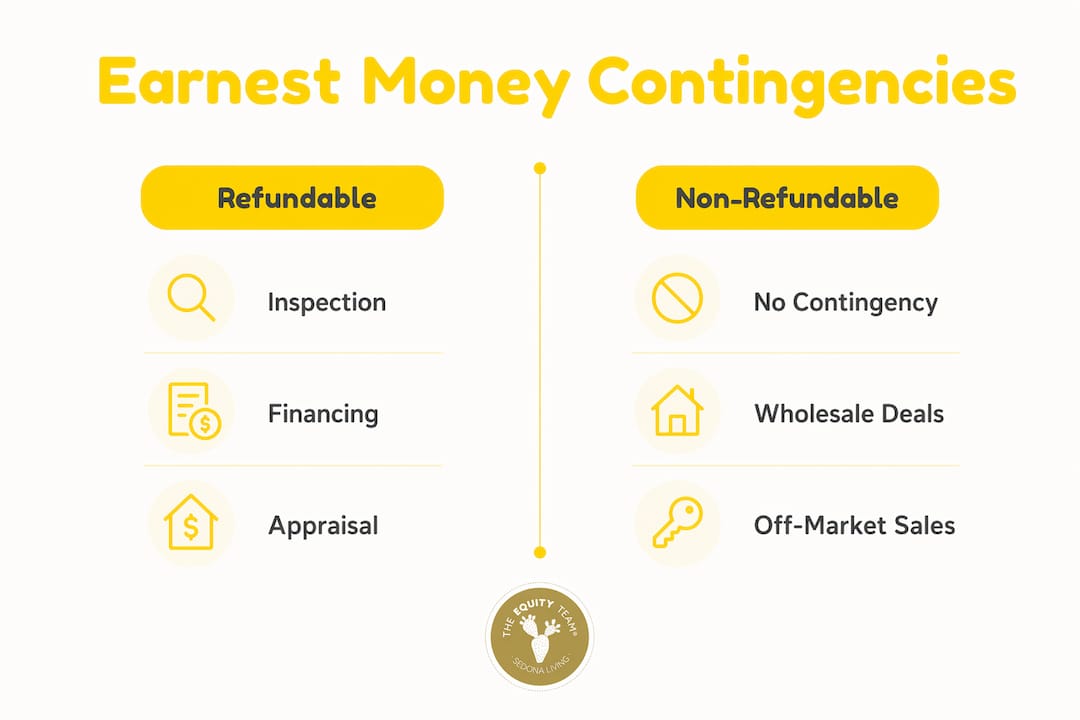
The refundable versus non-refundable distinction is where investment property deals diverge sharply from standard residential purchases. In a typical retail transaction, your deposit stays refundable through the contingency periods. In many investment deals, the rules change fast.
| Feature | Standard Retail Deal | Investment/Off-Market Deal |
|---|---|---|
| Refundability | Refundable through contingency periods | Often non-refundable immediately upon deposit |
| Inspection window | 10 days standard | May be waived or shortened to 3–5 days |
| Deposit amount | 1–3% of purchase price | Can be fixed dollar amount or higher percentage |
| Buyer leverage | Higher, contingencies intact | Lower, seller holds more power |
| Common deal types | MLS listings, traditional sales | Wholesale, off-market, fix-and-flip |
Non-refundable deposits in investment deals are common in wholesale and off-market transactions, where sellers demand proof of commitment before sharing deal details or taking the property off the market. The moment you wire a non-refundable deposit, the dynamic shifts. You are now the one with something to lose, which is precisely why sellers prefer this structure.
Non-refundable earnest money also speeds up closings. Sellers feel confident the buyer will not walk away over minor issues, so they are less likely to entertain backup offers or drag their feet on paperwork. For buyers, the calculus is straightforward: only go non-refundable when your due diligence is already done or when the deal economics are so strong that the deposit risk is worth it.
Pro Tip: Before agreeing to a non-refundable deposit on any Sedona investment property, complete as much research as possible upfront. Pull permit history, review STR income data, and confirm zoning compliance before your money becomes irrecoverable.
How does the escrow process work for earnest money in Sedona and Arizona?
In Arizona, earnest money deposits directly with an escrow company named in the sales contract, not with the buyer’s agent or brokerage. This keeps the funds neutral and ensures compliance with contract timeline milestones. Sedona transactions typically use local title companies familiar with Yavapai County recording requirements and the specific quirks of the Northern Arizona market.
Here is what the escrow process looks like from deposit to closing:
- Day 1–3: Buyer wires earnest deposit to the designated escrow or title company after contract acceptance.
- Day 3–10: Escrow officer confirms receipt and issues written documentation. Inspection and review periods run concurrently.
- Day 10–30: Financing, appraisal, and HOA contingency periods play out. Escrow tracks each deadline.
- Closing day: Earnest money is credited toward the buyer’s investment property down payment or closing costs.
- If canceled: Escrow holds funds until both parties sign a mutual release or a court order directs disbursement.
Disputes over earnest money are more common than most buyers expect. When buyer and seller disagree about who is entitled to the deposit, escrow will not release the funds without mutual written agreement or a court order. That standoff can last months. The practical lesson is simple: document every communication, meet every deadline, and never assume a verbal agreement will protect your deposit.
Escrow officers track contingency milestones meticulously and require proper signed cancellation notices before releasing any funds. A casual phone call to your agent saying “I want out” does not constitute a valid cancellation in Arizona. You need a written notice delivered within the contractual window.
What are common mistakes investors make with earnest money in Sedona?
Sedona’s market moves quickly, and the red rocks are not the only things that can trip you up. Earnest money mistakes tend to cluster around a few predictable patterns, and most of them are entirely avoidable.
- Sending the deposit late. Arizona contracts are strict about the three-business-day deposit window. A late wire, even by one day, can give the seller grounds to declare the contract void. Set a calendar reminder the moment you sign.
- Wiring funds to the wrong party. Deposits go to the escrow or title company, not to your agent, the seller’s agent, or the seller directly. Confirm the wire instructions in writing with the escrow officer before transferring anything.
- Missing contingency deadlines. Missing contingency deadlines can cause forfeiture of your earnest money even when you have a legitimate reason to cancel. Arizona contracts enforce these timelines strictly.
- Skipping written cancellation notices. Written cancellation notices are mandatory in Arizona. Verbal agreements rarely hold up in earnest money disputes, and relying on them is a gamble with real financial consequences.
- Underestimating non-refundable deposit risk. Investors chasing off-market Sedona deals sometimes agree to non-refundable deposits without completing basic due diligence. That enthusiasm can cost thousands if the deal falls apart.
Pro Tip: Create a simple transaction checklist the moment a contract is signed. Include deposit wire deadline, inspection deadline, financing contingency date, and appraisal contingency date. Share it with your agent and escrow officer so everyone is tracking the same milestones.
For broader contract and buying strategies, the tips for Sedona real estate investors resource from Equity Team covers the full picture of what it takes to close a deal in this market.
Key takeaways
Sedona investment property earnest money requires understanding local deposit norms, strict Arizona timelines, and the critical difference between refundable and non-refundable structures to protect your capital.
| Point | Details |
|---|---|
| Standard deposit range | Expect 1–3% of purchase price, with competitive Sedona deals often trending toward the higher end. |
| Deposit timing | Wire funds to the escrow company within three business days of contract acceptance to avoid breach. |
| Contingency protection | Use inspection, financing, appraisal, and HOA contingencies to preserve your right to cancel and recover funds. |
| Non-refundable risk | Investment and off-market deals often require non-refundable deposits; complete due diligence before committing. |
| Written notices required | Arizona law requires written cancellation notices; verbal agreements will not protect your earnest deposit in a dispute. |
Chad’s take on earnest money negotiations in Sedona
Working investment deals in Sedona has taught me one thing above all else: the earnest money conversation reveals a lot about how the rest of the transaction will go. Sellers who push hard for large non-refundable deposits on day one are often signaling that they know something you do not yet know. That is not always a red flag, but it is always worth a closer look.
I have seen buyers lose deposits not because they made bad decisions on the property itself, but because they treated contract deadlines casually. Arizona is not a state that forgives sloppy paperwork. The escrow officers here are thorough, and the contracts are specific. One missed written notice can flip a refundable deposit into a forfeited one overnight.
My honest recommendation is to treat every earnest money deadline like a flight departure time. You do not show up one minute late and expect the plane to wait. Document everything in writing, confirm wire instructions directly with the escrow company, and never assume your agent has handled a notice on your behalf without seeing the confirmation yourself. The Sedona market rewards prepared buyers. The red rocks are serene and breathtaking, but the contracts are all business.
— Chad
How Equity Team helps you navigate Sedona investment purchases
Buying a short-term rental investment in Sedona is genuinely exciting, and Equity Team is built specifically for this market. As the first STR-specialized agents in Northern Arizona, the team represents buyers and sellers operating in the top 10% of the rental market.
Whether you are figuring out how much earnest money to offer on a competitive listing or trying to decode a non-refundable deposit clause in an off-market deal, Equity Team has seen it all. Start with the right STR investment guide to understand what makes a Sedona property perform at the top of the market. When you are ready to move, reach out directly for personalized guidance on contracts, deposits, and closing strategy.
FAQ
How much earnest money is standard in Sedona?
Sedona earnest deposits typically follow Arizona norms of 1–3% of the purchase price. Competitive listings and luxury properties often require deposits at the higher end of that range to strengthen the offer.
Can you get your earnest money back in Arizona?
Buyers can receive a full refund if they cancel within the 10-day inspection period or within any valid contingency window. After those periods close, refund rights narrow significantly.
Who holds earnest money in Arizona?
The escrow or title company named in the sales contract holds the deposit as a neutral third party. Agents and brokerages do not hold earnest funds in standard Arizona transactions.
What happens to earnest money if a deal falls apart?
If both parties agree on who keeps the deposit, escrow releases funds based on a signed mutual release. If they disagree, escrow holds the funds until mediation or a court order resolves the dispute.
Is earnest money applied to the down payment at closing?
Yes. In a successful closing, the earnest deposit is credited toward the buyer’s investment property down payment or closing costs, reducing the total cash needed at the closing table.