

Sedona’s limited short-term rental inventory is the direct result of three compounding forces: extreme STR market concentration, layered local regulations, and Arizona state laws that prevent the city from capping or banning rentals outright. As of early 2026, STR listings reached 1,805, representing 18.1% of total housing stock. That figure makes Sedona one of the most STR-saturated small cities in the country. For real estate investors trying to understand why Sedona has limited STR inventory, the answer sits at the intersection of policy, market math, and investor behavior.
Why sedona has limited STR inventory: the market concentration problem
Sedona’s STR sector did not get crowded overnight. Listings grew 62% from 2021 to 2026, climbing from 1,113 units to 1,805 active rentals. That kind of growth in a city with a small total housing base creates a math problem with no easy fix.
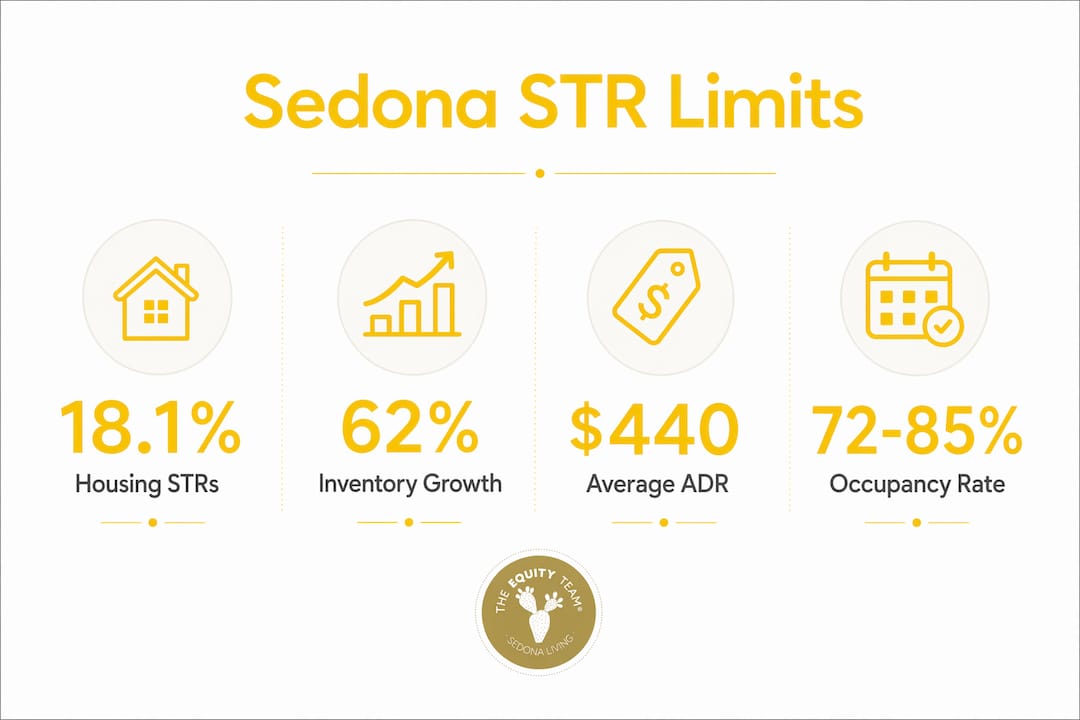
Nearly one in five Sedona homes is now a short-term rental. That ratio is one of the highest nationally for a city of its size. The ripple effect hits the long-term rental market hard. Teachers and hospitality workers commute 20–45 miles because workforce housing inside city limits has essentially evaporated. That is not a quirky Sedona fact. It is a genuine affordability crisis that shapes how the city approaches any new STR policy.
For investors, the concentration creates a different kind of problem. More listings competing for the same pool of visitors means occupancy rates have softened. Average occupancy dropped from 67.9% in 2021 to 53.0% in 2025. That is a meaningful decline. The market did not collapse, but it did sort itself. Revenue now concentrates among the top-performing properties while the bottom of the market struggles.
Here is a snapshot of how Sedona’s STR market has shifted:
| Metric | 2021 | 2025–2026 |
|---|---|---|
| Active STR listings | 1,113 | 1,805 |
| Average occupancy rate | 67.9% | 53.0% |
| Average daily rate (ADR) | ~$352 | ~$440 |
| Peak monthly revenue per listing | $8,656 | $5,934–$6,965 |
The ADR increase to $440 tells an interesting story. Prices went up even as occupancy fell. That means the market is rewarding quality and penalizing mediocrity. Investors who own well-located, well-managed properties are still doing well. Everyone else is feeling the squeeze.
- STR listings now represent 18.1% of Sedona’s total housing stock
- Occupancy fell 14.9 percentage points over four years
- ADR rose 25%, concentrating revenue among top-tier properties
- Workforce housing scarcity forces essential workers to commute from neighboring towns
What local regulations restrict sedona’s STR growth?
Sedona’s city ordinances add a second layer of friction on top of the market saturation problem. The rules are not designed to be cruel. They are designed to manage a city that gets millions of visitors per year while trying to preserve some semblance of neighborhood life. But for investors, the regulations directly constrain how many STR properties can realistically operate.
Here is how the local regulatory framework works in practice:
- STR permit required per unit. Every property advertised as a short-term rental must hold its own city-issued permit. You cannot operate under a blanket license for multiple units.
- TPT license mandatory. A Transaction Privilege Tax license from the Arizona Department of Revenue is required alongside the city permit. Operating without one is not a gray area.
- ADU restrictions tied to owner occupancy. ADUs cannot be rented short-term unless the owner lives on the primary property. This single rule eliminates a popular investor strategy. Remote investors who bought a home with a guesthouse expecting to rent both units short-term are out of luck.
- Enforcement includes permit suspension. Violations do not just result in fines. The city can suspend permits, which effectively shuts down revenue from that property until the issue is resolved.
- Special events restrictions apply. Certain high-traffic event periods carry additional use restrictions that limit how operators can market and rent their properties.
Pro Tip: If you are evaluating a Sedona property with an ADU or guesthouse, verify the owner-occupancy requirement before assuming both structures can generate STR income. This is one of the most common and costly surprises for out-of-state buyers.
The ADU rule deserves extra attention. Remote investors cannot use ADU conversions as STR units without maintaining primary residence on-site. This eliminates what would otherwise be a natural supply expansion strategy. In most markets, ADU conversions are how investors add inventory without buying new properties. Sedona closed that door. Understanding Sedona’s STR zoning laws before you buy is not optional. It is the difference between a profitable investment and an expensive lesson.
How do arizona state laws limit sedona’s control over strs?
Here is where things get genuinely interesting from a policy standpoint. Sedona officials would love to put a hard cap on STR permits. Many residents would cheer. But the city legally cannot do it. Arizona state law preempts local governments from banning STRs or capping the number of permits issued.
State laws SB 1350 and HB 2672 prevent cities from prohibiting STRs outright. Municipalities can regulate noise, safety, and nuisance behavior. They cannot say “no more permits.” That legal ceiling is why Sedona’s STR count kept climbing even as community frustration grew.
The situation may be shifting. HB 2429 passed the Arizona House 36-19 in March 2026 and is pending Senate review. The bill would give cities the power to establish permit caps, limit occupancy, and enforce STR rules more aggressively. Sedona officials have been vocal supporters.
“Sedona officials highlight workforce housing loss due to high STR concentration undermining community fabric and affordability.” — KNAU, March 2026
What does this mean for investors? A few things worth tracking:
- If HB 2429 passes the Senate, Sedona could implement permit caps that freeze new STR licenses
- Existing permit holders would likely be grandfathered in, making current STR properties significantly more valuable
- New investors entering after a cap would face a much harder path to obtaining a permit
- The legislative timeline is uncertain, but the political momentum is real
The state preemption situation is one of the most underappreciated factors in why Sedona’s STR inventory grew so fast. Without the ability to cap permits, the city could only watch the numbers climb. Future legislation could flip that dynamic entirely, which is a compelling argument for moving sooner rather than later if you are considering a Sedona STR purchase.
How do investor strategies shape sedona’s STR availability?
Market saturation and regulation tell part of the story. Investor behavior tells the rest. Sedona’s STR market has quietly sorted itself into two tiers, and the gap between them is widening.

Professional STR operations maintain 72%–85% occupancy despite the overall market softening. That is a remarkable spread compared to the 53% market average. The difference is not luck. It is professional management, quality photography, dynamic pricing tools, and properties that genuinely deliver on the breathtaking Sedona experience guests expect.
Pro Tip: When evaluating a Sedona STR investment, ask for trailing 12-month performance data from the actual property, not just market averages. The gap between top and bottom performers is wide enough to make averages nearly meaningless.
The shift toward professional operation has real consequences for inventory:
- Passive owners who bought during the 2021 boom are quietly exiting as revenue softens
- Their properties re-enter the market as either long-term rentals or primary residences, reducing STR supply
- Investor purchases have driven Sedona home prices up, pricing out local buyers and shrinking the pool of properties that make financial sense as STRs
- Financing for STR properties has become more complex as lenders scrutinize debt-service coverage ratios more carefully
Market observers confirm that success in Sedona now requires professional operation, not passive ownership. That shift is healthy for the market overall, but it raises the bar for new entrants. Investors who treat a Sedona STR like a set-it-and-forget-it asset are the ones contributing to the 24% drop in STR performance that has rattled parts of the market. The ones who treat it like a business are still winning.
Key takeaways
Sedona’s limited STR inventory results from high market saturation, restrictive local regulations, state preemption laws, and a market that now rewards only professional-grade operations.
| Point | Details |
|---|---|
| STR concentration is extreme | 18.1% of Sedona homes are STRs, one of the highest ratios nationally. |
| Local rules limit supply expansion | ADU restrictions and per-unit permit requirements prevent easy inventory growth. |
| State law caps city power | SB 1350 and HB 2672 prevent Sedona from banning STRs or capping permits. |
| Legislation could change everything | HB 2429, passed the Arizona House in March 2026, may give cities permit cap authority. |
| Top properties still outperform | Professionally managed STRs maintain 72%–85% occupancy versus the 53% market average. |
What i’ve learned from watching this market evolve
I have watched Sedona’s STR market go from a wide-open opportunity to one of the most nuanced investment environments in Arizona. The investors who struggle here are almost always the ones who underestimated how much the regulatory and market dynamics interact.
The ADU restriction catches people off guard more than anything else. Someone buys a beautiful property with a casita, assumes they can run both as STRs, and then discovers the owner-occupancy rule after closing. That is an expensive surprise. Reading the current STR climate data before you make an offer is not optional.
The HB 2429 situation is the most interesting variable right now. If that bill clears the Senate, the properties holding active STR permits become genuinely scarce assets. Scarcity drives value. Investors who get in before a permit cap takes effect are positioned very differently from those who wait.
My honest recommendation is to target properties that are already performing in the top tier, not properties you plan to turn around. The market has sorted itself. Trying to rescue a struggling STR in a saturated pocket of Sedona is a harder game than buying something already operating at 75% occupancy with strong reviews. Equity Team works specifically with clients in the top 10% of the STR market for exactly this reason. The math is just better up there.
— Chad
Find the right sedona STR property with equity team

Sedona’s STR inventory constraints are not going away. If anything, potential permit caps from HB 2429 could make existing STR properties even more valuable in the near future. Equity Team specializes in Sedona short-term rental investments and represents clients operating in the top 10% of the market. Whether you are searching for your first high-performing STR property or looking to sell at peak value, Equity Team brings the local expertise and STR-specific knowledge that generalist agents simply do not have. Browse current Sedona STR listings and connect with the team that knows this market from the inside out.
FAQ
Why does sedona have so few short-term rentals available?
Sedona’s STR inventory is constrained by a combination of high existing concentration (18.1% of housing stock), strict local permit and ADU requirements, and Arizona state laws that prevent the city from issuing new permit caps.
Can sedona ban short-term rentals?
No. Arizona state laws SB 1350 and HB 2672 preempt cities from banning STRs or capping permits outright. Sedona can regulate noise and safety but cannot prohibit short-term rentals.
What is HB 2429 and how does it affect sedona STR investors?
HB 2429 is a bill that passed the Arizona House 36-19 in March 2026 and would give cities the power to establish STR permit caps. If it passes the Senate, existing permit holders in Sedona would likely see their properties increase in value due to restricted new supply.
Are sedona short-term rentals still profitable in 2026?
Professionally managed properties maintain 72%–85% occupancy and benefit from an ADR of approximately $440, making them profitable. Passive or poorly managed STRs are underperforming as the overall market occupancy rate has dropped to 53%.
Can i rent an ADU or guesthouse as a short-term rental in sedona?
Only if you live on the primary property as your main residence. Sedona’s ordinance requires owner occupancy on-site before an ADU can be used as a short-term rental, which eliminates this strategy for most remote investors.