

Sedona STR reviews do not transfer to the buyer because Airbnb, VRBO, and local short-term rental permits are tied to the original owner’s verified identity, not the property itself. When a sale closes, the buyer inherits the real estate and nothing else. No Superhost badge, no five-star history, no platform ranking. This reality shapes how buyers evaluate Sedona STR properties, how sellers price them, and why so many deals hit unexpected friction. If you are exploring Sedona STR investments, understanding why Sedona STR reviews transfer to buyer discussions the way they do is the single most clarifying piece of knowledge you can have before making an offer.
Why Sedona STR reviews don’t transfer to the buyer
The short answer is platform policy. Airbnb ties accounts and listings to individual verified user identities for tax, safety, and compliance reasons, intentionally preventing transfers upon property sale. VRBO operates under the same logic. Both platforms require identity verification, tax documentation, and host agreements that are personal to the account holder. When ownership changes hands, those agreements do not follow the deed.
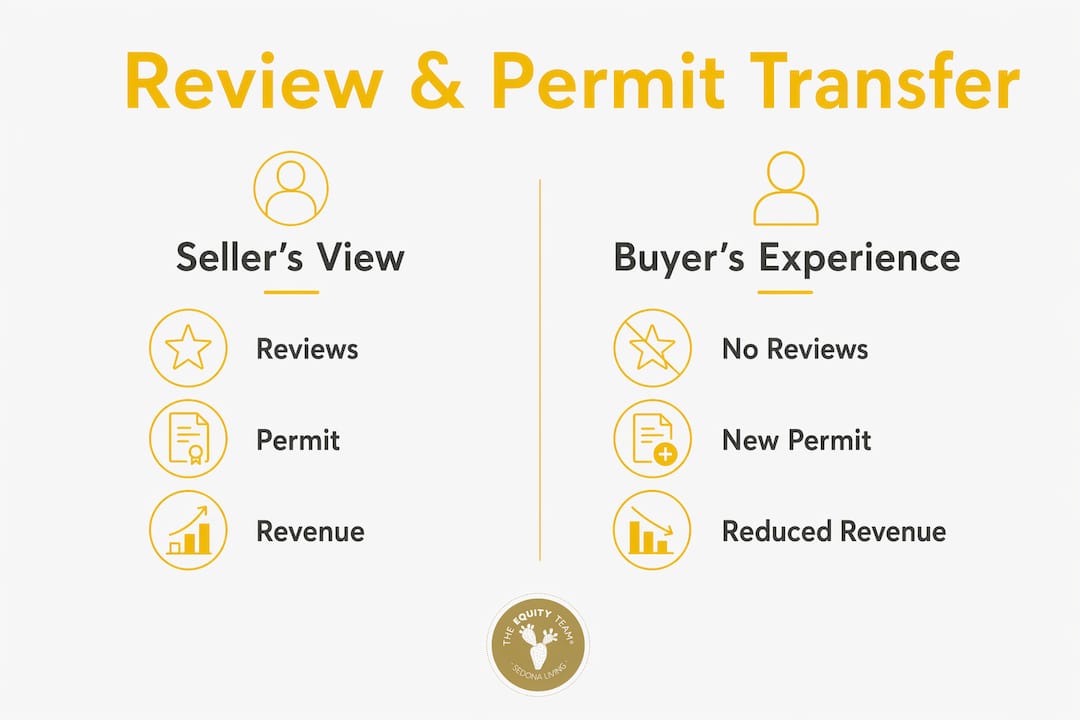
What this means in practice is stark. Buyers lose 100% of the seller’s accumulated platform history, including reviews, Superhost status, and search ranking. A seller who spent three years building a 4.9-star Airbnb profile with 300 glowing reviews cannot hand that profile to a buyer the way they hand over a set of keys. The buyer starts at zero, on day one, with a blank listing that the algorithm treats like a brand-new host.

This matters enormously for revenue. New STR listings with zero reviews typically experience a revenue drop in the first months until they gain sufficient booking history and guest feedback. Platforms like Airbnb and VRBO reward established listings with better search placement and higher booking conversion. A new listing in Sedona competes against properties with hundreds of reviews, and the algorithm is not sentimental about it.
Pro Tip: Ask sellers for at least 24 months of booking data, occupancy rates, and seasonal revenue breakdowns before making an offer. This documented history becomes your most reliable indicator of true earning potential once you rebuild your own listing.
The practical impact on early-month cash flow is real. Buyers should budget for a period of reduced income, typically two to four months, while the new listing accumulates reviews and climbs the platform rankings. Sedona’s strong demand from visitors drawn to the red rocks and vortex sites helps shorten that ramp-up period compared to less popular markets, but it does not eliminate it.
How Sedona’s STR permit rules affect buyers
Sedona’s permit system adds another layer of complexity that surprises many out-of-state investors. STR permits in Sedona are issued directly to the property owner, not the property itself, and do not automatically transfer to new buyers. The buyer must apply for a new permit from scratch, which involves inspections, approvals, and compliance checks.
Here is the sequence a buyer typically navigates after closing:
- Submit a new STR permit application to the City of Sedona.
- Schedule and pass a property inspection confirming safety and code compliance.
- Designate a local emergency point of contact who can respond within 60 minutes.
- Await permit approval before legally operating the property as a short-term rental.
- List the property on Airbnb or VRBO only after permit approval is confirmed.
Step three deserves special attention. Sedona specifically requires an emergency point of contact for permit compliance who can respond within 60 minutes. Out-of-state buyers who do not have local representatives risk immediate permit non-compliance, which can mean fines or permit denial. This is not a technicality. It is a hard operational requirement that has caught more than a few enthusiastic remote investors off guard.
Pro Tip: Before closing, identify and contract with a local Sedona property manager who can serve as your emergency contact and handle guest issues. This single step prevents permit delays and protects your revenue timeline.
The permit timeline itself can range from a few weeks to several months depending on application volume and inspection scheduling. During that window, the property cannot legally operate as an STR. That gap represents real revenue loss that buyers must factor into their acquisition math. And in markets with permit caps or active restrictions, non-transferability can mean a permanent operational halt if new permits are unavailable. Sedona’s STR restriction changes over recent years make this a live concern worth researching before any offer.
How non-transferable reviews affect property valuation and offers
This is where the rubber meets the road for investors doing a Sedona STR buyer offer evaluation. The loss of platform reputation is a material valuation factor, and sellers marketing as turnkey must disclose limits. Many sellers overprice properties by counting intangible assets like reviews and permits that legally cannot transfer. Buyers are fully aware of this and negotiate accordingly.
The table below illustrates how the same property looks different depending on whether a buyer accounts for review non-transferability in their offer.
| Valuation factor | Seller’s perspective | Buyer’s adjusted view |
|---|---|---|
| Platform reputation | 300 five-star reviews, Superhost status | Zero reviews on closing day |
| Permit status | Active, compliant permit | New application required |
| Projected Year 1 revenue | Based on seller’s established listing | Discounted for ramp-up period |
| Operational readiness | “Turnkey” marketing claim | Requires new accounts, contacts, setup |
| Historical income data | Strong proof of demand | Valuable proxy, not a guarantee |
The gap between those two columns is exactly why Sedona STR buyer contingency clauses sometimes appear in purchase agreements. A buyer contingency tied to permit approval or a minimum revenue threshold protects the investor if the permit process stalls or if the property’s actual demand turns out weaker than the seller’s history suggests.
Historical revenue documentation and demonstrated demand remain the most reliable buyer evaluation criteria despite the loss of transferred reviews and permits. A property that generated strong occupancy in Sedona’s peak seasons, October through May, tells a buyer something real about the location’s appeal. That data does not disappear when the listing resets. It just needs to be verified independently through tools like AirDNA or direct seller documentation rather than assumed from a shiny Superhost badge.
Strategies for buyers navigating review and permit non-transferability
Knowing the problem is half the battle. The other half is having a plan. Buyers who go into a Sedona STR acquisition with clear strategies for the transition period consistently outperform those who assume the seller’s momentum will carry over.
- Verify demand independently. Use AirDNA, Rabbu, or Mashvisor to confirm that the property’s location and features generate genuine market demand, separate from the seller’s personal hosting skill or review history.
- Request full financial documentation. Tax returns, platform payout statements, and occupancy calendars for at least two years give you a documented demand proxy that survives the listing reset.
- Plan your listing launch strategically. New listings benefit from competitive introductory pricing to attract early bookings and reviews. Dynamic pricing tools like PriceLabs or Wheelhouse help calibrate this without leaving money on the table long-term.
- Hire professional photography before launch. A new listing with zero reviews needs to win on visuals. Vacation rental photography that showcases Sedona’s red rock views and outdoor spaces can meaningfully accelerate early booking conversion.
- Secure your local contact before closing. As noted above, Sedona’s 60-minute emergency response requirement is non-negotiable. A local property manager or trusted contact must be in place before you submit your permit application.
- Build a financial buffer. Budget for two to four months of reduced revenue during the ramp-up period. Sedona’s STR income potential is real, but it takes a few months to fully materialize on a new listing.
Pro Tip: Consider timing your closing for late summer or early fall so your new listing launches just before Sedona’s peak season. A well-photographed listing that goes live in September can accumulate reviews quickly during the high-demand October through December window.
The 12 ways to maximize ROI on a Sedona investment property all become more relevant once you understand that the review reset is a temporary challenge, not a permanent disadvantage. Buyers who plan for it come out ahead.
Key takeaways
Sedona STR reviews do not transfer to buyers because Airbnb, VRBO, and local permits are tied to the seller’s identity, requiring buyers to rebuild platform reputation and obtain new permits from scratch.
| Point | Details |
|---|---|
| Reviews never transfer | Airbnb and VRBO prohibit account and listing transfers; buyers start with zero reviews on closing day. |
| Permits require new applications | Sedona STR permits are owner-specific; buyers must apply, inspect, and get approved before operating. |
| Valuation must reflect the reset | Buyers should discount offers to account for revenue loss during the ramp-up and permit approval period. |
| Historical data still matters | Documented revenue and occupancy records serve as a reliable proxy for true property demand. |
| Local contact is non-negotiable | Sedona’s 60-minute emergency response rule requires a local representative before permit approval. |
Chad’s honest take on the “turnkey” myth in Sedona
I have seen this play out dozens of times, and it never gets less surprising. A seller lists a Sedona property as “fully turnkey” with a gorgeous Airbnb profile, 400 reviews, and Superhost status. The asking price reflects all of that. Then the buyer’s agent, hopefully someone from Equity Team, has to explain that none of those digital assets survive the closing.
The sellers are not always being deceptive. Many genuinely believe they are selling an established business. But most sellers mistakenly believe they are selling a going concern with digital assets, when buyers actually receive only the real estate and a chance to start a new STR business. That gap in understanding is where deals get messy.
What I tell buyers is this: the reviews are gone, but the reason those reviews existed is not. If a property sits on a ridge with unobstructed views of Cathedral Rock, guests will love it regardless of who owns it. Your job is to verify that the underlying asset is genuinely strong, not just that the previous owner was a great host. A great host can make a mediocre property look good for a while. A great property will make you look good once you get your first 20 reviews.
Transparent sellers who disclose the non-transferability upfront and price accordingly close faster and with fewer headaches. I have watched deals fall apart because a seller refused to adjust their price to reflect the review reset reality. Buyers in 2026 are sophisticated. They know what transfers and what does not.
— Chad
Ready to find your Sedona STR investment?
Equity Team specializes in Sedona short-term rental investments and represents buyers and sellers operating in the top 10% of the market. We are the first STR-specialized agents in Northern Arizona, and we know exactly how to evaluate a property’s real earning potential beyond the seller’s review history.

Whether you want video walkthroughs and expert analyses of active listings or a personalized strategy for finding the right property, Equity Team has the tools and local knowledge to guide you. Start with our STR investment guide to understand exactly what to look for, what to ask, and how to structure an offer that reflects the real value of a Sedona STR.
FAQ
Do Airbnb reviews transfer when you buy an STR property?
No. Airbnb explicitly prohibits account and listing transfers to new owners, so buyers start with zero reviews and no platform history after closing.
Can a Sedona STR permit be transferred to a new buyer?
No. Sedona STR permits are issued to property owners, not properties. Buyers must submit a new application, pass inspections, and receive approval before operating legally.
What is a Sedona STR buyer contingency?
A Sedona STR buyer contingency is a clause in a purchase agreement that protects the buyer if the new STR permit is denied or if the property fails to meet a minimum revenue threshold during a defined period after closing.
How long does it take to rebuild reviews on a new Sedona STR listing?
Most new listings reach competitive review counts within two to four months, especially in Sedona’s high-demand seasons. Strategic launch timing and introductory pricing accelerate the process.
Why does historical revenue matter if reviews don’t transfer?
Documented revenue and occupancy data from the seller’s operating history serve as a reliable indicator of the property’s underlying demand, independent of the seller’s personal hosting reputation or review count.