

A Sedona vacation rental zone is a regulatory framework that defines how and where short-term rental properties can legally operate within city limits, shaping everything from permit requirements to guest eligibility. Under City Code Chapter 5.25, Sedona defines short-term rentals as any stay fewer than 30 consecutive days, and every unit operating under that definition needs its own city permit. Whether you’re hunting for the perfect vacation home in Sedona or sizing up an investment opportunity, understanding these zones and rules is the difference between a smooth booking and a very expensive surprise.
What is a Sedona vacation rental zone and how does it work?
The phrase “vacation rental zone” gets tossed around a lot, but Sedona doesn’t use it as a formal city term. The recognized industry term is short-term rental (STR) district or overlay, and Sedona’s version is built around operational compliance rather than simple geographic bans. That distinction matters enormously for travelers and investors alike.
Sedona does not ban STRs city-wide through zoning. Instead, the city controls how rentals operate, unit by unit, through a permit system tightened by amendments effective December 2024. Think of it less like a map with red and green zones and more like a detailed rulebook that every rental property has to follow before it can open its doors to guests.

The practical result is that rental availability across Sedona’s neighborhoods is shaped by who can meet compliance requirements, not by a city planner drawing lines on a map. For travelers, this means the vacation homes Sedona offers on Airbnb or VRBO are legally vetted properties. For investors, it means the barrier to entry is about paperwork and operational standards, not location alone.
How does Sedona regulate short-term rentals?
Sedona’s regulatory framework is more nuanced than most cities its size, and it has gotten sharper over the past two years. Here’s what the current rules actually require:
- Individual permits per unit. Every advertised rental needs its own city-issued permit. One owner with three properties needs three permits, full stop.
- Permit numbers on all listings. Permit numbers must appear on Airbnb, VRBO, and every other marketing channel. Missing numbers lead to fines and listing removals.
- ADU restrictions. Accessory Dwelling Units with full kitchens issued certificates of occupancy after September 14, 2024, cannot be rented short-term unless the owner lives on-site. That casita behind the main house? It may no longer qualify.
- Transaction Privilege Tax (TPT) license. Owners must hold a valid Arizona TPT license and collect applicable taxes from guests.
- Emergency contact availability. A local contact must be reachable and able to respond to complaints within a defined window, not just during business hours.
- Enforcement teeth. Violations like unauthorized special events start at $500 fines and can result in permit suspension for up to one year.
Pro Tip: Before booking or buying, search the property address in Sedona’s permit database. A listing without a visible permit number is a red flag worth investigating before you hand over a deposit or a down payment.
The city’s approach reflects a broader Arizona trend: state law limits how aggressively municipalities can restrict STRs outright, so Sedona channels its energy into operational compliance instead. The result is a market where the rules are real but workable for anyone willing to follow them.
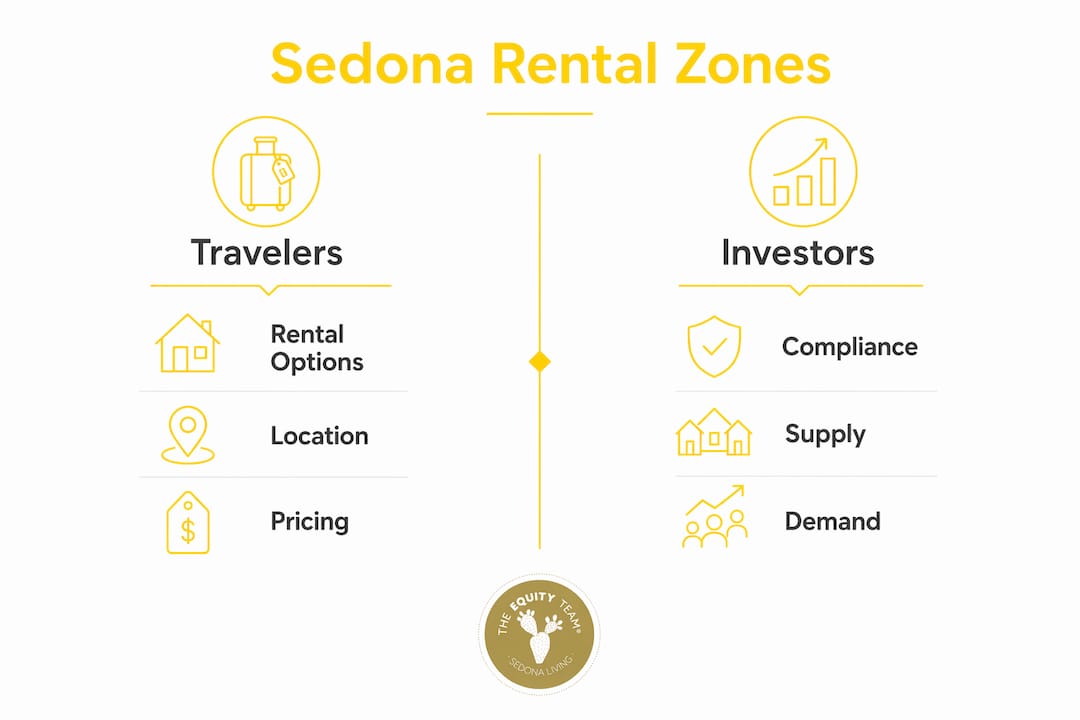
How do Sedona rental zones affect travelers and investors?
Here’s where geography gets interesting. Sedona’s physical layout creates natural “zones” that influence rental density, pricing, and guest experience far more than any city ordinance does.
| Area | Rental character | Best for |
|---|---|---|
| Uptown Sedona | Walkable, higher nightly rates, smaller lots, vibrant dining and galleries nearby | Couples, solo travelers, first-time visitors |
| West Sedona | Larger lots, more residential feel, family-friendly spaces, quieter streets | Families, longer stays, groups |
| Village of Oak Creek | Slightly outside city limits, different permit jurisdiction, more affordable entry points | Budget-conscious travelers, investors watching costs |
Uptown rentals command higher average daily rates because of walkability and proximity to the red rock views that make Sedona famous. West Sedona trades that buzz for space and a more serene neighborhood feel. Neither area is off-limits for short-term rentals, but the character of each shapes what guests expect and what investors can charge.
Supply constraints add another layer. Sedona’s rental market is supply-constrained not because of permit caps or zoning bans, but because Coconino National Forest surrounds much of the city, limiting new construction. Private HOA restrictions further tighten availability in certain neighborhoods. The result is a market where demand consistently outpaces supply, which is genuinely good news for compliant operators.
A common misconception is that Sedona imposes geographic bans on short-term rentals in specific neighborhoods. The city focuses on operational compliance, not map-based exclusions. Travelers searching for the best places to stay in Sedona should look for permit numbers, not worry about whether a neighborhood is “allowed.”
What do travelers and investors need to know about permits?
Getting a Sedona STR permit is not a casual afternoon project, but it’s also not a bureaucratic maze. Here’s the sequence every owner follows:
- Apply for a city STR permit for each individual unit, paying the associated fee per application.
- Obtain an Arizona TPT license through the Arizona Department of Revenue before collecting any guest payments.
- Post the permit number on every listing platform, including Airbnb, VRBO, and any direct booking website.
- Designate a local emergency contact who can respond to neighbor complaints or guest emergencies at any hour.
- Secure liability insurance with a minimum aggregate coverage of $500,000 per rental unit. Properties with pools, hot tubs, or trail access should consider higher limits.
- Avoid prohibited activities. Special events, parties, and gatherings beyond normal guest occupancy are explicitly banned and carry serious penalties.
Pro Tip: Liability insurance minimums are just that: minimums. Sedona properties near trails or with outdoor amenities like pools carry elevated risk. Many experienced operators carry $1 million or more in coverage, and some property management companies require it contractually.
Non-compliance is not a theoretical risk. The city actively monitors listing platforms for permit numbers, and neighbor complaints trigger inspections. For travelers, a rental without a visible permit number is not just a legal gray area. It’s a property that could be shut down mid-stay.
How do Sedona’s regulations affect short-term rental investment?
Sedona’s regulatory environment sounds strict on paper, but experienced investors read it differently. Tighter compliance requirements actually reduce competition from casual or accidental landlords, which benefits operators who do things right.
- No outright ban means opportunity remains open. Unlike some Arizona cities that have pushed hard against STRs, Sedona’s framework keeps the door open for compliant investors. The evolving rules and tighter compliance requirements filter out operators who won’t do the work.
- ADU restrictions shift the playing field. The September 2024 ADU rule removes a category of supply from the market. Fewer eligible rentals means less competition for properties that do qualify.
- HOA restrictions matter as much as city rules. Some Sedona neighborhoods have private covenants that restrict or ban STRs entirely, independent of city permits. Investors must check both layers before purchasing.
- Geographic constraints protect long-term value. Because national forest land limits expansion, supply constraints from geography create a natural floor under rental demand. Sedona is not a market where oversupply is a realistic threat.
- Uptown vs. West Sedona strategy. Uptown properties generate higher nightly rates but require more active management. West Sedona properties attract longer stays and families, which can mean lower turnover costs and steadier occupancy.
- Stay current on regulatory changes. The 24% drop in Sedona STRs seen in recent years reflects both market shifts and compliance attrition. Investors who track rule changes early gain a real advantage over those who react late.
The Equity Team works exclusively with STR investors in Northern Arizona and tracks every regulatory update as it happens. That kind of specialized knowledge is not a luxury in this market. It’s a requirement.
Key takeaways
Sedona’s short-term rental framework rewards compliant operators with a supply-constrained, high-demand market where geographic and regulatory barriers protect long-term investment value.
| Point | Details |
|---|---|
| STR definition matters | Any stay under 30 days falls under City Code Chapter 5.25 and requires a city permit per unit. |
| No geographic ban exists | Sedona regulates how rentals operate, not where, so compliance is the real barrier to entry. |
| ADU rule changes supply | Post-September 2024 ADUs without owner occupancy are ineligible, reducing competition for qualifying properties. |
| Insurance minimums are real | Owners must carry at least $500,000 in aggregate liability coverage, with higher amounts recommended for amenity-rich properties. |
| Geography protects investors | National forest boundaries and limited construction keep supply constrained, supporting strong rental demand across Sedona. |
My honest read on Sedona rental zones
I’ve spent years working with STR investors in Sedona, and the number one mistake I see is people treating “rental zone” like it’s a simple yes-or-no map. It isn’t. Sedona’s system is about operational fitness, and that’s actually a gift to serious investors once you understand it.
The ADU rule change in late 2024 shook a lot of people up, and rightfully so. But it also quietly removed a chunk of supply from the market, which tightened availability and supported rates for properties that remained eligible. That’s not a coincidence. That’s how regulatory friction works in a constrained market.
What I tell every client is this: the investors who thrive in Sedona are the ones who treat compliance as a competitive advantage, not a burden. When your permit number is posted, your insurance is solid, and your emergency contact actually picks up the phone, you’re not just following rules. You’re operating a property that guests trust and that the city won’t touch.
The breathtaking red rocks and serene canyon views do the marketing for you. Your job is to make sure the paperwork matches the scenery.
— Chad
Ready to find your Sedona short-term rental property?
Sedona’s STR market rewards investors who know the rules and move with confidence. The Equity Team is the first STR-specialized real estate team in Northern Arizona, and every client we work with operates in the top 10% of the rental market. We know which properties qualify, which neighborhoods perform, and which compliance details can make or break a deal.

Whether you’re buying your first Sedona vacation rental or scaling an existing portfolio, start with the right foundation. Explore our Sedona STR investment guide to see exactly how we help investors identify compliant, high-performing properties. You can also check current market conditions to understand what the numbers look like right now.
FAQ
What is a Sedona vacation rental zone?
A Sedona vacation rental zone refers to the regulatory framework governing short-term rentals in Sedona, Arizona. The city uses operational compliance rules under City Code Chapter 5.25 rather than geographic bans to control where and how STRs operate.
Does Sedona ban short-term rentals in certain neighborhoods?
Sedona does not impose outright geographic bans on short-term rentals. The city regulates STRs through individual permits, operational rules, and compliance requirements, though private HOA restrictions in some neighborhoods may independently limit rentals.
How do I know if a Sedona vacation rental is legally permitted?
Every legal Sedona short-term rental must display its city-issued permit number on all listing platforms, including Airbnb and VRBO. A listing without a visible permit number may not be operating legally.
What is the minimum liability insurance for a Sedona STR?
Sedona requires a minimum aggregate liability insurance coverage of $500,000 per rental unit. Properties with pools, hot tubs, or trail access commonly carry higher coverage amounts.
Can I rent out a guest house or casita in Sedona as a short-term rental?
Accessory Dwelling Units with full kitchens that received certificates of occupancy after September 14, 2024, cannot be rented short-term unless the property owner lives on-site. Older ADUs may still qualify depending on their certificate of occupancy date.