

Sedona is postcard-perfect, with red rock spires and skies so blue they look painted. But underneath all that breathtaking scenery lies a quirky little surprise waiting for unsuspecting property buyers: water rights. The role of water rights in Sedona property ownership is one of the most misunderstood topics in local real estate, and ignoring it can turn a dream investment into a very expensive lesson. Many buyers assume water access comes bundled with the deed, like appliances or a patio umbrella. It does not. Here is what savvy buyers and investors actually need to know before signing anything.
Table of Contents
- Key Takeaways
- The role of water rights in Sedona property ownership
- How water rights affect property value
- Local water infrastructure and rate changes
- Managing water rights and water quality post-purchase
- A candid take from someone who has seen it happen
- Work with a team that knows Sedona’s water picture
- FAQ
Key Takeaways
| Point | Details |
|---|---|
| Water rights are separate assets | In Arizona, water rights are distinct from land ownership and must be explicitly transferred in transactions. |
| Prior appropriation governs Arizona | The “first in time, first in right” doctrine controls who gets water access, regardless of land ownership. |
| Due diligence is non-negotiable | Buyers should conduct dedicated water rights title searches since they are commonly excluded from standard title commitments. |
| Local fees and rates are shifting | A new $6 million infrastructure project is changing water costs for Sedona property owners in 2026. |
| Water quality affects operating costs | Hard water and contaminants in Sedona accelerate appliance wear and increase annual household expenses significantly. |
The role of water rights in Sedona property ownership
Arizona does not play around when it comes to water, and it has every reason not to. The state sits in one of the driest regions on earth, and its prior appropriation doctrine is the legal backbone of all water use decisions. That doctrine works on a simple but powerful principle: “first in time, first in right.” Whoever established water use first has the senior claim. New owners step to the back of the line unless they explicitly acquire valid, documented water rights.
Here is the part that trips up buyers constantly. Water rights in Arizona are separate property interests from the land itself. They can be bought, sold, leased, or severed from the property without anyone telling the new buyer. A parcel can change hands with no water rights attached whatsoever, and the buyer would never know unless they specifically looked. That is not a loophole. That is just how Arizona law works.
In Sedona, water rights are also tied to infrastructure considerations like shared ditches, pump systems, and easements crossing neighboring land. Contracts must address who owns that infrastructure and who pays for maintenance. Skip this step and a future dispute over a shared pump line could cost far more than the pump itself.
Local ordinances layer additional complexity on top of state law. Sedona’s water usage rules govern what residents can draw, store, and redistribute. Permits matter. Deed language matters. And if a buyer is eyeing a guide to buying a home in Sedona, they will want a checklist that includes water rights verification right at the top.
Pro Tip: Ask for a dedicated water rights title search before closing, separate from the standard property title report. Standard title commitments commonly exclude water rights entirely, leaving buyers exposed without ever knowing it.
Key things to confirm during water rights due diligence:
- Whether water rights are explicitly listed in the deed or a separate conveyance document
- The priority date of any associated water rights (earlier is better)
- Whether infrastructure like ditches or pumps crosses third-party land, and what easements cover that
- Any HOA covenants or neighborhood agreements that restrict water usage or harvesting
How water rights affect property value
The impact of water rights on property is not just legal. It is deeply financial. A Sedona property with clearly documented, senior water rights is genuinely more valuable than an identical parcel without them. Investors especially feel this difference when calculating usability, rental potential, and resale prospects.

The risks of owning property with severed or absent water rights can be severe. Consider this scenario: a buyer purchases a scenic Sedona parcel, plans to develop short-term rental cabins, and discovers post-closing that the water rights were sold to a neighboring agricultural operation years earlier. The land has no guaranteed water access. Development stalls. The deal falls apart in a very expensive and not-at-all-charming way.
Water rights are commonly excluded from title commitments and require investigation through state, water court, or ditch records. That extra step costs a few hundred dollars and saves potentially tens of thousands.
Here is a practical checklist for evaluating how water rights affect real estate value before making an offer:
- Request the full water rights history attached to the property through Arizona’s Department of Water Resources.
- Confirm whether water rights have been severed, leased, or modified in any prior transaction.
- Verify the water source type: municipal, well, surface rights, or a combination.
- Check whether any pending water court proceedings could affect current rights.
- Review the Sedona land water access situation through local records and maps.
“Water rights should never be assumed to transfer automatically with land ownership in Western states like Arizona. Explicit, documented transfers are required.” — American Bar Association
The Sedona real estate market trends reflect this reality. Properties with clean water rights documentation and municipal connections tend to hold value better and sell faster than those with murkier histories.
Local water infrastructure and rate changes
Water rights are not a static concern. Sedona’s water infrastructure is actively evolving, and those changes carry real costs for property owners. The city recently approved a $6 million East Sedona Storage Tank and Booster Station project, a necessary upgrade to serve growing demand. That investment did not come free.
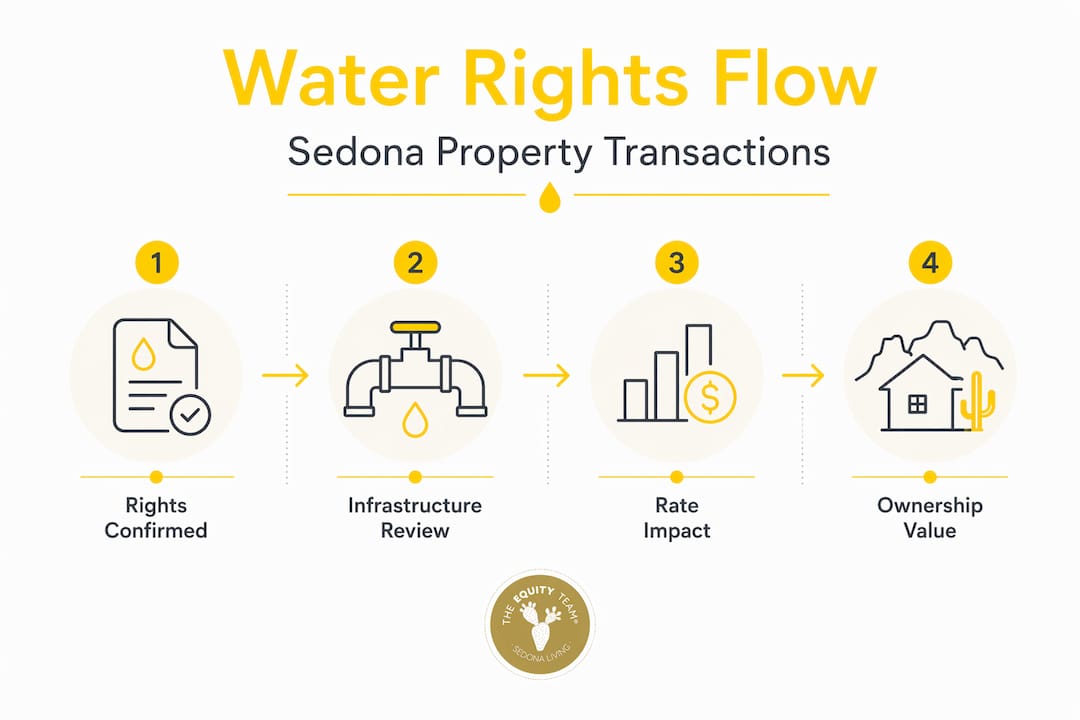
To soften the financial blow on residents, Sedona removed a franchise fee on water bills effective December 2025. The average monthly savings of $1.75 offsets about 45% of the $3.92 rate increase tied to that project. It is a small but thoughtful gesture, and it signals that the city is paying attention to how infrastructure costs land on property owners.
| Infrastructure Topic | Current Status | Impact on Owners |
|---|---|---|
| East Sedona Storage Tank Project | $6 million project underway | Water rate increase of $3.92/month |
| Franchise fee removal | Effective December 2025 | Average $1.75/month savings |
| Rainwater harvesting (under 100 gal) | No permit required | Free outdoor non-potable water source |
| Rainwater harvesting (over 250 gal) | Permit required | Non-compliance fines of $50 to $150 |
| Colorado River restrictions | New rules expected 2027 | Potential local rate increases and supply shifts |
Rainwater harvesting is one area where Sedona property owners have a practical tool to reduce water dependency. Small systems under 100 gallons can be set up without any permit for non-potable outdoor use. Systems over 250 gallons require permits, and ignoring that threshold can trigger fines related to mosquito breeding concerns under vector control rules.
Looking further ahead, new Colorado River restrictions expected in 2027 will ripple down to affect municipal water sharing agreements, storage arrangements, and costs across the region, including Sedona. Buyers and investors who factor this into their long-term planning are going to be in a much better position than those who do not.
Pro Tip: Investors buying short-term rental properties should calculate projected water costs using current rate structures and then add a 10 to 15 percent buffer for potential increases tied to upcoming regional policy changes.
Managing water rights and water quality post-purchase
Buying the property is just the beginning. Once someone owns Sedona real estate, managing water-related responsibilities becomes part of the ongoing job description, especially for short-term rental operators.
Sedona’s water quality grades a B overall as of late 2025, but only a C on health guidelines, with contaminants like arsenic, nitrate, and hexavalent chromium exceeding recommended levels. Hard water is a genuine operational headache. Water heater efficiency drops by 29% due to mineral buildup, and replacement cycles shorten from 12 to 15 years down to 6 to 8 years. Annual costs from hard water effects include roughly $180 in extra detergent, $200 to $350 in energy, $500 to $900 in repairs, and $300 to $600 in plumbing maintenance.
Practical steps for managing water-related responsibilities after purchase:
- Install a whole-home water filtration system to reduce hard water damage to appliances and plumbing.
- Schedule annual plumbing inspections to catch mineral buildup before it becomes a costly repair.
- For short-term rental operators, maintain a local emergency contact available within 60 minutes to handle water heater failures or plumbing issues. Failure to respond on time can result in permit revocation.
- Review HOA documents for water-related covenants, particularly any restrictions on greywater reuse or outdoor water fixtures.
- Stay current with Sedona short-term rental restriction changes that may affect how water-related emergency response obligations are enforced.
Investors running short-term rentals should treat water infrastructure maintenance as a line item in their operating budget, not an occasional surprise. The properties that stay in the top tier of the rental market are the ones with owners who plan ahead.
A candid take from someone who has seen it happen
I have watched more than a few buyers gloss over water rights during due diligence, and it almost always comes back to bite them. In my experience, most buyers think water is a utility, like electricity or gas. You buy the house, the water is on, and that is the end of it. But in Sedona and across Arizona, water is a property right. It has a history, a priority date, and its own legal paper trail.
What I have learned is that the investors who thrive here are the ones who ask the uncomfortable questions early. Is the water right documented? Was it ever severed? What is the infrastructure situation? These are not exotic legal questions. They are basic homework that takes a couple of days and protects a decision worth hundreds of thousands of dollars.
The evolving regulatory picture makes this even more pressing. The coming 2027 Colorado River restrictions are not a distant problem. They will filter down into local costs and availability within the next few years. Buyers who understand Sedona’s water situation today are going to make smarter long-term investment decisions than those who discover the issue after closing.
My recommendation: treat water rights as seriously as you would treat a title search or a home inspection. Because in Sedona, it absolutely deserves that level of attention.
— Chad
Work with a team that knows Sedona’s water picture
Water rights can feel like a lot. But with the right guidance, what seems complex becomes manageable, and what seems risky becomes an opportunity others miss. Equity Team specializes in Sedona short-term rental investments and knows the local regulatory landscape inside and out, including the water rights questions that trip up buyers who go it alone.

Whether buyers are hunting for a top-performing short-term rental or sellers want to present a property with clean documentation and strong value, Equity Team has the local expertise to make it happen. Check out the right STR investment guide for a clear-eyed look at how to evaluate Sedona properties with all the relevant factors, water rights included. Buyers who want to see profitable STR opportunities in one of Arizona’s most vibrant markets can start there. Equity Team is ready to talk.
FAQ
Do water rights automatically transfer with property in Arizona?
No. In Arizona, water rights are separate property interests that require explicit conveyance and are commonly excluded from standard title commitments. Buyers must verify and document water rights independently.
What is the prior appropriation doctrine and why does it matter in Sedona?
The prior appropriation doctrine gives water rights priority based on the date of first use, meaning earlier claims outrank newer ones regardless of land ownership. In Sedona, this means a property’s associated water rights could be junior and vulnerable during drought conditions.
How does water quality affect short-term rental properties in Sedona?
Sedona’s hard water reduces water heater efficiency by 29% and shortens appliance lifespans significantly, increasing operating costs for rental owners who are not proactively managing filtration and maintenance.
Can Sedona property owners collect rainwater?
Yes, but with limits. Systems under 100 gallons require no permit for outdoor non-potable use, while systems over 250 gallons need a permit. Non-compliance can result in fines between $50 and $150.
What water-related changes should Sedona property investors watch in 2027?
New Arizona rules restricting Colorado River water use in 2027 are expected to affect local water availability, shared storage agreements, and municipal water rates in Sedona. Investors should build flexibility into long-term operating budgets.