

Selling a Sedona vacation rental or short-term rental property sounds like a dream exit. Red rock views, strong appreciation, and a buyer pool that practically lines up around the block. But the sedona property sale tax implications can quietly eat into those profits in ways that catch even experienced owners off guard. Federal capital gains, depreciation recapture, local transaction privilege taxes, and Arizona-specific rules all collide at closing. Knowing what’s coming before you list the property is the difference between a great payday and a very expensive surprise.
Table of Contents
- Key Takeaways
- Sedona and Arizona taxes that affect your sale
- Federal capital gains rules for rental sellers
- Tax planning strategies that actually move the needle
- A practical checklist before you list
- My take on the tax surprises no one warns you about
- How Equity Team helps you sell smarter
- FAQ
Key Takeaways
| Point | Details |
|---|---|
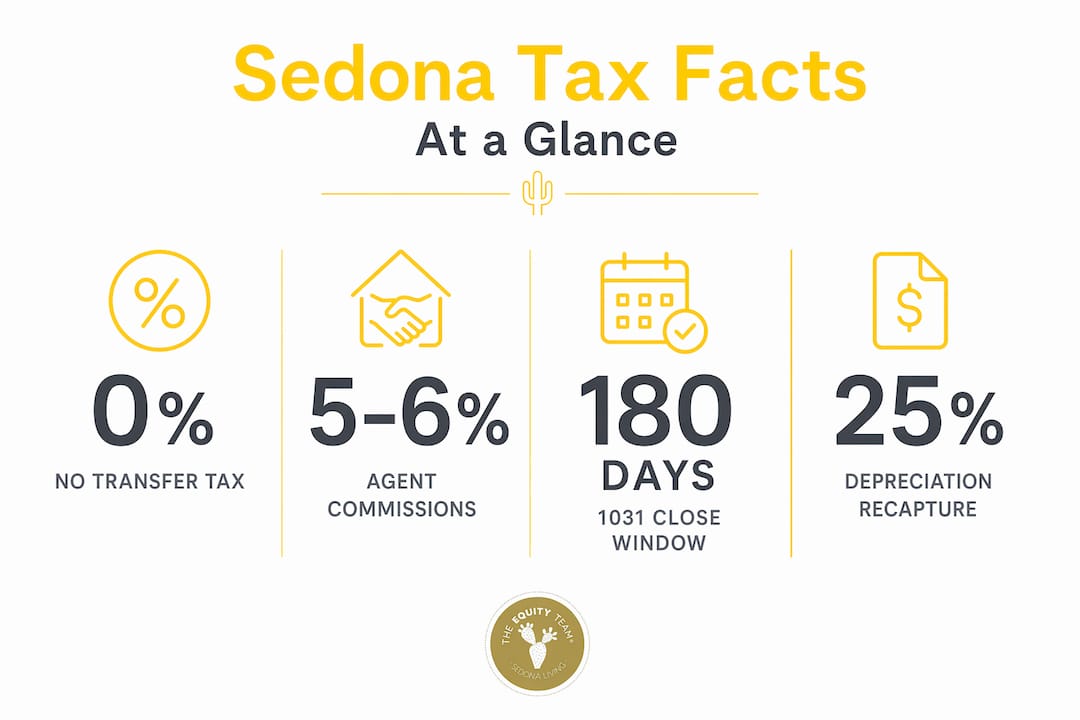
| No Arizona transfer tax | Arizona charges no real estate transfer tax, which simplifies closing costs compared to most states. |
| Capital gains exclusion limits | The IRS Section 121 exclusion only applies if the property was your primary residence for 2 of the last 5 years. |
| Depreciation recapture hits hard | Rental property owners face depreciation recapture taxed up to 25%, separate from capital gains rates. |
| 1031 exchanges defer taxes | Reinvesting proceeds into a like-kind property can defer capital gains taxes indefinitely. |
| Early planning saves money | Consulting a tax professional before listing can unlock strategies like cost segregation that are unavailable after closing. |
Sedona and Arizona taxes that affect your sale
Here is the good news: Arizona charges no real estate transfer tax, which is a genuine advantage over states like California or New York. That one quirk alone simplifies the closing table considerably. But Sedona has its own local flavor when it comes to taxes, and short-term rental owners need to pay close attention.
Sedona relies on a transaction privilege tax and bed tax at 3.5% each as its primary revenue sources. These taxes apply to rental income during the time you own and operate the property, not directly to the sale itself. However, if you have outstanding TPT obligations or an unlicensed rental at the time of sale, those liabilities become your problem to resolve before or at closing. Buyers will ask about it, and title companies will flag it.
Here is a quick breakdown of what sellers typically deal with at the closing table:
- Agent commissions: Real estate commissions typically represent 70 to 80% of total closing costs, which run around 5 to 6% of the sale price.
- Property tax proration: Sellers pay their prorated share of property taxes for the portion of the year they owned the home.
- TPT license status: Your Arizona TPT license must be current and any back taxes resolved before transfer.
- Title and escrow fees: These are typically split between buyer and seller in Arizona.
| Cost Item | Typical Seller Responsibility |
|---|---|
| Agent commissions | 5 to 6% of sale price |
| Property tax proration | Prorated to closing date |
| TPT back taxes (if any) | Seller resolves before closing |
| Title and escrow fees | Split with buyer |
| Transfer tax | None in Arizona |
Pro Tip: Request a TPT compliance review from Arizona Department of Revenue at least 60 days before your target closing date. Clearing any discrepancies early prevents last-minute delays that can kill a deal.
Arizona also excludes many home-sale gains from state personal income tax for primary residences. For short-term rental owners, that state-level shield often does not apply, which means the federal picture becomes even more important to understand.
Federal capital gains rules for rental sellers
This is where sedona vacation rental seller tax obligations get genuinely complex. The IRS treats a short-term rental very differently from a primary residence, and the gap in tax treatment can be tens of thousands of dollars.

The IRS Section 121 exclusion lets homeowners exclude up to $250,000 (single) or $500,000 (married filing jointly) in capital gains from federal income tax. The catch is the 2-of-5-year primary residence rule. If your Sedona property has been a full-time short-term rental, you likely do not qualify for this exclusion at all.
Here is how federal capital gains tax works for rental property sellers:
- Calculate your adjusted basis. Start with the purchase price, add capital improvements, and subtract accumulated depreciation. Depreciation you claimed (or should have claimed) during rental years reduces your basis.
- Determine your gain. Sale price minus adjusted basis equals your taxable gain.
- Apply the correct rate. Long-term capital gains rates are 0%, 15%, or 20% depending on your income. Properties held under one year are taxed at ordinary income rates, which can be as high as 37%.
- Account for depreciation recapture. Gain attributable to prior depreciation deductions is taxed at a maximum rate of 25%, separate from your capital gains rate.
- Check for NIIT. High-income sellers face an additional 3.8% Net Investment Income Tax on top of capital gains, which can meaningfully increase the total bill.
The depreciation recapture piece surprises a lot of sellers. If you owned a $700,000 Sedona rental for seven years and claimed $150,000 in depreciation, that $150,000 gets taxed at up to 25% regardless of your overall gain. That is a $37,500 tax bill from depreciation alone, before you even touch capital gains.
Pro Tip: If you converted a primary residence to a short-term rental within the last five years, you may still qualify for a partial Section 121 exclusion. Run the numbers with a CPA before assuming you get nothing.
Tax planning strategies that actually move the needle
Smart sedona str seller tax timing strategies can legally reduce what you owe by a significant amount. The key is planning before you list, not after you accept an offer.
1031 exchanges: defer now, pay later (or never)
A 1031 like-kind exchange defers capital gains taxes by rolling your proceeds into another qualifying investment property. You do not eliminate the tax, but you push it forward indefinitely. Many investors roll from property to property for decades and eventually pass assets to heirs with a stepped-up basis, effectively wiping out the deferred gain entirely.
The rules are strict: you have 45 days to identify a replacement property and 180 days to close. Miss either deadline and the full tax bill comes due immediately.
Cost segregation: accelerate deductions before you sell
Cost segregation studies reclassify property components into shorter depreciation schedules, generating large deductions in earlier years. For Sedona short-term rental owners, a well-timed cost segregation study can produce 20 to 30 times the study fee in tax savings. If you plan to sell in two to three years, commissioning a study now can generate deductions that offset other income while you still own the property.
Material participation and passive activity losses
Material participation is critical for qualifying short-term rental income under IRC Section 469. Owners who log 100 or more hours per year and more hours than any other individual can use cost segregation losses to offset W-2 income. This is a powerful combination. Misclassifying your participation level or failing to track hours can disqualify you from these benefits entirely, turning a smart strategy into a compliance problem.
Here is a side-by-side look at the two main tax deferral approaches:
| Strategy | Best For | Key Requirement | Risk |
|---|---|---|---|
| 1031 Exchange | Sellers reinvesting in real estate | 45/180-day deadlines | Strict timeline, no cash out |
| Cost Segregation | Owners holding 2+ more years | Professional study | Recapture on sale |
Pro Tip: Combine a cost segregation study with a 1031 exchange for maximum effect. Use the accelerated deductions during ownership, then defer the sale gain through the exchange. It is a legal one-two punch that high-performing STR owners use regularly.
A practical checklist before you list
Getting the sedona rental property closing process right means doing the prep work well before the sign goes in the yard. Here is a step-by-step approach that keeps you organized and protects your profits.
- Pull your complete purchase and improvement records. Every capital improvement you made increases your adjusted basis and reduces your taxable gain. Receipts for a new roof, kitchen remodel, or HVAC system all count.
- Calculate your accumulated depreciation. Your CPA or prior tax returns will show this. Do not skip it because the IRS will recapture it whether you tracked it or not.
- Verify your TPT license is current. Arizona requires short-term rental operators to maintain an active TPT license. Confirm there are no outstanding balances.
- Consult a tax professional before listing. Not during escrow. Before. This is when strategies like 1031 exchanges and cost segregation are still available to you.
- Evaluate your Section 121 eligibility. Even partial exclusions can save significant money if you converted the property from a primary residence at some point.
- Prepare for the 1099-S form. The title company will issue a 1099-S reporting the gross proceeds. Your tax return must reconcile this with your actual gain, so having clean records is non-negotiable.
A few documents worth gathering early:
- Original purchase contract and HUD-1 or closing disclosure
- Records of all capital improvements with receipts
- Prior year tax returns showing depreciation schedules
- Rental income records and occupancy logs
- Current TPT license and any correspondence with the Arizona Department of Revenue
Reviewing Sedona real estate market trends before you set a listing timeline also helps. Selling in a strong market year can offset tax costs that feel painful in a softer one.
My take on the tax surprises no one warns you about
I have worked with Sedona short-term rental owners at every stage of the investment cycle, and the pattern I see most often is this: sellers who did everything right during ownership get blindsided at the sale. They maximized revenue, kept the property in great shape, and built real equity. Then they get the tax bill and the celebration gets a lot quieter.
The part that catches people most off guard is depreciation recapture. Owners spend years claiming depreciation deductions, which is the right move. But when they sell, they treat the gain as a clean capital gain and forget that the depreciation comes back to haunt them at 25%. On a property with significant rental history, that number is not trivial.
My honest opinion on 1031 exchanges: they are powerful, but they are not always the answer. I have seen sellers rush into a replacement property just to avoid taxes, end up with an underperforming asset, and wish they had just paid the bill and moved on. The tax tail should not wag the investment dog. If the right replacement property exists, a 1031 exchange in Sedona is a brilliant move. If it does not, forced reinvestment is its own kind of expensive mistake.
The sellers who come out ahead are the ones who start the tax conversation 12 to 18 months before they plan to list. That window is long enough to do a cost segregation study, establish material participation, and structure the sale timeline to hit long-term gain treatment. Waiting until escrow opens means most of those options are already off the table.
— Chad
How Equity Team helps you sell smarter
Selling a Sedona short-term rental is not like selling a regular home, and the tax side of it proves that point every single time. Equity Team is the first STR-specialized real estate team in Northern Arizona, and the clients we represent operate in the top 10% of the Sedona rental market. That means we understand the tax picture, the permit considerations, and the local market dynamics that affect your bottom line.

Whether you are trying to time your sale for maximum tax efficiency or figure out if a short-term rental investment makes sense as a 1031 replacement property, Equity Team brings the local expertise that generic agents simply do not have. We connect sellers with the right tax professionals, help you understand what your property is actually worth in today’s market, and make sure you walk away with the best possible outcome. Reach out to Equity Team for a personalized consultation and find out what your Sedona STR is really worth.
FAQ
Does Arizona charge a real estate transfer tax?
No. Arizona imposes no state-level transfer tax on property sales, which reduces closing costs compared to most other states.
Can I use the $500,000 capital gains exclusion on my Sedona rental?
Only if the property served as your primary residence for at least 2 of the 5 years before the sale. A full-time short-term rental typically does not qualify, though partial exclusions may apply in some cases.
What is depreciation recapture and how does it affect my sale?
Depreciation recapture is the IRS’s way of taxing back the depreciation deductions you claimed during rental ownership. It is taxed at a maximum rate of 25% and applies regardless of your overall capital gains rate.
How does a 1031 exchange work for Sedona property sellers?
A 1031 exchange defers capital gains taxes by reinvesting sale proceeds into a like-kind replacement property within 180 days, with a 45-day window to identify candidates.
What Sedona-specific taxes should short-term rental sellers resolve before closing?
Sellers should confirm their Arizona TPT license is active and that all transaction privilege taxes and bed taxes are current. Outstanding balances can delay or complicate the closing process.