

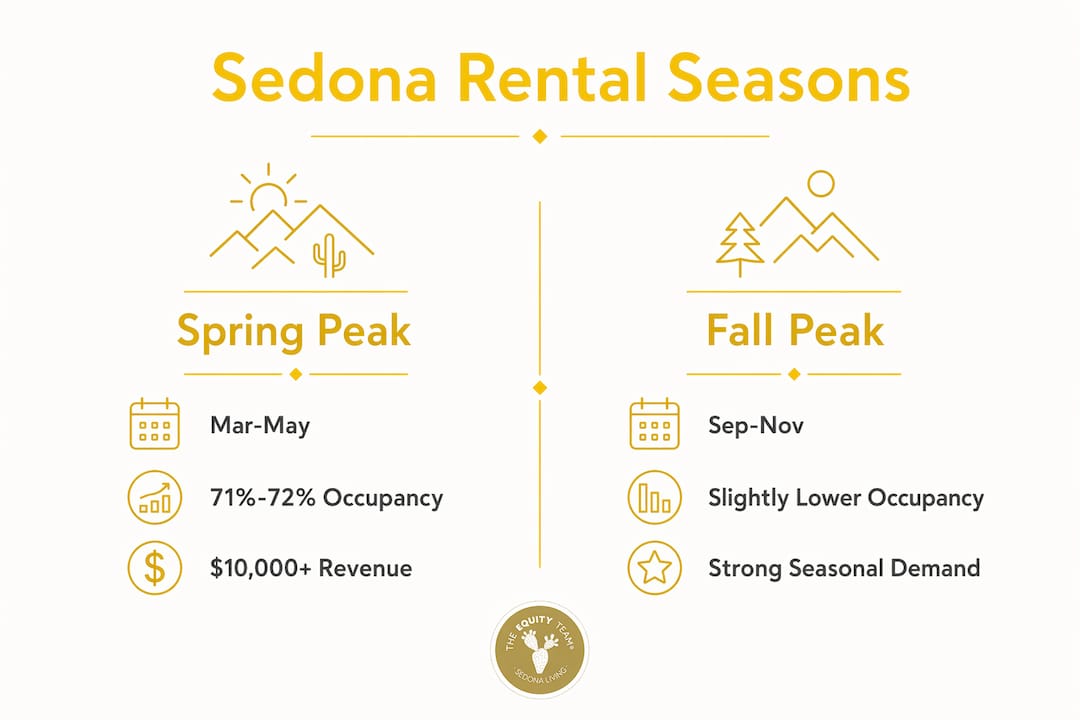
Sedona’s peak rental season is defined by two distinct high-demand windows: spring (march through may) and fall (september through november), with march as the strongest single month of the year. This dual-peak pattern sets Sedona apart from most vacation markets, which follow a single summer surge. For short-term rental investors, understanding this calendar is not optional. It is the foundation of every pricing decision, amenity investment, and booking strategy that separates top-performing properties from average ones. Equity Team works exclusively with investors in this market, and the seasonal rhythm of Sedona is the first thing every serious buyer needs to internalize.
What months define Sedona’s peak rental season?
Sedona runs on a dual-peak calendar, and that quirky rhythm is actually great news for investors. Most markets hand you one busy season and a long, quiet stretch. Sedona gives you two shots at strong revenue every year, which makes annual income projections far more reliable.
Spring is the headline act. Occupancy in march hits 71%–72%, and well-performing properties clear $10,000 in monthly revenue. April and may stay strong, with occupancy hovering around the same range and average daily rates (ADR) holding firm. Visitors flood in for the red rock scenery, mild temperatures, and the kind of vibrant outdoor energy that makes Sedona feel like a playground for the senses.

Fall is the quieter but surprisingly lucrative second peak. September through november brings slightly lower occupancy, around 61%, but ADR can reach its annual high during this window. Guests in fall tend to book longer stays and spend more per night, which means revenue per booking climbs even when total occupancy dips. The serene canyon light in october and november draws a crowd willing to pay for the experience.
Here is how the four seasons stack up for a typical Sedona short-term rental:
| Season | Months | Avg. Occupancy | Avg. ADR | Est. Monthly Revenue |
|---|---|---|---|---|
| Spring (peak) | March–May | 71%–72% | High | $10,000+ |
| Fall (peak) | September–November | ~61% | Highest of year | $7,000–$9,000 |
| Winter (shoulder) | December–February | ~48% | Moderate | $4,800–$5,800 |
| Summer (trough) | June–August | 35%–41% | $288–$357 | $3,540–$4,600 |
The Sedona property rental calendar rewards investors who plan around these windows rather than applying a flat annual rate. Properties that treat every month the same leave real money on the table.
How does summer affect Sedona rental performance?
Summer is the softest stretch on the Sedona vacation rental calendar, and the numbers make that clear. July and august occupancy drops to 35%–41%, with monthly revenue falling to roughly $3,540–$4,600. That is a significant dip from the spring peak, and investors who are not prepared for it can find themselves scrambling.
Sedona sits at about 4,500 feet of elevation, which makes it noticeably cooler than Phoenix. Still, summer temperatures regularly push into the 90s, and that is enough to send heat-sensitive travelers elsewhere. The breathtaking red rocks do not disappear in july, but the appeal of hiking them under a blazing sun loses its charm for many guests.
The good news is that the right amenities change the math considerably. Properties with pools, misting systems, and shaded outdoor areas maintain better occupancy and ADR during the hot months compared to properties without these features. A cool dip after a morning hike is a powerful selling point in august. Investors who build or buy with summer in mind create a meaningful competitive edge.
Strategies that work well for summer bookings include:
- Target budget-conscious travelers. Summer guests are often more price-sensitive, so competitive rates with strong value (pool, fast Wi-Fi, full kitchen) convert well.
- Market to family groups. School is out, families are traveling, and a spacious property with outdoor amenities fits their needs perfectly.
- Offer weekly discounts. Longer stays reduce turnover costs and keep occupancy steadier across the slow weeks.
- Highlight indoor comfort. Reliable air conditioning and cool indoor spaces are not just nice to have in summer. They are a booking requirement.
Pro Tip: Refresh your listing photos in late spring to feature your pool, shaded patio, or misting setup front and center. Guests searching for summer stays in Sedona are specifically filtering for heat relief, and your thumbnail image is the first filter they apply.
What role does winter play in Sedona’s rental season?
Winter is not a dead season in Sedona. It is a shoulder season with a loyal, niche audience and some genuinely surprising revenue spikes. Winter occupancy averages around 48%, with monthly revenue landing between $4,800 and $5,800. Those numbers are not as flashy as march, but they are steady and predictable.
The secret weapon of the Sedona winter rental market is the holiday window. Christmas through New Year’s week outperforms typical off-season projections by a wide margin. Guests pay premium rates for that serene, snow-dusted red rock backdrop, and properties that are well-positioned for the holiday crowd can see winter revenue that rivals a solid fall week.
Wellness tourism and snowbird visitors are the other pillars of winter demand. Sedona has a well-earned reputation as a destination for spa retreats, meditation, and spiritual renewal. That audience travels in winter specifically to escape cold weather elsewhere, and they tend to book longer stays. Here is how to make the most of the winter window:
- Target wellness travelers. Highlight proximity to Sedona’s famous spas, vortex sites, and yoga studios in your listing description.
- Promote weekend retreats. Weekday demand softens in winter, but weekends stay active. Minimum stay requirements of two to three nights on weekends protect your revenue floor.
- Price the holiday window aggressively. Christmas to New Year’s is a premium window. Rates should reflect that, and they should be set months in advance.
- Court snowbird guests. Travelers escaping cold northern winters often want stays of one to four weeks. A monthly rate option can fill long stretches of january and february that would otherwise sit empty.
- Lean into the atmosphere. Cozy fireplaces, warm lighting, and serene outdoor views photograph beautifully in winter. Update your listing to reflect the season’s unique charm.
Winter niche markets like wellness retreats and snowbird visitors create income streams that flat annual models consistently undervalue. Investors who recognize this earn more without adding a single extra property to their portfolio.
How should investors manage pricing across Sedona’s rental seasons?
Static pricing is the single most common and costly mistake in Sedona short-term rental management. Nightly rates must adjust daily based on local events, school calendars, booking velocity, and seasonal demand patterns. A flat annual rate that feels safe is actually a slow revenue leak.
The dual-peak structure of Sedona’s rental market creates two windows where demand can outpace available supply. During spring and fall peaks, inventory constraints become the limiting factor, not demand. When supply tightens, the investors who have already set competitive rates and secured bookings early capture the most revenue. Those who wait get the scraps.
Booking lead times matter more than most investors realize. Peak windows in spring and fall require 3–6 month lead times for best revenue capture. Guests planning a march trip to Sedona are often searching in december and january. If your calendar is not open and your rates are not set by then, you are invisible to the highest-value bookers.
Key pricing principles for Sedona investors:
- Use dynamic pricing tools. Rate management software that adjusts nightly prices based on real-time demand signals outperforms manual rate setting every time.
- Model revenue by week and month, not by year. Annual flat projections miss Sedona’s seasonal volatility entirely. Weekly and monthly models reflect actual market behavior.
- Set minimum stays strategically. Two-night minimums on weekends during shoulder seasons reduce gaps. Three-night minimums during peak weeks protect against low-value bookings that block higher-paying ones.
- Watch local events. Sedona Film Festival, Tlaquepaque arts events, and holiday weekends create micro-peaks that reward investors who track the Sedona tourism peak months calendar closely.
Pro Tip: Open your spring calendar by december 1st and your fall calendar by june 1st. Guests who book Sedona peak season travel are planners. If your property is not visible when they start searching, a competitor’s property fills that slot instead.
Key takeaways
Sedona’s dual-peak rental calendar rewards investors who plan by season, price dynamically, and match their amenities to each demand window.
| Point | Details |
|---|---|
| Spring is the top revenue window | March delivers 71%–72% occupancy and $10,000+ monthly revenue for strong properties. |
| Fall offers the highest ADR | September through november yields the year’s top nightly rates despite slightly lower occupancy. |
| Summer requires amenity investment | Pools, misting systems, and shaded areas reduce occupancy declines during the july–august trough. |
| Winter has reliable niche demand | Holiday weeks and wellness travelers sustain 48% occupancy and $4,800–$5,800 monthly revenue. |
| Dynamic pricing is non-negotiable | Static rates cost investors real money; daily adjustments aligned with demand patterns maximize income. |
Chad’s take on Sedona’s seasonal rental market
The thing that surprises most investors when they first look at Sedona rental data is the fall peak. Everyone expects spring to be strong. The red rocks, the wildflowers, the perfect hiking weather. That story sells itself. But fall catches people off guard, and that is exactly where opportunity lives.
In my experience working with Sedona short-term rental investors, the ones who outperform the market are not necessarily the ones with the most expensive properties. They are the ones who treat their rental like a business with a real seasonal operating plan. They open their calendars early, they adjust rates weekly, and they invest in amenities that serve guests in every season, not just the obvious peak months.
The summer trough is real, but it is not a reason to panic or drop rates to the floor. A property with a pool and a well-written listing that speaks directly to summer travelers will outperform a comparable property that just slashes its nightly rate and hopes for the best. Amenities are a long-term investment in year-round revenue stability.
The investors I see struggle are the ones who run annual projections and then wonder why reality does not match. Sedona does not operate on an annual rhythm. It operates on a weekly one. The market rewards those who pay attention to that rhythm and respond to it in real time. That is not complicated. It just requires discipline and the right data.
— Chad
Equity Team can help you find the right Sedona rental property
Sedona’s dual-peak rental calendar creates real income potential for investors who know how to work with it. Equity Team specializes exclusively in Sedona short-term rental investments and represents clients operating in the top 10% of the rental market. Whether you are evaluating your first property or adding to an existing portfolio, having a team that lives and breathes this market makes a measurable difference.

Equity Team offers property analyses, seasonal revenue modeling, and expert walkthroughs of active Sedona listings. If you are ready to find a property built for peak-season performance, find the right investment with guidance from the team that knows this market best. You can also browse a comparative market analysis to see how specific properties perform across Sedona’s seasonal windows before you commit.
FAQ
What is Sedona’s peak rental season?
Sedona’s peak rental season runs during spring (march through may) and fall (september through november), with march delivering the highest occupancy and monthly revenue of the year.
What months have the highest occupancy in Sedona?
March consistently leads with occupancy rates of 71%–72%, followed by the broader spring window through may and the fall window from september through november.
When is the slowest rental period in Sedona?
July and august are the softest months, with occupancy dropping to 35%–41% and monthly revenue falling to roughly $3,540–$4,600.
Is winter a good time to rent out a Sedona property?
Winter is a reliable shoulder season averaging 48% occupancy and $4,800–$5,800 monthly, with notable spikes during the christmas to New Year’s holiday window.
How far in advance should investors open their Sedona peak-season calendar?
Peak spring and fall windows require booking lead times of 3–6 months, so opening your calendar by december for spring and by june for fall captures the highest-value guests first.