

An Airbnb appraisal comes down to one question: what will a buyer or lender pay for this house, and what income can they count on? In Sedona, the best answer blends three things: closed comparable sales, a clean net operating income (NOI) number, and proof that the property can legally keep renting. Skip any one and the number wobbles like a jeep on Broken Arrow. A Sedona vacation rental comparative market analysis built by a team that lives and breathes short-term rentals (STRs) is how owners and buyers get all three lined up before the money moves.
TL;DR
- Appraisers lean on closed comparable sales first. Fannie Mae’s selling guide asks for at least three, ideally from the last 12 months.
- Income value is NOI divided by a cap rate, and a one-point swing in that cap rate can move value by six figures.
- Net income means real expenses: cleaning, platform fees, taxes, insurance, permits and management, not just the nightly rate times the nights booked.
- Permit status, insurance and rule changes can erase or protect value, so check them before anyone talks price.
- One operator’s hot streak rarely sets value. A stabilized, market-rate view does.
Table of Contents
- Appraisal, CMA and “what my Airbnb is worth”: three different questions
- Tip 1: Build the comp set the way an appraiser would
- Tip 2: Pair sales comps with the income approach
- Tip 3: Know what a lender’s rent form does and does not capture
- Tip 4: Normalize the income to a stabilized operation
- Tip 5: Count every expense, including the boring ones
- Tip 6: Treat permits and rules as part of the value
- Tip 7: Read Sedona market numbers with a calendar in hand
- Tip 8: Present the property so the number holds
- Our perspective
- Get a Sedona-specific number
- FAQ
- Sources
Appraisal, CMA and “what my Airbnb is worth”: three different questions
Sedona has a talent for making things sound simpler than they are, and “appraisal” is one of them. Three different numbers hide under that word.
A lender’s appraisal is the formal opinion of value ordered when a buyer finances a purchase. A comparative market analysis (CMA) is an agent’s pricing study built from comparable sales and active competition. An investor’s valuation is the buyer’s own math on what income the house can produce.
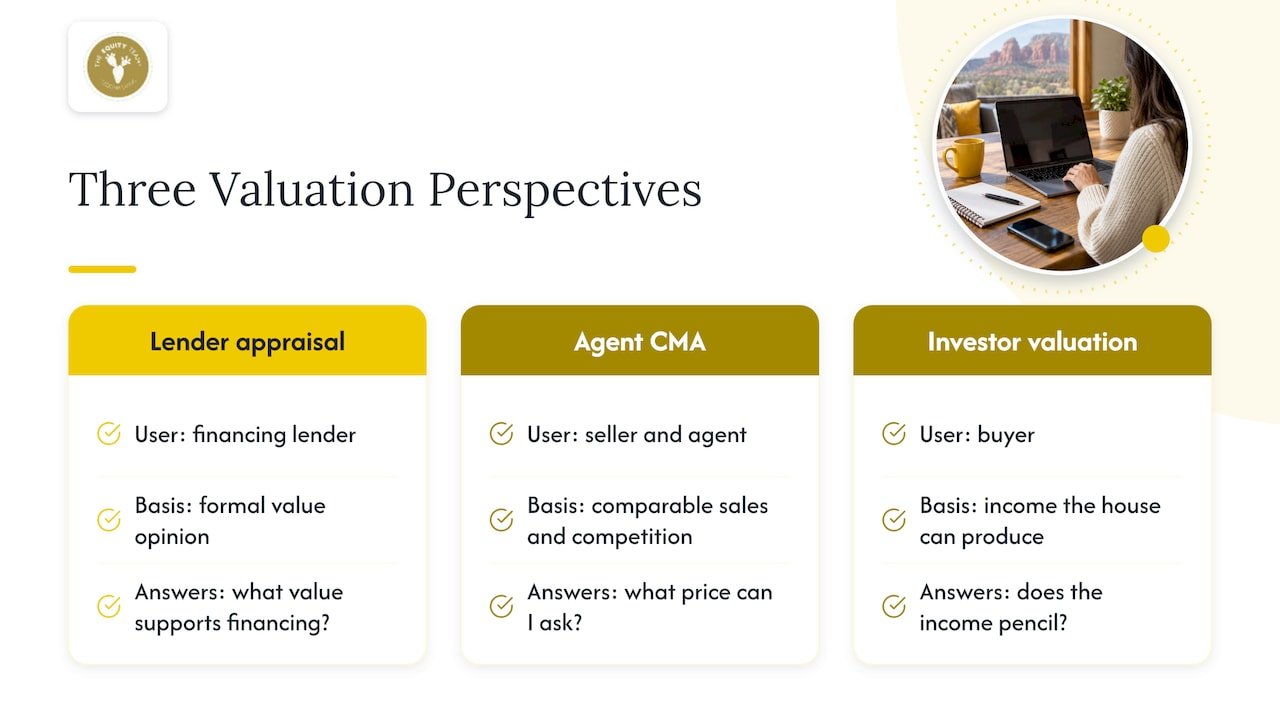
A STR sale touches all three. The lender wants a supportable value, the seller wants top dollar, and the buyer wants the income to pencil. Good tips work on all three at once, and the rest of this guide follows that order: comps, income, expenses, risk, then presentation.
Tip 1: Build the comp set the way an appraiser would
Fannie Mae’s guide says an appraisal needs at least three closed comparable sales, similar in physical and legal characteristics, and that sales from within the last 12 months should be used when appropriate. Older sales can appear if the report explains why. That 12-month window matters in a seasonal town where spring and fall demand differs from deep winter.
For a Sedona rental, “similar” goes further than bedrooms and square footage. A practicing appraiser’s guide to STR valuation lists the adjustments that matter: year-round availability, permitted versus unpermitted rental use, furniture and equipment packages, platform reputation and micro-location near demand drivers. The same guide notes that an unpermitted subject property has no STR valuation at all.
In practice, that means:
- Start with sales that could legally operate as rentals. A charming casita that cannot be rented short-term is a different animal, however pretty its red-rock view.
- Match the location story. Walkable to Uptown and tucked in a quiet canyon cul-de-sac book differently, so they price differently.
- Match condition and finish. A remodeled kitchen and a hot tub are not the same as a 1990s galley with a cracked spa cover.
- Adjust, do not just average. Each comp gets a plus or minus for each difference, and the adjusted prices tell the story.
- Decide what the furniture is. If a sale included a full furniture package, the price needs adjusting before it is compared with a sale that did not.
Our Sedona vacation rental comparative market analysis page explains how this plays out on local properties.
Tip 2: Pair sales comps with the income approach
Sedona sales of true STRs are not abundant in every neighborhood, and no two houses earn alike. That is why the appraiser quoted above argues a well-supported STR valuation uses at least two approaches and reconciles them: sales comparison carries more weight where STR sales are plentiful, and income carries more weight where investors dominate and comps are thin.
The income approach has a simple spine:
Value = NOI ÷ cap rate
NOI is net operating income: revenue minus operating expenses, before the mortgage. The cap rate is the yield a buyer expects, and the market sets it. One cost-segregation firm explains how to find it: divide each comparable STR sale’s NOI by its sale price, then look at the pattern.
A worked example (illustrative numbers)
Say a three-bedroom Sedona rental grosses $90,000 a year and, after a realistic 40% expense load, nets $54,000.
| Cap rate | Value = $54,000 ÷ cap rate |
|---|---|
| 5.5% | about $981,800 |
| 6.5% | about $830,800 |
One percentage point of cap rate is worth about $151,000 here. The cost-segregation firm makes the same point with its own example: on $36,200 of NOI, the gap between a 5.5% and a 6.5% cap rate is more than $100,000 of value. The lesson: the cap rate deserves as much homework as the revenue line.
A related caution from that source: comparable sales only hold if they could legally operate as rentals and sold in similar condition. Mixing in sales that cannot be rented drags the cap rate and the answer off course.
Tip 3: Know what a lender’s rent form does and does not capture
One snag catches owners by surprise. The standard rent schedule form lenders use, Form 1007, can document estimated monthly rents from comparable one-unit rentals but is not designed to document short-term rental rates. The lender decides how rental income is considered.
So a buyer’s glowing booking calendar may not translate neatly into the lender’s number. Sellers benefit from pricing the house with that in mind, and buyers benefit from knowing what financing path is available before they write an offer. Sedona STR deals are won by people who know the answer to “how will this be underwritten?” before the offer goes in.
Tip 4: Normalize the income to a stabilized operation
The appraiser’s guide flags a key point: STR income statements carry hotel-like costs, and they must be normalized to a stabilized, market-rate operation. It also cautions against valuing a house on one specific operator’s performance. A superhost with a gift for guest messaging does not transfer with the deed.
Normalizing means asking what an average competent operator would earn, not what the current owner’s best year produced. It cuts both ways:
- Sellers with strong numbers should show the revenue by month and explain what is repeatable: location, view, layout, amenities.
- Buyers should haircut one-off windfalls and credit the property for improvements the seller never got around to.
Our own Sedona appraisal page for Airbnb owners makes a related point: average Airbnb revenue rarely lifts appraised value on its own, which is why the comp work matters.
Tip 5: Count every expense, including the boring ones
Gross revenue is the fun number. NOI is the one that pays. Typical STR line items include:
- Cleaning and linen turnover, net of what guests pay in cleaning fees
- Platform host fees
- Utilities, internet and streaming, which run higher than a long-term rental
- Supplies and restocking
- Maintenance from turnover wear and tear
- Property management, if the owner is not self-managing
- Insurance, permits and taxes
- A vacancy allowance for the slow months
A published guide to vacation rental investing puts net cleaning costs at 5 to 8% of revenue even when fees are passed to guests, with professional management at 25 to 30% in its examples. Sedona specifics vary by house, so the safest approach is to use the property’s own bills and a stabilized management cost, not the seller’s best guess.
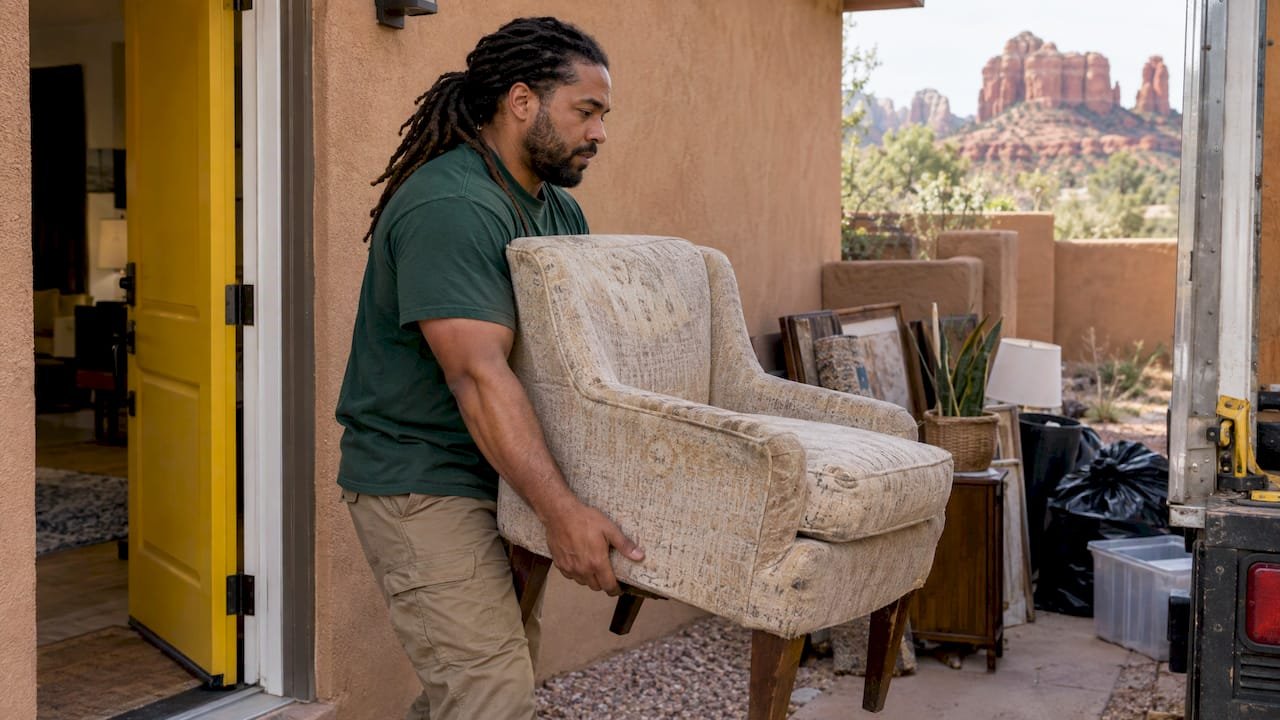
Turnover days are also where homes quietly lose money. Between guests, furniture gets moved, supplies get swapped and the odd forgotten pile of stuff needs hauling. A landlord cleanout checklist for hitting a one-week turnover shows how to budget those occasional clear-outs as a real expense rather than a surprise. Plugging that into the expense line makes the NOI more honest, and honest NOI is what survives an appraiser’s review.
Tip 6: Treat permits and rules as part of the value
In Sedona, legality is a value driver. If a house cannot hold a permit, the income approach has nothing to capitalize. The details can change, so the city’s current rules should always be checked before closing. As summarized by a rules-tracking site, Sedona’s permit fee rose to $210 per unit in January 2025, each advertised unit needs its own permit, and operators need a state transaction privilege tax license, a permit and $500,000 in liability insurance. The same page notes Ordinance 2025-02 restricted STR use of accessory dwelling units with certificates of occupancy issued on or after September 14, 2024, unless the owner’s primary residence is the main structure. It also reports that Arizona law bars cities from prohibiting short-term rentals.
For a buyer, a rules checklist before writing an offer:
- Is there an active permit, and is the permit tied to the unit being sold?
- Does the listing include a guest house or ADU, and when was its certificate of occupancy issued?
- Do HOA covenants allow rentals?
- Is the tax license in good standing?
- Are insurance and renewal dates current?
A vacation-rental investing guide also recommends stress-testing the underwriting at long-term rental income so the deal survives a regulation shock. That is a smart habit: if the purchase still works on a floor-level rent, the downside is bounded.
Tip 7: Read Sedona market numbers with a calendar in hand
Sedona data comes in many flavors, and it moves. Occupancy runs in the mid-50s in Arizona according to our Arizona Airbnb occupancy page, and our Sedona STR occupancy data analysis walks through how to read it. Those figures shift each reporting period, so use them as a range and not a promise.
What matters for appraisal is the spread between average and top performers. A house at the top of the market earns far more than the median, and the reasons are usually physical: views, privacy, bedroom count, pool or spa, design. Those features should be reflected in the comp adjustments, not hidden by market averages.
For trend context, our Sedona Airbnb market trends guide and cap rate explainer cover the metrics buyers and sellers keep asking about.
Tip 8: Present the property so the number holds
Sellers can influence the appraisal without gaming anything. Gather the evidence an appraiser or buyer’s analyst will want:
- Twelve months or more of monthly revenue, occupancy and nightly rate
- Itemized expenses with receipts
- Permit, tax license and insurance documents
- A list of upgrades with dates
- A note on what furnishings convey
- Photos that show the property as guests see it
Cleaner paperwork means fewer questions and fewer “unable to verify” haircuts. For sellers weighing timing, our pages on preparing a Sedona rental for sale and benchmarking income for resale go deeper. Luxury properties need extra care, since high occupancy still needs local CMAs.
Our perspective
Here is what we tell owners over coffee: a short-term rental is two assets in a trench coat. One is a house. The other is a small business that happens to live in it. Appraisers and lenders are comfortable with the house. Buyers pay for the business. The job is making the second asset legible.
That is why we think the best Sedona valuation is built from closed comps, a stabilized NOI and clean permit paperwork, all at once. We work only on short-term rental investment in Northern Arizona, and we represent clients who operate in the top 10% of the rental market. That focus means the comp set, the income story and the rules checklist are the daily routine, not a side project.
For sellers, we build the case for top dollar before the listing goes live. For buyers, we want the income number to survive a skeptical lender and a slow January. Sedona rewards the prepared, and it loves to surprise the rest.
Chad
Get a Sedona-specific number
An online calculator can give a range. A local study gives a price. We run a Sedona vacation rental CMA for owners who are thinking of selling, and we offer a seller prep consultation too. Owners still deciding whether to hold or sell can use our rental exit strategy and valuation conversation. Buyers who want an agent who underwrites STRs for a living can start at owninaz.com.

FAQ
How many comparable sales does an appraisal need?
Fannie Mae’s selling guide calls for at least three closed comparable sales, similar in physical and legal characteristics. Sales from the last 12 months should be used when appropriate, and older sales need an explanation in the report. In thin Sedona STR pockets, the income approach fills in the gaps.
Does my Airbnb revenue raise the appraised value?
Not automatically. Lenders’ rent forms are built for long-term rental data, and the lender decides how rental income is considered. Revenue helps most when it is documented, normalized to a stabilized operation and supported by comparable sales and a market cap rate.
What is the quick formula for valuing an Airbnb?
Divide NOI by the cap rate. NOI is revenue minus operating expenses before debt payments. Because a small change in cap rate can move value by six figures, use cap rates derived from comparable STR sales rather than a generic rule of thumb.
Do permits affect value in Sedona?
Yes. A property that cannot legally operate as a rental has no STR valuation, and permits, insurance and tax licensing are part of the cost structure. Confirm the current rules and permit status before making an offer or listing.
Sources
- Comparable Sales | Fannie Mae Selling Guide
- Valuing Short-Term Rentals: A Real Estate Practitioner’s Guide
- How to Value a Short-Term Rental Property Before You Buy
- Form 1007 and Its Impact on Short-Term Rental Appraisals
- Vacation Rental Investing: Markets, Returns, Reality
- Sedona, AZ Short-Term Rental Laws
- Landlord Cleanout Checklist