

Sedona is a place where the red rocks put on a show and the zoning code quietly keeps score. For a home that backs onto National Forest or land zoned Open Space, the headline number is 20 feet: residential districts must keep a minimum 20-foot setback from National Forest or Open Space zoning districts. That one line shapes where a deck can go, how big an addition can be, and how much “wow” a vacation rental can add. For a short-term rental buyer or seller, it is worth knowing before the offer, not after.
TL;DR
- A setback is the required distance between a lot line and a building. In Sedona’s code it is measured from the lot line, or from the edge of a street or access easement when the lot line sits inside one.
- Residential lots that abut National Forest or Open Space zoning need at least a 20-foot setback from that boundary.
- Everything else depends on the zoning district: RS-70 asks for 50 feet front and rear, while RS-6 asks for 20 feet front and rear.
- The code allows some exceptions, such as limited patio and deck encroachments and a possible front setback reduction on steep lots.
- Buyers and sellers of Sedona STRs should check the parcel’s district and setbacks early, because they decide what can be built, added or sold as potential.
Table of Contents
- What a setback actually is (and why open space gets its own rule)
- The numbers: setbacks by residential district
- A worked example: the view lot that backs onto the forest
- What the code lets you bend
- How to find the setbacks for a specific parcel
- Why this matters more for a short-term rental
- Land and vacant lots: where setbacks do the most work
- Our perspective
- Getting the parcel questions answered before the offer
- A quick pre-offer routine for STR buyers
- FAQ
- Sources
What a setback actually is (and why open space gets its own rule)
A setback sounds fussy, but the idea is simple. It is a buffer. Under Section 2.24.D of the Sedona Land Development Code (the SLDC, the city’s rulebook for what can be built where), a setback is the required distance between the established lot line and any building on the lot. If the lot line lies within a street or access easement, the measurement starts at the edge of that street or easement instead.
Why do cities bother? Arizona law lets municipalities do it. Under A.R.S. 9-462.01, cities may establish and maintain building setback lines and regulate the size and use of lots, yards and open spaces to promote public health, safety and welfare. Sedona uses that power, and then adds a special rule for the places where houses meet the wild stuff.
That special rule is the open space setback. The pretty ridge line behind a home is rarely just scenery. It may be National Forest or a parcel zoned Open Space, and the code treats that edge differently from a neighbor’s fence. Residential properties in Sedona that abut one of those districts must keep a minimum setback of 20 feet from that boundary.
Two plain-English notes keep this from getting muddy:
- Open space setback means the buffer from a National Forest or Open Space zoning boundary, not from a street.
- Zoning district means the category the city has assigned to a lot, such as RS-70 or RS-6. Each carries its own lot and building standards.
The numbers: setbacks by residential district
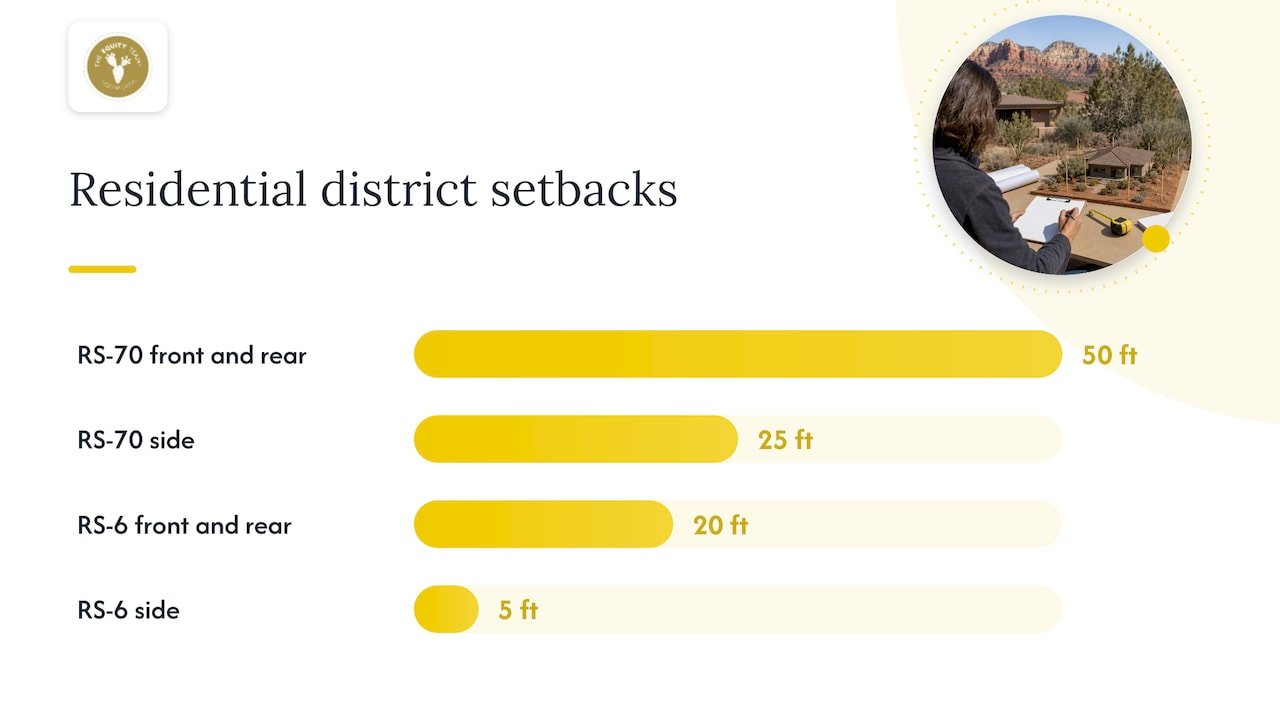
Here is where Sedona gets quirky. A lot at the edge of town in a large-lot district plays by very different rules than a compact lot in a denser neighborhood. The SLDC’s residential standards live in Table 2.2, and minimum setbacks vary across the districts it lists.
Two examples from that table, as of the code current through Ordinance 2025-11:
| District | Front and rear setback | Side setback |
|---|---|---|
| RS-70 | 50 feet | 25 feet |
| RS-6 | 20 feet | 5 feet |
Source: Table 2.2, SLDC section 2.23.A.
Put those next to the open space rule and a pattern shows up. A large RS-70 lot already has generous buffers on every side. A smaller RS-6 lot has tight ones, so a 20-foot open space setback along the back boundary can be the biggest constraint on the whole parcel. Same city, same red rocks, very different building envelopes.
Other districts and development standards sit in the code too. The SLDC is organized so that Article 2 covers zoning districts, Article 3 covers use regulations and Article 5 covers development standards. A parcel’s answer to “what can I do here” usually takes a trip through all three.
Arizona law also explains why numbers differ from lot to lot. Municipalities may divide their jurisdictions into zones with varying regulations, as long as standards stay uniform within each zone. They can also adopt overlay districts that modify or combine regulations from the underlying zoning districts. So a lot’s base district is the start of the story, not always the end.
A worked example: the view lot that backs onto the forest
Picture a house on an RS-6 lot whose back boundary is National Forest. Two setbacks now compete in the same strip of land: the district’s 20-foot rear setback and the 20-foot open space setback from the forest boundary. The relevant question for a buyer is not just “is there a hot tub spot?” but “where does the legal building line sit, and where does the existing house already sit against it?”
Here is how it plays out for an STR buyer with a wish list:
- The patio addition. A guest-pleasing deck facing the rocks is the classic upgrade. Whether it fits depends on the setback and on the encroachment rules below.
- The extra bedroom. More beds can mean more bookings, but the new walls have to clear the setback lines like any other building.
- The detached studio. An accessory building has to fit inside the same envelope. Our page on whether you can Airbnb an ADU in Sedona covers the rental side of that idea.
None of that is a reason to skip a view lot. It is a reason to know the envelope before pricing the dream.
What the code lets you bend
The SLDC is not a brick wall. It includes some give, and the research on the code shows two useful ones.
Limited encroachments. Table 2.6 lists features that may reach into a setback. For example, uncovered patios, decks and balconies may extend up to 6 feet into a required setback, as long as they remain at least 5 feet from all property lines. The same table covers architectural features, porches and equipment, each with stated limits.
A quick illustration using those figures: on a lot with a 20-foot rear setback, an uncovered deck could reach 6 feet into that zone, but it still has to stay 5 feet from the property line. Both conditions have to be satisfied, and the tighter one wins.
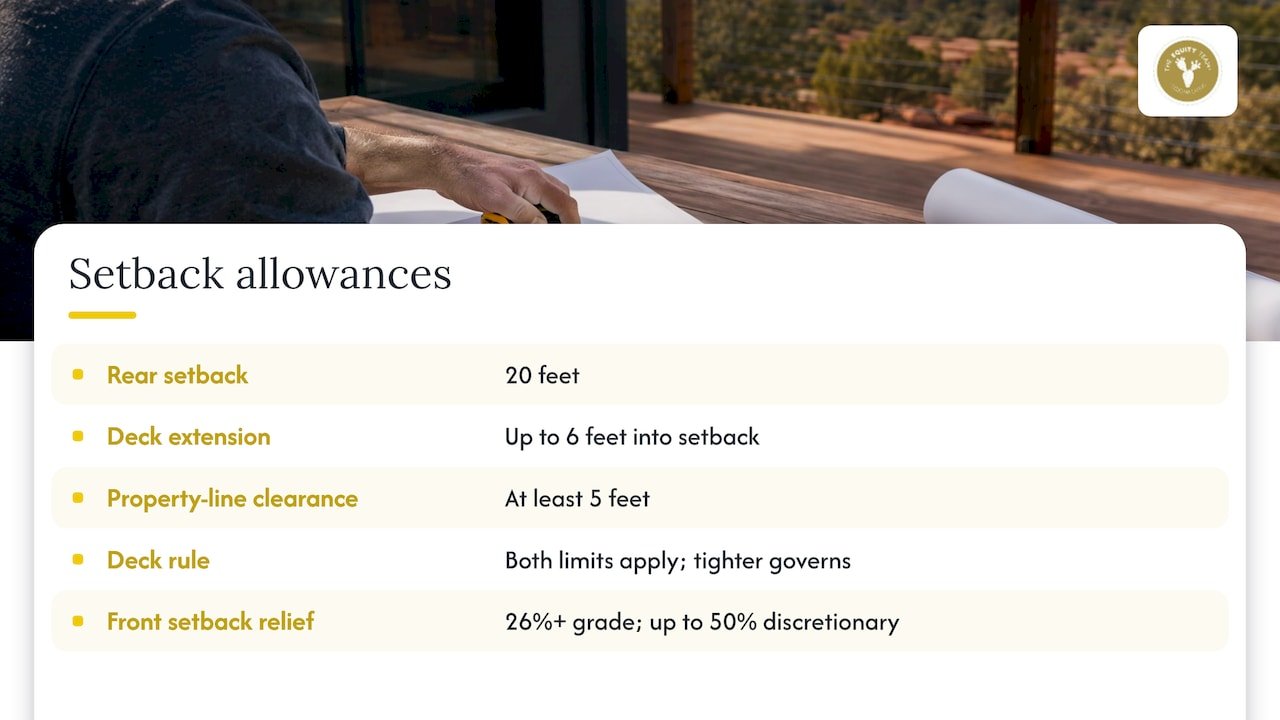
Steep-lot relief. Sedona has plenty of hillsides. For lots with a grade of 26 percent or higher, the Director may reduce front setbacks by up to 50 percent. That is a discretionary decision by city staff, not an automatic right, so a seller should not advertise it as a given.
One more point for the cautious: the version of the code the research relied on is current through Ordinance 2025-11, passed November 12, 2025, and the city’s clerk’s office is the place to ask about anything passed after that. Codes get amended, so a setback quoted in a listing should be checked against the current text.
How to find the setbacks for a specific parcel
This is the question that turns reading into action. A reasonable routine looks like this:
- Get the parcel number or address. It is on the listing, the tax bill or the title paperwork.
- Look up the parcel on the county map. Sedona sits across two counties. Yavapai County’s interactive map has a Sedona zoning layer and a property search by parcel number, address or owner. For parcels on the Coconino side, the Coconino County parcel viewer points to Community Development for zoning, setbacks and building codes.
- Note the zoning district. Write down the exact label, such as RS-70 or RS-6, and check whether the lot touches National Forest or Open Space zoning.
- Read the standards in the code. Table 2.2 gives the district numbers, and section 2.24.D gives the setback measurement rules, the 20-foot open space setback and the encroachment table.
- Check for overlays and recorded restrictions. An overlay can modify the base rules, and private deed restrictions can add rules the city never wrote. Our Sedona STR deed restriction check walks through that part.
- Compare the house to the lines. The existing structure, any additions and any unpermitted work all need to sit comfortably inside the envelope.
The step where this goes wrong is usually step 6. A map can tell what the rule is. It does not tell whether the 1980s sunroom was permitted, or whether a deck crept past the line over the years.
Why this matters more for a short-term rental
A primary home with an awkward setback is an inconvenience. An STR with one is an income question. Guests pay for outdoor space, views and privacy, and the features that deliver those are exactly the ones setbacks govern: decks, hot tubs, fire pits, casitas and extra bedrooms.
So setbacks touch three money moments.
Buying. A listing may describe a “potential expansion” or a “future patio.” The setback decides whether that potential is real. Buyers underwriting an STR on projected upgrades should price only what the envelope allows. Our Sedona STR zoning laws explainer puts these land-use rules alongside the rental rules, and the guide on what a Sedona vacation rental zone is covers the zone side.
Operating. Setbacks are one rule among several that decide how a rental performs. Permits and parking are the others that most often catch owners off guard, and both have their own pages: one permit per unit, every year and Sedona Airbnb parking rules.
Selling. A seller who knows the setbacks can explain exactly what a buyer may add, and can avoid the awkward moment when an inspection or survey surprises everyone. For rental sellers that clarity goes straight into how the property is presented and valued.
For context on the rental rules themselves, see how Sedona short-term rental restriction changes have played out. Setbacks sit on top of those, not instead of them.
Land and vacant lots: where setbacks do the most work
On a vacant lot, the setback is the first thing a designer draws. The buildable area is the lot minus the setbacks, minus steep slopes, minus any easements. A lot that looks generous on a listing photo can shrink into a modest rectangle once a 20-foot open space setback and the district’s front, side and rear numbers are laid over it. Our look at the pros and cons of buying land in Sedona goes through the other things that surprise land buyers.
A short checklist for vacant land:
- Confirm the zoning district and whether the lot touches National Forest or Open Space zoning.
- Draw the setbacks, then draw the access easement edge, since setbacks are measured from the easement edge when the lot line lies inside one.
- Look at the grade. A grade of 26 percent or higher may open the door to a front setback reduction, at the Director’s discretion.
- Ask whether the buildable area still fits the house the buyer actually wants.
Our perspective
Sedona is the only place we know where a ridge line can be a zoning issue and a sunset at the same time. We are the Equity Team, a team of Sedona real estate agents who specialize in short-term rental investment, and we like to say that the setback is where the romance meets the rulebook.
Our clients buy and sell STRs in the top 10% of the rental market, so we look at a lot with two questions at once: what does the house earn, and what can the lot legally support? A setback does not decide the first question, but it quietly decides a good part of the second.
That is why we think a Sedona STR buyer or seller is better off with an agent who lives in this market and specializes in rentals, rather than one who treats a vacation rental as just another listing. The numbers on a parcel, the district, the open space boundary and the permits belong in the conversation from the first showing, not the last week of escrow.
We would rather help a client find a property that does what they want than sell them a view and a surprise.
Chad
Getting the parcel questions answered before the offer
If the plan is to sell a Sedona vacation rental, the Equity Team offers a Sedona vacation rental CMA (comparative market analysis, a pricing study built on comparable properties) and a seller prep consultation, both through the vacation rental selling page. For owners still weighing whether to sell at all, there is a rental exit strategy and valuation conversation. Buyers who want an STR-specialized agent on their side can start at owninaz.com.

The sellers’ side has its own preparation list. The steps in preparing a Sedona rental for sale include the tax traps, and the Sedona real estate market trends page gives the wider picture of where the market is moving.
A quick pre-offer routine for STR buyers
Combine the pieces into one short routine, in the order that tends to save the most pain:
- Zoning and district. Identify them on the county map and write them down.
- Open space boundary. Note whether the lot touches National Forest or Open Space zoning, and apply the 20-foot setback.
- District numbers. Pull the front, side and rear setbacks from Table 2.2.
- Existing structures. Compare the house, decks and outbuildings with those lines.
- Planned upgrades. Test each one against the setback and the encroachment limits, such as the 6-foot reach for uncovered decks that must stay 5 feet from lines.
- Rental rules. Check permits, parking and any deed restrictions.
- Price it. Value the property as it legally stands, with upgrades counted only where the envelope allows them.
It is a lot less romantic than a sunset over Cathedral Rock. It is also the difference between a smooth closing and a long email thread.
FAQ
What is the open space setback in Sedona?
Residential properties that abut a National Forest or Open Space zoning district must keep a minimum setback of 20 feet from that boundary. It applies on top of the district’s own front, side and rear setbacks, so the stricter line governs what can be built.
Do Sedona setbacks vary by neighborhood?
Yes. Setbacks follow the zoning district, and the numbers differ a lot. In the SLDC’s Table 2.2, RS-70 has a 50-foot front and rear setback and a 25-foot side setback, while RS-6 has a 20-foot front and rear setback and a 5-foot side setback. Overlay districts can modify these further.
Can a deck or patio extend into a setback?
Sometimes. Under Table 2.6, uncovered patios, decks and balconies may extend up to 6 feet into a required setback, provided they stay at least 5 feet from all property lines. Covered structures and other features have their own limits in the same table.
How do I find the setbacks for a specific Sedona parcel?
Start with the parcel number or address and look up the zoning district on the county map, then read that district’s standards in the Sedona Land Development Code. Sedona spans two counties, so use the Yavapai County map or the Coconino County parcel viewer, depending on where the parcel sits. For a final answer on a specific lot, ask the city or county planning staff.
Can the city reduce a setback on a steep lot?
In some cases. The code says the Director may reduce front setbacks by up to 50 percent for lots with a grade of 26 percent or higher. It is a discretionary decision, so it is not something to count on before the city has approved it.
Sources
- 2.24.D Setbacks, Sedona Land Development Code
- 2.23.A Residential, Sedona Land Development Code
- Sedona Land Development Code
- A.R.S. 9-462.01, Zoning regulations; public hearing; definitions
- Yavapai County interactive map, Sedona zoning layer
- Coconino County Parcel Viewer