

Most Sedona Airbnb listings land on one of two paths: a 30-night-plus minimum stay or something much shorter tuned to tourist traffic, and nearly half the market has landed on the long end, with 44.4% of Sedona listings setting a 30+ night minimum. That split exists because Arizona law blocks cities from banning short-term rentals outright but still lets Sedona regulate health, safety, and nuisance issues, so before picking a minimum-night policy, we always check the city permit rules and any HOA covenants first.
TL;DR:
- Nearly half of Sedona Airbnb listings set a minimum stay of 30 nights or longer, dominating the market segment and targeting long-term guests.
- Permits, tax licenses, and HOA restrictions are crucial; city permits for stays under 30 nights do not override private HOA rules that often prohibit short-term rentals.
- Market data shows that hosts optimize seasonally with flexible minimum stays, shifting between short and long-term policies based on demand and operational costs.
- Picking minimum stays requires considering property location, operating expenses, seasonal demand, and implementing variable rules rather than a fixed number.
- Accurate compliance depends on sequential steps: securing permits, tax licenses, HOA approvals, and setting clear listing rules to avoid fines or listing bans.
Table of Contents
- 1. What Sedona requires: permits, tax licensing, and the 30-day line
- 2. What the market data says about minimum-stay settings in Sedona
- 3. How hosts should choose minimum nights for each property
- 4. HOAs, deed restrictions, and private limits that permits don’t cover
- 5. Action checklist for a compliant minimum-stay policy
- 6. Evidence from The Equity Team: local patterns and recent market change
- 7. A Sedona STR specialist’s take on minimum-stay strategy
- How The Equity Team supports Sedona STR buyers and sellers
- FAQ
- Sources
1. What Sedona requires: permits, tax licensing, and the 30-day line
Arizona drew a hard line around local control of short-term rentals back when it passed SB1168, codified as A.R.S. §9-500.39. The statute stops Sedona and every other Arizona city from banning vacation rentals wholesale. It does not stop them from regulating around the edges, and Sedona uses that room.
Cities retain the authority to require things like owner or manager contact information, minimum liability insurance coverage, and rules addressing nuisance behavior, noise, trash, and parking. They can also set health and safety standards. What they cannot do is tell a property owner “no short-term rentals here” simply because the neighbors would rather not deal with turnover traffic. That single distinction, preemption for an outright ban paired with room for targeted rules, shapes almost everything else in this guide.
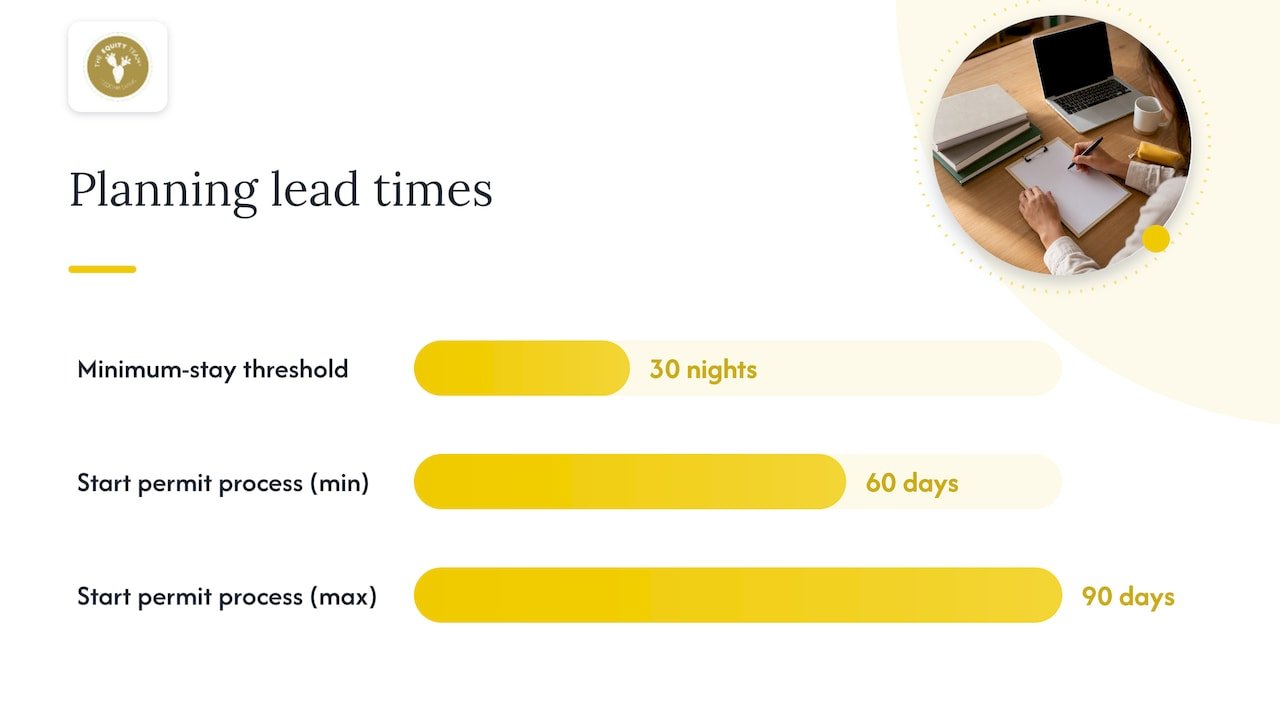
Sedona’s own rules build directly on that framework. According to a regulation summary from STRProfitMap, short-term rentals in Sedona are defined, by statute, as stays under 30 days. That 30-day line matters more than almost any other number in this article, because it determines which set of rules applies to your listing.
A property rented for 30 nights or more typically falls outside the short-term rental permitting requirements that apply to shorter stays. The same STRProfitMap summary notes there is currently no city-imposed cap on the number of STR permits issued in Sedona, though permit and disclosure obligations still apply to anyone renting under that 30-day threshold.
For listings under 30 nights, Sedona generally expects:
- A valid short-term rental permit on file before the property is listed or advertised.
- Visible display of required contact information so neighbors or code enforcement can reach a responsible party quickly.
- Compliance with an annual permit fee and renewal schedule, with penalties for lapsed or missing permits.
- A current Arizona Transaction Privilege Tax (TPT) license, since short-term lodging income is taxable in Arizona and booking platforms often require proof of licensing.
- Accurate display of minimum-night requirements on the listing itself, particularly when a property is being marketed as a 30-day-plus monthly rental rather than a short stay.
That last point trips up more hosts than you’d expect. A property advertised with a 30-night minimum needs to actually function as a monthly rental, both in the booking calendar and in how the listing is tagged on platforms like Airbnb. Blur that line, and you risk the platform or the city treating the listing as an unpermitted short-term rental.
For a deeper look at how Sedona’s zoning layers interact with these permit rules, our guide on Sedona vacation rental zones walks through which parts of town allow which rental types. And because Sedona has adjusted its STR rules more than once in recent years, it’s worth reviewing our summary of recent restriction changes before assuming last year’s rules still apply today.
2. What the market data says about minimum-stay settings in Sedona
It’s close to the dominant one.
44.4% of Sedona Airbnb listings currently set a minimum stay of 30 nights or longer, according to AirROI’s Sedona market data. That makes 30-plus-night minimums the single largest minimum-stay category in the entire local market, ahead of any individual short-stay option.
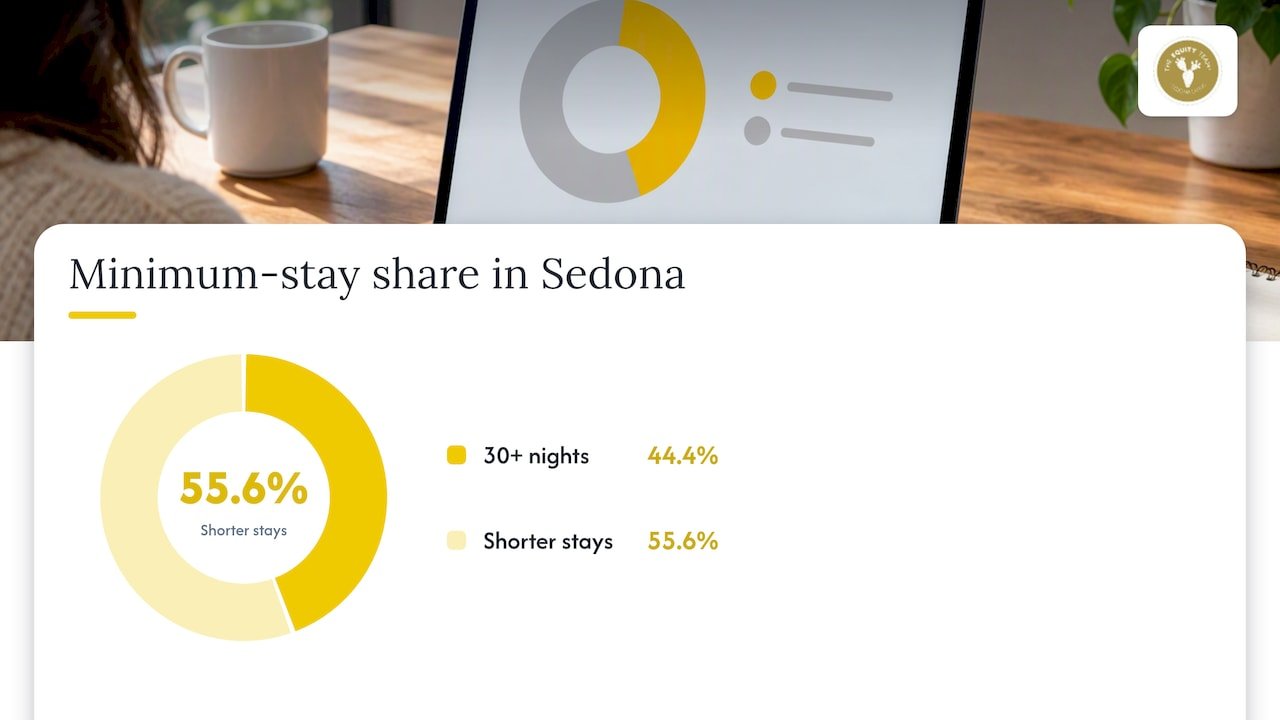
The remaining inventory splits across much shorter windows. A meaningful share of listings run 1-night and 2-night minimums, aimed squarely at weekend hikers, red rock sightseers, and anyone treating Sedona as a quick getaway rather than a home base. That bifurcation, long-stay on one end and ultra-short on the other, leaves comparatively less middle ground around 3 to 14-night minimums.
A few things follow from that pattern:
- A near plurality of hosts are either prioritizing lower turnover costs or targeting remote workers and seasonal residents rather than tourists.
- Competing in the 1 or 2-night segment means going up against a different kind of host: one optimizing for weekend tourist volume, dynamic pricing, and fast cleaning turnarounds.
- The thinner middle segment, roughly 3 to 14 nights, may represent an underserved window for travelers who want more than a weekend but aren’t ready to commit to a month.
AirDNA’s Sedona market report adds useful texture here. Its analysis shows that many successful Sedona operators don’t pick one minimum-stay number and stick with it year-round. Instead, they shift the minimum seasonally, tightening it during slow months to lock in longer, more predictable bookings and loosening it during peak hiking and sightseeing season to capture higher nightly rates from shorter stays.
It confirms that long-stay demand is real and well-established in Sedona, which supports a monthly-rental strategy for properties that fit that profile. It also means that a short-stay property entering the market has less head-to-head competition in the 30-plus-night category and might find more opportunity by staying in the shorter-stay lane and competing on experience and pricing instead.
3. How hosts should choose minimum nights for each property
Picking a minimum-stay number isn’t really one decision. It’s closer to three or four smaller ones stacked together: what season it is, what kind of property you’re renting, what your operating costs look like, and how much pricing flexibility you want to build in.
- Match the minimum to the season. During Sedona’s peak visitor windows, typically spring and fall, shorter minimums capture more individual bookings and let you charge premium nightly rates. During summer heat or winter’s quieter stretch, a longer minimum smooths out vacancy risk and reduces how often you’re scrambling to fill gaps.
- Match the minimum to the property itself. A centrally located one or two-bedroom condo near uptown Sedona tends to perform better with shorter minimums, since it appeals to the tourist crowd who wants walkable access to trails and restaurants. A larger cabin, guesthouse, or detached ADU further from the core often does better with a 30-plus-night minimum, appealing to remote workers, snowbirds, or relocating families who want space and don’t need walkability.
- Factor in real operating costs before shortening your minimum. Every turnover means a cleaning fee, linens, restocking, and wear on floors, furniture, and appliances. A cleaning turnover checklist is a useful reference point for estimating what each changeover actually costs, and that number should inform whether a 1-night minimum is actually profitable or just busy.
- Use revenue tactics instead of a single fixed number. Many Sedona hosts apply different minimums to different stretches of the calendar: a 2-night minimum on weekends when demand is highest, a 3 or 4-night minimum midweek to discourage low-margin single-night bookings, and a discounted weekly or monthly rate available on request for guests who ask about longer stays.
Pro Tip: *Run the math on your cleaning and turnover cost per stay, then divide it by your average nightly rate.
Our guide on Sedona STR pricing during active bookings goes further into adjusting these numbers in real time as your calendar fills in, which matters more in a market where the 30-plus-night segment already commands a sizable share of demand.
4. HOAs, deed restrictions, and private limits that permits don’t cover
Here’s where a lot of otherwise well-researched hosts get caught off guard: getting a city permit does not mean your property is actually clear to rent short-term. The City of Sedona enforces its own ordinances, but it has no authority over, and no interest in enforcing, private HOA rules or deed restrictions. Those are separate contracts between you and your homeowners’ association, and plenty of Sedona-area HOAs are stricter than the city itself.
STRProfitMap’s regulation summary flags this directly: HOA and deed restrictions are one of the most common private constraints hosts run into in Sedona, and they can override whatever flexibility the city permit process allows. A property might be perfectly permittable at the municipal level and still be completely off-limits for short-term rental under its HOA’s covenants.
Before closing on a property you plan to rent short-term, or before listing one you already own, it pays to dig into:
- The full CC&Rs (covenants, conditions, and restrictions), not just a summary, since rental restrictions are often buried in dense language.
- Recent HOA board meeting minutes, which can reveal whether the association has discussed, voted on, or already enforced rental restrictions.
- Resale certificates, which sometimes disclose pending rule changes or active violations tied to the property.
- A direct written confirmation from the HOA management company stating whether short-term rentals are currently allowed and under what conditions.
The common pitfall is assuming a permit equals a green light and skipping the HOA step entirely. That gap has cost investors real money, in the form of fines, forced listing takedowns, or properties purchased specifically for STR income that turn out to be unusable for that purpose. Our breakdown on running an Airbnb in a Sedona HOA covers how to request and interpret these documents before you’re locked into a purchase contract.
5. Action checklist for a compliant minimum-stay policy
Once you understand the legal layers, actually executing a compliant setup is mostly a matter of sequencing. Skipping a step or doing them out of order is usually what causes delays.
- Confirm how the property is classified. Decide early whether you’re pursuing a sub-30-day short-term rental or a 30-plus-night monthly setup, since the paperwork, permit requirements, and tax treatment differ for each.
- Apply for the City of Sedona STR permit if your minimum stay is under 30 nights. Factor in the annual fee and build in lead time, since permit processing is not always instant.
- Get your Arizona TPT license in order before your listing goes live. Booking platforms increasingly expect this documentation, and operating without one creates tax exposure.
- Pull the HOA’s CC&Rs and get written confirmation of rental rights, ideally before closing on the property rather than after.
- Adjust your insurance coverage to match your actual turnover frequency and guest profile. A policy built for a long-term tenant does not cover the liability exposure of weekly guest turnover. Short-term rental insurance guidance is a useful starting point for understanding what standard homeowner policies typically exclude.
- Set your minimum-night rules by date range and put them in writing in your listing’s house rules and cancellation policy, so there’s no ambiguity when a guest tries to book a single night during a period you’ve designated for 30-plus stays.
Pro Tip: Start the permit and TPT license process at least 60 to 90 days before your intended listing date. Municipal processing and license approval rarely move as fast as a closing date.
Investors juggling the tax side of this decision may also want to look at how QBI safe harbor rules apply to rental activity, since the number of hours and the nature of your involvement can affect how your Sedona rental income gets classified.
6. Evidence from The Equity Team: local patterns and recent market change
Working exclusively with Sedona short-term rental buyers and sellers gives us a close-up view of how regulation and market shifts actually play out on individual properties, not just in aggregate statistics.
One pattern we’ve watched closely: Sedona’s short-term rental inventory has reportedly contracted in recent years, a shift that tightens competition for hosts who remain compliant and well-positioned. When supply contracts, properties with a clear, well-documented minimum-stay strategy and clean permit status tend to capture disproportionate demand, since fewer competitors are chasing the same guests.
Supply contraction in a tourist market like Sedona doesn’t just mean less competition. It means the properties left standing need tighter operations, because occupancy that used to come easily now has to be earned through pricing and policy discipline.
That shift changes the calculus for buyers. A property suited to extended stays, think a quiet, larger home outside the tourist core, benefits from locking in 30-plus-night tenants now rather than gambling on short-stay occupancy in a tighter market. A centrally located property built for weekend tourists may need sharper pricing and a flexible minimum-stay calendar to stay competitive. We’ve walked buyers through both scenarios using video walkthroughs and property-level analyses that show how minimum-stay choices played out in real occupancy numbers.
7. A Sedona STR specialist’s take on minimum-stay strategy
My honest read, after spending years focused exclusively on Sedona’s short-term rental market: most hosts treat the minimum-stay setting as an afterthought when it should be one of the first decisions they make, right alongside pricing.
If you’re buying with STR income in mind, verify the City of Sedona permit status and the HOA’s actual rental rights before you fall in love with a property. Those two checks alone eliminate most of the surprises that derail new investors. Beyond that, lean toward 30-plus-night minimums for larger, less centrally located homes, and keep shorter minimums reserved for properties built around walkability and tourist convenience. Adjust seasonally rather than picking one number and leaving it untouched for years.
If you’re weighing a Sedona purchase or trying to figure out whether your current property’s minimum-stay setup is actually working for you, a Sedona-specific comparative market analysis is worth the conversation before you make any changes.
— Chad
How The Equity Team supports Sedona STR buyers and sellers
Minimum-stay strategy only matters if the property underneath it is positioned correctly, and that’s where we focus. We combine permit and HOA due diligence with real occupancy data so you’re not guessing at a minimum-night policy, you’re building one around numbers that hold up.

For buyers, that means representation focused on properties that actually fit a profitable STR strategy, not just a nice view. For sellers, it means positioning a property’s minimum-stay history and revenue performance in a way that gets top dollar instead of leaving money on the table. Specific ways we help:
- Buyer representation focused on properties suited to top-performing short-term rental strategies.
- A Sedona vacation rental comparative market analysis that shows how a property’s minimum-stay and pricing history compares to similar listings nearby.
- Seller prep consultation to align a property’s rental history and documentation with what serious STR buyers expect to see.
- Guidance on exit strategy and valuation for owners deciding whether to sell, refinance, or restructure an existing rental’s strategy.
If you’re trying to figure out whether your Sedona property, or one you’re considering buying, is set up with the right minimum-stay strategy for its location and size, let’s talk through a Sedona vacation rental CMA and map out what actually makes sense for your numbers.
This article is general information, not a substitute for advice from a qualified lawyer. Consult a qualified legal professional about your own circumstances before acting on anything here.
FAQ
Are short-term rentals allowed in Sedona?
Yes. Arizona’s SB1168 / A.R.S. §9-500.39 prevents Sedona from banning short-term rentals outright, though the city can still regulate them for health, safety, and nuisance reasons. Hosts generally need a city permit, proof of liability insurance, and an Arizona TPT license before listing a stay under 30 nights.
What’s the minimum stay at an Airbnb in Sedona?
Minimum stays vary widely by property and season, but 44.4% of Sedona listings currently set a 30-night-plus minimum, making that the single most common minimum-stay category in the market. The rest of the inventory is split mostly between 1 and 2-night minimums aimed at weekend tourists.
What is the 80/20 rule for Airbnb?
Definitions vary, and there’s no official Airbnb policy by that exact name specific to Sedona. In general industry use, it often refers to the idea that a small share of listings or amenities drive a large share of bookings and revenue, so it’s worth verifying any specific figure against your own property’s booking data rather than assuming a universal split.
What is the 75-55 rule in Airbnb?
This isn’t a standard or documented Airbnb or Sedona municipal policy, and we found no official definition tied to short-term rental regulation in Sedona. If you’ve seen the term elsewhere, treat it as informal shorthand rather than a rule that applies to permitting or minimum-stay requirements here.
Does a Sedona HOA override the city’s short-term rental permit rules?
Yes, in practice. The City of Sedona has no authority to enforce or override private HOA covenants, so even a permitted, fully compliant short-term rental can be restricted or banned under a property’s own HOA rules. Always review the CC&Rs and get written confirmation from the HOA before assuming a permit settles the matter.
Sources
- SB1168S.1 (Arizona legislative text)
- Sedona Arizona Airbnb Data 2026: Occupancy, Revenue & STR Market Report | AirROI
- Sedona, Arizona Airbnb market data 2026 | AirDNA
- Sedona, Arizona Short Term Rental Regulations Guide for Airbnb hosts