

Clarkdale can be a solid Airbnb investment for buyers who underwrite conservative occupancy and lean into the town’s quirky, boutique charm rather than chase big-city numbers. Annual revenue for typical listings runs at a modest level, with occupancy rates that are moderate, according to AirROI’s Clarkdale market data. Every property needs a Town of Clarkdale short-term rental license before it ever takes a booking.
TL;DR:
- Clarkdale’s small market size means a limited supply of listings can lead to high differentiation through unique design or local charm rather than volume.
- Peak demand occurs in spring and fall, with aggressive pricing and minimum-night policies during these periods boosting revenue potential.
- Listings with cozy, character-rich features, outdoor spaces, and local touches tend to outperform those offering a generic experience, especially for small groups and remote workers.
- Securing a short-term rental license from Clarkdale is essential before operating, and permit delays can impact revenue; verify permit status during due diligence.
- Conservative expense assumptions and careful screening, including occupancy and revenue estimates, are key to calculating realistic returns in Clarkdale’s seasonal, small-town market.
Table of Contents
- Clarkdale Airbnb market snapshot: ADR, occupancy, and RevPAR
- Clarkdale’s peak seasons and how to capture them
- What kinds of Clarkdale listings are winning right now
- Town of Clarkdale licensing rules every buyer must check
- Underwriting a Clarkdale Airbnb: expenses, cash flow, and ROI
- Deal filters and red flags when screening a Clarkdale property
- How the Clarkdale Airbnb purchase process typically unfolds
- Financing a Clarkdale short-term rental purchase
- Risks and challenges unique to the Clarkdale market
- Standing out among Clarkdale’s Airbnb hosts
- What The Equity Team sees in Clarkdale and the wider Verde Valley
- How The Equity Team helps Verde Valley STR buyers and sellers
- Where the Clarkdale numbers in this article come from
- Sources
- FAQ
Clarkdale Airbnb market snapshot: ADR, occupancy, and RevPAR
Clarkdale sits in the shadow of Sedona’s red rocks, but the numbers tell a different story than its famous neighbor. This is a small market, a handful of blocks of historic smelter-town charm, and that smallness cuts both ways for an investor sizing up the opportunity.
Average daily rate across the market lands somewhere in the $190 to $200 range, with some reports pushing closer to $249 depending on the snapshot window and property mix. Annual revenue for an average listing lands around $19,000 to $23,000, a range worth treating as a baseline rather than a ceiling.
Here’s what that snapshot means for someone weighing a purchase:
- Clarkdale’s active listing count is small, likely in the dozens rather than the hundreds, which limits direct competition for a well-run property.
- ADR sits meaningfully above many national small-town averages, suggesting guests will pay for the right experience even without beachfront or ski-slope positioning.
- Occupancy in the mid-30% range signals a seasonal, niche-driven market rather than a year-round workhorse.
- A Rabbu market snapshot pegs Clarkdale’s ROI score near the middle of the pack, a mid-range opportunity rather than a slam dunk.
What all this adds up to is a market where quantity doesn’t win. A tiny supply pool means a genuinely differentiated listing, think thoughtful design, a killer porch view, or a clever amenity package, can grab a disproportionate share of bookings. Investors who treat Clarkdale like a scaled-down Sedona and copy that playbook tend to do better than those who chase volume. The flip side is real too: thin occupancy numbers leave little room for a sloppy listing or a slow month to go unnoticed on the bottom line.
Clarkdale’s peak seasons and how to capture them
Clarkdale’s calendar swings hard between busy and quiet, and the swings follow a pattern familiar to anyone who has watched Sedona’s crowds ebb and flow. Spring and fall carry the heaviest demand, driven by the same mild temperatures and clear skies that pull hikers and road-trippers through the whole Verde Valley. Summer heat and winter chill both soften bookings, though neither kills them outright thanks to the town’s year-round tourist draws.
Smart hosts treat the calendar as a pricing instrument, not a fixed backdrop. A few moves tend to pay off:
- Push rates up aggressively during the spring and fall peaks, when demand already supports it, rather than leaving money on the table with flat pricing.
- Build in minimum-night requirements during peak weekends to avoid single-night turnovers that eat into cleaning margins.
- Target midweek stays with modest discounts aimed at remote workers who can book a quiet Tuesday-to-Thursday stretch away from a home office.
- Time price bumps around known draws like the Verde Canyon Railroad and nearby Tuzigoot, since those attractions pull a steady stream of day-trippers and overnighters alike.
- Market directly to niche travelers, birders chasing the Verde River corridor, rail enthusiasts, and small-group getaways looking for something quieter than Sedona’s main strip.
Pro Tip: Set your calendar’s minimum-night rule higher on weekends during peak months, then drop it to one night midweek to fill the gaps a strict rule would otherwise leave empty.
The interaction between ADR and occupancy is where the real revenue story gets written. A property that holds a high rate during the shoulder seasons while still filling midweek dates during the slow months will consistently outperform one that discounts across the board just to keep occupancy numbers looking busy.
What kinds of Clarkdale listings are winning right now
The properties doing well in Clarkdale aren’t uniform, but a pattern shows up across the top performers. Studios and small one- or two-bedroom cottages tend to lean into a cozy, historic character, think original brick, mining-town trim work, and a front porch built for watching the sunset. Larger three bedroom homes pull a different crowd: small groups or families using Clarkdale as a quieter base camp for exploring Sedona, Jerome, and the Verde Valley without paying Sedona’s premium.
Amenities that separate the top listings from the pack tend to be simple but deliberate:
-
Outdoor seating or a porch, since Clarkdale’s mild shoulder seasons practically demand it.
-
Fast, reliable Wi-Fi, a small detail that matters enormously to the remote-worker segment chasing quiet midweek stays.
-
Local touches, guidebooks, train schedules, or trail maps, that signal a host who actually knows the area.
-
Pet-friendly setups, which widen the guest pool in a market too small to afford narrow targeting.
Because the active listing count is so limited, a new property with the right amenity mix doesn’t need to out-market dozens of competitors, it needs to out-charm a handful. Given the guest profile skewing toward couples, remote workers, and small groups, a one or two bedroom cottage with character tends to be the safer bet for a first Clarkdale purchase, with larger homes generally appealing to buyers familiar with the group-travel niche.
Town of Clarkdale licensing rules every buyer must check
No Clarkdale Airbnb conversation gets far without the town’s permit process, and skipping this step is the single most common way investors blow their own underwriting. The Town of Clarkdale requires a short-term rental license before any property can legally operate as a vacation rental, with the application and the relevant sections of town code laid out on the municipal site.
Before writing an offer, confirm these items directly with the town:
- Whether the specific parcel is eligible for a short-term rental license or falls under a restriction.
- What safety requirements apply, smoke and carbon monoxide detectors, posted emergency information, and similar items are common across Arizona municipalities.
- Whether neighborhood notification is required as part of the permit process.
- Any additional Yavapai County or Arizona state requirements layered on top of the town’s own code.
Permit timing matters as much as permit cost. A license that takes weeks to process can push back a planned launch date, and that delay is real lost revenue during a peak season window. Bake both the permit fee and a reasonable processing buffer into your acquisition timeline rather than assuming a fast turnaround, and treat the town code reference as required reading before closing, not an afterthought for after the keys change hands.
Underwriting a Clarkdale Airbnb: expenses, cash flow, and ROI
Turning Clarkdale’s market numbers into a real investment decision means building a proper expense line, not just eyeballing the revenue figure. A realistic Clarkdale pro forma should account for:
- Property management, typically a percentage of gross booking revenue if you’re not self-managing.
- Cleaning and turnover costs, which scale with occupancy and guest count.
- Utilities, including higher summer cooling costs given the Verde Valley heat.
- Insurance, specifically a short-term rental policy rather than a standard homeowner policy.
- Property tax, assessed at the local rate for the parcel.
- A maintenance and vacancy reserve, especially important in a market with mid-30% occupancy and real seasonal swings.
Here’s a simplified illustrative example, using round numbers for clarity rather than a specific listing. Say a Clarkdale cottage generates a moderate amount of gross annual revenue typical for the market. Subtract a conservative percentage for combined management, cleaning, utilities, insurance, and property tax, leaving a net operating income before financing costs. Add a vacancy and maintenance reserve proportional to gross revenue, and you arrive at annual net cash flow before debt service. On a cash purchase price including closing costs, this works out to a conservative net yield assuming no rate growth and flat occupancy.
Rabbu’s market data for Clarkdale places the town’s ROI score in a mid-range band rather than at the top of Arizona’s short-term rental markets, which lines up with the conservative yield math above: Clarkdale rewards patient, well-run operations more than it rewards speculative upside.
The sensitivity here is worth sitting with. The same logic cuts the other way during a slow season, which is exactly why conservative occupancy assumptions and a real maintenance reserve matter more in a market this size than they would in a market with deeper, more consistent demand.
Deal filters and red flags when screening a Clarkdale property
Screening a Clarkdale property fast means knowing which numbers to check first and which questions tend to expose trouble before it becomes your trouble. A few heuristics keep the process honest.
- Target a gross revenue multiplier where the purchase price doesn’t exceed roughly 13 to 15 times projected annual gross revenue, keeping payback realistic in a mid-30% occupancy market.
- Set a minimum occupancy floor in your own model, don’t let a seller’s optimistic projection replace your own conservative estimate.
- Ask directly for twelve months of rental history and permit status, not a verbal assurance that “it’s been running fine.”
- Ask whether any neighbors have filed noise or parking complaints, since a single pattern of complaints can threaten a permit renewal.
- Ask about actual utility costs for a full year, especially summer cooling bills, which sellers sometimes understate.
Verify rather than trust. Unpermitted additions or garage conversions are common in older Clarkdale homes given the town’s mining-era housing stock, and an HOA or deed restriction can quietly block short-term rental use even where the town itself allows it. Confirm insurance coverage explicitly covers short-term rental use, since a standard homeowner policy typically does not.
Pro Tip: Ask the seller’s agent for the property’s actual permit number and call the town directly to confirm it’s active, rather than taking a listing description at its word.
How the Clarkdale Airbnb purchase process typically unfolds
Buying a short-term rental in Clarkdale follows the same broad real estate timeline as anywhere in Arizona, with a few extra checkpoints layered in for STR-specific due diligence. Expect roughly 30 to 45 days from accepted offer to closing, assuming conventional or cash financing and no major inspection surprises.
The sequence usually looks like this: initial search and pre-approval, an accepted offer with inspection and appraisal contingencies, a focused due diligence window where you confirm the parcel’s short-term rental eligibility and permit history with the town, then closing. Smart buyers start the town’s permit inquiry during the due diligence window rather than waiting until after closing, since a parcel-level restriction discovered after you own the property is a far more expensive problem to solve.
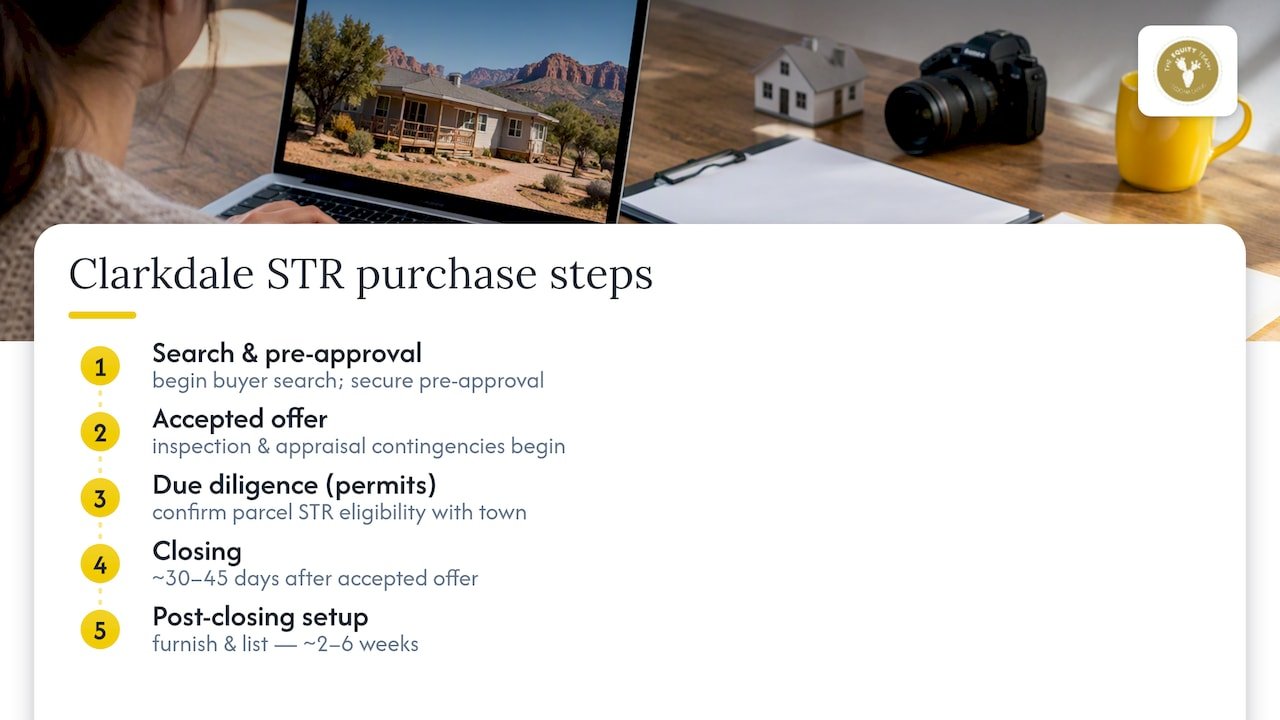
Furnishing and listing setup typically happens in the two to six weeks after closing, depending on whether you’re buying furnished or starting from scratch. Factor that gap into your first-year revenue projection: a property that closes in March but doesn’t list until late April misses part of the spring peak, which matters in a market where seasonality drives so much of the annual number.
Financing a Clarkdale short-term rental purchase
Financing a Clarkdale Airbnb generally follows standard investment property lending in Arizona, with a few wrinkles tied to the property’s short-term rental use. Conventional investment property loans typically require 20 to 25% down, and some lenders will weigh projected short-term rental income differently than standard long-term lease income when qualifying a buyer.
DSCR loans, which qualify based on the property’s rental income rather than the buyer’s personal income, have become a common path for investors scaling up a short-term rental portfolio, since they skip the traditional debt-to-income hurdle. Cash purchases remain common in a market this size, since a lower price point makes an all-cash close more achievable for investors who want to skip financing contingencies entirely and move faster on a limited supply of listings.
Whichever route you choose, confirm with your lender early whether they’ll finance a property that doesn’t yet hold a short-term rental permit, since some lenders want proof of permit eligibility before closing on an STR-intended purchase.
Risks and challenges unique to the Clarkdale market
Clarkdale’s biggest risk is also its biggest draw: it’s small. A market this size can’t absorb a wave of new competing listings without occupancy and ADR both feeling the pinch, and a shift in county or town policy toward short-term rentals could tighten permit availability with little warning.
Seasonal concentration is the other real risk. With spring and fall carrying the bulk of demand, a soft shoulder season or an unusually hot, slow summer can meaningfully dent annual revenue for an investor who underwrote too aggressively. Utility costs during peak summer heat add another variable that’s easy to underestimate when building a first-year budget.
Finally, Clarkdale’s proximity to Sedona cuts both ways. It pulls overflow demand from travelers priced out of Sedona’s higher rates, which helps occupancy, but it also means Clarkdale will likely never command Sedona-level ADR, capping the upside for investors expecting resort-town numbers from a small historic town.
Standing out among Clarkdale’s Airbnb hosts
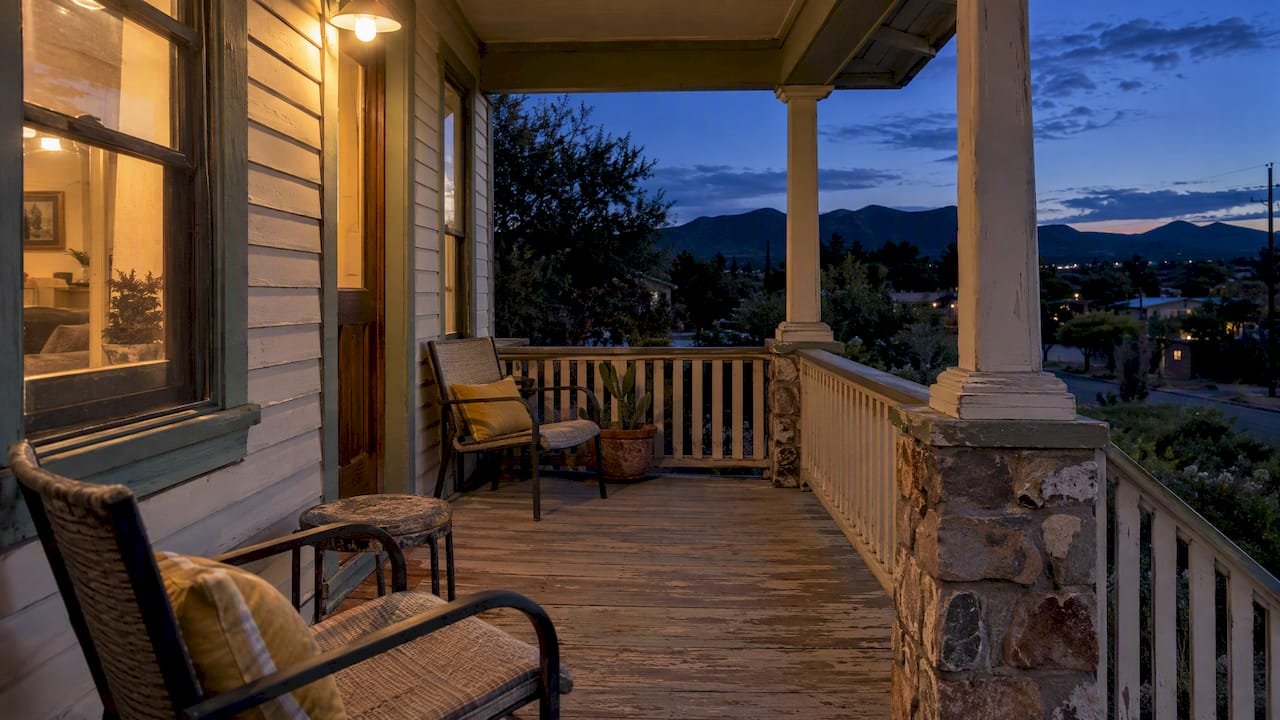
With a small pool of active listings, differentiation in Clarkdale isn’t about outspending the competition, it’s about outcharming it. The hosts pulling ahead tend to lean into local character rather than generic vacation-rental polish: historic details left intact, a porch set up for evening stargazing, and small local touches like a printed guide to the Verde Canyon Railroad or nearby Tuzigoot.
Curated guest experiences tend to beat price-only competition in a market this size. A listing paired with a relationship to a local outfitter, a birding guide, or a small recommended-restaurants list gives guests a reason to book beyond rate comparison, and it builds the kind of reviews that keep a listing near the top of search results in a market with few alternatives to displace it.
What The Equity Team sees in Clarkdale and the wider Verde Valley
Clarkdale buyers tend to fall into two camps: investors priced out of Sedona looking for a scaled-down version of the same lifestyle market, and locals who already know the town’s charm and want a modest income property. Both camps do better underwriting conservative numbers than chasing headlines.
For context, our own data across Sedona shows average Airbnb revenue near $47,600, while nearby Oak Creek runs a median closer to $12,700, a reminder that even neighboring Verde Valley markets can swing wildly. Clarkdale sits between those extremes, and the top-performing listings we see tend to win on curated guest experience, not just rate.
— Chad
How The Equity Team helps Verde Valley STR buyers and sellers
We’ve spent years inside Sedona and Verde Valley short-term rental deals, and that same lens applies when a buyer asks us about Clarkdale, Cottonwood, or anywhere else in the region. 
If you’re weighing a Clarkdale purchase, we can walk through buyer representation, pull comparable revenue data for a specific parcel, or talk through an exit strategy if you already own a Verde Valley rental and want to know its current value. A first conversation usually starts with a quick look at your target property or portfolio, followed by honest numbers rather than a sales pitch dressed up as market research.
Ready to talk through a Clarkdale or broader Verde Valley purchase? Reach out to The Equity Team to start the conversation, or request a Sedona vacation rental CMA if you’re weighing a sale instead of a purchase.
Where the Clarkdale numbers in this article come from
- Town of Clarkdale’s vacation rental page covers permit requirements and town code.
- Market figures referenced come from AirROI, Rabbu, and AirDNA Clarkdale datasets alongside internal OwnInAZ Sedona and Oak Creek data.
FAQ
Where are the most profitable Airbnb locations in the US?
Profitability varies widely by market and depends on purchase price relative to revenue, not just headline rates. Small, high-demand destination towns with limited supply, similar in structure to Clarkdale’s own dynamic, often outperform larger markets with heavy competition, though specific national rankings shift from year to year.
What is the 75-55 rule for Airbnb?
Definitions of this rule vary across the short-term rental industry, and there isn’t a single agreed-upon standard that applies universally. Investors are better served building their own occupancy and revenue thresholds based on actual local market data, like the figures outlined above for Clarkdale, rather than relying on a borrowed rule of thumb.
What states do not allow Airbnb?
No entire US state bans short-term rentals outright, but cities and counties within many states restrict or heavily regulate them at the local level. Arizona generally permits short-term rentals statewide, though towns like Clarkdale still require a local license before a property can legally operate.
Are Airbnbs still profitable in 2026?
Short-term rentals can still produce solid returns in 2026 for investors who underwrite conservatively and choose markets with real demand drivers, but blanket profitability claims don’t hold up market to market. In a boutique market like Clarkdale, profitability depends heavily on occupancy assumptions, permit compliance, and keeping expenses realistic rather than optimistic.
Do I need a license to run an Airbnb in Clarkdale?
Yes, the Town of Clarkdale requires a short-term rental license before any property can legally operate as a vacation rental. The application process covers safety requirements and neighborhood notification, so it’s worth starting during due diligence rather than after closing.