

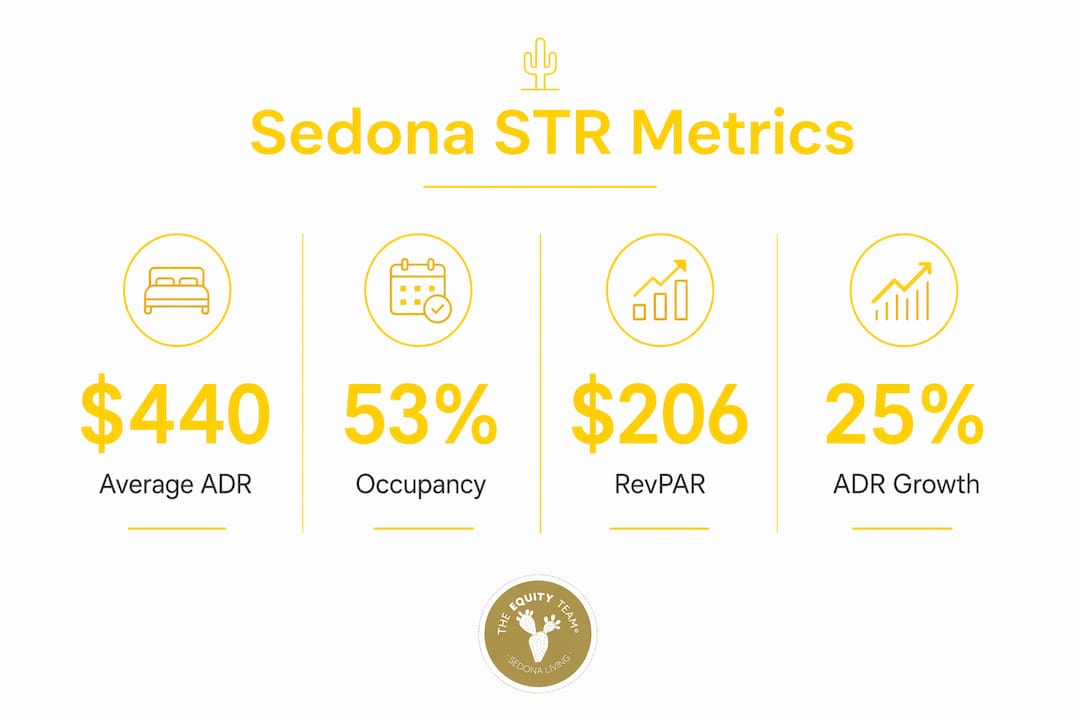
Sedona STR pricing during active bookings is defined by a market where the average daily rate sits around $440 and occupancy hovers near 53%. That combination produces a RevPAR of roughly $206, which sounds tidy until you realize top-quartile operators are clearing $546+ ADR at 72% occupancy or better. The gap between median and top performance is not luck. It is the direct result of how operators manage pricing while bookings are actively flowing in. Sedona’s red rock backdrop may be serene, but the pricing game here is anything but sleepy.
What are current Sedona STR pricing trends during active bookings?
Sedona’s rental market has gone through a fascinating transformation since 2021. ADR has grown 25% from 2021 to 2026, climbing to roughly $440. That growth is impressive on paper, but occupancy dropped from 68% in 2021 to about 53% in 2025, which means operators are earning more per night but filling fewer of them.
The revenue picture is nuanced. Median annual STR revenue in Sedona sits around $75,000, with operators at that level running about 68% occupancy. The spread between median and top performers is wide, and it traces directly back to pricing discipline and property positioning.

Booking lead times add another layer of complexity. Sedona guests book about 55 days in advance on average. That window gives operators a meaningful runway to adjust rates before a booking lands, but only if their pricing tools are already calibrated and running.
Here is a snapshot of the key market benchmarks operators should track:
| Metric | Current Value |
|---|---|
| Average daily rate (ADR) | ~$440 |
| Occupancy rate (2025) | ~53% |
| RevPAR | ~$206 |
| Median annual revenue | ~$75,000 |
| Average booking lead time | ~55 days |
| Top-quartile ADR target | $546+ |
Seasonal cycles are sharp and predictable. March sits at the top of the demand calendar, while august represents the clearest low point. Operators who treat every month identically are essentially leaving money on the table during peak windows and overpricing during slow ones.
- March and april are the strongest months for both occupancy and rate.
- October delivers a second peak, driven by fall foliage and cooler temperatures.
- August is the softest month, with demand dropping noticeably.
- December through february shows moderate demand, with holiday spikes around Christmas and New Year’s.
How do seasonal demand and local events influence pricing in Sedona?
Sedona runs on a dual-peak calendar, and operators who understand that rhythm price with real confidence. Spring (march through april) and fall (october) are the two power windows. Summer softens, and winter is moderate with holiday bursts. That pattern is not random. It follows Sedona’s weather, which swings from perfect hiking conditions in spring and fall to genuinely hot summers that send some visitors elsewhere.
Peak seasonal months allow hosts to charge 20–50% above their base rates. That is not a small adjustment. On a $400 base rate, a 40% premium pushes the nightly rate to $560, which changes the math on monthly revenue significantly.
Local events amplify those seasonal peaks further. The Sedona International Film Festival, the Sedona Arts Festival, and peak Red Rock Scenic Byway traffic each create their own pricing windows. The Film Festival alone generates roughly a 35% pricing premium, the Arts Festival around 30%, and Red Rock Byway peak traffic around 25%. These are not soft suggestions. They are documented demand spikes that reward operators who plan ahead.
Timing matters as much as the rate itself. Operators who set event premiums at least 21 days before the event window capture early-booking guests who plan further out. Waiting until the week before means competing for last-minute travelers who are often more price-sensitive.
- Sedona International Film Festival: ~35% premium above base rate
- Sedona Arts Festival: ~30% premium above base rate
- Red Rock Scenic Byway peak season: ~25% premium above base rate
- Spring peak (march–april): 20–50% above base rate
- Fall peak (october): 20–40% above base rate
Pro Tip: Set event-specific rates on your calendar at least three weeks before the event opens. Guests booking 55 days out will see your premium pricing and book anyway, because demand at that point is driven by the event, not the price.
What dynamic pricing strategies maximize revenue during active bookings?
Dynamic pricing in Sedona is not about chasing every competitor move. It is about building a rate structure that holds firm when demand is high and adjusts thoughtfully when it softens. The foundation is a stable base rate that reflects your property’s value, layered with premiums for weekends, events, and peak months.
The most effective approach follows three layers.
- Set a defensible base rate. Your base rate should reflect your property’s amenities, location, and guest experience. It should not be the lowest rate you are willing to accept. It should be the rate that positions your property correctly in Sedona’s luxury-leaning market.
- Layer weekend premiums automatically. Weekend demand in Sedona is inelastic, driven by weddings, events, and short-trip travelers. Weekend demand often stays inelastic even when weekday vacancies exist. That means you should not cut weekend rates just because Monday and Tuesday are open.
- Sync your calendar 365 days forward. Automating dynamic pricing with 365-day calendar syncing captures high-spending guests who book 55 days out. Manual updates simply cannot keep pace with how quickly demand signals shift.
Here is how the three main pricing approaches compare in practice:
| Approach | How it works | Best for |
|---|---|---|
| Static pricing | Fixed nightly rate year-round | Operators who rarely monitor the market |
| Dynamic pricing | Rates adjust daily based on demand signals | Active operators in competitive markets |
| Hybrid pricing | Stable base with automated event and weekend premiums | Most Sedona operators at scale |
The hybrid approach wins for most Sedona operators. It preserves brand value by avoiding the race-to-the-bottom that pure reactive pricing creates, while still capturing demand spikes automatically.
Pro Tip: Use your 55-day booking window as a pricing trigger. If a date is still open 30 days out and it is not a peak period, a modest rate adjustment makes sense. If it is a weekend or event date, hold the rate. Scarcity on those nights is your friend.
What common mistakes do Sedona STR operators make in pricing?
Pricing errors in Sedona tend to cluster around the same few habits. The good news is that each one is fixable once you see it clearly.
- Underpricing weekends and events. This is the most expensive mistake. Operators who set flat weekly rates miss the premium that Friday and Saturday nights reliably command. A property that earns $400 on a Tuesday should be earning $550 or more on a Saturday.
- Relying on manual calendar updates. Manual pricing is almost always too slow. By the time an operator notices a competitor dropped their rate or a local event sold out nearby hotels, the booking window has already shifted. Automated pricing tools with daily syncing solve this problem directly.
- Reactive discounting based on competitor vacancies. Seeing a nearby property drop its rate and immediately matching that cut is a trap. Avoid reactive discounting based on competitor vacancies. Your property’s value does not change because a neighbor panicked.
- Ignoring booking lead time data. The 55-day average lead time is a pricing signal, not just a curiosity. Operators who ignore it miss the window to set premiums before high-demand dates fill up.
- Rigid minimum stay policies in shoulder seasons. A strict three-night minimum in august turns away two-night bookings that would otherwise fill gaps. Flexible minimum stay rules during slower months keep occupancy from collapsing.
Pro Tip: Review your minimum stay settings at the start of each month. Tighten them during peak windows to push average booking value up. Loosen them in shoulder months to protect occupancy.
How to integrate Sedona’s STR market data into your pricing decisions
Market data is only useful if it connects directly to pricing decisions. The three metrics that matter most are ADR, occupancy, and RevPAR, and each one tells a different part of the story.
ADR tells you where your rate sits relative to the market. Sedona’s current average of $440 is your baseline reference. If your property consistently earns below that, the gap usually points to either underpricing or a property presentation problem. If you are above it, you are either genuinely outperforming or pricing yourself out of bookings.
Occupancy tells you whether your rate is landing with guests. The market average of 53% is not a target. It is a floor. Top-quartile performance requires 72%+ occupancy at $546+ ADR. That combination is also what most DSCR lenders want to see before approving investment financing, which makes it a practical threshold, not just an aspirational one. Equity Team works with investors who are specifically targeting that top-quartile range, and the Sedona STR investment landscape rewards operators who understand these thresholds before they buy.
RevPAR ties it together. At roughly $206, Sedona’s current RevPAR reflects the tension between rising ADR and falling occupancy. Operators who push ADR without protecting occupancy will see RevPAR stall. The goal is to grow both, which is exactly what yield-based pricing is designed to do.
| Metric | Market average | Top-quartile target |
|---|---|---|
| ADR | ~$440 | $546+ |
| Occupancy | ~53% | 72%+ |
| RevPAR | ~$206 | $393+ |
Rising supply in Sedona is intensifying competition, which makes algorithmic pricing adjustments well ahead of peak periods more important than ever. Operators who wait for demand to arrive before adjusting rates are already behind. For investors exploring STR financing options, understanding these benchmarks upfront shapes smarter acquisition decisions.
Key Takeaways
Sedona STR pricing during active bookings rewards operators who set yield-based rates, automate calendar syncing, and apply event premiums at least 21 days in advance rather than reacting to competitor moves.
| Point | Details |
|---|---|
| ADR and occupancy benchmarks | Market ADR averages $440; top performers target $546+ at 72%+ occupancy. |
| Dual-peak seasonality | March, april, and october allow 20–50% premiums above base rates. |
| Event-driven premiums | Film Festival adds ~35%; Arts Festival ~30%; plan rates 21+ days ahead. |
| Avoid reactive discounting | Weekend demand is inelastic; hold rates even when weekday nights sit open. |
| Automate with 365-day sync | Automated pricing captures guests booking 55 days out before manual updates can react. |
Chad’s take on pricing Sedona STRs during active bookings
The conventional wisdom in STR pricing says “fill the calendar first, then worry about rate.” Sedona breaks that rule completely. I have watched operators chase occupancy by dropping rates, only to hit 70% occupancy at $320 a night and wonder why their numbers look worse than a property running 55% at $480.
Sedona is a yield market. The guests who come here are not bargain hunters. They are booking a specific experience, and they are willing to pay for it. When you discount aggressively, you do not attract more of those guests. You attract a different kind of guest entirely, and that shift shows up in reviews, wear on the property, and long-term brand positioning.
The operators I see consistently outperforming are the ones who set their base rate with conviction, automate their weekend and event premiums, and then mostly leave the calendar alone. They are not refreshing their pricing dashboard every morning. They built a system that works while they focus on the guest experience. That is the real edge in this market. The right STR investment property combined with disciplined pricing is what separates a good year from a great one.
— Chad
Equity Team can help you price and position your Sedona STR
Sedona’s STR market rewards operators who know their numbers and move before the market does. Equity Team is the first STR-specialized real estate team in Northern Arizona, and the clients we represent consistently operate in the top 10% of the Sedona rental market.

Whether you are buying your first Sedona investment property or repositioning an existing one, Equity Team brings the local market data, pricing insight, and investment expertise to help you hit top-quartile performance. Explore current Sedona STR opportunities and see how the right property, priced correctly from day one, changes the entire revenue picture.
FAQ
What is the average nightly rate for Sedona STRs in 2026?
Sedona’s average daily rate sits around $440 in 2026, representing 25% growth since 2021. Top-quartile operators achieve $546 or more per night.
When is the best time to raise Sedona STR rates?
March, april, and october are Sedona’s peak pricing months, allowing operators to charge 20–50% above base rates. Event windows like the Sedona International Film Festival support an additional 35% premium.
How far in advance do Sedona guests typically book?
Sedona guests book approximately 55 days in advance on average. Operators should have dynamic pricing and event premiums set well before that window opens.
Should Sedona STR operators discount rates to fill vacancies?
Weekend vacancies in Sedona do not warrant rate cuts because weekend demand is inelastic, driven by events and weddings. Reactive discounting on weekdays can also damage long-term brand value in a luxury-leaning market.
What occupancy rate do Sedona STRs need for top performance?
Top-quartile Sedona STR performance requires occupancy above 72% combined with an ADR of $546 or more. That threshold also aligns with what most DSCR lenders require for investment loan qualification.