

Most investors walk into Sedona assuming newer automatically means better. It’s an understandable instinct. Shiny finishes, fresh appliances, no deferred maintenance lurking in the walls. But the role of property age in Sedona STR performance is far more nuanced than that tidy assumption suggests. A 1985 adobe with a jaw-dropping red rock view and a smart renovation can absolutely outperform a 2019 build with generic interiors and zero personality. This guide breaks down exactly how property age shapes guest demand, financing, maintenance costs, and investment returns in Sedona’s vibrant 2026 short-term rental market.
Table of Contents
- Key takeaways
- The role of property age in Sedona’s STR market
- How property age shapes STR performance
- Financing and insurance for older Sedona properties
- Strategic renovation planning for older Sedona STRs
- Evaluating investment potential in older Sedona properties
- My honest take on property age and Sedona STRs
- How Equity Team can help you find the right property
- FAQ
Key takeaways
| Point | Details |
|---|---|
| Effective age beats chronological age | A well-renovated older home competes directly with new builds when amenities and finishes are updated. |
| Financing hurdles are real | Older roofs, wiring, and plumbing can delay or derail loan approvals, so early due diligence is non-negotiable. |
| Renovation priorities drive returns | Energy efficiency, modern layouts, and premium amenities are the upgrades that move the needle on ADR. |
| Older properties offer acquisition upside | Deferred maintenance creates price discounts, giving investors with renovation capital a genuine edge. |
| Local regulations apply regardless of age | Sedona STR permits are required annually for all properties, old or new, with no exceptions. |
The role of property age in Sedona’s STR market
Sedona’s short-term rental scene is not for the faint of heart. The market currently holds 1,116 registered STR units, representing 16.39% of the city’s total housing inventory. Top performers in that pool are clearing 72% or better occupancy rates and pulling average daily rates above $546. That is a genuinely competitive playing field, and property age is one of the quieter variables shaping who wins and who sits empty on a Saturday night.
The distribution of older versus newer properties across Sedona’s STR inventory tells an interesting story. A meaningful share of active rentals are homes built before 2000, many of them in the most desirable neighborhoods closest to the trails and canyon views that guests actually pay for. Location still rules in this market. But age creates a fork in the road. A property that has been thoughtfully updated reads as modern and inviting to guests. One that has been left to age without investment reads as tired, regardless of its coordinates.
Property age interacts with performance metrics in ways that go beyond the obvious. It shapes guest expectations set by listing photos, it influences the maintenance budget an owner needs to hold in reserve, and it affects how lenders and insurers view the asset. Amenities and management quality can compensate for a lot, but they cannot paper over a leaky roof or outdated electrical. Understanding the Sedona STR climate means understanding that age is a factor you manage, not one you ignore.
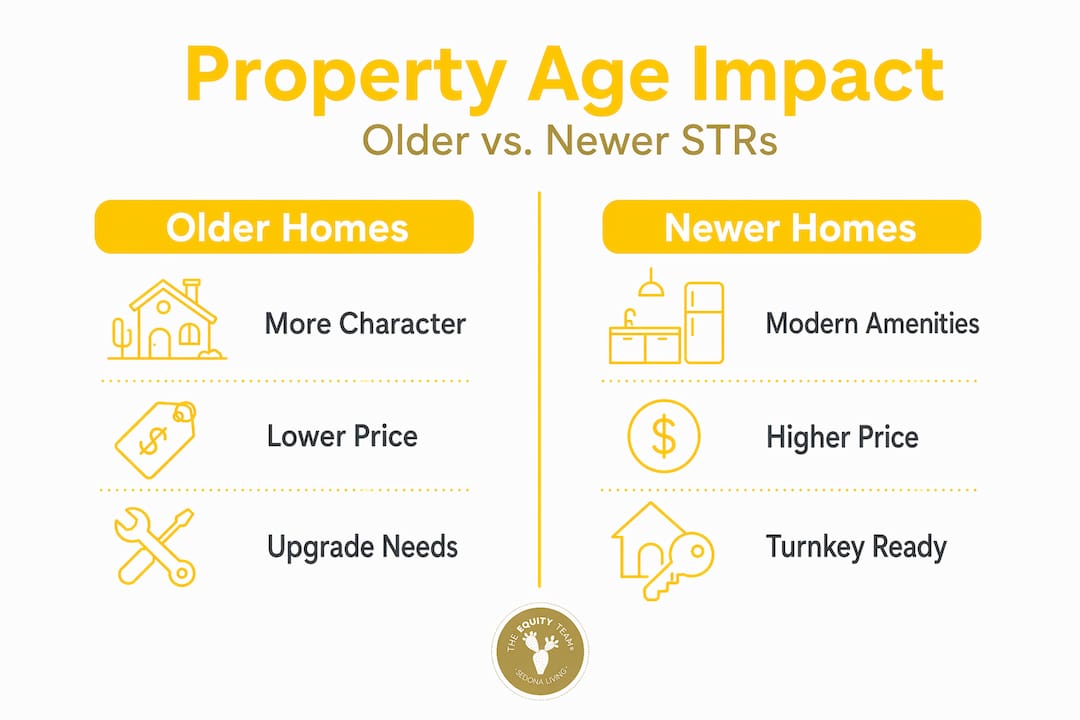
| Property era | Common strengths | Common challenges |
|---|---|---|
| Pre-1990 | Character, location, price point | Electrical, plumbing, insulation age |
| 1990 to 2005 | Established neighborhoods, solid bones | Roof age, HVAC efficiency, dated interiors |
| 2006 to 2018 | Modern layouts, better energy codes | Fewer character features, mid-range finishes |
| 2019 to present | New systems, warranty coverage | Higher acquisition cost, less location premium |
How property age shapes STR performance
Here is where things get genuinely interesting. Effective age, meaning the condition and functional quality of a property relative to its actual build year, matters far more than the number on the deed. A 1992 home that received a full kitchen and bath renovation in 2023, with new HVAC and fresh landscaping, presents to guests as a modern property. Guests booking a $400 per night Sedona getaway are not asking when the home was built. They are looking at photos and deciding whether the space feels luxurious and functional.
That said, older properties do carry real performance risks when they have not been updated. Here is what typically drags down occupancy and ADR for aging Sedona STRs:
- Dated kitchens and bathrooms. These are the rooms guests photograph and review. Laminate countertops and brass fixtures from 1988 will show up in your star ratings.
- Comfort system reliability. Older HVAC units fail at inconvenient times. A guest sweating through a July night in Sedona will not leave a kind review.
- Insulation and energy performance. Older homes often run hot in summer and cold in winter, which affects guest comfort and utility costs simultaneously.
- Aesthetic mismatch. Sedona guests expect a certain elevated, Southwestern-inspired aesthetic. Properties that feel generic or worn underperform against the market’s visual standard.
- Deferred maintenance signals. Guests notice things. A sticking door, a dripping faucet, or a musty smell communicates neglect, and neglect communicates risk.
The flip side is that well-maintained older properties in Sedona carry something newer builds often lack: character. Adobe construction, exposed wood beams, and mature desert landscaping create a sense of place that guests genuinely seek out. When that character is paired with modern amenities, the combination is hard to beat.
Pro Tip: When evaluating an older Sedona STR, pull comparable listings from the same neighborhood and filter by review scores above 4.8. If older renovated properties are holding those scores, the market is telling you that age is not the limiting factor. Condition is.

It is also worth noting that AirDNA market data is reliable for Sedona at the market level but less precise for individual older properties with unique features. Always manually refine your revenue comps when analyzing a property that sits outside the typical mold.
Financing and insurance for older Sedona properties
This is the section most investors wish someone had told them about before they fell in love with a charming 1978 adobe. Financing and insurance are often the biggest practical hurdles for older Sedona STR properties, and they have nothing to do with how good the property looks on Airbnb.
Lenders do not have a hard cutoff age for properties, but they do scrutinize systems. Older roofs, outdated wiring, and aging plumbing are the three items that most commonly trigger delays, required repairs before closing, or outright loan denials. Knob-and-tube wiring, for example, is a red flag for both lenders and insurers. A roof beyond its serviceable life will often require replacement as a condition of financing.
Here is a practical sequence for navigating these challenges:
- Order a pre-offer inspection. Before you get emotionally attached, get a licensed inspector to walk the property with a focus on roof age, electrical panel, plumbing materials, and HVAC condition.
- Request permits and documentation. Ask the seller for records of any system updates. A documented roof replacement in 2019 is a very different conversation with an underwriter than an unknown roof of uncertain age.
- Contact your insurer early. Insurance approval and premium estimates for older properties should be in hand before you finalize your offer. Surprises at closing are expensive.
- Build repair costs into your offer. If the inspection reveals a roof that needs replacement, price that into your acquisition math. Do not assume the seller will credit you dollar for dollar.
- Explore renovation loan products. FHA 203(k) loans and conventional renovation financing can wrap purchase and repair costs together, which is particularly useful for older properties with known upgrade needs.
Well-maintained older homes can absolutely be financed through conventional products when documentation is solid and systems are in acceptable condition. The key word is documentation. Lenders want evidence of updates, not just assurances.
Pro Tip: Ask your insurance agent for a quote before you make an offer, not after. For older Sedona properties, insurance premiums can be meaningfully higher and will affect your monthly payment and cash flow projections.
Strategic renovation planning for older Sedona STRs
Older properties in Sedona are not liabilities. They are opportunities wearing a work uniform. The investors who understand this are the ones quietly acquiring well-located homes at a discount and turning them into top-quartile performers. The key is knowing where to put the renovation dollars.
Renovation priorities that actually move the needle in Sedona’s STR market:
- Kitchen and primary bathroom upgrades. These two spaces dominate guest perception. Quartz countertops, updated fixtures, and quality appliances photograph beautifully and drive five-star reviews.
- Energy efficiency improvements. Energy-efficient upgrades create a measurable premium in flat or cautious markets. New windows, added insulation, and efficient HVAC reduce guest complaints and utility costs while boosting property value.
- Outdoor living spaces. Sedona guests are there for the outdoors. A well-designed patio with a fire pit, quality seating, and a view will show up in every review and justify a higher nightly rate.
- Roof and systems replacement. These are not glamorous, but they are the foundation. Addressing them early removes the financing and insurance friction discussed above and prevents the sudden cost spikes that deferred maintenance reliably produces.
A phased approach to renovation makes sense for cash flow management. Address structural and system items in year one, then layer in aesthetic upgrades as the property generates revenue. This prevents the trap of over-investing before you have validated the property’s earning potential.
| Renovation type | STR impact | Estimated priority |
|---|---|---|
| Kitchen and bath remodel | High ADR and review score lift | Year 1 |
| Roof and HVAC replacement | Financing, insurance, reliability | Year 1 |
| Energy efficiency upgrades | Lower operating costs, value premium | Year 1 to 2 |
| Outdoor living and landscaping | Occupancy and nightly rate boost | Year 2 |
| Interior design and staging | Listing quality and first impressions | Year 2 |
Sedona’s local STR permit requirements apply to all properties regardless of age. Any renovation work that triggers permit requirements locally should be documented carefully, both for compliance and for future financing conversations.
Evaluating investment potential in older Sedona properties
The honest truth is that deferred maintenance on older homes often leads to below-market sale prices, and that is where the opportunity lives for investors who come prepared. A well-located older home in Sedona with known renovation needs can be acquired at a meaningful discount compared to a turnkey newer property in a less desirable spot.
Here is how to think about the investment case:
- Acquisition price advantage. Older properties with deferred maintenance often sell at a discount. If the location is strong and the bones are solid, that discount is your renovation budget and your margin.
- Appreciation trajectory. Renovated older homes in desirable Sedona neighborhoods hold and grow value well. Location premium compounds over time in a market with constrained supply.
- Competitive positioning. A freshly renovated older property with character often outperforms a generic newer build in guest reviews and repeat bookings. Sedona travelers are experience-seekers, and authenticity resonates.
- Exit strategy alignment. Your renovation quality and neighborhood trajectory should inform your exit timeline. A property in a neighborhood trending toward higher-end development will appreciate faster post-renovation.
- Regulatory awareness. Sedona’s STR regulations are active and evolving. Staying current on permit requirements and any future supply caps protects your investment regardless of property age.
The 24% drop in Sedona STR inventory seen in recent years has actually tightened competition, which benefits well-positioned properties. Fewer listings competing for the same demand pool means stronger occupancy for operators who get the product right.
My honest take on property age and Sedona STRs
I have watched investors walk away from genuinely excellent older properties because they were scared of the age number. And I have watched other investors overpay for newer builds that underperformed because the location was mediocre and the views were nonexistent.
In my experience, the investors who consistently land in the top 10% of Sedona’s STR market are not the ones who chased the newest construction. They are the ones who understood that condition and location are the real levers. They bought older properties in the right spots, did the due diligence on systems before closing, planned their renovations with a clear ROI lens, and managed their properties with genuine care.
What I have learned is that property age is a proxy for risk, not a guarantee of it. A 1995 home with a documented renovation history, new roof, updated electrical, and a modern kitchen is a lower-risk STR investment than a 2015 home with deferred maintenance and a landlocked lot. The number on the deed tells you where to look. It does not tell you what you will find.
My practical advice: stop filtering by year built and start filtering by effective condition and location quality. Then bring in someone who knows the Sedona market well enough to tell you which older properties have the bones worth investing in.
— Chad
How Equity Team can help you find the right property
Whether you are eyeing a charming older adobe or a newer build with canyon views, the question of property age is just one piece of a much bigger puzzle. Equity Team specializes in Sedona short-term rental investments and represents clients operating in the top 10% of the rental market. That means they know which older properties are worth renovating, which neighborhoods are trending up, and how to read a property’s real earning potential beyond surface appearances.

If you are ready to stop guessing and start investing with real data behind you, Equity Team has the tools and the local expertise to make that happen. Start with their guide on finding the right STR investment to understand what separates a top performer from a money pit. You can also explore profitable STR investments in Sedona for a broader look at what makes properties in this market genuinely work. Reach out to Equity Team directly for a personalized conversation about your specific situation.
FAQ
Does property age affect STR performance in Sedona?
Yes, but effective age matters more than chronological age. A well-renovated older property with modern amenities and a great location can match or outperform newer builds in occupancy and nightly rates.
What financing challenges come with older Sedona STR properties?
Older roofs, outdated electrical systems, and aging plumbing are the most common triggers for loan delays or denials. Early inspections and documented system updates are the best way to keep financing on track.
Which renovations give the best return on older Sedona STRs?
Kitchen and bathroom remodels, roof and HVAC replacement, and energy efficiency upgrades deliver the strongest combination of guest satisfaction, review scores, and property value improvement.
Are older properties worth buying for Sedona short-term rentals?
Absolutely, especially when they are in desirable locations and priced to reflect deferred maintenance. Investors with renovation capital can acquire well-located older homes at a discount and turn them into strong performers.
Do Sedona STR regulations apply differently to older properties?
No. Sedona requires annual STR permits for all properties regardless of build year. Compliance with local rules applies equally to a 1975 adobe and a 2024 new build.