

Sedona luxury rental investment can pay off, but only for buyers who underwrite carefully and buy the right house. Three things drive results: a high nightly rate, steady occupancy, and a supply of homes that topography and zoning keep tight. Local lodging data shows occupancy in the high 60% range, with rates above historical norms.
TL;DR:
- Model current market ADR, occupancy, and RevPAR across three scenarios; at an illustrative $750 ADR and 60% occupancy, annual revenue reaches $164,250 before expenses.
- Prioritize unobstructed red rock views, privacy, and trail access, then verify view corridors, outdoor exposure, and permitted improvements before budgeting for a pool or spa.
- Compare renovation costs with defensible ADR gains rather than resale polish; kitchens, spa style bathrooms, climate control, and indoor outdoor spaces target guest priorities.
- Compare management fees by included concierge service, marketing, pricing, and housekeeping, and review feedback from comparable luxury properties and response times before signing.
- Since January 1, 2025, owners need not collect city tax on rentals of 30 days or more; shorter stays remain taxable and require licensing.
Table of Contents
- Why Sedona’s luxury short-term rental market holds its pricing
- How to underwrite a Sedona luxury short-term rental
- Which Sedona neighborhoods and property types support luxury rates
- Buying turnkey versus repositioning a luxury property
- What management model fits a luxury Sedona rental
- Arizona tax and licensing changes to account for
- Why a Sedona short-term rental specialist changes the math
- An investor’s view: who should chase Sedona luxury
- Ready to run the numbers on a Sedona luxury rental?
- FAQ
- Sources
Why Sedona’s luxury short-term rental market holds its pricing
Sedona is a playground for the quirky and the serene, and guests arrive for the red rocks, the trails, and the wellness scene. Leisure and park-driven travel keeps demand steady, and the town can’t simply build its way out of that demand. Steep terrain, zoning limits, and local development priorities keep new inventory scarce.
That scarcity is the quiet hero of this market. After the pandemic swings, lodging performance stabilized, and nightly rates have held above where they sat in earlier years. For luxury owners, that means pricing power, as long as the property delivers what premium guests expect.
HVS reports that Sedona’s lodging market is supply-constrained, with occupancy in the high 60% range and ADR elevated above historical norms, which supports leisure and luxury positioning rather than a race to the bottom.
What this means for you as an investor:
- Scarce inventory protects nightly rates better than a market where anyone can build.
- Leisure-driven demand rewards views, privacy, and amenities over sheer square footage.
- A stabilized market favors careful underwriting over hype about peak-year numbers.
- Luxury guests compare listings closely, so quality gaps show up fast in reviews and rates.
If you want the broader case, our overview of profitable short-term rental investments in Sedona walks through what draws investors here, and our market trends guide tracks where the numbers are heading.
How to underwrite a Sedona luxury short-term rental
Start with three terms. ADR is the average daily rate you actually collect per booked night. Occupancy is the share of available nights that get booked. RevPAR is revenue per available night, which equals ADR multiplied by occupancy. Annual revenue is simply RevPAR times 365.
Published Sedona market data reports market-level average revenue, occupancy, ADR, and RevPAR, and investors lean on those figures to underwrite deals. Pull the current numbers there, then run your own scenarios. Here is a worked example with clearly illustrative inputs, not market data:
- Conservative: Use a lower ADR and occupancy assumption to calculate RevPAR and estimated annual revenue.
- Typical: Say ADR is $750 and occupancy is 60%. RevPAR is $450, so annual revenue is $164,250.
- Optimistic: Use a higher ADR and occupancy assumption to calculate RevPAR and estimated annual revenue.
Revenue is not income. Subtract management, cleaning, utilities, maintenance, property taxes, insurance, and platform fees, and then set aside a reserve for furnishings that luxury guests expect to look new. Our STR occupancy data analysis shows how to stress-test the occupancy line, and our local investor playbook shows what an average Sedona listing earns so you can see how far above average a luxury property needs to perform.
Sedona market reports publish ADR, occupancy, and RevPAR at the market level, so check the latest STR report before you lock in any scenario.
Amenities move the ADR band more than almost anything else. Listings with infinity pools, expansive views, and bespoke interiors stand out on Airbnb in a way a tidy but ordinary house does not. Price those upgrades as ADR drivers, then ask whether the lift stays their cost and upkeep.
Which Sedona neighborhoods and property types support luxury rates
Luxury guests pay for what they can see and feel: views, quiet, and a short walk or drive to the trails. These property profiles tend to support premium pricing:
- Red-rock view parcels: Unobstructed views are the headline feature, and guests book them for the photos alone.
- Private acreage: Space between neighbors delivers the privacy that higher rates depend on.
- Gated communities: Controlled access and manicured surroundings suit guests who expect a resort feel.
- Trailhead-adjacent homes: Walk-out access to hiking appeals to active travelers and cuts down on drive time.
When you search, look past the listing photos. Check view corridors and whether a neighbor’s future build could block them, lot orientation for sunrise and sunset light, and how private the outdoor spaces really feel at guest eye level. Confirm what improvements are permitted before you plan a pool, spa, or addition.
Pro Tip: Visit a prospective property at sunset and again mid-morning, because a view that looks private in one light can feel exposed in another.
Buying turnkey versus repositioning a luxury property
Overpaying for a dated luxury house is the easiest mistake in this market. Prime red-rock-view inventory is scarce, so many experienced investors prefer to create value rather than purchase it at full retail. That idea is often called Builder’s Alpha: the return you earn by building new or renovating at a high level, instead of paying a seller for someone else’s finished product. A well-positioned redevelopment can also carry the premium that modern architecture commands.
Renovation dollars work hardest where guests spend their time:
- Kitchens built for cooking and entertaining, not just staging.
- Spa-style bathrooms with generous showers and quality fixtures.
- High-end HVAC that keeps desert summers and cold winter nights comfortable.
- Indoor-outdoor flow, with patios and seating oriented toward the view.
- Pools and hot tubs, where the property and local rules allow them.
Builders can help with guest-unit additions too. A casita adds sleeping capacity and privacy, and regional contractors such as A to Z Construction build casitas and guest cottages, which is worth knowing when you are pricing out an expansion.
Deal flow matters as much as design. Off-market access, an agent who knows which owners are quietly ready to sell, a rental-specific comparative market analysis, and careful review of video walkthroughs let you screen properties before you fly in. Our video walkthroughs of Sedona short-term rentals show how that screening works. Financing is part of the picture too, and a mortgage broker such as HomePilot can compare Arizona loan options, including jumbo loans, from multiple lenders.
Pro Tip: Price your renovation budget against the ADR lift you can defend with comparable listings, not against how nice the finished house will feel.
What management model fits a luxury Sedona rental
Management fees vary, and the figure you see quoted rarely tells the whole story. What matters is what sits inside the fee. Luxury homes usually need more than a lockbox and a cleaning crew, so compare these inclusions carefully:
- Concierge services, from grocery stocking to restaurant and tour bookings.
- Marketing reach, including professional photography and listing optimization.
- Dynamic pricing that reacts to events, seasons, and competing listings.
- Housekeeping standards that match a premium nightly rate.
High-touch hospitality can lift both ADR and occupancy, because reviews and repeat bookings follow good service. A higher fee earns its place when the extra service shows up in rates and ratings. It does not when it only adds a line to your expense sheet.
Vet any local manager before you sign:
- Ask for guest reviews from comparable luxury properties.
- Confirm what white-glove services are included versus billed separately.
- Check how they market homes beyond a single platform.
- Ask how quickly they respond to guest issues and maintenance calls.
Arizona tax and licensing changes to account for
Compliance is the part of underwriting people skip, and it is the part that can cost you later. The key distinction is stay length. Under Arizona Department of Revenue guidance, beginning January 1, 2025, owners of residential rentals of 30 days or more should no longer collect and remit city transaction privilege tax on that income. Stays under 30 days remain taxable under the transient lodging classification, so a nightly luxury rental still needs its license and tax filings.
Practical steps:
- Confirm how your intended stay lengths are classified before you underwrite revenue.
- If you use a property management company, confirm how it files and holds its registration, since that determines who collects and remits what.
- Check your county assessor registration so property records match how you operate.
- Talk to a tax professional about ownership structure and how rental classification affects your return.
Our guide to Sedona rental property taxes and the 30-day rule covers how to avoid retroactive bills.
Why a Sedona short-term rental specialist changes the math
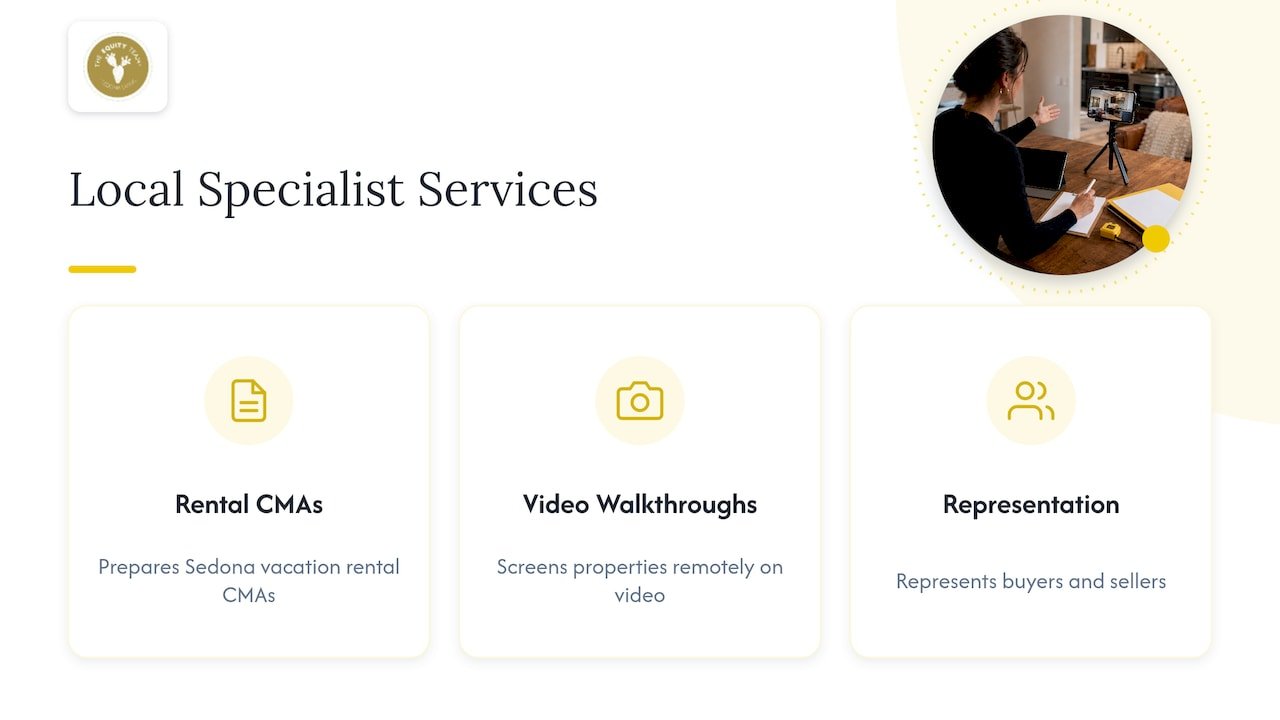
We are a team of real estate agents in Sedona, Arizona, focused on short-term rental investment, and we represent clients who operate high-performing rentals. We represent buyers and sellers, prepare Sedona vacation rental comparative market analyses, hold valuation conversations, and walk properties on video so investors can screen deals remotely. That local view sharpens your underwriting and your access to deals before you commit capital.
An investor’s view: who should chase Sedona luxury
Luxury Sedona rentals reward patient owners who treat the house like a hospitality business, not a lottery ticket. They fit people comfortable with seasonal swings and willing to put real money into design. Run through this quick checklist before you buy:
- Is your investment horizon long enough to ride out a slow season?
- Do you have a renovation budget beyond the purchase price?
- Can you live with seasonality in monthly income?
- Do you want passive ownership, or are you ready to stay involved?
— Chad
Ready to run the numbers on a Sedona luxury rental?

We help investors source, underwrite, and close on Sedona short-term rentals, and we help owners prepare to sell at top dollar. Our services include:
- Buyer representation focused on luxury short-term rentals.
- A Sedona vacation rental CMA built around rental performance.
- A rental exit strategy and valuation conversation.
- A seller prep consultation before you list.
Request your Sedona vacation rental CMA or book a consultation with us today at Owninaz.
FAQ
Is Sedona real estate a good investment?
Sedona can be a strong investment because supply is limited by topography and zoning, which supports pricing. HVS reports a supply-constrained lodging market with elevated rates. Results still depend on the property, price paid, and how well it is operated.
What is the 7% rule for rental property?
Use a quick filter, not a substitute for underwriting. Luxury short-term rentals need a full model with ADR, occupancy, and operating expenses.
Are there long-term rentals available in Sedona, Arizona?
Yes, long-term residential rentals of 30 days or more exist in Sedona, and Arizona treats them differently for tax purposes than nightly stays. Under ADOR guidance, owners should not collect city TPT on those long-term rentals as of January 1, 2025.
How should I check Sedona rental income potential?
Pull market-level ADR, occupancy, and RevPAR from a published STR market report, then run conservative, typical, and optimistic scenarios. Subtract realistic operating costs before judging a deal.
Sources
- Residential Rental Licensing Requirements and Processes | Arizona Department of Revenue
- HVS | Sedona’s Lodging Market: Resilience and Pricing Power
- Sedona, Arizona Airbnb Market Data 2026: STR Report & …